Captains, Mates, and Pilots of Water Vessels
Also called: Boat Captain, Captain, First Mate, MateCommand or supervise operations of ships and water vessels, such as tugboats and ferryboats. Required to hold license issued by U.S. Coast Guard.
On a phone, press and hold a picture to save it to Photos.
opens your phone's share sheet, where you can save both to Photos
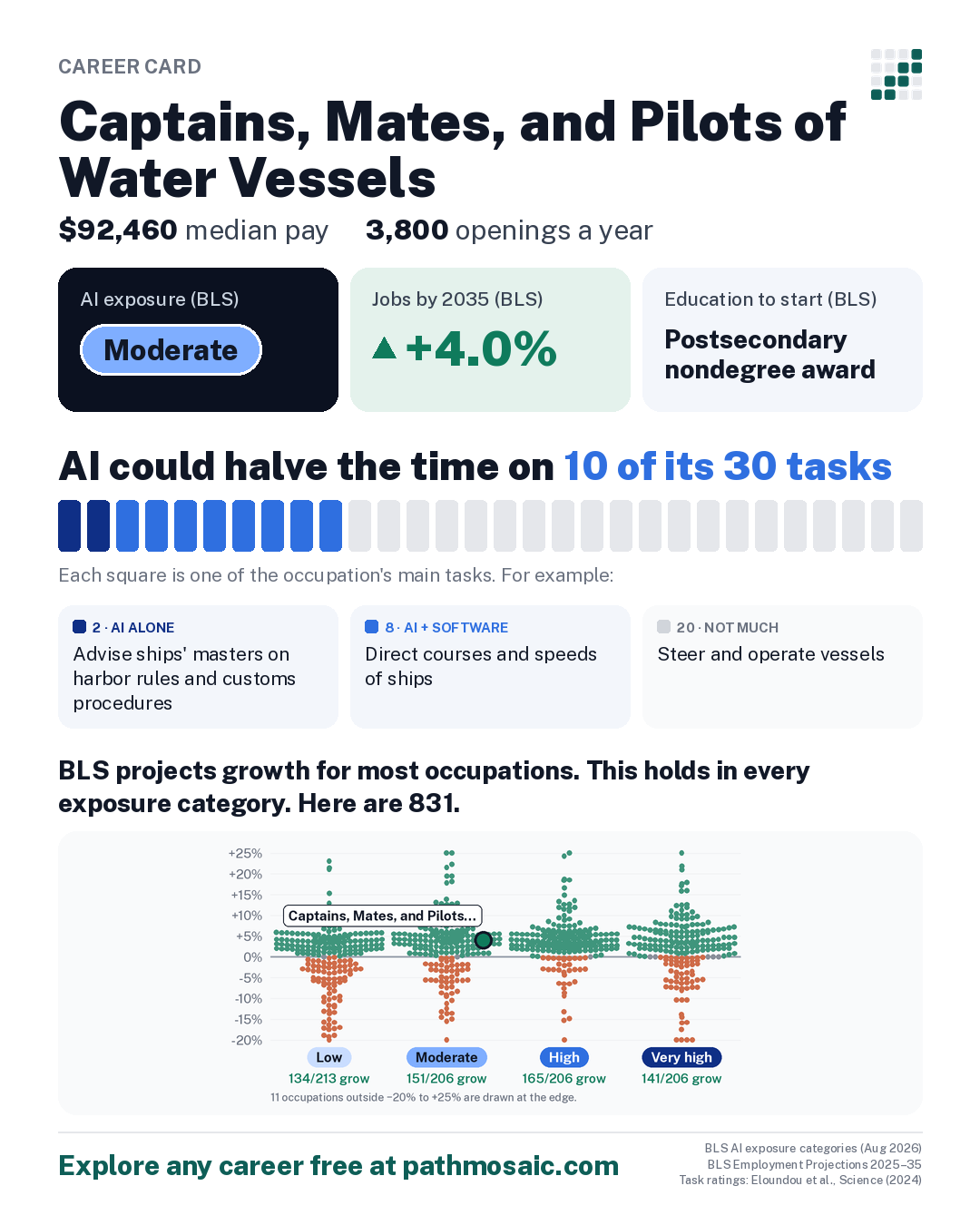
What the data says: AI could halve the time on 10 of its 30 tasks, and jobs are projected to grow 4.0% by 2035. How to think about this →
About this projection
BLS builds AI into its projections where the research supports it: “BLS generally applies adjustments based on this research conservatively, where there is convincing evidence for a change.”
It also notes a limit: “BLS projection methods are not designed to capture extremely rapid technological change.”
On its AI exposure groups, BLS says exposure “does not imply job loss.”
Recent conditions
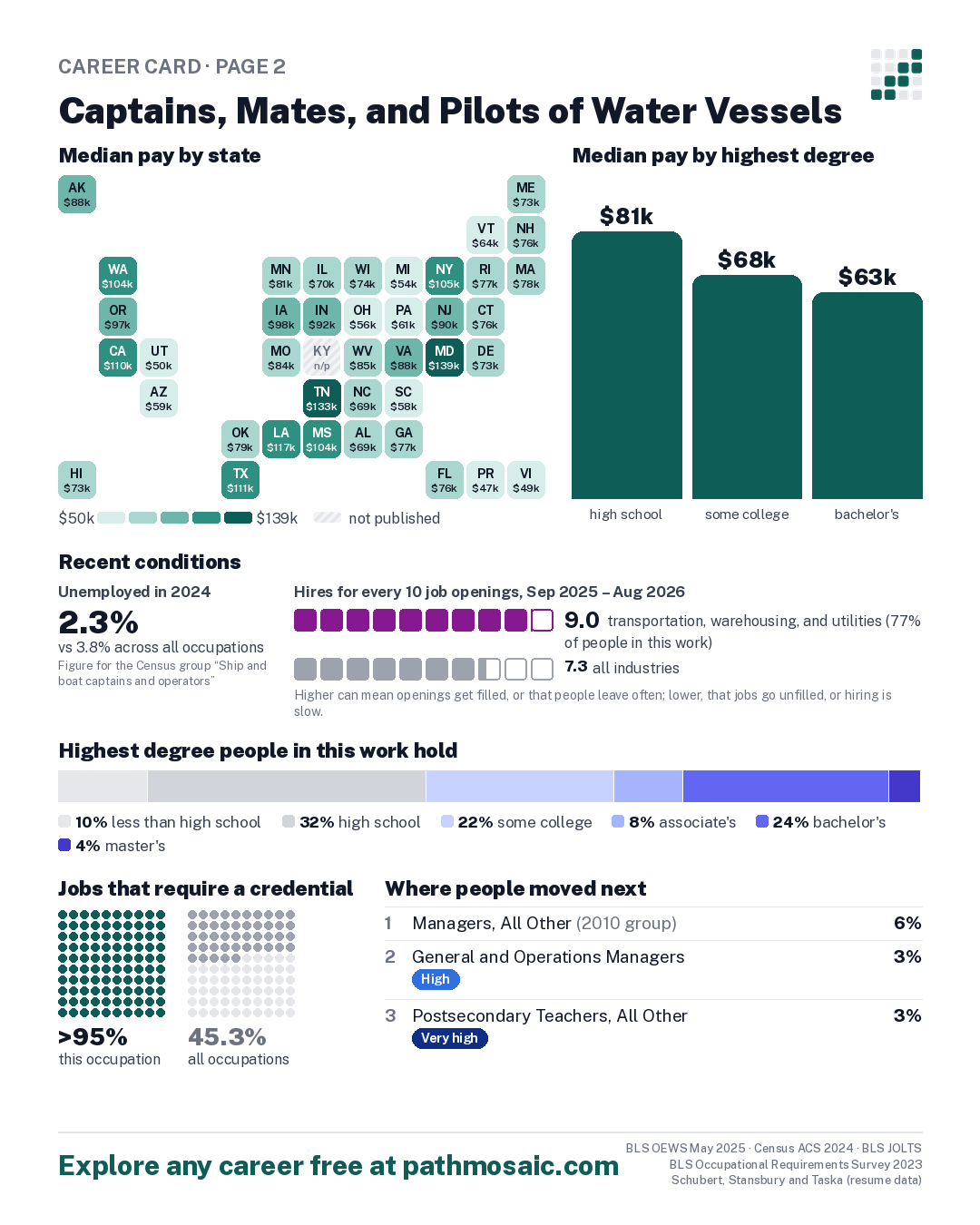
- In 2024, 2.3% of people in this work were unemployed, against 3.8% across all occupations Census ACS 2024, all workers in the Census group “Ship and boat captains and operators”
- From Sep 2025 to Aug 2026, 9.0 hires for every 10 job openings in transportation, warehousing, and utilities, which employs about 77% of people in this work, against 7.3 across all industries BLS JOLTS
One box per opening, filled for each hire; hires beyond the openings are added in a lighter shade. Higher can mean openings get filled, or that people leave often; lower, that jobs go unfilled, or hiring is slow.9.0 this industry7.3 all industries
Median pay by state BLS OEWS May 2025, state estimates
Tap a state for its figures.
Median pay in every state
| State | Median | Middle half earn | Jobs |
|---|---|---|---|
| Alabama | $68,920 | $45,500 to $102,410 | 350 |
| Alaska | $88,230 | $60,750 to $121,700 | 710 |
| Arizona | $58,700 | $46,640 to $76,720 | 40 |
| California | $110,090 | $73,630 to $132,310 | 2,420 |
| Connecticut | $75,810 | $72,030 to $114,190 | 380 |
| Delaware | $73,280 | $55,190 to $100,220 | 50 |
| Florida | $76,040 | $53,250 to $102,540 | 5,040 |
| Georgia | $77,090 | $44,010 to $101,280 | 220 |
| Hawaii | $72,960 | $52,980 to $102,750 | 700 |
| Illinois | $69,600 | $59,830 to $104,330 | 900 |
| Indiana | $92,000 | $63,700 to $130,380 | 1,010 |
| Iowa | $97,700 | $62,190 to $105,670 | 80 |
| Kentucky | not published | not published | 1,060 |
| Louisiana | $117,160 | $79,830 to $132,620 | 6,830 |
| Maine | $72,770 | $56,330 to $80,750 | 360 |
| Maryland | $138,950 | $98,450 to $179,520 | 450 |
| Massachusetts | $77,950 | $62,160 to $101,940 | 650 |
| Michigan | $53,590 | $37,950 to $79,440 | 640 |
| Minnesota | $80,920 | $57,020 to $111,700 | 110 |
| Mississippi | $104,220 | $75,270 to $137,860 | 570 |
| Missouri | $83,670 | $45,710 to $114,230 | 420 |
| New Hampshire | $75,870 | $66,780 to $102,250 | 70 |
| New Jersey | $90,310 | $59,860 to $130,130 | 510 |
| New York | $104,800 | $79,410 to $129,250 | 1,930 |
| North Carolina | $69,170 | $57,870 to $95,840 | 490 |
| Ohio | $56,070 | $38,660 to $77,790 | 420 |
| Oklahoma | $79,110 | $76,660 to $97,800 | 30 |
| Oregon | $97,050 | $62,770 to $128,000 | 350 |
| Pennsylvania | $61,420 | $38,580 to $105,650 | 580 |
| Puerto Rico | $47,410 | $34,670 to $71,780 | 120 |
| Rhode Island | $76,790 | $56,200 to $103,290 | 250 |
| South Carolina | $57,660 | $43,780 to $106,710 | 520 |
| Tennessee | $132,710 | $76,420 to $165,700 | 940 |
| Texas | $111,390 | $70,780 to $145,560 | 3,400 |
| Utah | $50,010 | $46,890 to $52,150 | not published |
| Vermont | $64,020 | $45,210 to $112,670 | 40 |
| Virgin Islands | $48,700 | $36,720 to $59,040 | 130 |
| Virginia | $87,610 | $66,460 to $120,460 | 2,270 |
| Washington | $103,730 | $75,470 to $129,040 | 1,560 |
| West Virginia | $85,290 | $61,610 to $102,940 | 110 |
| Wisconsin | $74,390 | $64,100 to $103,980 | 170 |
Nationally: $92,460. Shades run from the lowest state median to the highest; a territory below that range takes the lightest. How to read this
How AI touches the work
What AI could speed up, task by task, and where people already use it.
AI could halve the time on 10 of its 30 tasks
| AI rating | Its main tasks | Share of Claude conversations May 2026 |
|---|---|---|
| AI + software | Direct courses and speeds of ships, based on specialized knowledge of local winds, weather, water depths, tides, currents, and hazards. | Not published |
| AI + software | Consult maps, charts, weather reports, or navigation equipment to determine and direct ship movements. | Not published |
| Not much | Steer and operate vessels, using radios, depth finders, radars, lights, buoys, or lighthouses. | Not published |
| AI + software | Serve as a vessel's docking master upon arrival at a port or at a berth. | Not published |
| AI + software | Prevent ships under navigational control from engaging in unsafe operations. | Not published |
| Not much | Dock or undock vessels, sometimes maneuvering through narrow spaces, such as locks. | Not published |
See all 30 tasks
| Not much | Inspect vessels to ensure efficient and safe operation of vessels and equipment and conformance to regulations. | Not published |
| Not much | Stand watches on vessels during specified periods while vessels are under way. | Not published |
| AI alone | Operate ship-to-shore radios to exchange information needed for ship operations. | Not published |
| Not much | Maintain boats or equipment on board, such as engines, winches, navigational systems, fire extinguishers, or life preservers. | Not published |
| AI + software | Report to appropriate authorities any violations of federal or state pilotage laws. | Not published |
| Not much | Provide assistance in maritime rescue operations. | Not published |
| Not much | Learn to operate new technology systems and procedures through instruction, simulators, or models. | Not published |
| AI + software | Maintain records of daily activities, personnel reports, ship positions and movements, ports of call, weather and sea conditions, pollution control efforts, or cargo or passenger status. | Not published |
| Not much | Measure depths of water, using depth-measuring equipment. | Not published |
| Not much | Signal passing vessels, using whistles, flashing lights, flags, or radios. | Not published |
| Not much | Read gauges to verify sufficient levels of hydraulic fluid, air pressure, or oxygen. | Not published |
| Not much | Arrange for ships to be fueled, restocked with supplies, or repaired. | Not published |
| AI alone | Advise ships' masters on harbor rules and customs procedures. | Not published |
| Not much | Direct or coordinate crew members or workers performing activities such as loading or unloading cargo, steering vessels, operating engines, or operating, maintaining, or repairing ship equipment. | Not published |
| AI + software | Signal crew members or deckhands to rig tow lines, open or close gates or ramps, or pull guard chains across entries. | Not published |
| Not much | Calculate sightings of land, using electronic sounding devices and following contour lines on charts. | Not published |
| Not much | Supervise crews in cleaning or maintaining decks, superstructures, or bridges. | Not published |
| Not much | Observe loading or unloading of cargo or equipment to ensure that handling and storage are performed according to specifications. | Not published |
| Not much | Perform various marine duties, such as checking for oil spills or other pollutants around ports or harbors or patrolling beaches. | Not published |
| Not much | Tow and maneuver barges or signal tugboats to tow barges to destinations. | Not published |
| Not much | Purchase supplies or equipment. | Not published |
| AI + software | Assign watches or living quarters to crew members. | Not published |
| Not much | Interview and hire crew members. | Not published |
| Not much | Conduct safety drills such as man overboard or fire drills. | Not published |
Ordered by how important O*NET's respondents rate each task (1 to 5) times the share who say it is part of their job. The ordering is ours. O*NET hasn't rated 1 of the tasks, so they come last, in O*NET's own order. 0 of the 30 have a published share of Claude conversations; “not published” means too few conversations for Anthropic to publish a figure.
Where people already use AI
The tasks above say what AI could speed up. This shows what people are using it for. Its 30 tasks fall under 21 work activities that many occupations share, and Microsoft counted how often each one came up in 200,000 conversations with its Copilot assistant in 2024.
- #4 Maintain current knowledge in area of expertise
- #8 Read documents or materials to inform work processes
- #12 Explain regulations, policies, or procedures
- and 2 more, in the table below
| Work activity | This occupation's tasks under it | People asked AI for help in 10,000 conversations |
AI did it for them in 10,000 conversations |
|---|---|---|---|
| Direct organizational operations, activities, or procedures | |||
| Monitor safety or security of work areas, facilities, or properties | |||
| Operate transportation equipment or vehicles | |||
| Monitor equipment operation | |||
| Signal others to coordinate work activities | |||
| Maintain current knowledge in area of expertise | |||
| Read documents or materials to inform work processes | |||
| Explain regulations, policies, or procedures |
Show all 21 activities
| Purchase goods or services | |||
| Determine operational methods or procedures | |||
| Advise others on business or operational matters | |||
| Communicate with others about operational plans or activities | |||
| Operate communications equipment or systems | |||
| Measure physical characteristics of materials, products, or equipment | |||
| Schedule operational activities | |||
| Maintain operational records | |||
| Notify others of emergencies or problems | |||
| Analyze environmental or geospatial data | |||
| Maintain vehicles in working condition | |||
| Intervene in crisis situations or emergencies | |||
| Teach safety procedures or standards to others |
How to read this
Work activities come from O*NET, which links every task to the broader activities it involves. Microsoft's figures are for the activity across everyone who used Copilot, not for captains, mates, and pilots of water vessels specifically. Copilot is a general chat assistant; dedicated coding tools are not included, so programming help is under-counted here. Activities are listed by how many of this occupation's tasks fall under them.
The task ratings say whether AI could halve the time a task takes: on its own (“AI alone”), or with software built on it (“AI + software”). They were made by people in 2023 (Eloundou et al.). Claude's share is the task's share of all Claude.ai conversations in May 2026; Anthropic doesn't publish a task with too few conversations. None of these add up to the BLS exposure group, which combines five research measures.
More in the Guide: task ratings · task order · work activities · Copilot figures · Claude
High exposure doesn't mean fewer jobs
BLS projects most occupations in its two most exposed groups to grow: 141 of 206 rated Very high and 165 of 206 rated High. Each dot is one of the 831 occupations BLS rates.
Career moves into and out of this occupation
From moves between occupations found in online resumes, 2002–2016. Career changes only: a first job after school isn't a move.
Where people moved next
of 14,300 moves out
- 1 Managers, All Other (2010 group) an older group BLS has since split; no exposure group today 6%
- 2 General and Operations Managers High +5.0% 3%
- 3 Postsecondary Teachers, All Other Very high +2.0% 3%
- 4 Career/Technical Education Teachers, Postsecondary Very high -0.3% 3%
- 5 Airline Pilots, Copilots, and Flight Engineers Moderate +8.3% 3%
Where people moved in from
of 15,285 moves in
- 1 Secretaries and Administrative Assistants, Except Legal, Medical, and Executive Very high -6.0% 5%
- 2 Teacher Assistants (2010 group) an older group BLS has since split; no exposure group today 5%
- 3 Managers, All Other (2010 group) an older group BLS has since split; no exposure group today 5%
- 4 Career/Technical Education Teachers, Postsecondary Very high -0.3% 3%
- 5 Airline Pilots, Copilots, and Flight Engineers Moderate +8.3% 2%
Resumes over-represent younger, white-collar job-seekers and moves into management. Schubert, Stansbury and Taska (resume data).
Education and training for the occupation
O*NET survey of workers in this occupation
- 4% less than high school
- 42% high school
- 37% postsecondary certificate
- 5% some college
- 2% associate's
- 8% bachelor's
O*NET 31.0 survey of workers in this occupation · 83 people answered.
Census survey (American Community Survey)
- 10% less than high school
- 32% high school
- 22% some college
- 8% associate's
- 24% bachelor's
- 4% master's
Census ACS 2024, all workers in the Census group “Ship and boat captains and operators” · 490 people surveyed.
Why the two can differ
O*NET asks about 20 people in each occupation, which makes its shares uncertain, but it reports the exact occupation and counts certificates. The Census survey reaches thousands, but it groups some occupations together and counts degrees only. More in the Guide
Median pay by highest degree full-time, year-round · Census ACS 2024, all workers in the Census group “Ship and boat captains and operators”
2 programs: Commercial Fishing and Marine Science/Merchant Marine Officer.
Jobs that require a credential BLS Occupational Requirements Survey 2023
>95% this occupation
45.3% all occupations
| By kind | This occupation | All occupations |
|---|---|---|
| a license | 98.7% | 19.1% |
| an educational certificate | <0.5% | 2.8% |
| a certification | not published |
Share of jobs whose employer requires it. BLS doesn't say which credential. How to read this
Look up certifications, training and licenses U.S. Department of Labor
- Certification Finder ↗ certifications CareerOneStop lists for this occupation
- Training Finder ↗ schools and programs, nationwide; narrow the place there
- License Finder ↗ licenses by state
- Apprenticeship Finder ↗ DOL lists 2 registered apprenticeships in this occupation (Officer in Charge of Navig Watch; PILOT, SHIP). Apprenticeship.gov can't be linked to one occupation, so search for “Captains, Mates, and Pilots of Water Vessels” there.
These open in a new tab and send only the occupation's public code. More in the Guide
BLS AI exposure categories (Aug 2026) · BLS Employment Projections 2025–35 · O*NET 31.0 · Task ratings: Eloundou et al., Science (2024) · Microsoft "Working with AI" v1.1 · Anthropic Economic Index (2026-06-26) · Schubert, Stansbury and Taska · NCES CIP–SOC · Census ACS 2024 · BLS JOLTS
See it online, and explore any career: https://www.pathmosaic.com/card/53-5021.00