Conservation Scientists
Also called: Conservationist, Land Resource Specialist, Research Soil Scientist, Resource ConservationistManage, improve, and protect natural resources to maximize their use without damaging the environment. May conduct soil surveys and develop plans to eliminate soil erosion or to protect rangelands. May instruct farmers, agricultural production managers, or ranchers in best ways to use crop rotation, contour plowing, or terracing to conserve soil and water; in the number and kind of livestock and forage plants best suited to particular ranges; and in range and farm improvements, such as fencing and reservoirs for stock watering.
On a phone, press and hold a picture to save it to Photos.
opens your phone's share sheet, where you can save both to Photos
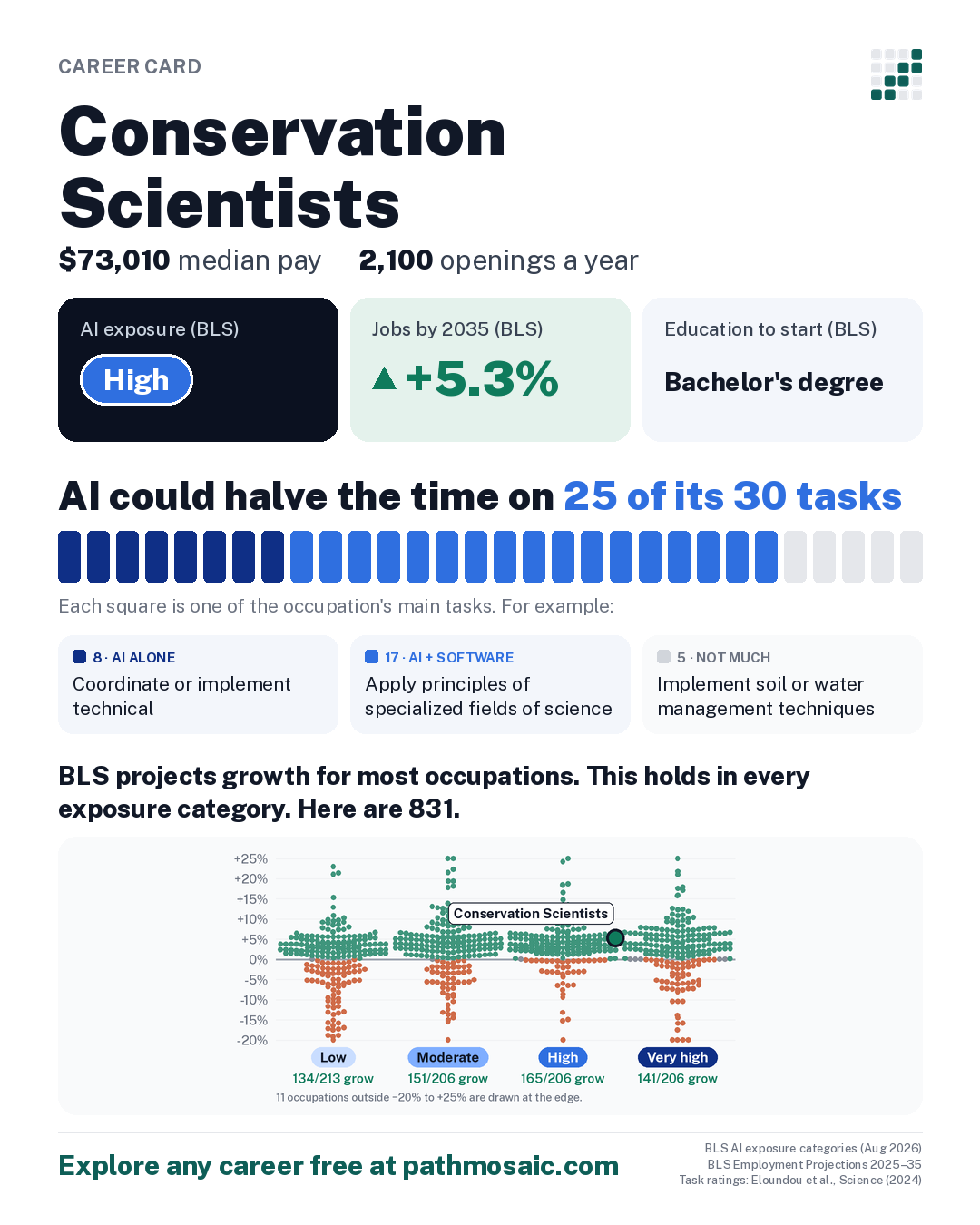
What the data says: AI could halve the time on 25 of its 30 tasks, yet jobs are projected to grow 5.3% by 2035. How to think about this →
About this projection
BLS builds AI into its projections where the research supports it: “BLS generally applies adjustments based on this research conservatively, where there is convincing evidence for a change.”
It also notes a limit: “BLS projection methods are not designed to capture extremely rapid technological change.”
On its AI exposure groups, BLS says exposure “does not imply job loss.”
BLS figures cover the broader occupation “Conservation scientists”, which includes this one and others.
Recent conditions
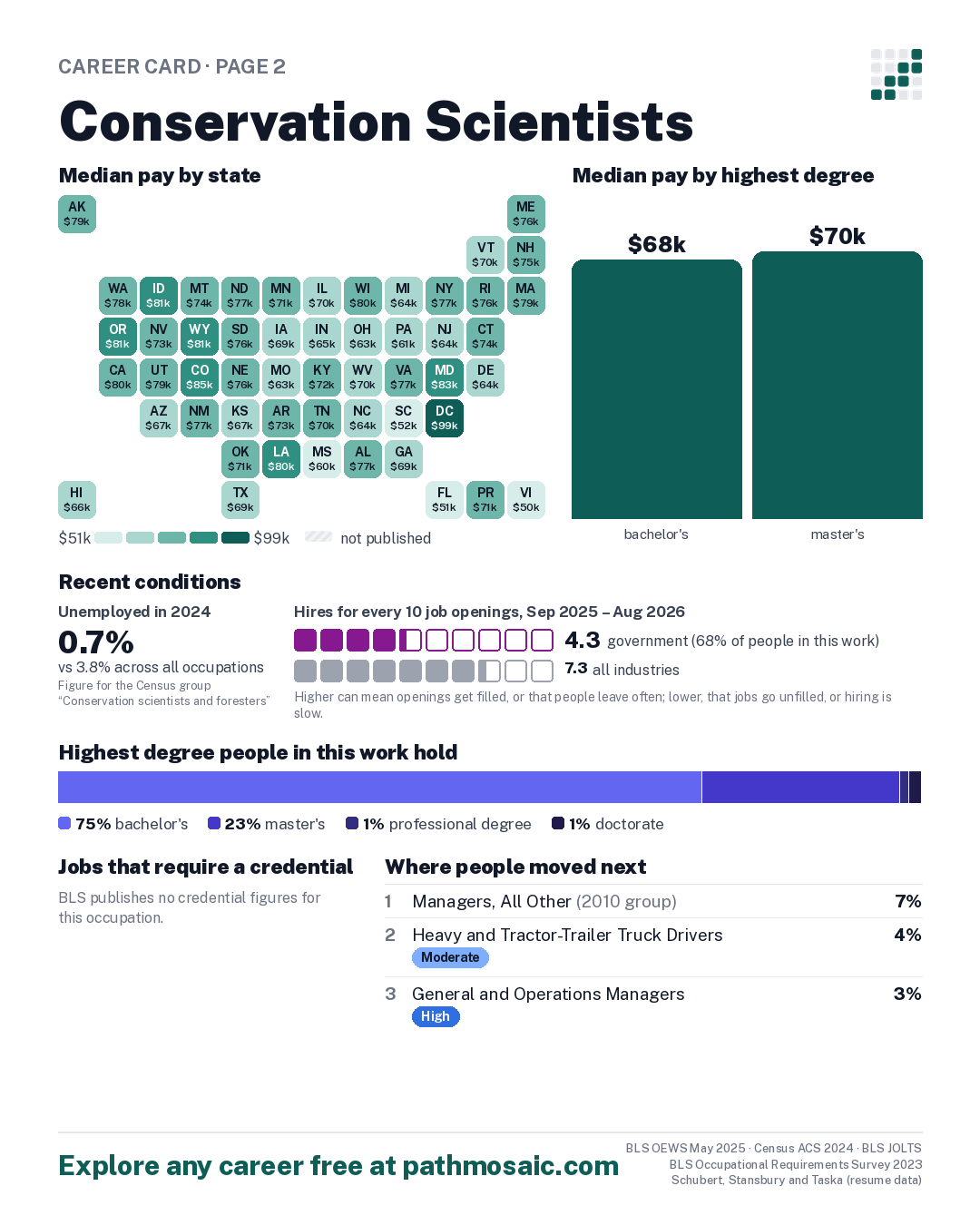
- In 2024, 0.7% of people in this work were unemployed, against 3.8% across all occupations Census ACS 2024, all workers in the Census group “Conservation scientists and foresters”
- From Sep 2025 to Aug 2026, 4.3 hires for every 10 job openings in government, which employs about 68% of people in this work, against 7.3 across all industries BLS JOLTS
One box per opening, filled for each hire; hires beyond the openings are added in a lighter shade. Higher can mean openings get filled, or that people leave often; lower, that jobs go unfilled, or hiring is slow.4.3 this industry7.3 all industries
Median pay by state BLS OEWS May 2025, state estimates
Tap a state for its figures.
Median pay in every state
| State | Median | Middle half earn | Jobs |
|---|---|---|---|
| Alabama | $77,000 | $60,300 to $101,500 | 110 |
| Alaska | $79,260 | $66,080 to $103,110 | 290 |
| Arizona | $66,750 | $53,510 to $81,850 | 410 |
| Arkansas | $73,320 | $61,110 to $96,100 | 230 |
| California | $79,810 | $64,310 to $104,990 | 2,110 |
| Colorado | $84,820 | $67,770 to $108,540 | 1,230 |
| Connecticut | $73,860 | $70,920 to $82,050 | 140 |
| Delaware | $63,850 | $52,990 to $74,180 | 80 |
| District of Columbia | $99,400 | $77,060 to $119,100 | 110 |
| Florida | $51,130 | $40,830 to $72,820 | 950 |
| Georgia | $69,240 | $54,910 to $97,470 | 360 |
| Hawaii | $65,740 | $47,100 to $95,180 | 220 |
| Idaho | $81,330 | $61,110 to $86,260 | 300 |
| Illinois | $69,590 | $51,630 to $95,820 | 730 |
| Indiana | $64,570 | $49,000 to $84,070 | 430 |
| Iowa | $69,240 | $60,070 to $81,730 | 610 |
| Kansas | $67,200 | $50,660 to $86,260 | 220 |
| Kentucky | $71,980 | $53,380 to $96,100 | 180 |
| Louisiana | $80,190 | $49,990 to $106,330 | 190 |
| Maine | $75,900 | $59,180 to $89,960 | 290 |
| Maryland | $83,290 | $66,850 to $107,520 | 470 |
| Massachusetts | $78,740 | $65,210 to $92,060 | 760 |
| Michigan | $63,500 | $52,980 to $89,230 | 820 |
| Minnesota | $71,280 | $51,630 to $88,670 | 770 |
| Mississippi | $59,510 | $49,940 to $78,850 | 470 |
| Missouri | $63,130 | $50,560 to $79,920 | 600 |
| Montana | $73,920 | $57,530 to $88,710 | 560 |
| Nebraska | $76,400 | $63,130 to $94,500 | 220 |
| Nevada | $73,030 | $48,920 to $92,870 | 210 |
| New Hampshire | $74,650 | $53,380 to $88,460 | 130 |
| New Jersey | $64,020 | $50,540 to $80,930 | 500 |
| New Mexico | $76,800 | $56,620 to $94,520 | 330 |
| New York | $76,990 | $58,670 to $93,350 | 640 |
| North Carolina | $64,460 | $50,300 to $81,920 | 540 |
| North Dakota | $77,280 | $60,090 to $95,030 | 340 |
| Ohio | $63,160 | $50,190 to $78,350 | 680 |
| Oklahoma | $71,270 | $51,160 to $86,260 | 310 |
| Oregon | $80,790 | $70,450 to $104,690 | 1,020 |
| Pennsylvania | $61,480 | $48,310 to $76,500 | 900 |
| Puerto Rico | $71,280 | $49,940 to $91,560 | 50 |
| Rhode Island | $76,130 | $64,490 to $103,710 | 60 |
| South Carolina | $52,310 | $42,270 to $69,020 | 300 |
| South Dakota | $76,400 | $61,110 to $88,710 | 360 |
| Tennessee | $70,500 | $53,080 to $94,520 | 250 |
| Texas | $68,620 | $58,470 to $81,310 | 1,970 |
| Utah | $78,850 | $63,490 to $100,420 | 410 |
| Vermont | $70,130 | $58,140 to $82,160 | 100 |
| Virgin Islands | $50,080 | $50,080 to $50,080 | 40 |
| Virginia | $77,380 | $60,190 to $108,890 | 480 |
| Washington | $78,450 | $62,240 to $88,790 | 1,270 |
| West Virginia | $69,910 | $47,740 to $91,560 | 160 |
| Wisconsin | $79,540 | $63,130 to $93,200 | 970 |
| Wyoming | $81,310 | $63,810 to $91,170 | 150 |
Nationally: $73,010. Shades run from the lowest state median to the highest; a territory below that range takes the lightest. How to read this
How AI touches the work
What AI could speed up, task by task, and where people already use it.
AI could halve the time on 25 of its 30 tasks
| AI rating | Its main tasks | Share of Claude conversations May 2026 |
|---|---|---|
| AI + software | Apply principles of specialized fields of science, such as agronomy, soil science, forestry, or agriculture, to achieve conservation objectives. | Not published |
| AI + software | Gather information from geographic information systems (GIS) databases or applications to formulate land use recommendations. | Not published |
| Not much | Implement soil or water management techniques, such as nutrient management, erosion control, buffers, or filter strips, in accordance with conservation plans. | Not published |
| AI + software | Participate on work teams to plan, develop, or implement programs or policies for improving environmental habitats, wetlands, or groundwater or soil resources. | Not published |
| Not much | Develop or maintain working relationships with local government staff or board members. | Not published |
| AI + software | Advise land users, such as farmers or ranchers, on plans, problems, or alternative conservation solutions. | Not published |
See all 30 tasks
| Not much | Monitor projects during or after construction to ensure projects conform to design specifications. | Not published |
| Not much | Revisit land users to view implemented land use practices or plans. | Not published |
| AI + software | Plan soil management or conservation practices, such as crop rotation, reforestation, permanent vegetation, contour plowing, or terracing, to maintain soil or conserve water. | Not published |
| AI alone | Compute design specifications for implementation of conservation practices, using survey or field information, technical guides or engineering manuals. | under 0.01% |
| AI + software | Visit areas affected by erosion problems to identify causes or determine solutions. | Not published |
| AI alone | Analyze results of investigations to determine measures needed to maintain or restore proper soil management. | Not published |
| AI + software | Respond to complaints or questions on wetland jurisdiction, providing information or clarification. | Not published |
| AI alone | Provide information, knowledge, expertise, or training to government agencies at all levels to solve water or soil management problems or to assure coordination of resource protection activities. | Not published |
| AI + software | Compute cost estimates of different conservation practices, based on needs of land users, maintenance requirements, or life expectancy of practices. | Not published |
| AI + software | Compile or interpret biodata to determine extent or type of wetlands or to aid in program formulation. | Not published |
| AI alone | Review proposed wetland restoration easements or provide technical recommendations. | Not published |
| AI + software | Enter local soil, water, or other environmental data into adaptive or Web-based decision tools to identify appropriate analyses or techniques. | Not published |
| AI + software | Develop soil maps. | Not published |
| Not much | Manage field offices or involve staff in cooperative ventures. | Not published |
| AI alone | Develop, conduct, or participate in surveys, studies, or investigations of various land uses to inform corrective action plans. | Not published |
| AI alone | Coordinate or implement technical, financial, or administrative assistance programs for local government units to ensure efficient program implementation or timely responses to requests for assistance. | Not published |
| AI alone | Review or approve amendments to comprehensive local water plans or conservation district plans. | Not published |
| AI + software | Identify or recommend integrated weed and pest management (IPM) strategies, such as resistant plants, cultural or behavioral controls, soil amendments, insects, natural enemies, barriers, or pesticides. | Not published |
| AI + software | Conduct fact-finding or mediation sessions among government units, landowners, or other agencies to resolve disputes. | Not published |
| AI + software | Initiate, schedule, or conduct annual audits or compliance checks of program implementation by local government. | Not published |
| AI + software | Review grant applications or make funding recommendations. | Not published |
| AI alone | Develop or conduct environmental studies, such as plant material field trials or wildlife habitat impact studies. | Not published |
| AI + software | Develop water conservation or harvest plans, using weather information systems, irrigation information management systems, or other sources of daily evapotranspiration (ET) data. | Not published |
| AI + software | Review annual reports of counties, conservation districts, or watershed management organizations, certifying compliance with mandated reporting requirements. | Not published |
Ordered by how important O*NET's respondents rate each task (1 to 5) times the share who say it is part of their job. The ordering is ours. 1 of the 30 have a published share of Claude conversations; “not published” means too few conversations for Anthropic to publish a figure.
Where people already use AI
The tasks above say what AI could speed up. This shows what people are using it for. Its 30 tasks fall under 21 work activities that many occupations share, and Microsoft counted how often each one came up in 200,000 conversations with its Copilot assistant in 2024.
- #14 Create visual designs or displays
- #33 Compile records, documentation, or other data
| Work activity | This occupation's tasks under it | People asked AI for help in 10,000 conversations |
AI did it for them in 10,000 conversations |
|---|---|---|---|
| Advise others on environmental sustainability or green practices | |||
| Examine materials or documentation for accuracy or compliance | |||
| Develop plans for managing or preserving natural resources | |||
| Develop research plans or methodologies | |||
| Monitor environmental conditions | |||
| Direct scientific or technical activities | |||
| Create visual designs or displays | |||
| Compile records, documentation, or other data |
Show all 21 activities
| Develop technical specifications for products or operations | |||
| Communicate environmental or sustainability information | |||
| Develop professional relationships or networks | |||
| Estimate project development or operational costs | |||
| Research agricultural processes or practices | |||
| Monitor operations to ensure adequate performance | |||
| Maintain operational records | |||
| Analyze environmental or geospatial data | |||
| Train others on operational or work procedures | |||
| Develop systems or practices to mitigate or resolve environmental problems | |||
| Mediate disputes | |||
| Assess compliance with environmental standards or regulations | |||
| Collect environmental or biological samples |
How people in this work use Claude
What people in this work made with Claude % of conversations
- Advice or a recommendation23%
- An explanation or answer23%
- A chart or visualization18%
- A plan or strategy17%
- A document or report5%
How they worked with Claude
22% of these conversations were about work. Anthropic Economic Index, May 2026.
How to read this
Work activities come from O*NET, which links every task to the broader activities it involves. Microsoft's figures are for the activity across everyone who used Copilot, not for conservation scientists specifically. Copilot is a general chat assistant; dedicated coding tools are not included, so programming help is under-counted here. Activities are listed by how many of this occupation's tasks fall under them.
The task ratings say whether AI could halve the time a task takes: on its own (“AI alone”), or with software built on it (“AI + software”). They were made by people in 2023 (Eloundou et al.). Claude's share is the task's share of all Claude.ai conversations in May 2026; Anthropic doesn't publish a task with too few conversations. None of these add up to the BLS exposure group, which combines five research measures.
More in the Guide: task ratings · task order · work activities · Copilot figures · Claude
High exposure doesn't mean fewer jobs
BLS projects most occupations in its two most exposed groups to grow: 141 of 206 rated Very high and 165 of 206 rated High. Each dot is one of the 831 occupations BLS rates.
Career moves into and out of this occupation
From moves between occupations found in online resumes, 2002–2016. Career changes only: a first job after school isn't a move.
Where people moved next
of 7,641 moves out
- 1 Managers, All Other (2010 group) an older group BLS has since split; no exposure group today 7%
- 2 Heavy and Tractor-Trailer Truck Drivers Moderate +3.8% 4%
- 3 General and Operations Managers High +5.0% 3%
- 4 Management Analysts Very high +10.1% 3%
- 5 Engineering Technicians, Except Drafters, All Other (2010 group) an older group BLS has since split; no exposure group today 3%
Where people moved in from
of 7,654 moves in
- 1 Managers, All Other (2010 group) an older group BLS has since split; no exposure group today 5%
- 2 Tank Car, Truck, and Ship Loaders Low +2.8% 3%
- 3 Retail Salespersons Very high -0.3% 3%
- 4 Heavy and Tractor-Trailer Truck Drivers Moderate +3.8% 3%
- 5 Waiters and Waitresses Moderate +2.0% 2%
Resumes over-represent younger, white-collar job-seekers and moves into management. Schubert, Stansbury and Taska (resume data).
Education and training for the occupation
O*NET survey of workers in this occupation
- 4% postsecondary certificate
- 70% bachelor's
- 9% post-bachelor's certificate
- 13% master's
- 4% research doctorate
O*NET 31.0 survey of workers in this occupation · 23 people answered.
Census survey (American Community Survey)
- 75% bachelor's
- 23% master's
- 1% professional degree
- 1% doctorate
Census ACS 2024, all workers in the Census group “Conservation scientists and foresters” · 400 people surveyed.
Why the two can differ
O*NET asks about 20 people in each occupation, which makes its shares uncertain, but it reports the exact occupation and counts certificates. The Census survey reaches thousands, but it groups some occupations together and counts degrees only. More in the Guide
Median pay by highest degree full-time, year-round · Census ACS 2024, all workers in the Census group “Conservation scientists and foresters”
17 programs, such as Agroecology and Sustainable Agriculture, Range Science and Management and Natural Resources/Conservation, General.
See all
- Agroecology and Sustainable Agriculture
- Range Science and Management
- Natural Resources/Conservation, General
- Environmental/Natural Resources Management and Policy, General
- Water, Wetlands, and Marine Resources Management
- Land Use Planning and Management/Development
- Forestry, General
- Forest Sciences and Biology
- Forest Management/Forest Resources Management
- Wildlife, Fish and Wildlands Science and Management
- Ecology
- Environmental Biology
- Conservation Biology
- Ecology and Evolutionary Biology
- Ecology, Evolution, Systematics and Population Biology, Other
- Sustainability Studies
- Geography and Environmental Studies
Jobs that require a credential BLS Occupational Requirements Survey 2023
BLS publishes no credential figures for this occupation.
Look up certifications, training and licenses U.S. Department of Labor
- Certification Finder ↗ certifications CareerOneStop lists for this occupation
- Training Finder ↗ schools and programs, nationwide; narrow the place there
- License Finder ↗ licenses by state
- Apprenticeship Finder ↗ DOL lists 1 registered apprenticeship in this occupation (SOIL CONSERVATION TECHNICIAN). Apprenticeship.gov can't be linked to one occupation, so search for “Conservation Scientists” there.
These open in a new tab and send only the occupation's public code. More in the Guide
BLS AI exposure categories (Aug 2026) · BLS Employment Projections 2025–35 · O*NET 31.0 · Task ratings: Eloundou et al., Science (2024) · Microsoft "Working with AI" v1.1 · Anthropic Economic Index (2026-06-26) · Schubert, Stansbury and Taska · NCES CIP–SOC · Census ACS 2024 · BLS JOLTS
See it online, and explore any career: https://www.pathmosaic.com/card/19-1031.00