Landscaping and Groundskeeping Workers
Also called: Greenskeeper, Groundskeeper, Groundsman, LandscaperLandscape or maintain grounds of property using hand or power tools or equipment. Workers typically perform a variety of tasks, which may include any combination of the following: sod laying, mowing, trimming, planting, watering, fertilizing, digging, raking, sprinkler installation, and installation of mortarless segmental concrete masonry wall units.
On a phone, press and hold a picture to save it to Photos.
opens your phone's share sheet, where you can save both to Photos
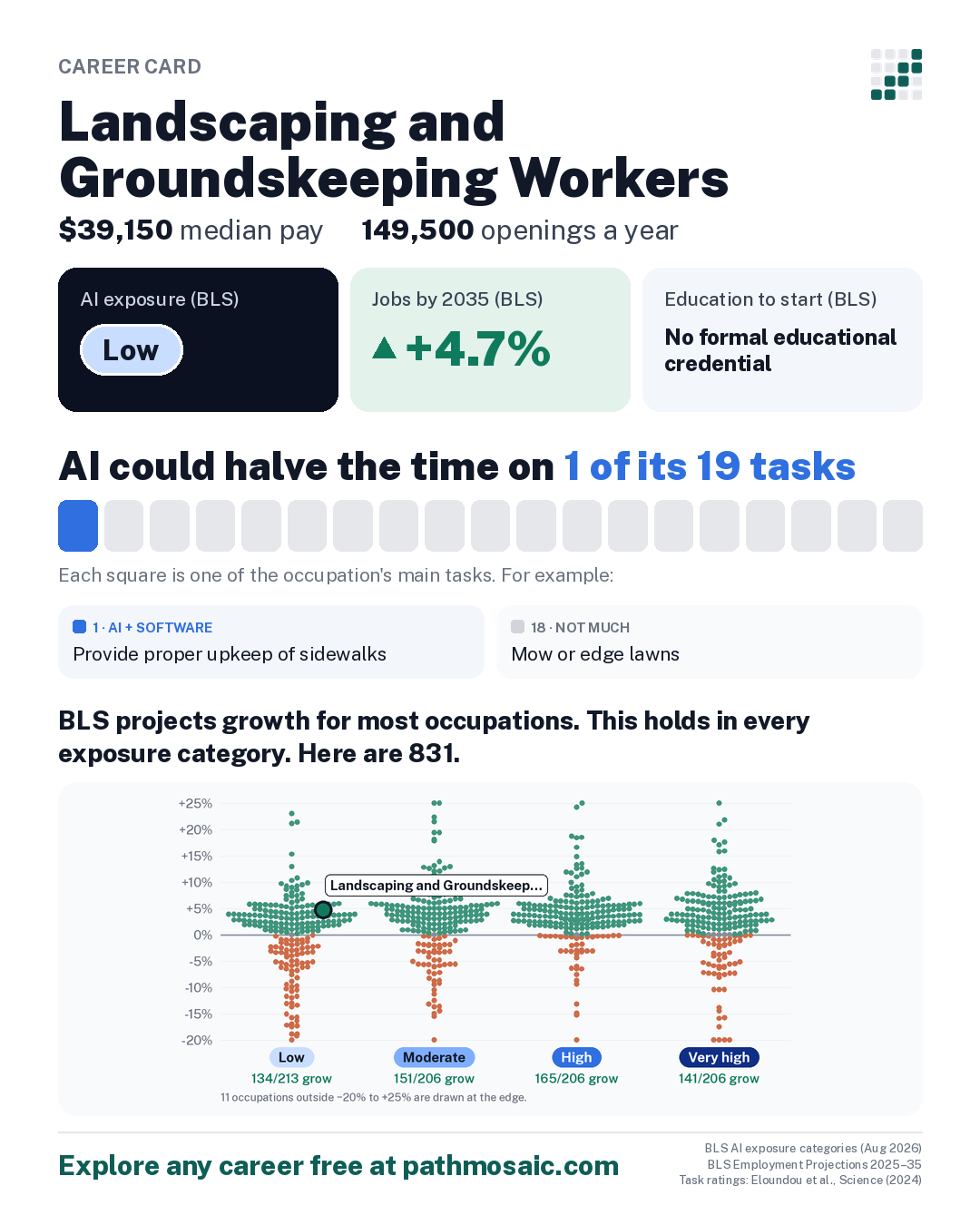
What the data says: AI could halve the time on 1 of its 19 tasks, and jobs are projected to grow 4.7% by 2035. How to think about this →
About this projection
BLS builds AI into its projections where the research supports it: “BLS generally applies adjustments based on this research conservatively, where there is convincing evidence for a change.”
It also notes a limit: “BLS projection methods are not designed to capture extremely rapid technological change.”
On its AI exposure groups, BLS says exposure “does not imply job loss.”
Recent conditions
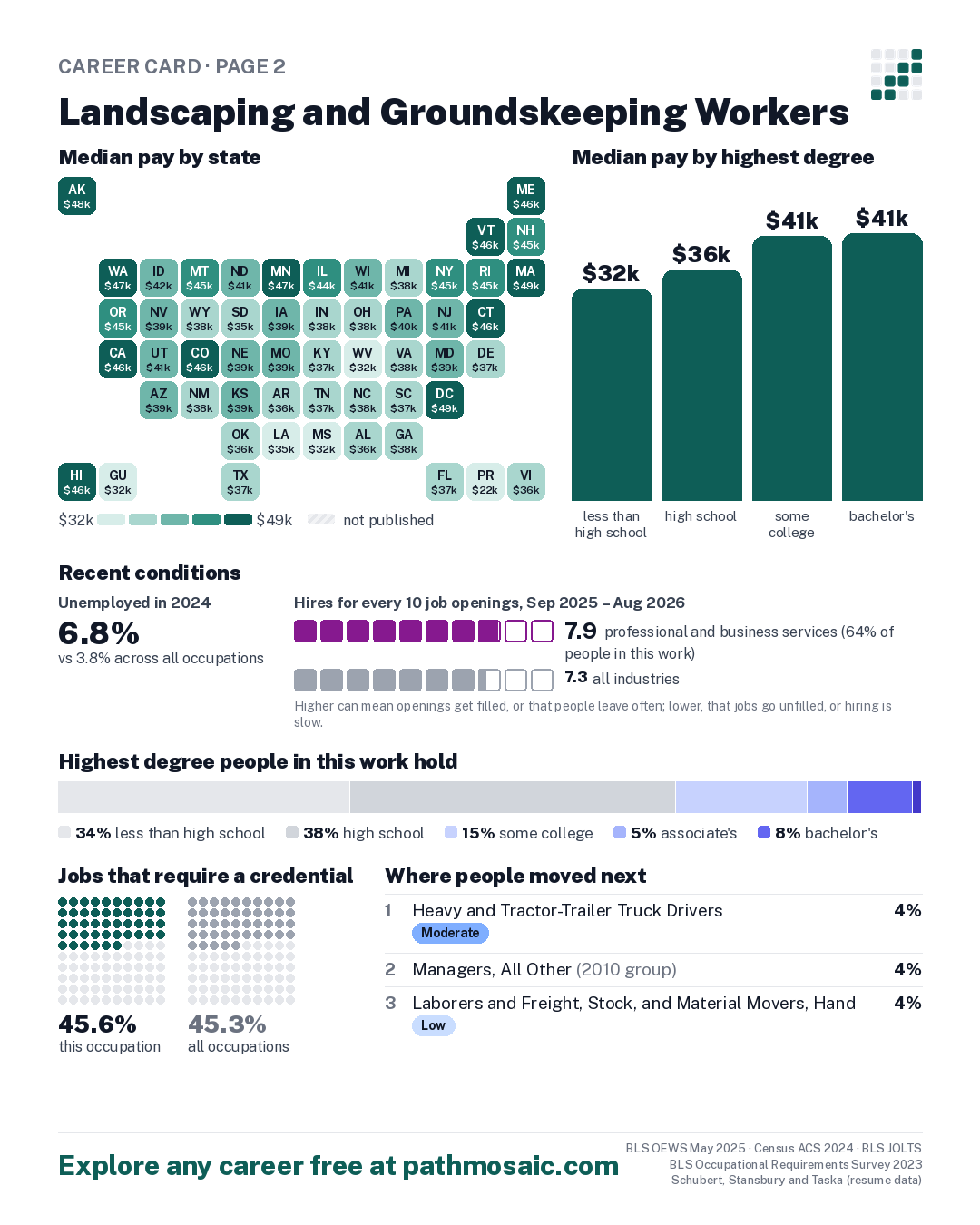
- In 2024, 6.8% of people in this work were unemployed, against 3.8% across all occupations Census ACS 2024
- From Sep 2025 to Aug 2026, 7.9 hires for every 10 job openings in professional and business services, which employs about 64% of people in this work, against 7.3 across all industries BLS JOLTS
One box per opening, filled for each hire; hires beyond the openings are added in a lighter shade. Higher can mean openings get filled, or that people leave often; lower, that jobs go unfilled, or hiring is slow.7.9 this industry7.3 all industries
Median pay by state BLS OEWS May 2025, state estimates
Tap a state for its figures.
Median pay in every state
| State | Median | Middle half earn | Jobs |
|---|---|---|---|
| Alabama | $35,630 | $29,650 to $38,570 | 12,020 |
| Alaska | $47,690 | $38,460 to $49,130 | 1,080 |
| Arizona | $38,910 | $37,280 to $45,120 | 22,450 |
| Arkansas | $35,770 | $30,140 to $39,020 | 6,610 |
| California | $45,560 | $38,420 to $50,490 | 106,180 |
| Colorado | $45,760 | $39,930 to $48,880 | 21,990 |
| Connecticut | $45,740 | $37,550 to $48,650 | 13,490 |
| Delaware | $37,350 | $36,290 to $44,960 | 4,130 |
| District of Columbia | $48,790 | $47,490 to $55,750 | 800 |
| Florida | $37,100 | $35,420 to $43,660 | 86,040 |
| Georgia | $37,970 | $34,370 to $44,360 | 25,510 |
| Guam | $31,620 | $22,030 to $37,100 | 690 |
| Hawaii | $45,920 | $37,720 to $50,440 | 7,040 |
| Idaho | $41,600 | $37,010 to $47,380 | 7,980 |
| Illinois | $43,790 | $36,610 to $46,960 | 34,780 |
| Indiana | $38,070 | $35,220 to $46,100 | 19,260 |
| Iowa | $38,920 | $32,170 to $46,240 | 8,800 |
| Kansas | $39,330 | $35,670 to $46,570 | 9,480 |
| Kentucky | $36,670 | $31,240 to $44,330 | 8,920 |
| Louisiana | $34,870 | $29,620 to $36,990 | 8,510 |
| Maine | $45,970 | $38,070 to $48,370 | 6,410 |
| Maryland | $39,380 | $37,130 to $46,000 | 17,440 |
| Massachusetts | $48,670 | $45,390 to $58,520 | 22,880 |
| Michigan | $38,120 | $35,730 to $46,270 | 32,330 |
| Minnesota | $46,610 | $36,960 to $50,320 | 17,610 |
| Mississippi | $31,630 | $28,170 to $37,420 | 4,940 |
| Missouri | $38,520 | $35,820 to $45,290 | 18,310 |
| Montana | $45,350 | $37,290 to $50,890 | 4,270 |
| Nebraska | $39,140 | $36,630 to $47,510 | 7,280 |
| Nevada | $38,820 | $36,640 to $46,830 | 9,980 |
| New Hampshire | $44,890 | $38,240 to $50,470 | 6,050 |
| New Jersey | $41,360 | $36,980 to $47,310 | 30,470 |
| New Mexico | $37,560 | $34,780 to $44,770 | 5,030 |
| New York | $44,840 | $37,550 to $48,520 | 47,600 |
| North Carolina | $37,910 | $35,830 to $44,510 | 32,730 |
| North Dakota | $40,790 | $35,830 to $50,380 | 2,100 |
| Ohio | $38,220 | $35,330 to $45,640 | 34,420 |
| Oklahoma | $35,770 | $31,210 to $40,130 | 9,280 |
| Oregon | $45,040 | $39,020 to $48,380 | 11,870 |
| Pennsylvania | $39,500 | $35,900 to $46,590 | 34,850 |
| Puerto Rico | $21,910 | $21,840 to $24,490 | 6,430 |
| Rhode Island | $44,730 | $39,520 to $46,500 | 4,040 |
| South Carolina | $36,710 | $32,010 to $42,630 | 15,600 |
| South Dakota | $35,370 | $30,710 to $39,250 | 2,980 |
| Tennessee | $37,020 | $34,840 to $43,640 | 18,250 |
| Texas | $36,740 | $32,620 to $41,270 | 63,430 |
| Utah | $40,740 | $37,260 to $46,810 | 12,850 |
| Vermont | $46,230 | $41,620 to $49,480 | 2,700 |
| Virgin Islands | $36,300 | $30,410 to $38,520 | 280 |
| Virginia | $38,410 | $35,570 to $44,650 | 25,180 |
| Washington | $46,950 | $43,000 to $56,410 | 22,550 |
| West Virginia | $32,240 | $29,860 to $36,580 | 3,340 |
| Wisconsin | $41,230 | $36,090 to $47,440 | 18,970 |
| Wyoming | $38,310 | $31,590 to $45,530 | 1,790 |
Nationally: $39,150. Shades run from the lowest state median to the highest; a territory below that range takes the lightest. How to read this
How AI touches the work
What AI could speed up, task by task, and where people already use it.
AI could halve the time on 1 of its 19 tasks
| AI rating | Its main tasks | Share of Claude conversations May 2026 |
|---|---|---|
| Not much | Mow or edge lawns, using power mowers or edgers. | Not published |
| Not much | Gather and remove litter. | Not published |
| Not much | Use hand tools, such as shovels, rakes, pruning saws, saws, hedge or brush trimmers, or axes. | Not published |
| Not much | Trim or pick flowers and clean flower beds. | Not published |
| Not much | Prune or trim trees, shrubs, or hedges, using shears, pruners, or chain saws. | Not published |
| Not much | Operate vehicles or powered equipment, such as mowers, tractors, twin-axle vehicles, snow blowers, chainsaws, electric clippers, sod cutters, or pruning saws. | Not published |
See all 19 tasks
| Not much | Care for established lawns by mulching, aerating, weeding, grubbing, removing thatch, or trimming or edging around flower beds, walks, or walls. | Not published |
| Not much | Rake, mulch, and compost leaves. | Not published |
| AI + software | Provide proper upkeep of sidewalks, driveways, parking lots, fountains, planters, burial sites, or other grounds features. | Not published |
| Not much | Plant seeds, bulbs, foliage, flowering plants, grass, ground covers, trees, or shrubs, and apply mulch for protection, using gardening tools. O*NET flags this task's ratings as uncertain | Not published |
| Not much | Care for natural turf fields, making sure the underlying soil has the required composition to allow proper drainage and to support the grasses. | Not published |
| Not much | Plan or cultivate lawns or gardens. | under 0.01% |
| Not much | Water lawns, trees, or plants, using portable sprinkler systems, hoses, or watering cans. | Not published |
| Not much | Mix and spray or spread fertilizers, herbicides, or insecticides onto grass, shrubs, or trees, using hand or automatic sprayers or spreaders. | Not published |
| Not much | Attach wires from planted trees to support stakes. | Not published |
| Not much | Haul or spread topsoil, or spread straw over seeded soil to hold soil in place. | Not published |
| Not much | Follow planned landscaping designs to determine where to lay sod, sow grass, or plant flowers or foliage. | Not published |
| Not much | Maintain or repair tools, equipment, or structures, such as buildings, greenhouses, fences, or benches, using hand or power tools. O*NET flags this task's ratings as uncertain | Not published |
| Not much | Shovel snow from walks, driveways, or parking lots, and spread salt in those areas. O*NET flags this task's ratings as uncertain | Not published |
Ordered by how important O*NET's respondents rate each task (1 to 5) times the share who say it is part of their job. The ordering is ours. 1 of the 19 have a published share of Claude conversations; “not published” means too few conversations for Anthropic to publish a figure.
Where people already use AI
The tasks above say what AI could speed up. This shows what people are using it for. Its 19 tasks fall under 12 work activities that many occupations share, and Microsoft counted how often each one came up in 200,000 conversations with its Copilot assistant in 2024.
- #8 Read documents or materials to inform work processes
| Work activity | This occupation's tasks under it | People asked AI for help in 10,000 conversations |
AI did it for them in 10,000 conversations |
|---|---|---|---|
| Perform agricultural activities | |||
| Operate agricultural or forestry equipment | |||
| Cut trees or other vegetation | |||
| Clean tools, equipment, facilities, or work areas | |||
| Dispose of waste or debris | |||
| Read documents or materials to inform work processes | |||
| Prepare mixtures or solutions | |||
| Maintain tools or equipment |
Show all 12 activities
| Apply protective solutions or coatings | |||
| Inspect facilities or equipment | |||
| Build structures | |||
| Operate transportation equipment or vehicles |
How people in this work use Claude
What people in this work made with Claude % of conversations
- Advice or a recommendation41%
- An explanation or answer35%
- A plan or strategy19%
- An image or graphic3%
- An academic paper or thesis0%
How they worked with Claude
0% of these conversations were about work. Anthropic Economic Index, May 2026.
How to read this
Work activities come from O*NET, which links every task to the broader activities it involves. Microsoft's figures are for the activity across everyone who used Copilot, not for landscaping and groundskeeping workers specifically. Copilot is a general chat assistant; dedicated coding tools are not included, so programming help is under-counted here. Activities are listed by how many of this occupation's tasks fall under them.
The task ratings say whether AI could halve the time a task takes: on its own (“AI alone”), or with software built on it (“AI + software”). They were made by people in 2023 (Eloundou et al.). Claude's share is the task's share of all Claude.ai conversations in May 2026; Anthropic doesn't publish a task with too few conversations. None of these add up to the BLS exposure group, which combines five research measures.
More in the Guide: task ratings · task order · work activities · Copilot figures · Claude
High exposure doesn't mean fewer jobs
BLS projects most occupations in its two most exposed groups to grow: 141 of 206 rated Very high and 165 of 206 rated High. Each dot is one of the 831 occupations BLS rates.
Career moves into and out of this occupation
From moves between occupations found in online resumes, 2002–2016. Career changes only: a first job after school isn't a move.
Where people moved next
of 42,479 moves out
- 1 Heavy and Tractor-Trailer Truck Drivers Moderate +3.8% 4%
- 2 Managers, All Other (2010 group) an older group BLS has since split; no exposure group today 4%
- 3 Laborers and Freight, Stock, and Material Movers, Hand Low +1.8% 4%
- 4 Retail Salespersons Very high -0.3% 3%
- 5 Customer Service Representatives Very high -5.3% 2%
Where people moved in from
of 34,921 moves in
- 1 Laborers and Freight, Stock, and Material Movers, Hand Low +1.8% 5%
- 2 Retail Salespersons Very high -0.3% 4%
- 3 Customer Service Representatives Very high -5.3% 3%
- 4 Cashiers High -6.5% 3%
- 5 Heavy and Tractor-Trailer Truck Drivers Moderate +3.8% 3%
Resumes over-represent younger, white-collar job-seekers and moves into management. Schubert, Stansbury and Taska (resume data).
Education and training for the occupation
Census survey (American Community Survey)
- 34% less than high school
- 38% high school
- 15% some college
- 5% associate's
- 8% bachelor's
- 1% master's
Census ACS 2024, all workers in this occupation · 10,486 people surveyed.
Median pay by highest degree full-time, year-round · Census ACS 2024, all workers in this occupation
7 programs, such as Applied Horticulture/Horticulture Operations, General, Ornamental Horticulture and Greenhouse Operations and Management.
See all
- Applied Horticulture/Horticulture Operations, General
- Ornamental Horticulture
- Greenhouse Operations and Management
- Landscaping and Groundskeeping
- Plant Nursery Operations and Management
- Turf and Turfgrass Management
- Golf Course Operation and Grounds Management
Jobs that require a credential BLS Occupational Requirements Survey 2023
45.6% this occupation
45.3% all occupations
| By kind | This occupation | All occupations |
|---|---|---|
| a license | 2.0% | 19.1% |
| a certification | <0.5% | 5.8% |
| an educational certificate | <0.5% | 2.8% |
Share of jobs whose employer requires it. BLS doesn't say which credential. How to read this
Look up certifications, training and licenses U.S. Department of Labor
- Certification Finder ↗ certifications CareerOneStop lists for this occupation
- Training Finder ↗ schools and programs, nationwide; narrow the place there
- License Finder ↗ licenses by state
- Apprenticeship Finder ↗ DOL lists 4 registered apprenticeships in this occupation. Apprenticeship.gov can't be linked to one occupation, so search for “Landscaping and Groundskeeping Workers” there.
These open in a new tab and send only the occupation's public code. More in the Guide
BLS AI exposure categories (Aug 2026) · BLS Employment Projections 2025–35 · O*NET 31.0 · Task ratings: Eloundou et al., Science (2024) · Microsoft "Working with AI" v1.1 · Anthropic Economic Index (2026-06-26) · Schubert, Stansbury and Taska · NCES CIP–SOC · Census ACS 2024 · BLS JOLTS
See it online, and explore any career: https://www.pathmosaic.com/card/37-3011.00