Police and Sheriff's Patrol Officers
Also called: Deputy Sheriff, Patrol Officer, Police Officer, State TrooperMaintain order and protect life and property by enforcing local, tribal, state, or federal laws and ordinances. Perform a combination of the following duties: patrol a specific area; direct traffic; issue traffic summonses; investigate accidents; apprehend and arrest suspects, or serve legal processes of courts. Includes police officers working at educational institutions.
On a phone, press and hold a picture to save it to Photos.
opens your phone's share sheet, where you can save both to Photos
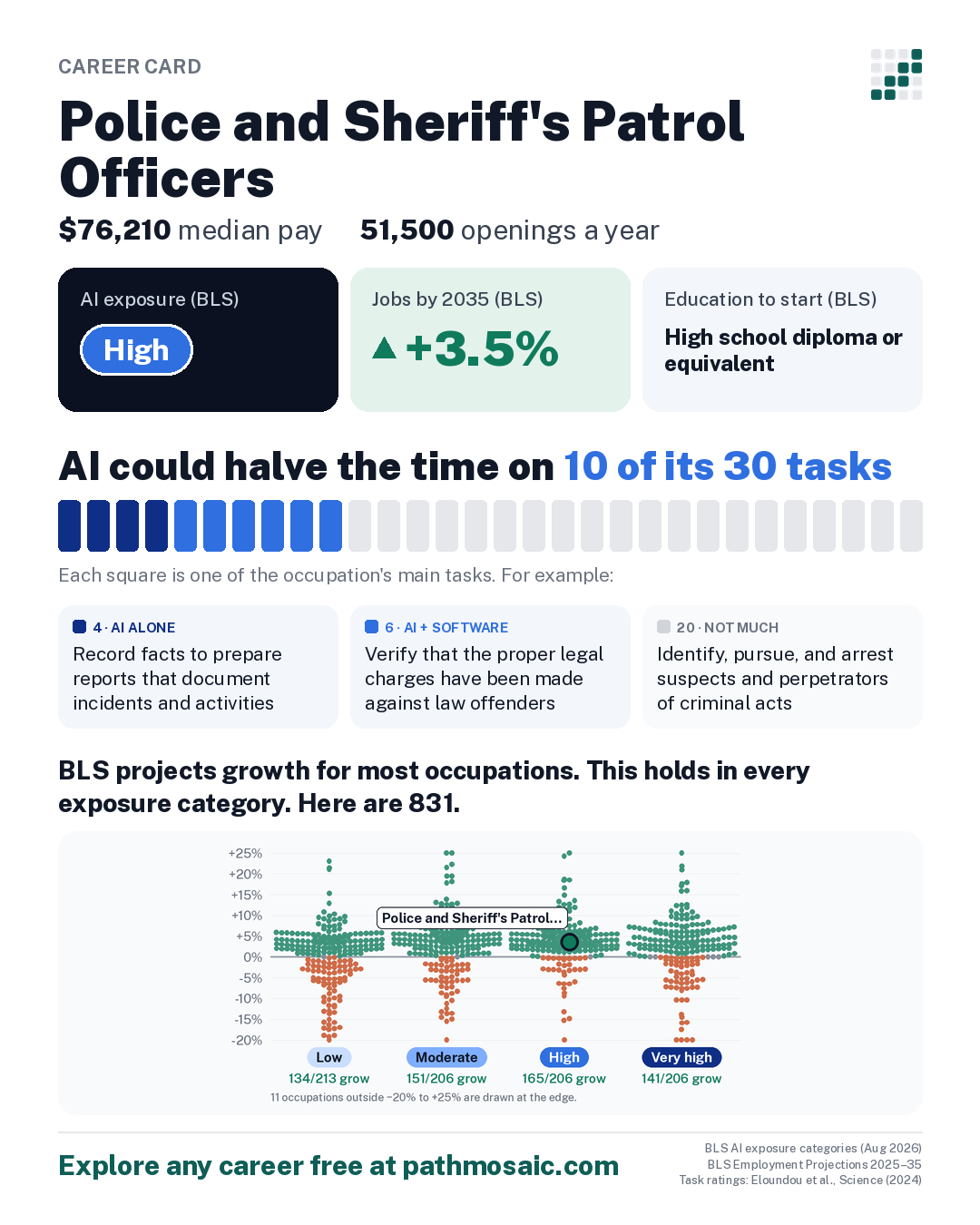
What the data says: AI could halve the time on 10 of its 30 tasks, and jobs are projected to grow 3.5% by 2035. How to think about this →
About this projection
BLS builds AI into its projections where the research supports it: “BLS generally applies adjustments based on this research conservatively, where there is convincing evidence for a change.”
It also notes a limit: “BLS projection methods are not designed to capture extremely rapid technological change.”
On its AI exposure groups, BLS says exposure “does not imply job loss.”
BLS figures cover the broader occupation “Police and sheriff's patrol officers”, which includes this one and others.
Recent conditions
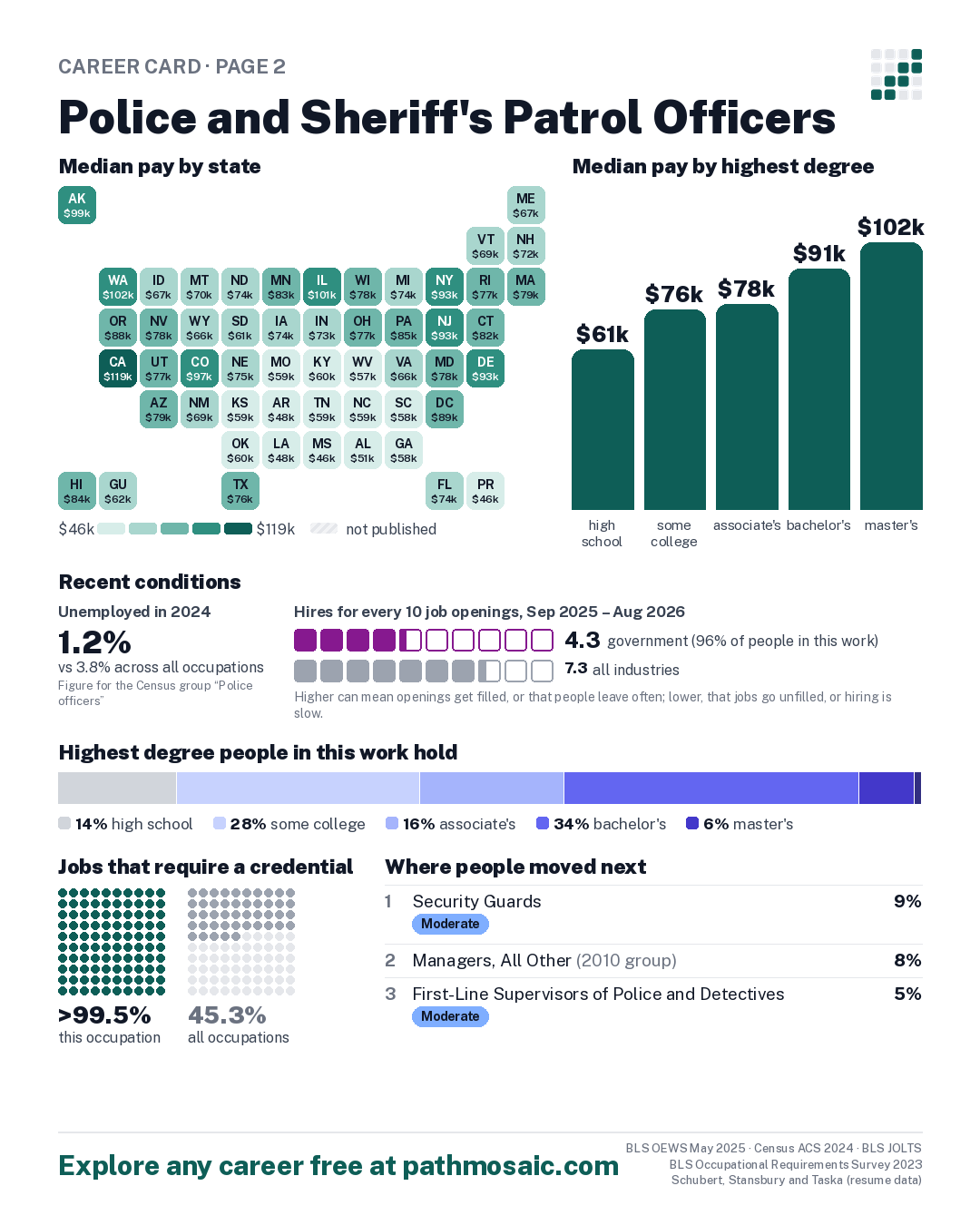
- In 2024, 1.2% of people in this work were unemployed, against 3.8% across all occupations Census ACS 2024, all workers in the Census group “Police officers”
- From Sep 2025 to Aug 2026, 4.3 hires for every 10 job openings in government, which employs about 96% of people in this work, against 7.3 across all industries BLS JOLTS
One box per opening, filled for each hire; hires beyond the openings are added in a lighter shade. Higher can mean openings get filled, or that people leave often; lower, that jobs go unfilled, or hiring is slow.4.3 this industry7.3 all industries
Median pay by state BLS OEWS May 2025, state estimates
Tap a state for its figures.
Median pay in every state
| State | Median | Middle half earn | Jobs |
|---|---|---|---|
| Alabama | $51,270 | $44,260 to $63,090 | 11,710 |
| Alaska | $99,130 | $78,810 to $126,480 | 1,260 |
| Arizona | $78,880 | $68,550 to $96,800 | 12,010 |
| Arkansas | $47,670 | $40,100 to $56,720 | 5,710 |
| California | $118,880 | $97,280 to $126,780 | 65,940 |
| Colorado | $97,350 | $76,640 to $102,620 | 9,610 |
| Connecticut | $82,170 | $77,500 to $93,520 | 6,500 |
| Delaware | $92,970 | $75,550 to $102,530 | 1,800 |
| District of Columbia | $88,650 | $77,210 to $107,360 | 4,720 |
| Florida | $74,470 | $60,520 to $93,460 | 43,630 |
| Georgia | $58,120 | $48,290 to $63,270 | 22,170 |
| Guam | $62,130 | $47,150 to $85,430 | 540 |
| Hawaii | $83,820 | $82,640 to $108,110 | 2,420 |
| Idaho | $66,990 | $58,090 to $83,560 | 2,810 |
| Illinois | $100,520 | $76,480 to $107,810 | 29,180 |
| Indiana | $73,370 | $60,710 to $84,820 | 12,980 |
| Iowa | $74,470 | $63,810 to $86,160 | 5,130 |
| Kansas | $59,230 | $48,670 to $71,950 | 6,130 |
| Kentucky | $60,490 | $47,940 to $68,990 | 7,890 |
| Louisiana | $48,380 | $43,090 to $59,440 | 12,400 |
| Maine | $67,050 | $61,230 to $76,550 | 2,120 |
| Maryland | $77,970 | $66,300 to $95,990 | 9,720 |
| Massachusetts | $78,940 | $71,970 to $97,390 | 17,040 |
| Michigan | $73,730 | $60,410 to $80,170 | 16,750 |
| Minnesota | $83,360 | $75,750 to $98,430 | 9,160 |
| Mississippi | $46,140 | $37,270 to $54,450 | 8,070 |
| Missouri | $59,460 | $46,760 to $75,930 | 13,570 |
| Montana | $70,050 | $59,860 to $77,500 | 2,160 |
| Nebraska | $74,620 | $63,170 to $93,480 | 3,490 |
| Nevada | $78,140 | $76,010 to $101,260 | 5,720 |
| New Hampshire | $71,640 | $61,480 to $77,010 | 2,460 |
| New Jersey | $92,610 | $67,070 to $117,800 | 21,780 |
| New Mexico | $69,180 | $58,870 to $73,430 | 4,580 |
| New York | $92,790 | $57,180 to $107,080 | 53,470 |
| North Carolina | $59,300 | $49,460 to $72,700 | 22,370 |
| North Dakota | $74,500 | $62,670 to $78,050 | 1,630 |
| Ohio | $77,020 | $62,700 to $90,390 | 23,430 |
| Oklahoma | $59,700 | $45,250 to $78,580 | 9,660 |
| Oregon | $88,140 | $78,170 to $98,650 | 5,030 |
| Pennsylvania | $85,470 | $63,080 to $96,970 | 26,510 |
| Puerto Rico | $45,510 | $34,320 to $48,150 | 11,640 |
| Rhode Island | $77,230 | $69,370 to $91,620 | 1,940 |
| South Carolina | $58,070 | $48,570 to $68,190 | 12,930 |
| South Dakota | $60,740 | $52,330 to $72,000 | 2,000 |
| Tennessee | $59,280 | $48,710 to $75,410 | 15,630 |
| Texas | $75,900 | $61,240 to $93,800 | 63,100 |
| Utah | $77,310 | $64,520 to $94,150 | 5,500 |
| Vermont | $68,910 | $59,680 to $79,080 | 1,020 |
| Virginia | $65,870 | $58,140 to $78,480 | 19,970 |
| Washington | $102,080 | $92,930 to $118,480 | 9,160 |
| West Virginia | $56,960 | $48,950 to $61,330 | 2,900 |
| Wisconsin | $78,090 | $67,450 to $84,850 | 12,320 |
| Wyoming | $66,140 | $59,640 to $73,650 | 1,310 |
Nationally: $76,210. Shades run from the lowest state median to the highest; a territory below that range takes the lightest. How to read this
How AI touches the work
What AI could speed up, task by task, and where people already use it.
AI could halve the time on 10 of its 30 tasks
| AI rating | Its main tasks | Share of Claude conversations May 2026 |
|---|---|---|
| Not much | Identify, pursue, and arrest suspects and perpetrators of criminal acts. | Not published |
| Not much | Provide for public safety by maintaining order, responding to emergencies, protecting people and property, enforcing motor vehicle and criminal laws, and promoting good community relations. | Not published |
| Not much | Investigate illegal or suspicious activities. | under 0.01% |
| AI alone | Record facts to prepare reports that document incidents and activities. | under 0.01% |
| Not much | Render aid to accident survivors and other persons requiring first aid for physical injuries. | Not published |
| Not much | Review facts of incidents to determine if criminal act or statute violations were involved. | Not published |
See all 30 tasks
| Not much | Drive vehicles or patrol specific areas to detect law violators, issue citations, and make arrests. | Not published |
| Not much | Monitor, note, report, and investigate suspicious persons and situations, safety hazards, and unusual or illegal activity in patrol area. | Not published |
| AI + software | Verify that the proper legal charges have been made against law offenders. | Not published |
| Not much | Investigate traffic accidents and other accidents to determine causes and to determine if a crime has been committed. | Not published |
| Not much | Execute arrest warrants, locating and taking persons into custody. | Not published |
| AI + software | Monitor traffic to ensure motorists observe traffic regulations and exhibit safe driving procedures. | Not published |
| Not much | Testify in court to present evidence or act as witness in traffic and criminal cases. | Not published |
| Not much | Patrol specific area on foot, horseback, or motorized conveyance, responding promptly to calls for assistance. | Not published |
| Not much | Relay complaint and emergency-request information to appropriate agency dispatchers. | Not published |
| Not much | Direct traffic flow and reroute traffic in case of emergencies. | Not published |
| AI + software | Photograph or draw diagrams of crime or accident scenes and interview principals and eyewitnesses. | Not published |
| AI alone | Evaluate complaint and emergency-request information to determine response requirements. | under 0.01% |
| Not much | Patrol and guard courthouses, grand jury rooms, or assigned areas to provide security, enforce laws, maintain order, and arrest violators. | Not published |
| AI + software | Notify patrol units to take violators into custody or to provide needed assistance or medical aid. | Not published |
| Not much | Provide road information to assist motorists. | Not published |
| AI alone | Inform citizens of community services and recommend options to facilitate longer-term problem resolution. | 0.01% |
| Not much | Place people in protective custody. | Not published |
| Not much | Transport or escort prisoners and defendants en route to courtrooms, prisons or jails, attorneys' offices, or medical facilities. | Not published |
| AI alone | Question individuals entering secured areas to determine their business, directing and rerouting individuals as necessary. | Not published |
| AI + software | Conduct community programs for all ages concerning topics such as drugs and violence. | Not published |
| AI + software | Process prisoners, and prepare and maintain records of prisoner bookings and prisoner status during booking and pre-trial process. | Not published |
| Not much | Locate and confiscate real or personal property, as directed by court order. | Not published |
| Not much | Supervise law enforcement staff, such as jail staff, officers, and deputy sheriffs. | Not published |
| Not much | Serve statements of claims, subpoenas, summonses, jury summonses, orders to pay alimony, and other court orders. | Not published |
Ordered by how important O*NET's respondents rate each task (1 to 5) times the share who say it is part of their job. The ordering is ours. 4 of the 30 have a published share of Claude conversations; “not published” means too few conversations for Anthropic to publish a figure.
Where people already use AI
The tasks above say what AI could speed up. This shows what people are using it for. Its 30 tasks fall under 21 work activities that many occupations share, and Microsoft counted how often each one came up in 200,000 conversations with its Copilot assistant in 2024.
- #5 Provide information or assistance to the public
- #12 Explain regulations, policies, or procedures
- #19 Provide general assistance to others, such as customers, patrons, or motorists
- and 1 more, in the table below
| Work activity | This occupation's tasks under it | People asked AI for help in 10,000 conversations |
AI did it for them in 10,000 conversations |
|---|---|---|---|
| Monitor safety or security of work areas, facilities, or properties | |||
| Maintain safety or security | |||
| Investigate criminal or legal matters | |||
| Notify others of emergencies or problems | |||
| Investigate incidents or accidents | |||
| Interview people to obtain information | |||
| Intervene in crisis situations or emergencies | |||
| Record information about legal matters |
Show all 21 activities
| Provide information or assistance to the public | |||
| Explain regulations, policies, or procedures | |||
| Provide general assistance to others, such as customers, patrons, or motorists | |||
| Determine operational methods or procedures | |||
| Record images with photographic or audiovisual equipment | |||
| Maintain operational records | |||
| Perform court-related or other legal administrative activities | |||
| Advise others on workplace health or safety issues | |||
| Administer emergency medical treatment | |||
| Escort others | |||
| Present information in legal proceedings | |||
| Direct vehicle traffic | |||
| Direct legal activities |
How people in this work use Claude
What people in this work made with Claude % of conversations
- An explanation or answer41%
- Advice or a recommendation19%
- A document or report11%
- An analysis or summary9%
- An email or message3%
How they worked with Claude
30% of these conversations were about work. Anthropic Economic Index, May 2026.
How to read this
Work activities come from O*NET, which links every task to the broader activities it involves. Microsoft's figures are for the activity across everyone who used Copilot, not for police and sheriff's patrol officers specifically. Copilot is a general chat assistant; dedicated coding tools are not included, so programming help is under-counted here. Activities are listed by how many of this occupation's tasks fall under them.
The task ratings say whether AI could halve the time a task takes: on its own (“AI alone”), or with software built on it (“AI + software”). They were made by people in 2023 (Eloundou et al.). Claude's share is the task's share of all Claude.ai conversations in May 2026; Anthropic doesn't publish a task with too few conversations. None of these add up to the BLS exposure group, which combines five research measures.
More in the Guide: task ratings · task order · work activities · Copilot figures · Claude
High exposure doesn't mean fewer jobs
BLS projects most occupations in its two most exposed groups to grow: 141 of 206 rated Very high and 165 of 206 rated High. Each dot is one of the 831 occupations BLS rates.
Career moves into and out of this occupation
From moves between occupations found in online resumes, 2002–2016. Career changes only: a first job after school isn't a move.
Where people moved next
of 128,128 moves out
- 1 Security Guards Moderate +0.9% 9%
- 2 Managers, All Other (2010 group) an older group BLS has since split; no exposure group today 8%
- 3 First-Line Supervisors of Police and Detectives Moderate +3.3% 5%
- 4 Postsecondary Teachers, All Other Very high +2.0% 4%
- 5 Heavy and Tractor-Trailer Truck Drivers Moderate +3.8% 3%
Where people moved in from
of 106,675 moves in
- 1 Security Guards Moderate +0.9% 12%
- 2 Managers, All Other (2010 group) an older group BLS has since split; no exposure group today 7%
- 3 First-Line Supervisors of Police and Detectives Moderate +3.3% 5%
- 4 Correctional Officers and Jailers Moderate -7.4% 3%
- 5 Heavy and Tractor-Trailer Truck Drivers Moderate +3.8% 2%
Resumes over-represent younger, white-collar job-seekers and moves into management. Schubert, Stansbury and Taska (resume data).
Education and training for the occupation
Census survey (American Community Survey)
- 14% high school
- 28% some college
- 16% associate's
- 34% bachelor's
- 6% master's
- 1% professional degree
Census ACS 2024, all workers in the Census group “Police officers” · 8,054 people surveyed.
Median pay by highest degree full-time, year-round · Census ACS 2024, all workers in the Census group “Police officers”
9 programs, such as Environmental/Natural Resources Law Enforcement and Protective Services, Criminal Justice and Corrections, General and Criminal Justice/Police Science.
See all
- Environmental/Natural Resources Law Enforcement and Protective Services
- Criminal Justice and Corrections, General
- Criminal Justice/Police Science
- Law Enforcement Investigation and Interviewing
- Law Enforcement Record-Keeping and Evidence Management
- Critical Incident Response/Special Police Operations
- Protective Services Operations
- Maritime Law Enforcement
- Criminalistics and Criminal Science
Jobs that require a credential BLS Occupational Requirements Survey 2023
>99.5% this occupation
45.3% all occupations
| By kind | This occupation | All occupations |
|---|---|---|
| a license | 55.1% | 19.1% |
| a certification | 4.3% | 5.8% |
| an educational certificate | 89.3% | 2.8% |
Share of jobs whose employer requires it. BLS doesn't say which credential. How to read this
Look up certifications, training and licenses U.S. Department of Labor
- Certification Finder ↗ certifications CareerOneStop lists for this occupation
- Training Finder ↗ schools and programs, nationwide; narrow the place there
- License Finder ↗ licenses by state
- Apprenticeship Finder ↗ DOL lists 9 registered apprenticeships in this occupation. Apprenticeship.gov can't be linked to one occupation, so search for “Police and Sheriff's Patrol Officers” there.
These open in a new tab and send only the occupation's public code. More in the Guide
BLS AI exposure categories (Aug 2026) · BLS Employment Projections 2025–35 · O*NET 31.0 · Task ratings: Eloundou et al., Science (2024) · Microsoft "Working with AI" v1.1 · Anthropic Economic Index (2026-06-26) · Schubert, Stansbury and Taska · NCES CIP–SOC · Census ACS 2024 · BLS JOLTS
See it online, and explore any career: https://www.pathmosaic.com/card/33-3051.00