Operating Engineers and Other Construction Equipment Operators
Also called: Equipment Operator (EO), Heavy Equipment Operator (HEO), Machine Operator, Operating EngineerOperate one or several types of power construction equipment, such as motor graders, bulldozers, scrapers, compressors, pumps, derricks, shovels, tractors, or front-end loaders to excavate, move, and grade earth, erect structures, or pour concrete or other hard surface pavement. May repair and maintain equipment in addition to other duties.
On a phone, press and hold a picture to save it to Photos.
opens your phone's share sheet, where you can save both to Photos
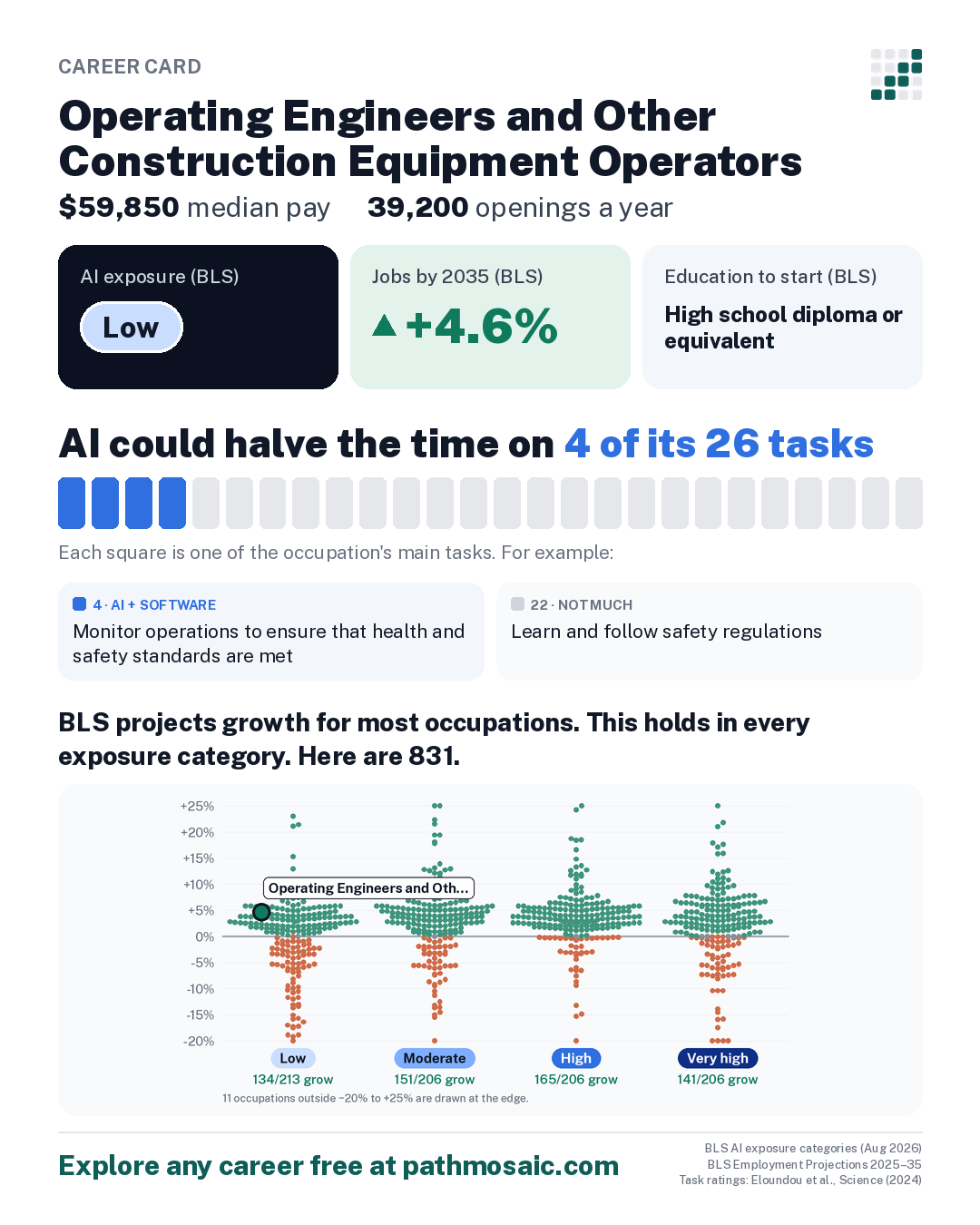
What the data says: AI could halve the time on 4 of its 26 tasks, and jobs are projected to grow 4.6% by 2035. How to think about this →
About this projection
BLS builds AI into its projections where the research supports it: “BLS generally applies adjustments based on this research conservatively, where there is convincing evidence for a change.”
It also notes a limit: “BLS projection methods are not designed to capture extremely rapid technological change.”
On its AI exposure groups, BLS says exposure “does not imply job loss.”
Recent conditions
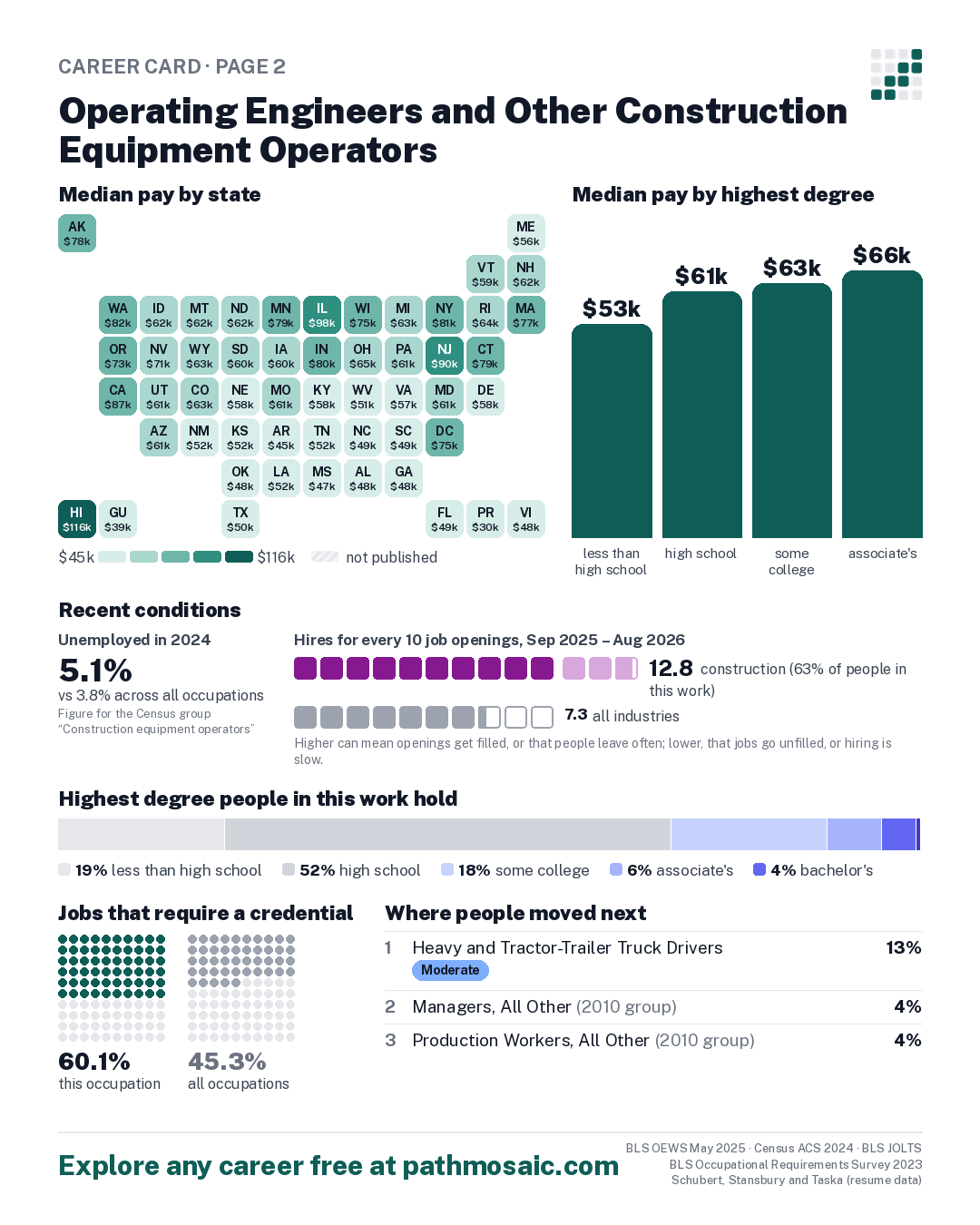
- In 2024, 5.1% of people in this work were unemployed, against 3.8% across all occupations Census ACS 2024, all workers in the Census group “Construction equipment operators”
- From Sep 2025 to Aug 2026, 12.8 hires for every 10 job openings in construction, which employs about 63% of people in this work, against 7.3 across all industries BLS JOLTS
One box per opening, filled for each hire; hires beyond the openings are added in a lighter shade. Higher can mean openings get filled, or that people leave often; lower, that jobs go unfilled, or hiring is slow.12.8 this industry7.3 all industries
Median pay by state BLS OEWS May 2025, state estimates
Tap a state for its figures.
Median pay in every state
| State | Median | Middle half earn | Jobs |
|---|---|---|---|
| Alabama | $47,520 | $39,780 to $57,540 | 9,640 |
| Alaska | $77,810 | $66,830 to $99,890 | 3,050 |
| Arizona | $60,620 | $51,200 to $65,370 | 13,200 |
| Arkansas | $44,520 | $38,350 to $49,860 | 5,800 |
| California | $87,160 | $65,230 to $125,560 | 36,020 |
| Colorado | $62,620 | $57,700 to $73,670 | 11,700 |
| Connecticut | $78,750 | $64,720 to $101,610 | 2,860 |
| Delaware | $58,020 | $46,500 to $66,140 | 1,230 |
| District of Columbia | $74,610 | $65,450 to $86,280 | 620 |
| Florida | $49,400 | $46,330 to $58,360 | 27,510 |
| Georgia | $47,880 | $41,670 to $56,940 | 15,700 |
| Guam | $39,170 | $38,690 to $45,370 | 650 |
| Hawaii | $115,860 | $73,200 to $121,780 | 2,380 |
| Idaho | $61,680 | $52,590 to $75,390 | 4,270 |
| Illinois | $97,740 | $69,230 to $109,320 | 12,290 |
| Indiana | $79,580 | $58,240 to $93,300 | 11,520 |
| Iowa | $60,330 | $53,610 to $72,660 | 5,530 |
| Kansas | $51,620 | $44,720 to $62,030 | 7,070 |
| Kentucky | $57,780 | $49,040 to $65,720 | 7,050 |
| Louisiana | $51,700 | $46,440 to $62,230 | 7,860 |
| Maine | $56,140 | $48,920 to $61,480 | 2,210 |
| Maryland | $61,410 | $49,430 to $70,860 | 6,610 |
| Massachusetts | $76,820 | $62,370 to $107,550 | 9,680 |
| Michigan | $62,690 | $54,710 to $78,410 | 9,500 |
| Minnesota | $79,130 | $63,310 to $95,740 | 8,590 |
| Mississippi | $47,410 | $39,530 to $57,200 | 4,170 |
| Missouri | $60,540 | $48,290 to $84,400 | 10,470 |
| Montana | $61,580 | $56,310 to $72,130 | 3,750 |
| Nebraska | $58,360 | $47,940 to $63,480 | 3,180 |
| Nevada | $71,410 | $60,710 to $90,030 | 5,410 |
| New Hampshire | $62,200 | $57,310 to $73,860 | 1,330 |
| New Jersey | $89,660 | $64,100 to $126,330 | 5,980 |
| New Mexico | $52,000 | $47,470 to $60,090 | 5,520 |
| New York | $80,980 | $60,540 to $112,920 | 14,490 |
| North Carolina | $49,310 | $45,700 to $57,870 | 16,580 |
| North Dakota | $62,150 | $58,180 to $76,430 | 4,890 |
| Ohio | $64,940 | $54,430 to $92,930 | 16,920 |
| Oklahoma | $47,970 | $41,920 to $56,700 | 7,050 |
| Oregon | $73,430 | $61,200 to $97,840 | 5,630 |
| Pennsylvania | $60,530 | $50,790 to $77,780 | 22,120 |
| Puerto Rico | $29,810 | $26,970 to $36,620 | 2,400 |
| Rhode Island | $63,610 | $61,660 to $83,820 | 970 |
| South Carolina | $48,940 | $44,960 to $57,780 | 8,160 |
| South Dakota | $59,500 | $50,690 to $63,460 | 2,050 |
| Tennessee | $52,000 | $46,490 to $59,360 | 10,660 |
| Texas | $50,460 | $46,120 to $59,990 | 55,540 |
| Utah | $60,740 | $51,800 to $65,430 | 7,880 |
| Vermont | $58,870 | $52,760 to $63,680 | 1,280 |
| Virgin Islands | $47,650 | $37,430 to $62,390 | 120 |
| Virginia | $57,160 | $48,040 to $63,330 | 12,100 |
| Washington | $81,700 | $64,390 to $114,640 | 10,290 |
| West Virginia | $51,300 | $42,630 to $61,690 | 7,830 |
| Wisconsin | $75,280 | $61,520 to $94,610 | 8,140 |
| Wyoming | $62,960 | $54,370 to $84,950 | 3,800 |
Nationally: $59,850. Shades run from the lowest state median to the highest; a territory below that range takes the lightest. How to read this
How AI touches the work
What AI could speed up, task by task, and where people already use it.
AI could halve the time on 4 of its 26 tasks
| AI rating | Its main tasks | Share of Claude conversations May 2026 |
|---|---|---|
| Not much | Learn and follow safety regulations. | Not published |
| Not much | Start engines, move throttles, switches, or levers, or depress pedals to operate machines, such as bulldozers, trench excavators, road graders, or backhoes. | Not published |
| Not much | Drive and maneuver equipment equipped with blades in successive passes over working areas to remove topsoil, vegetation, or rocks or to distribute and level earth or terrain. | Not published |
| Not much | Take actions to avoid potential hazards or obstructions, such as utility lines, other equipment, other workers, or falling objects. | Not published |
| Not much | Load and move dirt, rocks, equipment, or other materials, using trucks, crawler tractors, power cranes, shovels, graders, or related equipment. | Not published |
| Not much | Operate tractors or bulldozers to perform such tasks as clearing land, mixing sludge, trimming backfills, or building roadways or parking lots. | Not published |
See all 26 tasks
| Not much | Coordinate machine actions with other activities, positioning or moving loads in response to hand or audio signals from crew members. | Not published |
| Not much | Locate underground services, such as pipes or wires, prior to beginning work. | Not published |
| Not much | Operate equipment to demolish or remove debris or to remove snow from streets, roads, or parking lots. | Not published |
| Not much | Operate loaders to pull out stumps, rip asphalt or concrete, rough-grade properties, bury refuse, or perform general cleanup. | Not published |
| AI + software | Monitor operations to ensure that health and safety standards are met. | Not published |
| Not much | Repair and maintain equipment, making emergency adjustments or assisting with major repairs as necessary. | Not published |
| AI + software | Keep records of material or equipment usage or problems encountered. | Not published |
| Not much | Adjust handwheels and depress pedals to control attachments, such as blades, buckets, scrapers, or swing booms. | Not published |
| Not much | Align machines, cutterheads, or depth gauge makers with reference stakes and guidelines or ground or position equipment, following hand signals of other workers. | Not published |
| AI + software | Signal operators to guide movement of tractor-drawn machines. | Not published |
| AI + software | Check fuel supplies at sites to ensure adequate availability. | Not published |
| Not much | Select and fasten bulldozer blades or other attachments to tractors, using hitches. | Not published |
| Not much | Connect hydraulic hoses, belts, mechanical linkages, or power takeoff shafts to tractors. | Not published |
| Not much | Drive tractor-trailer trucks to move equipment from site to site. | Not published |
| Not much | Talk to clients and study instructions, plans, or diagrams to establish work requirements. | Not published |
| Not much | Push other equipment when extra traction or assistance is required. | Not published |
| Not much | Operate road watering, oiling, or rolling equipment, or street sealing equipment, such as chip spreaders. | Not published |
| Not much | Operate compactors, scrapers, or rollers to level, compact, or cover refuse at disposal grounds. | Not published |
| Not much | Turn valves to control air or water output of compressors or pumps. | Not published |
| Not much | Test atmosphere for adequate oxygen or explosive conditions when working in confined spaces. | Not published |
Ordered by how important O*NET's respondents rate each task (1 to 5) times the share who say it is part of their job. The ordering is ours. 0 of the 26 have a published share of Claude conversations; “not published” means too few conversations for Anthropic to publish a figure.
Where people already use AI
The tasks above say what AI could speed up. This shows what people are using it for. Its 26 tasks fall under 19 work activities that many occupations share, and Microsoft counted how often each one came up in 200,000 conversations with its Copilot assistant in 2024.
- #4 Maintain current knowledge in area of expertise
- #8 Read documents or materials to inform work processes
- #12 Explain regulations, policies, or procedures
- and 1 more, in the table below
| Work activity | This occupation's tasks under it | People asked AI for help in 10,000 conversations |
AI did it for them in 10,000 conversations |
|---|---|---|---|
| Operate construction or excavation equipment | |||
| Position tools or equipment | |||
| Set up equipment | |||
| Monitor operations to ensure adequate performance | |||
| Perform general construction or extraction activities | |||
| Maintain current knowledge in area of expertise | |||
| Read documents or materials to inform work processes | |||
| Explain regulations, policies, or procedures |
Show all 19 activities
| Select materials or equipment for operations or projects | |||
| Maintain tools or equipment | |||
| Dispose of waste or debris | |||
| Maintain operational records | |||
| Operate transportation equipment or vehicles | |||
| Inspect commercial, industrial, or production systems or equipment | |||
| Move materials, equipment, or supplies | |||
| Signal others to coordinate work activities | |||
| Operate pumping systems or equipment | |||
| Load products, materials, or equipment for transportation or further processing | |||
| Test sites or materials for environmental hazards |
How people in this work use Claude
What people in this work made with Claude % of conversations
- An email or message26%
- A document or report18%
- An analysis or summary14%
- An explanation or answer12%
- Advice or a recommendation6%
How they worked with Claude
65% of these conversations were about work. Anthropic Economic Index, May 2026.
How to read this
Work activities come from O*NET, which links every task to the broader activities it involves. Microsoft's figures are for the activity across everyone who used Copilot, not for operating engineers and other construction equipment operators specifically. Copilot is a general chat assistant; dedicated coding tools are not included, so programming help is under-counted here. Activities are listed by how many of this occupation's tasks fall under them.
The task ratings say whether AI could halve the time a task takes: on its own (“AI alone”), or with software built on it (“AI + software”). They were made by people in 2023 (Eloundou et al.). Claude's share is the task's share of all Claude.ai conversations in May 2026; Anthropic doesn't publish a task with too few conversations. None of these add up to the BLS exposure group, which combines five research measures.
More in the Guide: task ratings · task order · work activities · Copilot figures · Claude
High exposure doesn't mean fewer jobs
BLS projects most occupations in its two most exposed groups to grow: 141 of 206 rated Very high and 165 of 206 rated High. Each dot is one of the 831 occupations BLS rates.
Career moves into and out of this occupation
From moves between occupations found in online resumes, 2002–2016. Career changes only: a first job after school isn't a move.
Where people moved next
of 19,136 moves out
- 1 Heavy and Tractor-Trailer Truck Drivers Moderate +3.8% 13%
- 2 Managers, All Other (2010 group) an older group BLS has since split; no exposure group today 4%
- 3 Production Workers, All Other (2010 group) an older group BLS has since split; no exposure group today 4%
- 4 Maintenance and Repair Workers, General Low +4.2% 4%
- 5 Laborers and Freight, Stock, and Material Movers, Hand Low +1.8% 2%
Where people moved in from
of 16,451 moves in
- 1 Heavy and Tractor-Trailer Truck Drivers Moderate +3.8% 9%
- 2 Production Workers, All Other (2010 group) an older group BLS has since split; no exposure group today 4%
- 3 Customer Service Representatives Very high -5.3% 4%
- 4 Laborers and Freight, Stock, and Material Movers, Hand Low +1.8% 4%
- 5 Maintenance and Repair Workers, General Low +4.2% 3%
Resumes over-represent younger, white-collar job-seekers and moves into management. Schubert, Stansbury and Taska (resume data).
Education and training for the occupation
O*NET survey of workers in this occupation
- 1% less than high school
- 1% postsecondary certificate
- 98% not published
O*NET marks 98% of the answers as too uncertain to publish, so the parts shown don't add up to 100%.
O*NET 31.0 survey of workers in this occupation · 23 people answered.
Census survey (American Community Survey)
- 19% less than high school
- 52% high school
- 18% some college
- 6% associate's
- 4% bachelor's
- 1% master's
Census ACS 2024, all workers in the Census group “Construction equipment operators” · 4,432 people surveyed.
Why the two can differ
O*NET asks about 20 people in each occupation, which makes its shares uncertain, but it reports the exact occupation and counts certificates. The Census survey reaches thousands, but it groups some occupations together and counts degrees only. More in the Guide
Median pay by highest degree full-time, year-round · Census ACS 2024, all workers in the Census group “Construction equipment operators”
2 programs: Construction/Heavy Equipment/Earthmoving Equipment Operation and Mobil Crane Operator/Operation.
Jobs that require a credential BLS Occupational Requirements Survey 2023
60.1% this occupation
45.3% all occupations
| By kind | This occupation | All occupations |
|---|---|---|
| a license | 31.4% | 19.1% |
| a certification | 19.6% | 5.8% |
| an educational certificate | not published |
Share of jobs whose employer requires it. BLS doesn't say which credential. How to read this
Look up certifications, training and licenses U.S. Department of Labor
- Certification Finder ↗ certifications CareerOneStop lists for this occupation
- Training Finder ↗ schools and programs, nationwide; narrow the place there
- License Finder ↗ licenses by state
- Apprenticeship Finder ↗ DOL lists 4 registered apprenticeships in this occupation. Apprenticeship.gov can't be linked to one occupation, so search for “Operating Engineers and Other Construction Equipment Operators” there.
These open in a new tab and send only the occupation's public code. More in the Guide
BLS AI exposure categories (Aug 2026) · BLS Employment Projections 2025–35 · O*NET 31.0 · Task ratings: Eloundou et al., Science (2024) · Microsoft "Working with AI" v1.1 · Anthropic Economic Index (2026-06-26) · Schubert, Stansbury and Taska · NCES CIP–SOC · Census ACS 2024 · BLS JOLTS
See it online, and explore any career: https://www.pathmosaic.com/card/47-2073.00