Cutting, Punching, and Press Machine Setters, Operators, and Tenders, Metal and Plastic
Also called: Machine Operator, Press Operator, Saw Operator, Setup OperatorSet up, operate, or tend machines to saw, cut, shear, slit, punch, crimp, notch, bend, or straighten metal or plastic material.
On a phone, press and hold a picture to save it to Photos.
opens your phone's share sheet, where you can save both to Photos
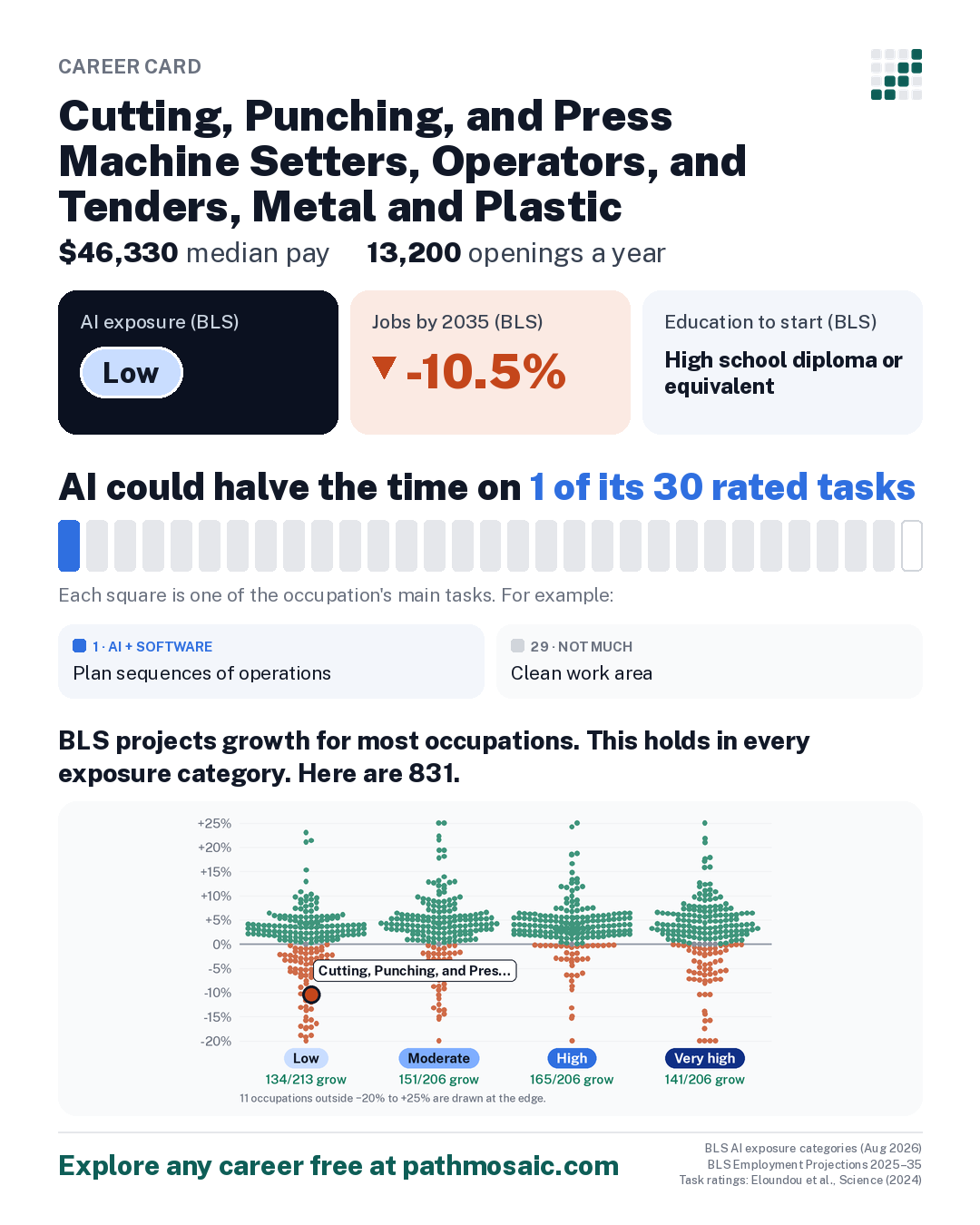
What the data says: AI could halve the time on 1 of its 30 rated tasks, and jobs are projected to shrink 10.5% by 2035. How to think about this →
About this projection
BLS builds AI into its projections where the research supports it: “BLS generally applies adjustments based on this research conservatively, where there is convincing evidence for a change.”
It also notes a limit: “BLS projection methods are not designed to capture extremely rapid technological change.”
On its AI exposure groups, BLS says exposure “does not imply job loss.”
Recent conditions
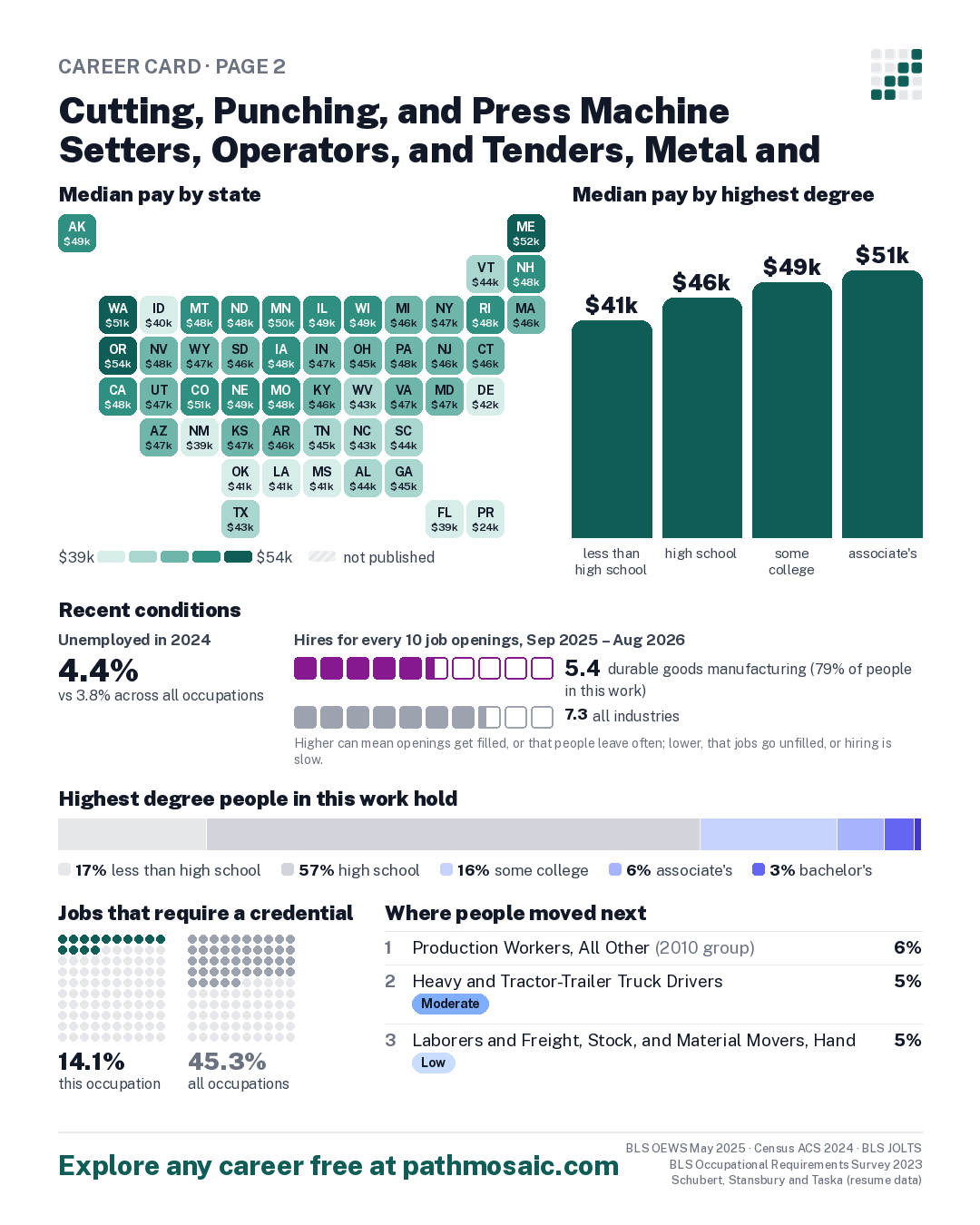
- In 2024, 4.4% of people in this work were unemployed, against 3.8% across all occupations Census ACS 2024
- From Sep 2025 to Aug 2026, 5.4 hires for every 10 job openings in durable goods manufacturing, which employs about 79% of people in this work, against 7.3 across all industries BLS JOLTS
One box per opening, filled for each hire; hires beyond the openings are added in a lighter shade. Higher can mean openings get filled, or that people leave often; lower, that jobs go unfilled, or hiring is slow.5.4 this industry7.3 all industries
Median pay by state BLS OEWS May 2025, state estimates
Tap a state for its figures.
Median pay in every state
| State | Median | Middle half earn | Jobs |
|---|---|---|---|
| Alabama | $43,830 | $37,850 to $48,000 | 6,000 |
| Alaska | $49,010 | $45,160 to $58,320 | 80 |
| Arizona | $46,610 | $39,780 to $51,240 | 1,100 |
| Arkansas | $45,580 | $37,140 to $51,160 | 3,020 |
| California | $48,450 | $43,710 to $58,450 | 7,710 |
| Colorado | $50,790 | $45,840 to $59,830 | 1,400 |
| Connecticut | $46,280 | $38,440 to $53,920 | 2,030 |
| Delaware | $41,640 | $39,860 to $48,380 | 240 |
| Florida | $39,440 | $36,180 to $46,670 | 2,740 |
| Georgia | $45,080 | $38,690 to $50,730 | 5,260 |
| Idaho | $39,580 | $37,650 to $46,200 | 720 |
| Illinois | $48,990 | $41,670 to $59,030 | 8,060 |
| Indiana | $46,980 | $40,630 to $56,350 | 9,680 |
| Iowa | $48,240 | $40,120 to $52,730 | 2,030 |
| Kansas | $46,840 | $39,520 to $53,670 | 1,900 |
| Kentucky | $45,760 | $39,300 to $60,230 | 7,290 |
| Louisiana | $40,870 | $37,660 to $48,900 | 760 |
| Maine | $51,820 | $47,130 to $60,440 | 180 |
| Maryland | $47,320 | $39,420 to $50,780 | 270 |
| Massachusetts | $45,760 | $39,570 to $57,460 | 2,590 |
| Michigan | $46,120 | $38,580 to $66,130 | 22,060 |
| Minnesota | $49,770 | $42,850 to $60,130 | 6,130 |
| Mississippi | $40,650 | $36,220 to $48,990 | 1,700 |
| Missouri | $48,310 | $39,500 to $60,170 | 3,240 |
| Montana | $48,490 | $45,280 to $51,680 | 130 |
| Nebraska | $48,690 | $39,520 to $58,020 | 1,320 |
| Nevada | $47,690 | $40,540 to $50,420 | 580 |
| New Hampshire | $48,110 | $41,950 to $52,430 | 600 |
| New Jersey | $45,680 | $40,130 to $51,800 | 1,950 |
| New Mexico | $39,430 | $36,400 to $45,580 | 220 |
| New York | $46,930 | $39,800 to $57,070 | 3,340 |
| North Carolina | $43,400 | $37,390 to $50,090 | 3,940 |
| North Dakota | $48,400 | $47,230 to $56,670 | 230 |
| Ohio | $45,230 | $38,360 to $50,640 | 13,350 |
| Oklahoma | $40,930 | $36,260 to $49,870 | 2,480 |
| Oregon | $53,680 | $48,070 to $59,550 | 1,180 |
| Pennsylvania | $47,860 | $40,710 to $58,780 | 8,890 |
| Puerto Rico | $24,090 | $21,840 to $28,670 | 240 |
| Rhode Island | $48,170 | $43,550 to $59,780 | 470 |
| South Carolina | $44,420 | $39,230 to $49,290 | 4,100 |
| South Dakota | $46,060 | $41,900 to $53,330 | 490 |
| Tennessee | $44,780 | $37,580 to $48,310 | 5,380 |
| Texas | $42,720 | $36,940 to $47,460 | 13,290 |
| Utah | $46,670 | $44,030 to $50,960 | 1,050 |
| Vermont | $43,560 | $39,640 to $51,950 | 70 |
| Virginia | $47,300 | $41,380 to $52,890 | 1,790 |
| Washington | $51,160 | $46,280 to $60,890 | 1,750 |
| West Virginia | $43,070 | $35,410 to $57,570 | 290 |
| Wisconsin | $49,270 | $43,930 to $58,560 | 7,960 |
| Wyoming | $46,890 | $45,520 to $51,870 | 60 |
Nationally: $46,330. Shades run from the lowest state median to the highest; a territory below that range takes the lightest. How to read this
How AI touches the work
What AI could speed up, task by task, and where people already use it.
AI could halve the time on 1 of its 30 rated tasks
| AI rating | Its main tasks | Share of Claude conversations May 2026 |
|---|---|---|
| Not much | Clean work area. | Not published |
| Not much | Set up, operate, or tend machines to saw, cut, shear, slit, punch, crimp, notch, bend, or straighten metal or plastic material. | Not published |
| Not much | Examine completed workpieces for defects, such as chipped edges or marred surfaces and sort defective pieces according to types of flaws. | Not published |
| Not much | Measure completed workpieces to verify conformance to specifications, using micrometers, gauges, calipers, templates, or rulers. | Not published |
| Not much | Start machines, monitor their operations, and record operational data. | Not published |
| Not much | Read work orders or production schedules to determine specifications, such as materials to be used, locations of cutting lines, or dimensions and tolerances. | Not published |
See all 31 tasks
| Not much | Load workpieces, plastic material, or chemical solutions into machines. | Not published |
| Not much | Test and adjust machine speeds or actions, according to product specifications, using gauges and hand tools. | Not published |
| Not much | Turn controls to set cutting speeds, feed rates, or table angles for specified operations. | Not published |
| Not much | Install, align, and lock specified punches, dies, cutting blades, or other fixtures in rams or beds of machines, using gauges, templates, feelers, shims, and hand tools. | Not published |
| Not much | Position, align, and secure workpieces against fixtures or stops on machine beds or on dies. | Not published |
| Not much | Clean and lubricate machines. | Not published |
| Not much | Lubricate workpieces with oil. | Not published |
| Not much | Position guides, stops, holding blocks, or other fixtures to secure and direct workpieces, using hand tools and measuring devices. | Not published |
| Not much | Turn valves to start flow of coolant against cutting areas or to start airflow that blows cuttings away from kerfs. | Not published |
| Not much | Adjust ram strokes of presses to specified lengths, using hand tools. | Not published |
| Not much | Mark identifying data on workpieces. | Not published |
| Not much | Set stops on machine beds, change dies, and adjust components, such as rams or power presses, when making multiple or successive passes. | Not published |
| AI + software | Plan sequences of operations, applying knowledge of physical properties of workpiece materials. | Not published |
| Not much | Replace defective blades or wheels, using hand tools. | Not published |
| Not much | Scribe reference lines on workpieces as guides for cutting operations, according to blueprints, templates, sample parts, or specifications. | Not published |
| Not much | Sharpen dulled blades, using bench grinders, abrasive wheels, or lathes. | Not published |
| Not much | Place workpieces on cutting tables, manually or using hoists, cranes, or sledges. | Not published |
| Not much | Remove housings, feed tubes, tool holders, or other accessories to replace worn or broken parts, such as springs or bushings. | Not published |
| Not much | Operate forklifts to deliver materials. | Not published |
| Not much | Grind out burrs or sharp edges, using portable grinders, speed lathes, or polishing jacks. | Not published |
| Not much | Select, clean, and install spacers, rubber sleeves, or cutters on arbors. | Not published |
| Not rated | Use equipment designed to join sheet metal, such as spot welders. | Not published |
| Not much | Hone cutters with oilstones to remove nicks. | Not published |
| Not much | Preheat workpieces, using heating furnaces or hand torches. | Not published |
| Not much | Set blade tensions, heights, and angles to perform prescribed cuts, using wrenches. | Not published |
Ordered by how important O*NET's respondents rate each task (1 to 5) times the share who say it is part of their job. The ordering is ours. 0 of the 31 have a published share of Claude conversations; “not published” means too few conversations for Anthropic to publish a figure.
Where people already use AI
The tasks above say what AI could speed up. This shows what people are using it for. Its 31 tasks fall under 25 work activities that many occupations share, and Microsoft counted how often each one came up in 200,000 conversations with its Copilot assistant in 2024.
- #8 Read documents or materials to inform work processes
- #38 Select materials or equipment for operations or projects
| Work activity | This occupation's tasks under it | People asked AI for help in 10,000 conversations |
AI did it for them in 10,000 conversations |
|---|---|---|---|
| Operate cutting or grinding equipment | |||
| Maintain tools or equipment | |||
| Position workpieces or materials on equipment | |||
| Adjust equipment to ensure adequate performance | |||
| Clean tools, equipment, facilities, or work areas | |||
| Set up equipment | |||
| Position materials or components for assembly | |||
| Read documents or materials to inform work processes |
Show all 25 activities
| Select materials or equipment for operations or projects | |||
| Plan work activities | |||
| Measure physical characteristics of materials, products, or equipment | |||
| Sort materials or products | |||
| Inspect completed work or finished products | |||
| Mark materials or objects for identification | |||
| Maintain operational records | |||
| Disassemble equipment | |||
| Repair tools or equipment | |||
| Monitor equipment operation | |||
| Smooth surfaces of objects or equipment | |||
| Inspect commercial, industrial, or production systems or equipment | |||
| Prepare industrial materials for processing or use | |||
| Join parts using soldering, welding, or brazing techniques | |||
| Load products, materials, or equipment for transportation or further processing | |||
| Operate industrial processing or production equipment | |||
| Operate lifting or moving equipment |
How to read this
Work activities come from O*NET, which links every task to the broader activities it involves. Microsoft's figures are for the activity across everyone who used Copilot, not for cutting, punching, and press machine setters, operators, and tenders, metal and plastic specifically. Copilot is a general chat assistant; dedicated coding tools are not included, so programming help is under-counted here. Activities are listed by how many of this occupation's tasks fall under them.
The task ratings say whether AI could halve the time a task takes: on its own (“AI alone”), or with software built on it (“AI + software”). They were made by people in 2023 (Eloundou et al.). Claude's share is the task's share of all Claude.ai conversations in May 2026; Anthropic doesn't publish a task with too few conversations. None of these add up to the BLS exposure group, which combines five research measures.
More in the Guide: task ratings · task order · work activities · Copilot figures · Claude
High exposure doesn't mean fewer jobs
BLS projects most occupations in its two most exposed groups to grow: 141 of 206 rated Very high and 165 of 206 rated High. Each dot is one of the 831 occupations BLS rates.
Career moves into and out of this occupation
From moves between occupations found in online resumes, 2002–2016. Career changes only: a first job after school isn't a move.
Where people moved next
of 18,134 moves out
- 1 Production Workers, All Other (2010 group) an older group BLS has since split; no exposure group today 6%
- 2 Heavy and Tractor-Trailer Truck Drivers Moderate +3.8% 5%
- 3 Laborers and Freight, Stock, and Material Movers, Hand Low +1.8% 5%
- 4 Managers, All Other (2010 group) an older group BLS has since split; no exposure group today 5%
- 5 Industrial Truck and Tractor Operators Low +1.5% 3%
Where people moved in from
of 16,478 moves in
- 1 Production Workers, All Other (2010 group) an older group BLS has since split; no exposure group today 8%
- 2 Laborers and Freight, Stock, and Material Movers, Hand Low +1.8% 6%
- 3 Nursing Assistants Low +2.6% 4%
- 4 Industrial Truck and Tractor Operators Low +1.5% 3%
- 5 Managers, All Other (2010 group) an older group BLS has since split; no exposure group today 3%
Resumes over-represent younger, white-collar job-seekers and moves into management. Schubert, Stansbury and Taska (resume data).
Education and training for the occupation
O*NET survey of workers in this occupation
- 1% less than high school
- 63% high school
- 35% postsecondary certificate
- 1% some college
O*NET 31.0 survey of workers in this occupation · 17 people answered.
Census survey (American Community Survey)
- 17% less than high school
- 57% high school
- 16% some college
- 6% associate's
- 3% bachelor's
- 1% master's
Census ACS 2024, all workers in this occupation · 609 people surveyed.
Why the two can differ
O*NET asks about 20 people in each occupation, which makes its shares uncertain, but it reports the exact occupation and counts certificates. The Census survey reaches thousands, but it groups some occupations together and counts degrees only. More in the Guide
Median pay by highest degree full-time, year-round · Census ACS 2024, all workers in this occupation
2 programs: Machine Tool Technology/Machinist and Sheet Metal Technology/Sheetworking.
Jobs that require a credential BLS Occupational Requirements Survey 2023
14.1% this occupation
45.3% all occupations
| By kind | This occupation | All occupations |
|---|---|---|
| a license | <0.5% | 19.1% |
| a certification | <0.5% | 5.8% |
| an educational certificate | <0.5% | 2.8% |
Share of jobs whose employer requires it. BLS doesn't say which credential. How to read this
Look up certifications, training and licenses U.S. Department of Labor
- Certification Finder ↗ certifications CareerOneStop lists for this occupation
- Training Finder ↗ schools and programs, nationwide; narrow the place there
- License Finder ↗ licenses by state
- Apprenticeship Finder ↗ DOL lists 4 registered apprenticeships in this occupation. Apprenticeship.gov can't be linked to one occupation, so search for “Cutting, Punching, and Press Machine Setters, Operators, and Tenders, Metal and Plastic” there.
These open in a new tab and send only the occupation's public code. More in the Guide
BLS AI exposure categories (Aug 2026) · BLS Employment Projections 2025–35 · O*NET 31.0 · Task ratings: Eloundou et al., Science (2024) · Microsoft "Working with AI" v1.1 · Anthropic Economic Index (2026-06-26) · Schubert, Stansbury and Taska · NCES CIP–SOC · Census ACS 2024 · BLS JOLTS
See it online, and explore any career: https://www.pathmosaic.com/card/51-4031.00