Financial Risk Specialists
Also called: Analyst, Risk Analyst, Risk Specialist, Securities AnalystAnalyze and measure exposure to credit and market risk threatening the assets, earning capacity, or economic state of an organization. May make recommendations to limit risk.
On a phone, press and hold a picture to save it to Photos.
opens your phone's share sheet, where you can save both to Photos
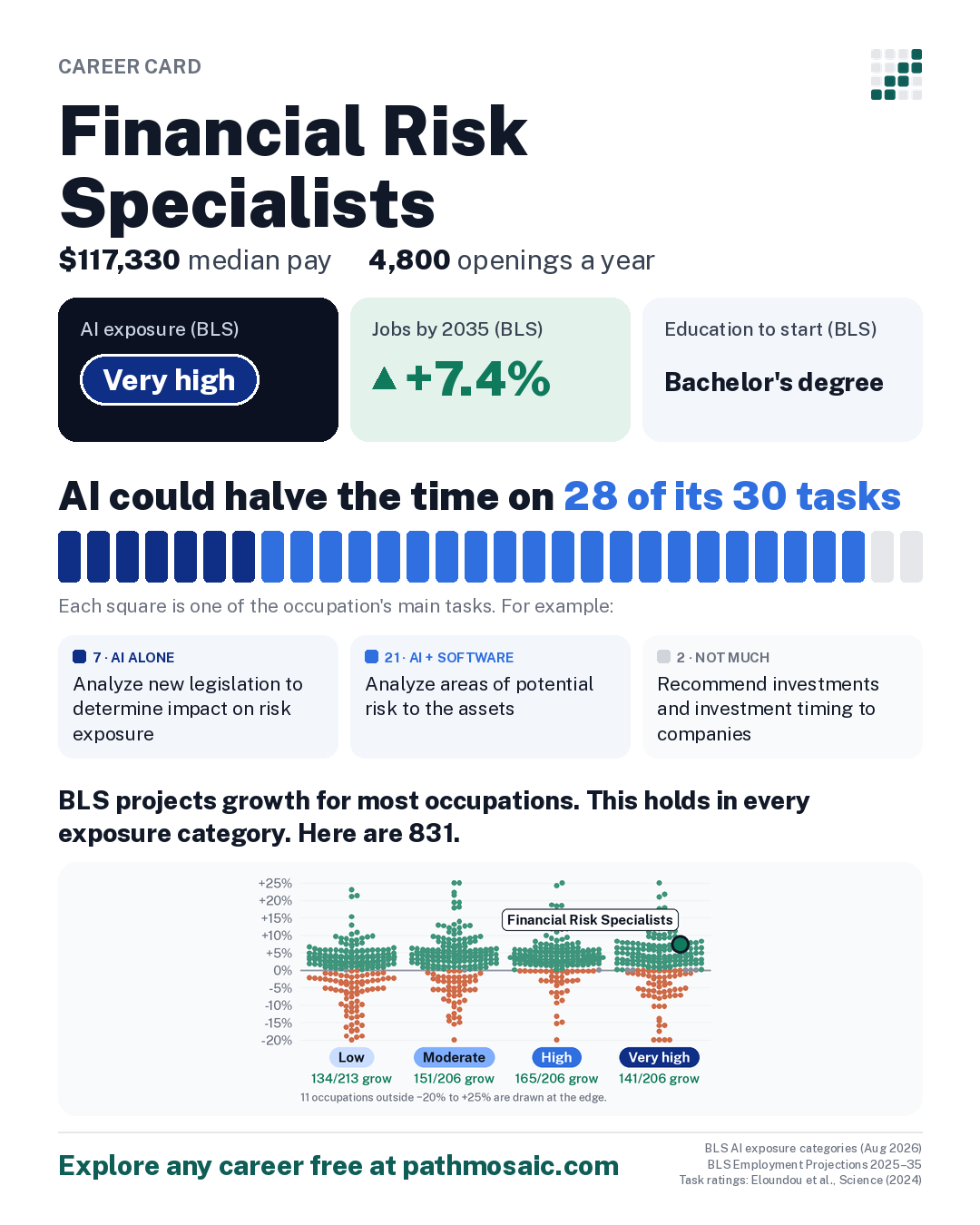
What the data says: AI could halve the time on 28 of its 30 tasks, yet jobs are projected to grow 7.4% by 2035. In the most exposed occupations, the squeeze shows up first among early-career workers. How to think about this →
About this projection
BLS builds AI into its projections where the research supports it: “BLS generally applies adjustments based on this research conservatively, where there is convincing evidence for a change.”
It also notes a limit: “BLS projection methods are not designed to capture extremely rapid technological change.”
On its AI exposure groups, BLS says exposure “does not imply job loss.”
Recent conditions
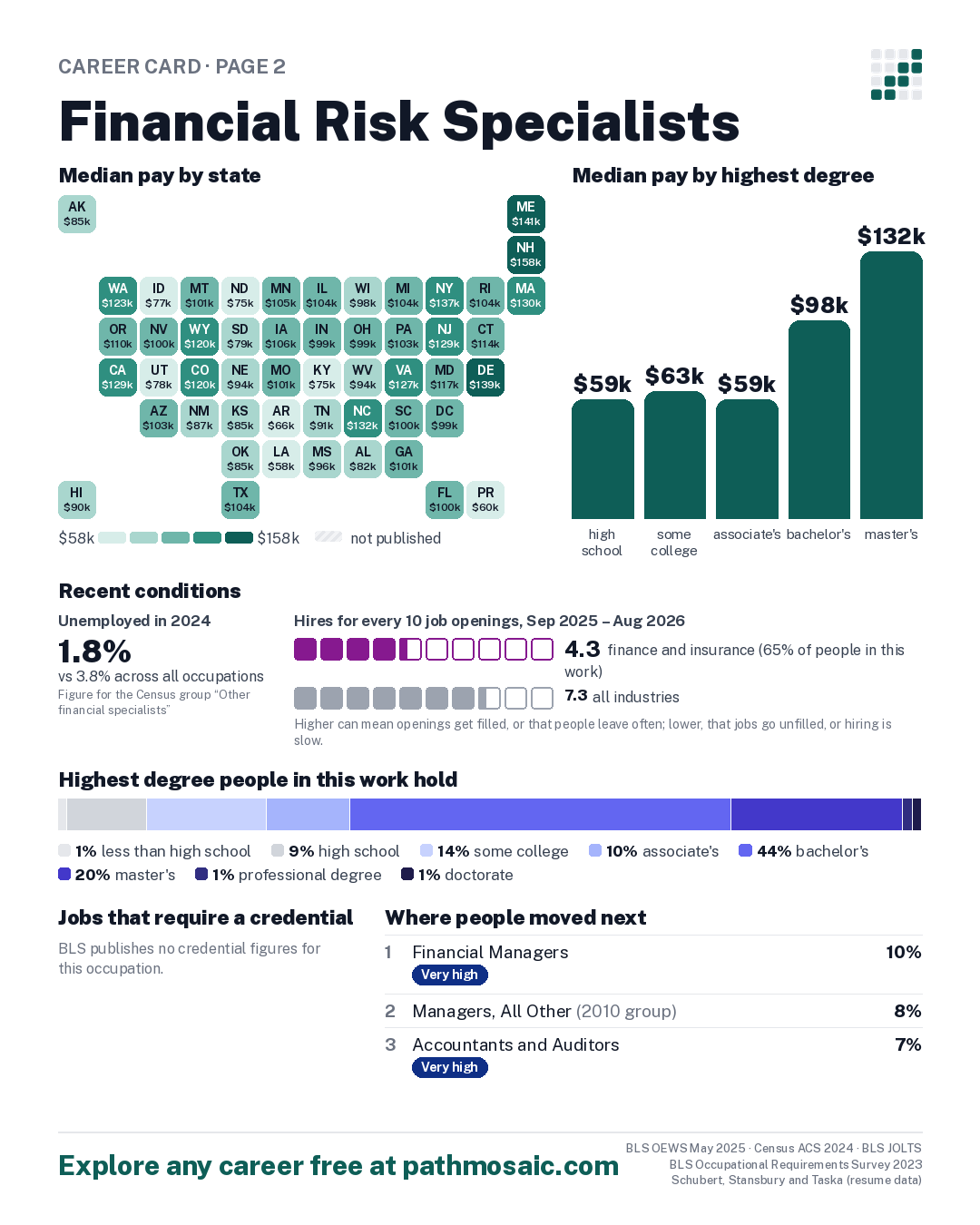
- In 2024, 1.8% of people in this work were unemployed, against 3.8% across all occupations Census ACS 2024, all workers in the Census group “Other financial specialists”
- From Sep 2025 to Aug 2026, 4.3 hires for every 10 job openings in finance and insurance, which employs about 65% of people in this work, against 7.3 across all industries BLS JOLTS
One box per opening, filled for each hire; hires beyond the openings are added in a lighter shade. Higher can mean openings get filled, or that people leave often; lower, that jobs go unfilled, or hiring is slow.4.3 this industry7.3 all industries
Median pay by state BLS OEWS May 2025, state estimates
Tap a state for its figures.
Median pay in every state
| State | Median | Middle half earn | Jobs |
|---|---|---|---|
| Alabama | $81,750 | $55,710 to $110,950 | 180 |
| Alaska | $85,370 | $56,530 to $130,110 | 50 |
| Arizona | $102,800 | $77,890 to $133,810 | 1,700 |
| Arkansas | $66,110 | $50,340 to $107,580 | 150 |
| California | $129,110 | $100,160 to $168,980 | 5,740 |
| Colorado | $120,300 | $90,520 to $157,420 | 1,050 |
| Connecticut | $113,990 | $83,430 to $157,400 | 660 |
| Delaware | $139,440 | $110,110 to $168,720 | 1,160 |
| District of Columbia | $99,230 | $98,530 to $145,110 | 210 |
| Florida | $99,900 | $77,380 to $134,680 | 3,770 |
| Georgia | $100,570 | $67,010 to $134,190 | 2,180 |
| Hawaii | $89,860 | $78,330 to $123,360 | 90 |
| Idaho | $76,870 | $55,390 to $100,460 | 270 |
| Illinois | $104,300 | $79,070 to $156,080 | 2,920 |
| Indiana | $99,250 | $61,760 to $119,100 | 380 |
| Iowa | $105,680 | $90,800 to $132,880 | 530 |
| Kansas | $84,790 | $63,690 to $121,370 | 150 |
| Kentucky | $74,640 | $56,750 to $96,480 | 500 |
| Louisiana | $58,440 | $51,200 to $67,860 | 520 |
| Maine | $141,020 | $94,020 to $141,020 | not published |
| Maryland | $117,130 | $84,160 to $143,870 | 890 |
| Massachusetts | $130,400 | $90,070 to $169,610 | 1,440 |
| Michigan | $103,940 | $79,720 to $132,260 | 1,150 |
| Minnesota | $105,420 | $86,310 to $131,410 | 1,190 |
| Mississippi | $96,100 | $64,990 to $154,990 | 230 |
| Missouri | $100,620 | $79,490 to $128,410 | 1,070 |
| Montana | $100,920 | $82,970 to $114,290 | 50 |
| Nebraska | $94,280 | $72,840 to $105,600 | 250 |
| Nevada | $100,010 | $74,200 to $141,080 | 570 |
| New Hampshire | $158,320 | $111,310 to $158,320 | 300 |
| New Jersey | $129,220 | $101,390 to $165,760 | 2,760 |
| New Mexico | $87,260 | $62,010 to $107,760 | 180 |
| New York | $136,830 | $105,140 to $179,630 | 12,060 |
| North Carolina | $132,040 | $99,010 to $167,830 | 3,200 |
| North Dakota | $74,630 | $61,510 to $99,770 | 90 |
| Ohio | $98,650 | $77,240 to $130,870 | 2,110 |
| Oklahoma | $85,140 | $60,000 to $106,510 | 330 |
| Oregon | $109,580 | $79,890 to $129,560 | 430 |
| Pennsylvania | $103,040 | $80,700 to $132,950 | 2,370 |
| Puerto Rico | $60,360 | $44,740 to $63,890 | 290 |
| Rhode Island | $104,470 | $82,010 to $144,420 | 450 |
| South Carolina | $99,520 | $70,490 to $134,580 | 560 |
| South Dakota | $78,960 | $73,570 to $125,550 | 130 |
| Tennessee | $90,950 | $73,480 to $118,410 | 540 |
| Texas | $103,760 | $80,660 to $132,580 | 4,780 |
| Utah | $77,770 | $63,420 to $101,980 | 630 |
| Virginia | $126,510 | $98,430 to $162,270 | 1,770 |
| Washington | $123,150 | $95,000 to $165,520 | 900 |
| West Virginia | $94,350 | $80,490 to $126,640 | 50 |
| Wisconsin | $97,820 | $77,440 to $117,840 | 610 |
| Wyoming | $119,550 | $106,100 to $119,550 | 170 |
Nationally: $117,330. Shades run from the lowest state median to the highest; a territory below that range takes the lightest. How to read this
How AI touches the work
What AI could speed up, task by task, and where people already use it.
AI could halve the time on 28 of its 30 tasks
| AI rating | Its main tasks | Share of Claude conversations May 2026 |
|---|---|---|
| AI + software | Analyze areas of potential risk to the assets, earning capacity, or success of organizations. | 0.04% |
| AI alone | Analyze new legislation to determine impact on risk exposure. | under 0.01% |
| AI + software | Conduct statistical analyses to quantify risk, using statistical analysis software or econometric models. | under 0.01% |
| Not much | Confer with traders to identify and communicate risks associated with specific trading strategies or positions. | Not published |
| AI + software | Consult financial literature to ensure use of the latest models or statistical techniques. | Not published |
| AI + software | Contribute to development of risk management systems. | Not published |
See all 30 tasks
| AI + software | Determine potential environmental impacts of new products or processes on long-term growth and profitability. | Not published |
| AI + software | Develop contingency plans to deal with emergencies. | under 0.01% |
| AI alone | Develop or implement risk-assessment models or methodologies. | Not published |
| AI + software | Devise scenario analyses reflecting possible severe market events. | 0.01% |
| AI + software | Devise systems or processes to monitor validity of risk assessments. | Not published |
| AI + software | Document, and ensure communication of, key risks. | under 0.01% |
| AI + software | Draw charts and graphs, using computer spreadsheets, to illustrate technical reports. | Not published |
| AI alone | Evaluate and compare the relative quality of various securities in a given industry. | Not published |
| AI + software | Evaluate the risks and benefits involved in implementing green building technologies. | Not published |
| AI + software | Evaluate the risks related to green investments, such as renewable energy company stocks. | Not published |
| AI + software | Gather risk-related data from internal or external resources. | Not published |
| AI + software | Identify key risks and mitigating factors of potential investments, such as asset types and values, legal and ownership structures, professional reputations, customer bases, or industry segments. | 0.06% |
| AI + software | Inform financial decisions by analyzing financial information to forecast business, industry, or economic conditions. | under 0.01% |
| AI + software | Interpret data on price, yield, stability, future investment-risk trends, economic influences, and other factors affecting investment programs. | Not published |
| AI alone | Maintain input or data quality of risk management systems. | under 0.01% |
| AI alone | Meet with clients to answer queries on subjects such as risk exposure, market scenarios, or values-at-risk calculations. | under 0.01% |
| AI + software | Monitor developments in the fields of industrial technology, business, finance, and economic theory. | Not published |
| AI + software | Prepare plans of action for investment, using financial analyses. | Not published |
| AI + software | Produce reports or presentations that outline findings, explain risk positions, or recommend changes. | 0.01% |
| AI alone | Provide statistical modeling advice to other departments. | 0.01% |
| Not much | Recommend investments and investment timing to companies, investment firm staff, or the public. | Not published |
| AI + software | Recommend ways to control or reduce risk. | 0.11% |
| AI alone | Review or draft risk disclosures for offer documents. | under 0.01% |
| AI + software | Track, measure, or report on aspects of market risk for traded issues. | Not published |
O*NET hasn't rated these tasks, so they're in O*NET's own order. 14 of the 30 have a published share of Claude conversations; “not published” means too few conversations for Anthropic to publish a figure.
Where people already use AI
The tasks above say what AI could speed up. This shows what people are using it for. Its 30 tasks fall under 20 work activities that many occupations share, and Microsoft counted how often each one came up in 200,000 conversations with its Copilot assistant in 2024.
- #4 Maintain current knowledge in area of expertise
- #11 Provide information to guests, clients, or customers
- #14 Create visual designs or displays
- and 4 more, in the table below
| Work activity | This occupation's tasks under it | People asked AI for help in 10,000 conversations |
AI did it for them in 10,000 conversations |
|---|---|---|---|
| Analyze business or financial risks | |||
| Analyze business or financial data | |||
| Develop operational or technical procedures or standards | |||
| Provide information to guests, clients, or customers | |||
| Advise others on business or operational matters | |||
| Maintain current knowledge in area of expertise | |||
| Create visual designs or displays | |||
| Determine values or prices of goods or services |
Show all 20 activities
| Explain financial information | |||
| Gather data about operational or development activities | |||
| Assess characteristics or impacts of regulations or policies | |||
| Analyze market or industry conditions | |||
| Advise others on financial matters | |||
| Monitor financial data or activities | |||
| Prepare legal or regulatory documents | |||
| Coordinate activities with clients, agencies, or organizations | |||
| Prepare financial documents, reports, or budgets | |||
| Maintain operational records | |||
| Develop financial or business plans | |||
| Develop contingency or emergency response plans |
How people in this work use Claude
What people in this work made with Claude % of conversations
- Advice or a recommendation21%
- A document or report19%
- An analysis or summary16%
- A plan or strategy9%
- An explanation or answer8%
How they worked with Claude
52% of these conversations were about work. Anthropic Economic Index, May 2026.
How to read this
Work activities come from O*NET, which links every task to the broader activities it involves. Microsoft's figures are for the activity across everyone who used Copilot, not for financial risk specialists specifically. Copilot is a general chat assistant; dedicated coding tools are not included, so programming help is under-counted here. Activities are listed by how many of this occupation's tasks fall under them.
The task ratings say whether AI could halve the time a task takes: on its own (“AI alone”), or with software built on it (“AI + software”). They were made by people in 2023 (Eloundou et al.). Claude's share is the task's share of all Claude.ai conversations in May 2026; Anthropic doesn't publish a task with too few conversations. None of these add up to the BLS exposure group, which combines five research measures.
More in the Guide: task ratings · task order · work activities · Copilot figures · Claude
High exposure doesn't mean fewer jobs
BLS projects most occupations in its two most exposed groups to grow: 141 of 206 rated Very high and 165 of 206 rated High. Each dot is one of the 831 occupations BLS rates.
Career moves into and out of this occupation
From moves between occupations found in online resumes, 2002–2016. Career changes only: a first job after school isn't a move.
Where people moved next
of 242,017 moves out
- 1 Financial Managers Very high +9.7% 10%
- 2 Managers, All Other (2010 group) an older group BLS has since split; no exposure group today 8%
- 3 Accountants and Auditors Very high +5.0% 7%
- 4 Management Analysts Very high +10.1% 7%
- 5 General and Operations Managers High +5.0% 5%
Where people moved in from
of 228,159 moves in
- 1 Accountants and Auditors Very high +5.0% 9%
- 2 Financial Managers Very high +9.7% 6%
- 3 Managers, All Other (2010 group) an older group BLS has since split; no exposure group today 6%
- 4 Management Analysts Very high +10.1% 4%
- 5 General and Operations Managers High +5.0% 4%
The resume data uses 2010 occupation codes. This occupation comes from “Financial Analysts” and “Financial Specialists, All Other”, which today also include “Financial and Investment Analysts” and the occupation still called “Financial Specialists, All Other”, so these figures cover those too. Resumes over-represent younger, white-collar job-seekers and moves into management. Schubert, Stansbury and Taska (resume data).
Education and training for the occupation
Census survey (American Community Survey)
- 1% less than high school
- 9% high school
- 14% some college
- 10% associate's
- 44% bachelor's
- 20% master's
- 1% professional degree
- 1% doctorate
Census ACS 2024, all workers in the Census group “Other financial specialists” · 1,005 people surveyed.
Median pay by highest degree full-time, year-round · Census ACS 2024, all workers in the Census group “Other financial specialists”
12 programs, such as Financial Mathematics, Risk Management and Accounting.
See all
- Financial Mathematics
- Risk Management
- Accounting
- Accounting and Finance
- Accounting and Business/Management
- Business/Managerial Economics
- Finance, General
- International Finance
- Investments and Securities
- Public Finance
- Financial Risk Management
- Actuarial Science
Jobs that require a credential BLS Occupational Requirements Survey 2023
BLS publishes no credential figures for this occupation.
Look up certifications, training and licenses U.S. Department of Labor
- Certification Finder ↗ certifications CareerOneStop lists for this occupation
- Training Finder ↗ schools and programs, nationwide; narrow the place there
- License Finder ↗ licenses by state
- Apprenticeship Finder ↗ DOL lists 1 registered apprenticeship in this occupation (Risk Management Analyst (Energy)). Apprenticeship.gov can't be linked to one occupation, so search for “Financial Risk Specialists” there.
These open in a new tab and send only the occupation's public code. More in the Guide
BLS AI exposure categories (Aug 2026) · BLS Employment Projections 2025–35 · O*NET 31.0 · Task ratings: Eloundou et al., Science (2024) · Microsoft "Working with AI" v1.1 · Anthropic Economic Index (2026-06-26) · Schubert, Stansbury and Taska · NCES CIP–SOC · Census ACS 2024 · BLS JOLTS · Brynjolfsson, Chandar and Chen, Stanford (Aug 2026)
See it online, and explore any career: https://www.pathmosaic.com/card/13-2054.00