Janitors and Cleaners, Except Maids and Housekeeping Cleaners
Also called: Cleaner, Custodial Worker, Custodian, JanitorKeep buildings in clean and orderly condition. Perform heavy cleaning duties, such as cleaning floors, shampooing rugs, washing walls and glass, and removing rubbish. Duties may include tending furnace and boiler, performing routine maintenance activities, notifying management of need for repairs, and cleaning snow or debris from sidewalk.
On a phone, press and hold a picture to save it to Photos.
opens your phone's share sheet, where you can save both to Photos
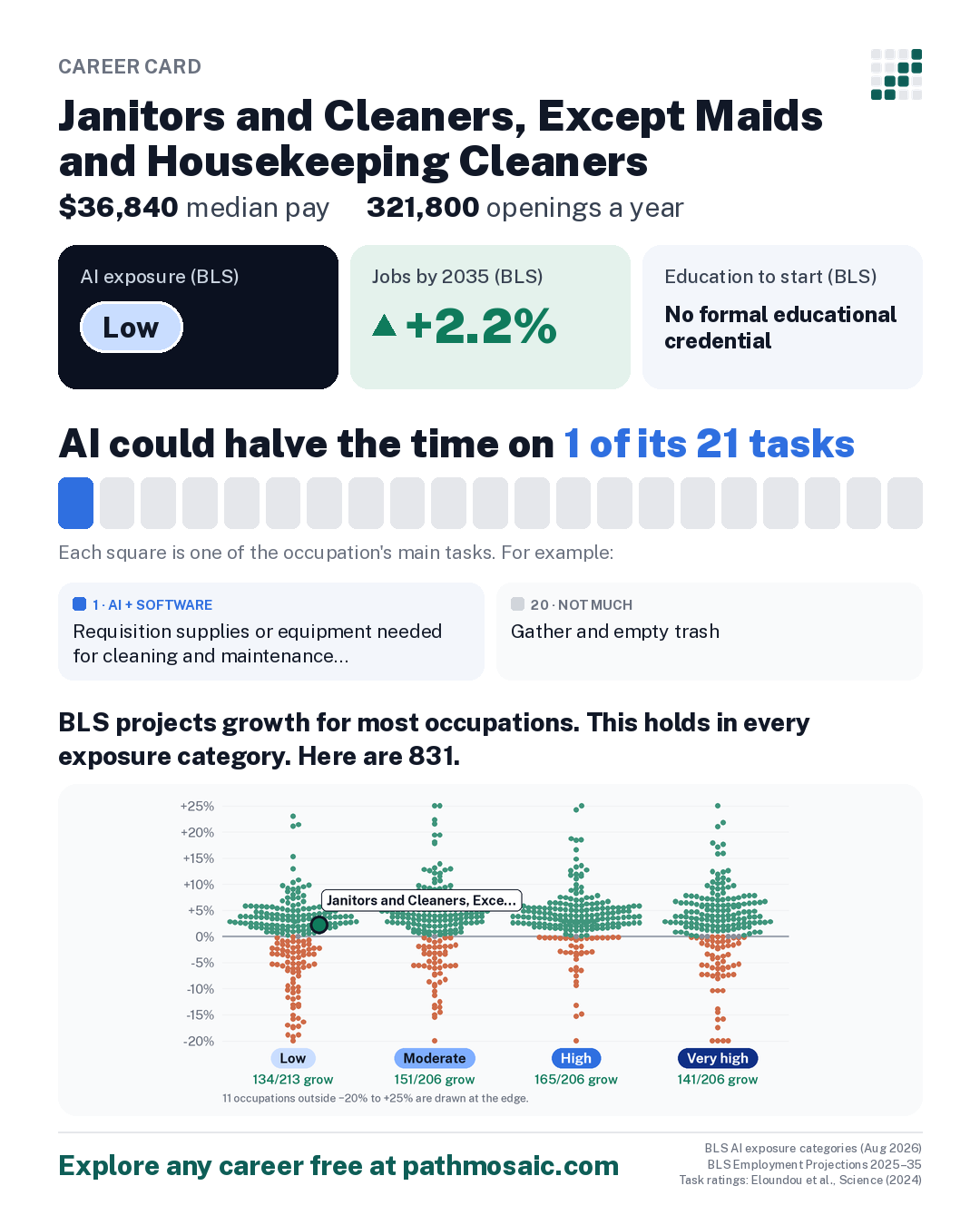
What the data says: AI could halve the time on 1 of its 21 tasks, and jobs are projected to grow 2.2% by 2035. How to think about this →
About this projection
BLS builds AI into its projections where the research supports it: “BLS generally applies adjustments based on this research conservatively, where there is convincing evidence for a change.”
It also notes a limit: “BLS projection methods are not designed to capture extremely rapid technological change.”
On its AI exposure groups, BLS says exposure “does not imply job loss.”
Recent conditions
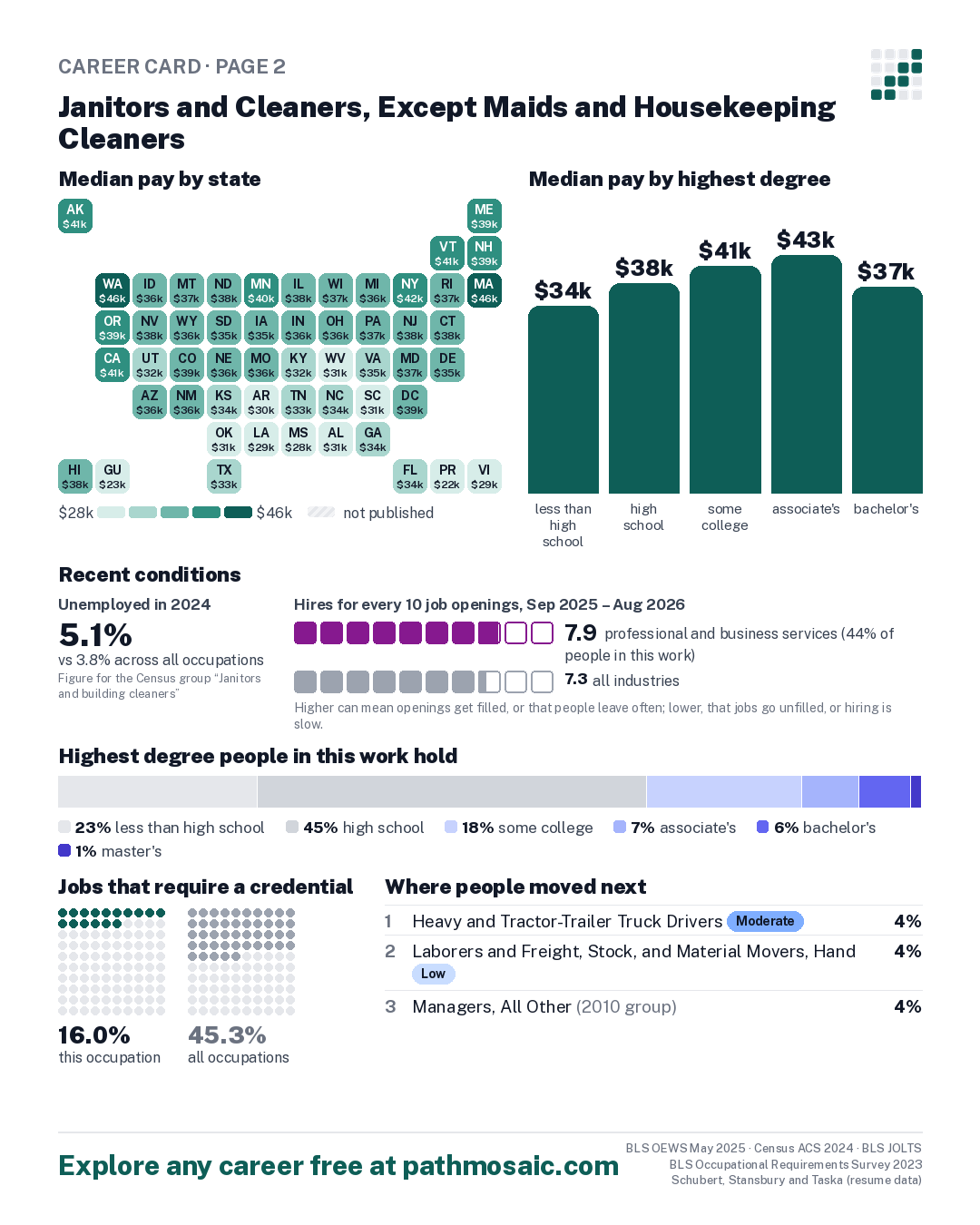
- In 2024, 5.1% of people in this work were unemployed, against 3.8% across all occupations Census ACS 2024, all workers in the Census group “Janitors and building cleaners”
- From Sep 2025 to Aug 2026, 7.9 hires for every 10 job openings in professional and business services, which employs about 44% of people in this work, against 7.3 across all industries BLS JOLTS
One box per opening, filled for each hire; hires beyond the openings are added in a lighter shade. Higher can mean openings get filled, or that people leave often; lower, that jobs go unfilled, or hiring is slow.7.9 this industry7.3 all industries
Median pay by state BLS OEWS May 2025, state estimates
Tap a state for its figures.
Median pay in every state
| State | Median | Middle half earn | Jobs |
|---|---|---|---|
| Alabama | $30,620 | $28,020 to $36,080 | 25,110 |
| Alaska | $40,510 | $35,610 to $47,760 | 5,200 |
| Arizona | $36,220 | $34,340 to $39,460 | 38,290 |
| Arkansas | $29,750 | $27,470 to $34,940 | 19,490 |
| California | $41,090 | $36,830 to $48,250 | 234,240 |
| Colorado | $38,600 | $36,880 to $46,000 | 34,220 |
| Connecticut | $37,960 | $35,470 to $47,150 | 28,740 |
| Delaware | $35,320 | $31,300 to $41,690 | 9,220 |
| District of Columbia | $38,520 | $37,840 to $41,720 | 16,400 |
| Florida | $34,490 | $30,060 to $37,140 | 131,900 |
| Georgia | $34,310 | $29,270 to $37,470 | 55,660 |
| Guam | $22,710 | $21,840 to $26,920 | 720 |
| Hawaii | $37,710 | $31,080 to $46,810 | 11,230 |
| Idaho | $36,110 | $32,240 to $39,520 | 10,800 |
| Illinois | $37,810 | $35,660 to $45,410 | 93,760 |
| Indiana | $36,460 | $30,750 to $40,920 | 49,220 |
| Iowa | $35,380 | $30,280 to $41,570 | 23,960 |
| Kansas | $34,480 | $30,030 to $37,460 | 17,220 |
| Kentucky | $32,320 | $29,220 to $37,810 | 25,750 |
| Louisiana | $28,930 | $23,510 to $34,510 | 27,610 |
| Maine | $38,940 | $36,300 to $45,600 | 9,180 |
| Maryland | $36,620 | $34,580 to $42,870 | 40,390 |
| Massachusetts | $45,580 | $37,560 to $49,720 | 55,490 |
| Michigan | $36,050 | $31,200 to $39,040 | 65,790 |
| Minnesota | $39,610 | $36,040 to $46,330 | 42,300 |
| Mississippi | $28,380 | $23,730 to $33,990 | 15,940 |
| Missouri | $35,900 | $31,110 to $39,270 | 41,070 |
| Montana | $37,110 | $33,730 to $44,050 | 8,320 |
| Nebraska | $35,900 | $31,200 to $42,240 | 12,860 |
| Nevada | $38,420 | $31,450 to $48,070 | 32,830 |
| New Hampshire | $39,150 | $35,310 to $47,120 | 9,420 |
| New Jersey | $37,630 | $35,200 to $44,310 | 67,660 |
| New Mexico | $36,020 | $30,970 to $38,480 | 14,360 |
| New York | $41,640 | $36,360 to $50,100 | 195,250 |
| North Carolina | $34,500 | $29,240 to $37,230 | 53,330 |
| North Dakota | $37,750 | $35,470 to $46,200 | 6,720 |
| Ohio | $35,900 | $30,790 to $42,760 | 72,540 |
| Oklahoma | $31,110 | $28,180 to $35,770 | 23,620 |
| Oregon | $39,340 | $36,080 to $46,650 | 25,890 |
| Pennsylvania | $36,520 | $31,070 to $43,140 | 86,920 |
| Puerto Rico | $21,890 | $21,840 to $23,460 | 29,030 |
| Rhode Island | $37,310 | $33,240 to $46,240 | 7,270 |
| South Carolina | $31,180 | $28,070 to $36,840 | 30,100 |
| South Dakota | $35,480 | $31,260 to $39,130 | 8,630 |
| Tennessee | $33,440 | $29,580 to $37,280 | 38,120 |
| Texas | $33,010 | $27,740 to $37,930 | 184,840 |
| Utah | $32,200 | $28,440 to $37,820 | 24,710 |
| Vermont | $40,910 | $37,050 to $46,500 | 5,130 |
| Virgin Islands | $29,000 | $26,480 to $29,940 | 680 |
| Virginia | $35,170 | $30,020 to $38,730 | 65,970 |
| Washington | $45,520 | $39,020 to $53,920 | 47,380 |
| West Virginia | $30,980 | $27,800 to $37,670 | 9,340 |
| Wisconsin | $37,000 | $34,370 to $44,080 | 45,640 |
| Wyoming | $36,050 | $32,420 to $43,590 | 4,760 |
Nationally: $36,840. Shades run from the lowest state median to the highest; a territory below that range takes the lightest. How to read this
How AI touches the work
What AI could speed up, task by task, and where people already use it.
AI could halve the time on 1 of its 21 tasks
| AI rating | Its main tasks | Share of Claude conversations May 2026 |
|---|---|---|
| Not much | Notify managers concerning the need for major repairs or additions to building operating systems. | Not published |
| Not much | Gather and empty trash. | Not published |
| Not much | Service, clean, or supply restrooms. | Not published |
| Not much | Clean building floors by sweeping, mopping, scrubbing, or vacuuming. | Not published |
| Not much | Follow procedures for the use of chemical cleaners and power equipment to prevent damage to floors and fixtures. | Not published |
| AI + software | Requisition supplies or equipment needed for cleaning and maintenance duties. | Not published |
See all 21 tasks
| Not much | Dust furniture, walls, machines, or equipment. | Not published |
| Not much | Monitor building security and safety by performing tasks such as locking doors after operating hours or checking electrical appliance use to ensure that hazards are not created. | Not published |
| Not much | Mix water and detergents or acids in containers to prepare cleaning solutions, according to specifications. | Not published |
| Not much | Clean windows, glass partitions, or mirrors, using soapy water or other cleaners, sponges, or squeegees. | Not published |
| Not much | Move heavy furniture, equipment, or supplies, either manually or with hand trucks. | Not published |
| Not much | Strip, seal, finish, and polish floors. | Not published |
| Not much | Clean and polish furniture and fixtures. | Not published |
| Not much | Set up, arrange, or remove decorations, tables, chairs, ladders, or scaffolding to prepare facilities for events, such as banquets or meetings. | Not published |
| Not much | Remove snow from sidewalks, driveways, or parking areas, using snowplows, snow blowers, or snow shovels, or spread snow-melting chemicals. | Not published |
| Not much | Make adjustments or minor repairs to heating, cooling, ventilating, plumbing, or electrical systems. | Not published |
| Not much | Drive vans, industrial trucks, or other vehicles required to travel to, or to perform, cleaning work. | Not published |
| Not much | Steam-clean or shampoo carpets. | Not published |
| Not much | Spray insecticides or fumigants to prevent insect or rodent infestation. | Not published |
| Not much | Clean chimneys, flues, and connecting pipes, using power or hand tools. | Not published |
| Not much | Mow or trim lawns or shrubbery, using mowers or hand or power trimmers, and clear debris from grounds. | Not published |
Ordered by how important O*NET's respondents rate each task (1 to 5) times the share who say it is part of their job. The ordering is ours. 0 of the 21 have a published share of Claude conversations; “not published” means too few conversations for Anthropic to publish a figure.
Where people already use AI
The tasks above say what AI could speed up. This shows what people are using it for. Its 21 tasks fall under 13 work activities that many occupations share, and Microsoft counted how often each one came up in 200,000 conversations with its Copilot assistant in 2024.
- #38 Select materials or equipment for operations or projects
| Work activity | This occupation's tasks under it | People asked AI for help in 10,000 conversations |
AI did it for them in 10,000 conversations |
|---|---|---|---|
| Clean tools, equipment, facilities, or work areas | |||
| Prepare mixtures or solutions | |||
| Dispose of waste or debris | |||
| Operate transportation equipment or vehicles | |||
| Move materials, equipment, or supplies | |||
| Select materials or equipment for operations or projects | |||
| Communicate with others about operational plans or activities | |||
| Arrange displays or decorations |
Show all 13 activities
| Maintain tools or equipment | |||
| Apply protective solutions or coatings | |||
| Monitor safety or security of work areas, facilities, or properties | |||
| Cut trees or other vegetation | |||
| Operate agricultural or forestry equipment |
How to read this
Work activities come from O*NET, which links every task to the broader activities it involves. Microsoft's figures are for the activity across everyone who used Copilot, not for janitors and cleaners, except maids and housekeeping cleaners specifically. Copilot is a general chat assistant; dedicated coding tools are not included, so programming help is under-counted here. Activities are listed by how many of this occupation's tasks fall under them.
The task ratings say whether AI could halve the time a task takes: on its own (“AI alone”), or with software built on it (“AI + software”). They were made by people in 2023 (Eloundou et al.). Claude's share is the task's share of all Claude.ai conversations in May 2026; Anthropic doesn't publish a task with too few conversations. None of these add up to the BLS exposure group, which combines five research measures.
More in the Guide: task ratings · task order · work activities · Copilot figures · Claude
High exposure doesn't mean fewer jobs
BLS projects most occupations in its two most exposed groups to grow: 141 of 206 rated Very high and 165 of 206 rated High. Each dot is one of the 831 occupations BLS rates.
Career moves into and out of this occupation
From moves between occupations found in online resumes, 2002–2016. Career changes only: a first job after school isn't a move.
Where people moved next
of 112,437 moves out
- 1 Heavy and Tractor-Trailer Truck Drivers Moderate +3.8% 4%
- 2 Laborers and Freight, Stock, and Material Movers, Hand Low +1.8% 4%
- 3 Managers, All Other (2010 group) an older group BLS has since split; no exposure group today 4%
- 4 Customer Service Representatives Very high -5.3% 3%
- 5 Security Guards Moderate +0.9% 3%
Where people moved in from
of 106,309 moves in
- 1 Laborers and Freight, Stock, and Material Movers, Hand Low +1.8% 6%
- 2 Cashiers High -6.5% 5%
- 3 Customer Service Representatives Very high -5.3% 4%
- 4 Retail Salespersons Very high -0.3% 3%
- 5 Fast Food and Counter Workers Moderate +5.8% 3%
Resumes over-represent younger, white-collar job-seekers and moves into management. Schubert, Stansbury and Taska (resume data).
Education and training for the occupation
O*NET survey of workers in this occupation
- 14% less than high school
- 1% post-doctoral training
- 86% not published
O*NET marks 86% of the answers as too uncertain to publish, so the parts shown don't add up to 100%.
O*NET 31.0 survey of workers in this occupation · 17 people answered.
Census survey (American Community Survey)
- 23% less than high school
- 45% high school
- 18% some college
- 7% associate's
- 6% bachelor's
- 1% master's
Census ACS 2024, all workers in the Census group “Janitors and building cleaners” · 24,021 people surveyed.
Why the two can differ
O*NET asks about 20 people in each occupation, which makes its shares uncertain, but it reports the exact occupation and counts certificates. The Census survey reaches thousands, but it groups some occupations together and counts degrees only. More in the Guide
Median pay by highest degree full-time, year-round · Census ACS 2024, all workers in the Census group “Janitors and building cleaners”
Jobs that require a credential BLS Occupational Requirements Survey 2023
16.0% this occupation
45.3% all occupations
| By kind | This occupation | All occupations |
|---|---|---|
| a license | <0.5% | 19.1% |
| a certification | <0.5% | 5.8% |
| an educational certificate | 0.7% | 2.8% |
Share of jobs whose employer requires it. BLS doesn't say which credential. How to read this
Look up certifications, training and licenses U.S. Department of Labor
- Certification Finder ↗ certifications CareerOneStop lists for this occupation
- Training Finder ↗ schools and programs, nationwide; narrow the place there
- License Finder ↗ licenses by state
- Apprenticeship Finder ↗ DOL lists 4 registered apprenticeships in this occupation. Apprenticeship.gov can't be linked to one occupation, so search for “Janitors and Cleaners, Except Maids and Housekeeping Cleaners” there.
These open in a new tab and send only the occupation's public code. More in the Guide
BLS AI exposure categories (Aug 2026) · BLS Employment Projections 2025–35 · O*NET 31.0 · Task ratings: Eloundou et al., Science (2024) · Microsoft "Working with AI" v1.1 · Anthropic Economic Index (2026-06-26) · Schubert, Stansbury and Taska · NCES CIP–SOC · Census ACS 2024 · BLS JOLTS
See it online, and explore any career: https://www.pathmosaic.com/card/37-2011.00