Chemistry Teachers, Postsecondary
Also called: Assistant Professor, Chemistry Instructor, Chemistry Professor, ProfessorTeach courses pertaining to the chemical and physical properties and compositional changes of substances. Work may include providing instruction in the methods of qualitative and quantitative chemical analysis. Includes both teachers primarily engaged in teaching, and those who do a combination of teaching and research.
On a phone, press and hold a picture to save it to Photos.
opens your phone's share sheet, where you can save both to Photos
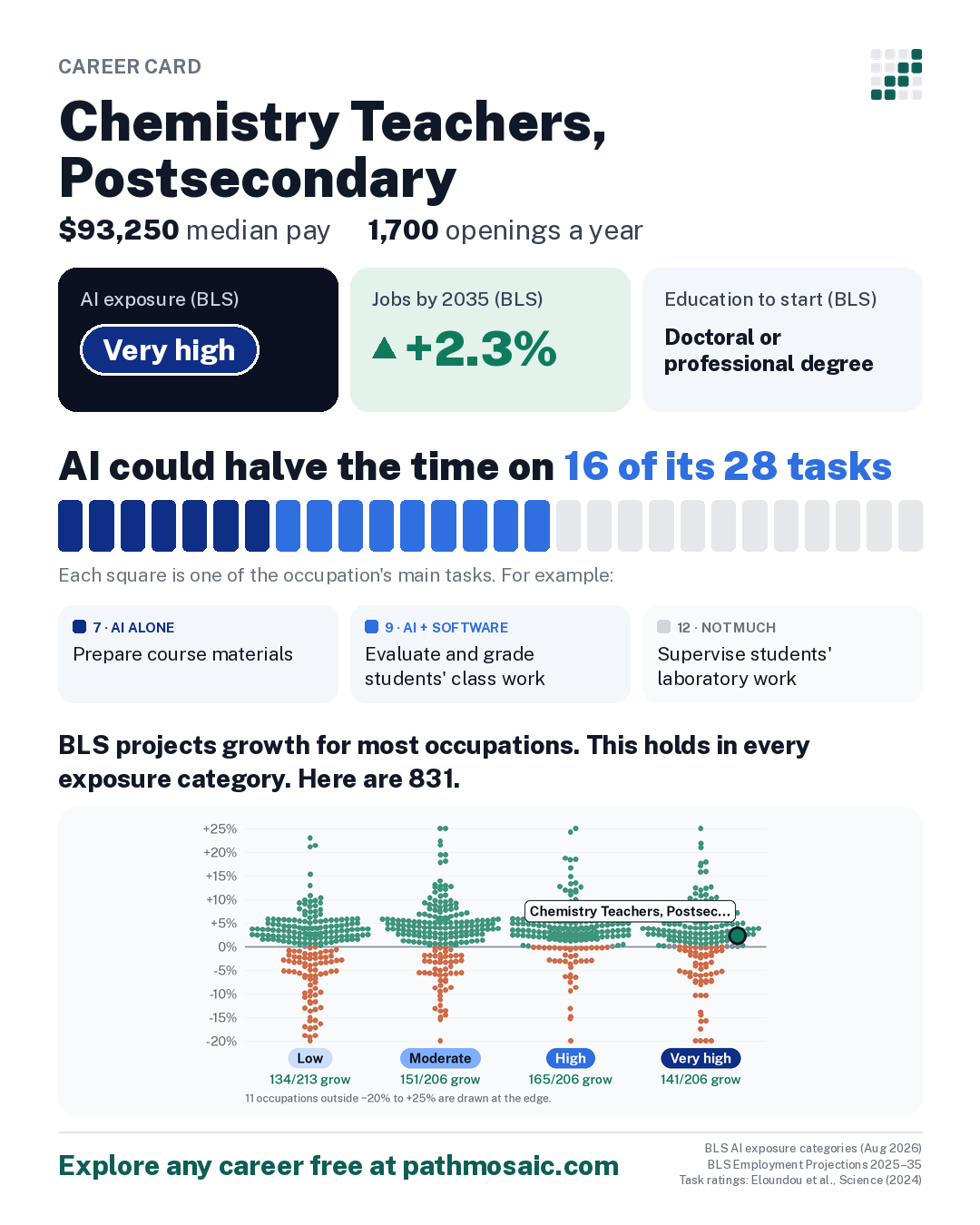
What the data says: AI could halve the time on 16 of its 28 tasks, yet jobs are projected to grow 2.3% by 2035. In the most exposed occupations, the squeeze shows up first among early-career workers. How to think about this →
About this projection
BLS builds AI into its projections where the research supports it: “BLS generally applies adjustments based on this research conservatively, where there is convincing evidence for a change.”
It also notes a limit: “BLS projection methods are not designed to capture extremely rapid technological change.”
On its AI exposure groups, BLS says exposure “does not imply job loss.”
Recent conditions
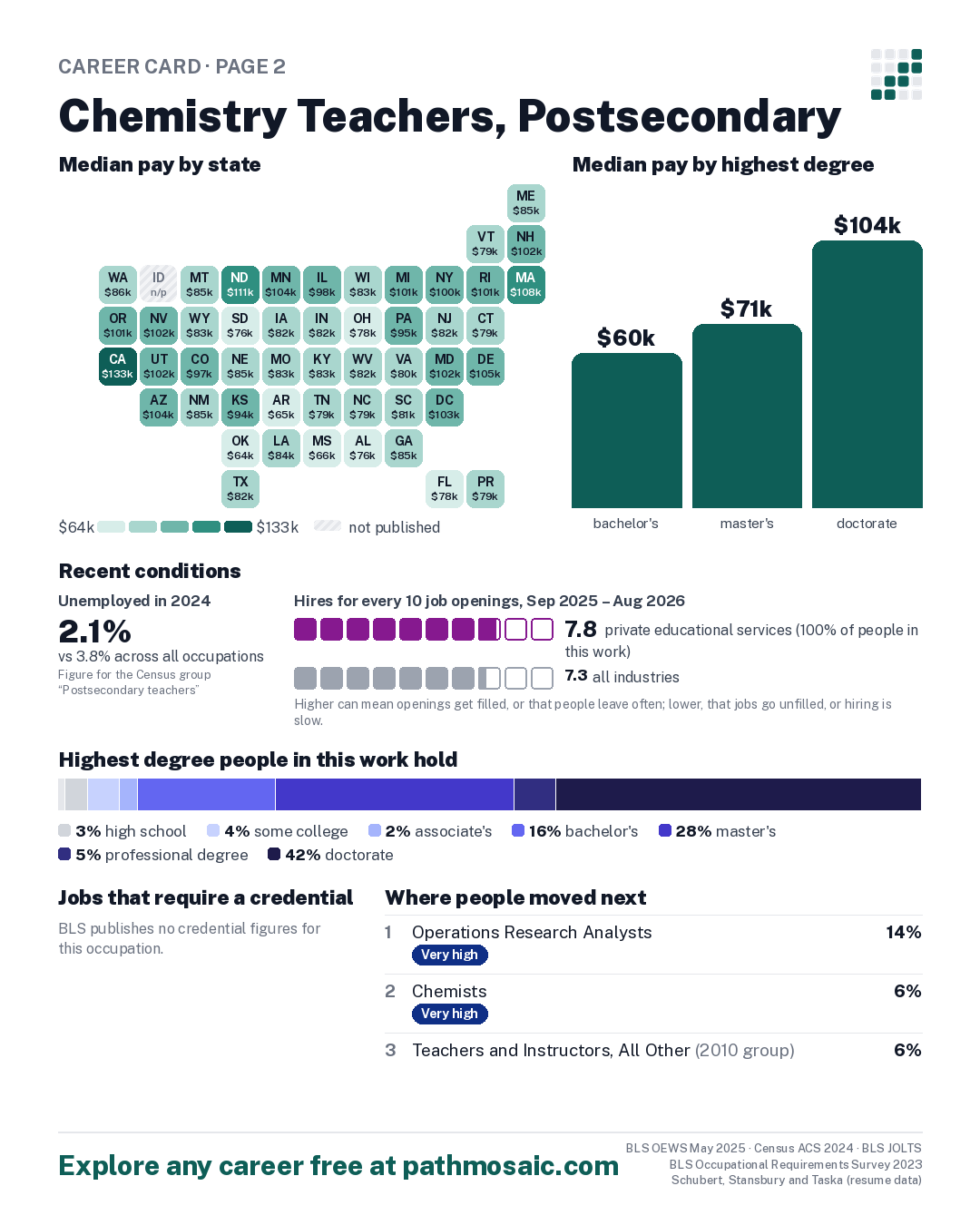
- In 2024, 2.1% of people in this work were unemployed, against 3.8% across all occupations Census ACS 2024, all workers in the Census group “Postsecondary teachers”
- From Sep 2025 to Aug 2026, 7.8 hires for every 10 job openings in private educational services, which employs about 100% of people in this work, against 7.3 across all industries BLS JOLTS
One box per opening, filled for each hire; hires beyond the openings are added in a lighter shade. Higher can mean openings get filled, or that people leave often; lower, that jobs go unfilled, or hiring is slow.7.8 this industry7.3 all industries
Median pay by state BLS OEWS May 2025, state estimates
Tap a state for its figures.
Median pay in every state
| State | Median | Middle half earn | Jobs |
|---|---|---|---|
| Alabama | $76,430 | $63,450 to $100,110 | 310 |
| Arizona | $103,790 | $76,540 to $133,170 | 210 |
| Arkansas | $64,720 | $62,880 to $75,890 | 110 |
| California | $132,960 | $102,980 to $188,810 | 1,650 |
| Colorado | $96,600 | $69,200 to $110,570 | 330 |
| Connecticut | $78,820 | $70,860 to $109,450 | 350 |
| Delaware | $104,610 | $96,400 to $159,290 | 80 |
| District of Columbia | $103,370 | $81,340 to $132,350 | 100 |
| Florida | $77,630 | $62,750 to $82,290 | 340 |
| Georgia | $85,300 | $65,530 to $119,830 | 500 |
| Idaho | not published | not published | 60 |
| Illinois | $97,860 | $63,490 to $125,550 | 880 |
| Indiana | $81,530 | $63,250 to $103,460 | 530 |
| Iowa | $82,050 | $64,100 to $127,200 | 230 |
| Kansas | $93,830 | $75,070 to $135,240 | 170 |
| Kentucky | $82,550 | $62,710 to $130,020 | 250 |
| Louisiana | $83,680 | $72,330 to $115,880 | 140 |
| Maine | $85,250 | $61,450 to $121,990 | 70 |
| Maryland | $101,530 | $80,680 to $133,140 | 310 |
| Massachusetts | $108,270 | $80,930 to $168,200 | 820 |
| Michigan | $101,030 | $74,600 to $129,080 | 560 |
| Minnesota | $104,380 | $81,030 to $168,240 | 430 |
| Mississippi | $66,420 | $51,970 to $93,000 | 130 |
| Missouri | $83,000 | $62,100 to $123,830 | 460 |
| Montana | $84,680 | $66,640 to $128,370 | 80 |
| Nebraska | $85,050 | $74,630 to $97,590 | 150 |
| Nevada | $101,640 | $83,670 to $125,750 | 60 |
| New Hampshire | $102,220 | $83,300 to $127,680 | 70 |
| New Jersey | $81,600 | $62,430 to $111,000 | 750 |
| New Mexico | $85,240 | $67,120 to $101,310 | 80 |
| New York | $99,880 | $76,800 to $129,880 | 1,840 |
| North Carolina | $78,620 | $62,050 to $103,790 | 900 |
| North Dakota | $111,020 | $77,800 to $132,990 | 60 |
| Ohio | $77,910 | $62,210 to $102,030 | 700 |
| Oklahoma | $64,450 | $49,180 to $101,940 | 220 |
| Oregon | $101,350 | $82,650 to $130,580 | 460 |
| Pennsylvania | $95,070 | $73,730 to $103,640 | 1,270 |
| Puerto Rico | $78,640 | $71,910 to $94,730 | 210 |
| Rhode Island | $100,920 | $66,830 to $132,530 | 110 |
| South Carolina | $81,200 | $64,250 to $105,600 | 270 |
| South Dakota | $75,810 | $61,960 to $102,500 | 70 |
| Tennessee | $79,150 | $65,130 to $111,490 | 370 |
| Texas | $81,810 | $62,640 to $105,820 | 1,470 |
| Utah | $102,110 | $76,680 to $127,180 | 200 |
| Vermont | $78,560 | $63,470 to $93,690 | 90 |
| Virginia | $80,330 | $62,660 to $106,500 | 760 |
| Washington | $85,970 | $74,110 to $101,620 | 390 |
| West Virginia | $81,830 | $64,150 to $103,280 | 90 |
| Wisconsin | $83,480 | $76,850 to $108,120 | 450 |
| Wyoming | $82,830 | $75,070 to $101,300 | 30 |
Nationally: $93,250. Shades run from the lowest state median to the highest; a territory below that range takes the lightest. How to read this
How AI touches the work
What AI could speed up, task by task, and where people already use it.
AI could halve the time on 16 of its 28 tasks
| AI rating | Its main tasks | Share of Claude conversations May 2026 |
|---|---|---|
| Not much | Prepare and deliver lectures to undergraduate or graduate students on topics such as organic chemistry, analytical chemistry, and chemical separation. | under 0.01% |
| AI + software | Evaluate and grade students' class work, laboratory performance, assignments, and papers. | Not published |
| Not much | Supervise students' laboratory work. | Not published |
| Not much | Establish, teach, and monitor students' compliance with safety rules for handling chemicals, equipment, and other hazardous materials. | Not published |
| AI alone | Prepare course materials, such as syllabi, homework assignments, and handouts. | Not published |
| AI + software | Maintain student attendance records, grades, and other required records. | Not published |
See all 28 tasks
| AI + software | Plan, evaluate, and revise curricula, course content, and course materials and methods of instruction. | Not published |
| AI + software | Compile, administer, and grade examinations, or assign this work to others. | Not published |
| AI + software | Maintain regularly scheduled office hours to advise and assist students. | Not published |
| Not much | Initiate, facilitate, and moderate classroom discussions. | Not published |
| Not much | Keep abreast of developments in the field by reading current literature, talking with colleagues, and participating in professional conferences. | Not published |
| Not much | Supervise undergraduate or graduate teaching, internship, and research work. | Not published |
| AI + software | Advise students on academic and vocational curricula and on career issues. | Not published |
| AI alone | Conduct research in a particular field of knowledge and publish findings in professional journals, books, or electronic media. | Not published |
| AI alone | Write letters of recommendation for students. | Not published |
| AI + software | Collaborate with colleagues to address teaching and research issues. | Not published |
| AI + software | Select, order, and maintain materials and supplies for teaching and research, such as textbooks, chemicals, and laboratory equipment. | Not published |
| Not much | Serve on academic or administrative committees that deal with institutional policies, departmental matters, and academic issues. | Not published |
| AI alone | Write grant proposals to procure external research funding. | Not published |
| AI alone | Prepare and submit required reports related to instruction. | Not published |
| Not much | Serve on committees or in professional societies. | Not published |
| Not much | Participate in campus and community events. | Not published |
| Not much | Clean laboratory facilities. | Not published |
| Not much | Participate in student recruitment, registration, and placement activities. | Not published |
| AI alone | Compile bibliographies of specialized materials for outside reading assignments. | Not published |
| AI + software | Perform administrative duties, such as serving as a department head. | Not published |
| Not much | Act as advisers to student organizations. | Not published |
| AI alone | Provide professional consulting services to government or industry. | Not published |
Ordered by how important O*NET's respondents rate each task (1 to 5) times the share who say it is part of their job. The ordering is ours. 1 of the 28 have a published share of Claude conversations; “not published” means too few conversations for Anthropic to publish a figure.
Where people already use AI
The tasks above say what AI could speed up. This shows what people are using it for. Its 28 tasks fall under 26 work activities that many occupations share, and Microsoft counted how often each one came up in 200,000 conversations with its Copilot assistant in 2024.
- #4 Maintain current knowledge in area of expertise
- #10 Write material for artistic or commercial purposes
- #20 Present research or technical information
- and 5 more, in the table below
| Work activity | This occupation's tasks under it | People asked AI for help in 10,000 conversations |
AI did it for them in 10,000 conversations |
|---|---|---|---|
| Advise others on educational or vocational matters | |||
| Maintain current knowledge in area of expertise | |||
| Assess student capabilities, needs, or performance | |||
| Teach academic or vocational subjects | |||
| Supervise personnel activities | |||
| Serve on organizational committees | |||
| Write material for artistic or commercial purposes | |||
| Present research or technical information |
Show all 26 activities
| Prepare informational or instructional materials | |||
| Perform administrative or clerical activities | |||
| Compile records, documentation, or other data | |||
| Purchase goods or services | |||
| Select materials or equipment for operations or projects | |||
| Evaluate programs, practices, or processes | |||
| Promote products, services, or programs | |||
| Monitor individual behavior or performance | |||
| Plan events or programs | |||
| Prepare reports of operational or procedural activities | |||
| Clean tools, equipment, facilities, or work areas | |||
| Maintain operational records | |||
| Develop educational programs, plans, or procedures | |||
| Direct organizational operations, activities, or procedures | |||
| Prepare proposals or grant applications | |||
| Train others to use equipment or products | |||
| Develop safety standards, policies, or procedures | |||
| Replenish inventories of materials, equipment, or products |
How people in this work use Claude
What people in this work made with Claude % of conversations
- An explanation or answer28%
- Teaching material18%
- Advice or a recommendation12%
- A document or report11%
- A plan or strategy8%
How they worked with Claude
14% of these conversations were about work. Anthropic Economic Index, May 2026.
How to read this
Work activities come from O*NET, which links every task to the broader activities it involves. Microsoft's figures are for the activity across everyone who used Copilot, not for chemistry teachers, postsecondary specifically. Copilot is a general chat assistant; dedicated coding tools are not included, so programming help is under-counted here. Activities are listed by how many of this occupation's tasks fall under them.
The task ratings say whether AI could halve the time a task takes: on its own (“AI alone”), or with software built on it (“AI + software”). They were made by people in 2023 (Eloundou et al.). Claude's share is the task's share of all Claude.ai conversations in May 2026; Anthropic doesn't publish a task with too few conversations. None of these add up to the BLS exposure group, which combines five research measures.
More in the Guide: task ratings · task order · work activities · Copilot figures · Claude
High exposure doesn't mean fewer jobs
BLS projects most occupations in its two most exposed groups to grow: 141 of 206 rated Very high and 165 of 206 rated High. Each dot is one of the 831 occupations BLS rates.
Career moves into and out of this occupation
From moves between occupations found in online resumes, 2002–2016. Career changes only: a first job after school isn't a move.
Where people moved next
of 3,215 moves out
- 1 Operations Research Analysts Very high +11.9% 14%
- 2 Chemists Very high +6.4% 6%
- 3 Teachers and Instructors, All Other (2010 group) an older group BLS has since split; no exposure group today 6%
- 4 Postsecondary Teachers, All Other Very high +2.0% 6%
- 5 Management Analysts Very high +10.1% 4%
Where people moved in from
of 5,230 moves in
- 1 Operations Research Analysts Very high +11.9% 17%
- 2 Teachers and Instructors, All Other (2010 group) an older group BLS has since split; no exposure group today 6%
- 3 Chemists Very high +6.4% 5%
- 4 Managers, All Other (2010 group) an older group BLS has since split; no exposure group today 5%
- 5 Postsecondary Teachers, All Other Very high +2.0% 4%
Resumes over-represent younger, white-collar job-seekers and moves into management. Schubert, Stansbury and Taska (resume data).
Education and training for the occupation
O*NET survey of workers in this occupation
- 2% bachelor's
- 6% post-bachelor's certificate
- 35% master's
- 25% research doctorate
- 31% post-doctoral training
O*NET 31.0 survey of workers in this occupation · 34 people answered.
Census survey (American Community Survey)
- 1% less than high school
- 3% high school
- 4% some college
- 2% associate's
- 16% bachelor's
- 28% master's
- 5% professional degree
- 42% doctorate
Census ACS 2024, all workers in the Census group “Postsecondary teachers” · 15,280 people surveyed.
Why the two can differ
O*NET asks about 20 people in each occupation, which makes its shares uncertain, but it reports the exact occupation and counts certificates. The Census survey reaches thousands, but it groups some occupations together and counts degrees only. More in the Guide
Median pay by highest degree full-time, year-round · Census ACS 2024, all workers in the Census group “Postsecondary teachers”
17 programs, such as Science Teacher Education/General Science Teacher Education, Chemistry Teacher Education and Chemistry, General.
See all
- Science Teacher Education/General Science Teacher Education
- Chemistry Teacher Education
- Chemistry, General
- Analytical Chemistry
- Inorganic Chemistry
- Organic Chemistry
- Physical Chemistry
- Polymer Chemistry
- Chemical Physics
- Environmental Chemistry
- Forensic Chemistry
- Theoretical Chemistry
- Cheminformatics/Chemistry Informatics
- Chemistry, Other
- Geochemistry
- Materials Chemistry
- Medicinal and Pharmaceutical Chemistry
Jobs that require a credential BLS Occupational Requirements Survey 2023
BLS publishes no credential figures for this occupation.
Look up certifications, training and licenses U.S. Department of Labor
- Certification Finder ↗ certifications CareerOneStop lists for this occupation
- Training Finder ↗ schools and programs, nationwide; narrow the place there
- License Finder ↗ licenses by state
- Apprenticeships: DOL's list of apprenticeable occupations doesn't include this one.
These open in a new tab and send only the occupation's public code. More in the Guide
BLS AI exposure categories (Aug 2026) · BLS Employment Projections 2025–35 · O*NET 31.0 · Task ratings: Eloundou et al., Science (2024) · Microsoft "Working with AI" v1.1 · Anthropic Economic Index (2026-06-26) · Schubert, Stansbury and Taska · NCES CIP–SOC · Census ACS 2024 · BLS JOLTS · Brynjolfsson, Chandar and Chen, Stanford (Aug 2026)
See it online, and explore any career: https://www.pathmosaic.com/card/25-1052.00