Semiconductor Processing Technicians
Also called: Diffusion Operator, Manufacturing Technician (Manufacturing Tech), Process Technician (Process Tech), Wafer Fabrication OperatorPerform any or all of the following functions in the manufacture of electronic semiconductors: load semiconductor material into furnace; saw formed ingots into segments; load individual segment into crystal growing chamber and monitor controls; locate crystal axis in ingot using x-ray equipment and saw ingots into wafers; and clean, polish, and load wafers into series of special purpose furnaces, chemical baths, and equipment used to form circuitry and change conductive properties.
On a phone, press and hold a picture to save it to Photos.
opens your phone's share sheet, where you can save both to Photos
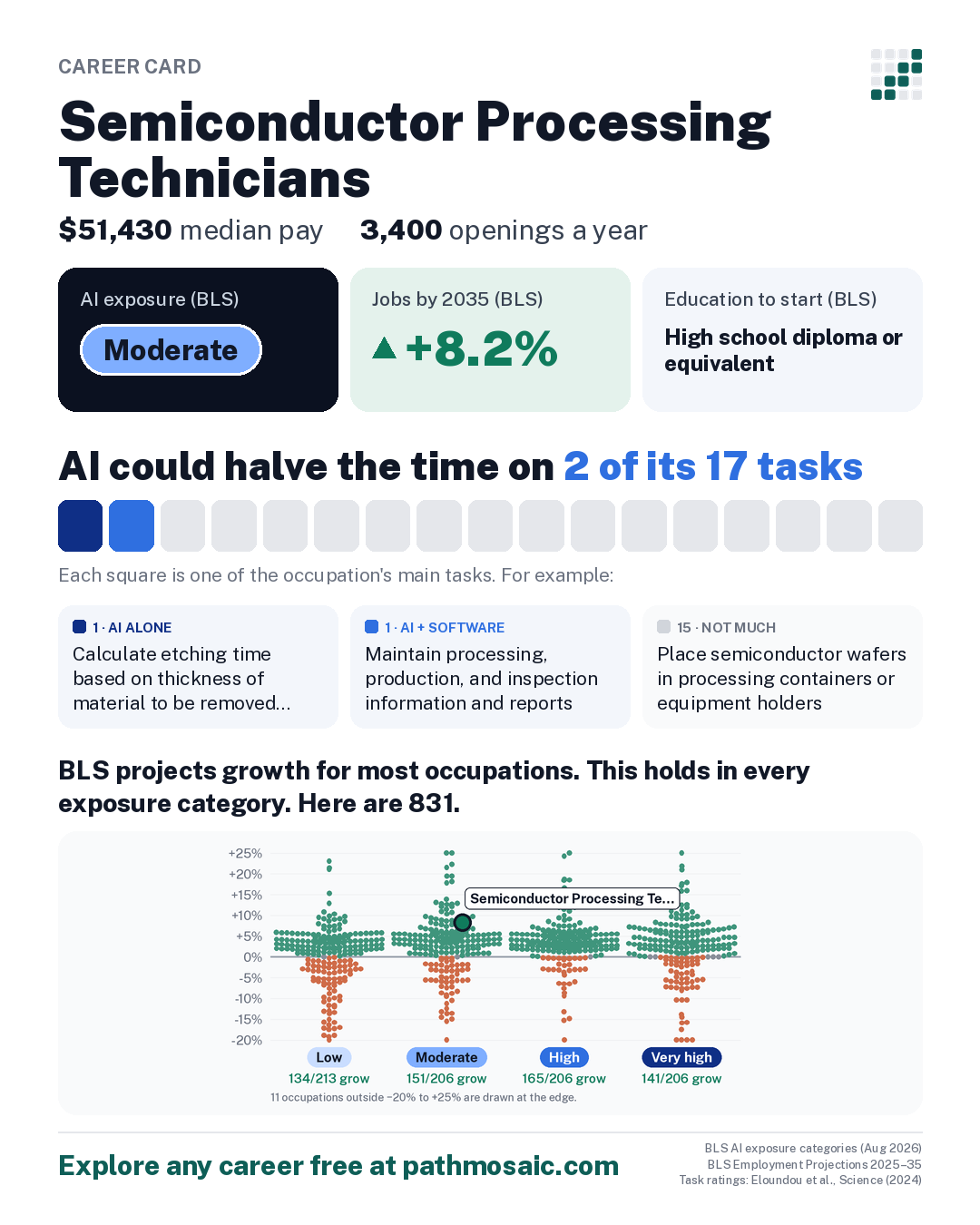
What the data says: AI could halve the time on 2 of its 17 tasks, and jobs are projected to grow 8.2% by 2035. How to think about this →
About this projection
BLS builds AI into its projections where the research supports it: “BLS generally applies adjustments based on this research conservatively, where there is convincing evidence for a change.”
It also notes a limit: “BLS projection methods are not designed to capture extremely rapid technological change.”
On its AI exposure groups, BLS says exposure “does not imply job loss.”
Recent conditions
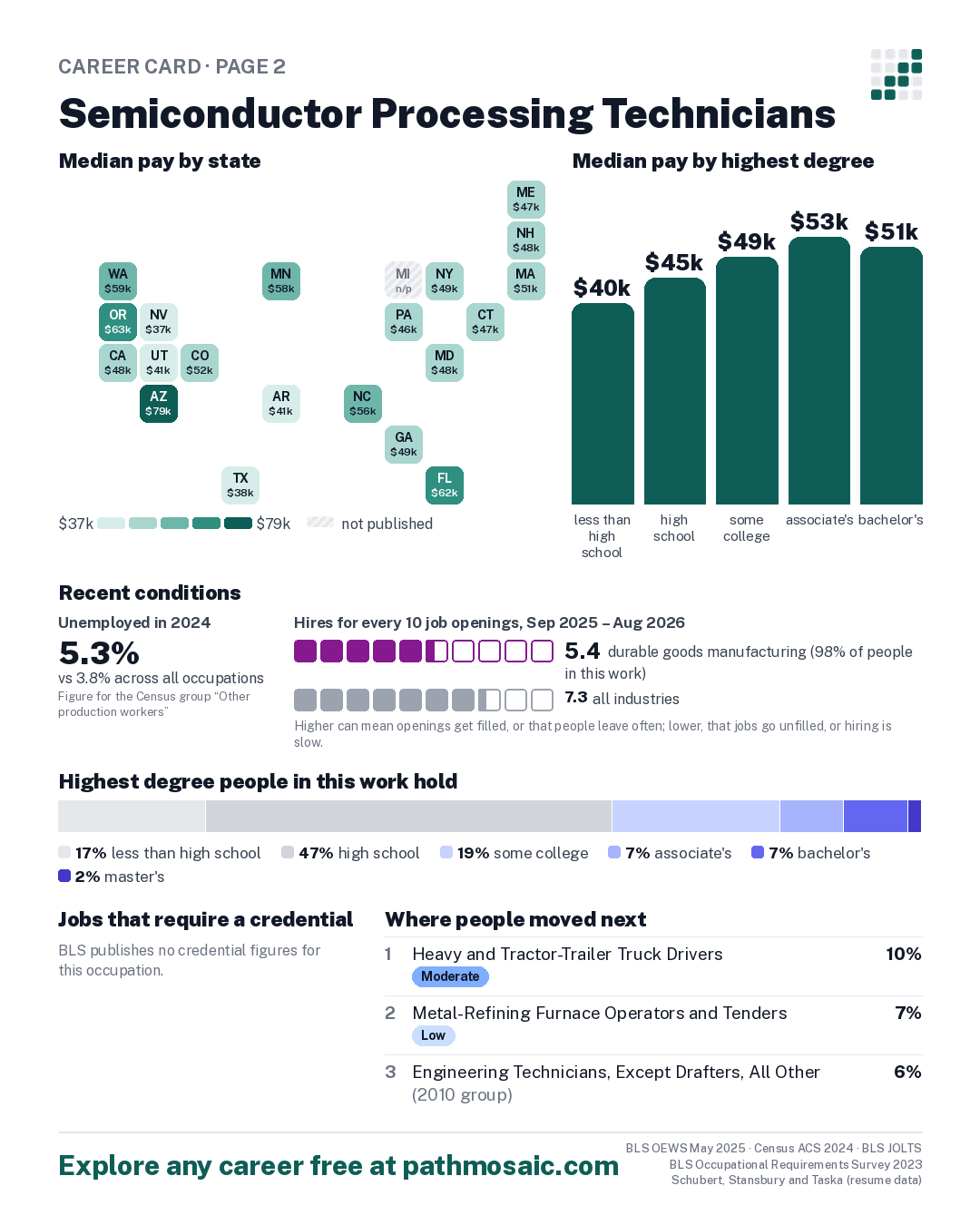
- In 2024, 5.3% of people in this work were unemployed, against 3.8% across all occupations Census ACS 2024, all workers in the Census group “Other production workers”
- From Sep 2025 to Aug 2026, 5.4 hires for every 10 job openings in durable goods manufacturing, which employs about 98% of people in this work, against 7.3 across all industries BLS JOLTS
One box per opening, filled for each hire; hires beyond the openings are added in a lighter shade. Higher can mean openings get filled, or that people leave often; lower, that jobs go unfilled, or hiring is slow.5.4 this industry7.3 all industries
Median pay by state BLS OEWS May 2025, state estimates
Tap a state for its figures.
Median pay in every state
| State | Median | Middle half earn | Jobs |
|---|---|---|---|
| Arizona | $78,940 | $51,190 to $80,670 | 2,270 |
| Arkansas | $40,610 | $36,500 to $48,120 | 40 |
| California | $48,030 | $46,020 to $55,640 | 4,650 |
| Colorado | $52,360 | $45,720 to $65,010 | 790 |
| Connecticut | $47,000 | $45,480 to $49,600 | 50 |
| Florida | $62,330 | $49,950 to $67,370 | 190 |
| Georgia | $48,580 | $44,080 to $48,580 | not published |
| Maine | $47,270 | $45,220 to $50,070 | 320 |
| Maryland | $47,610 | $47,610 to $60,770 | 120 |
| Massachusetts | $51,410 | $41,870 to $59,220 | 1,190 |
| Michigan | not published | not published | 270 |
| Minnesota | $57,780 | $49,420 to $57,810 | not published |
| Nevada | $37,290 | $36,060 to $38,480 | not published |
| New Hampshire | $47,710 | $46,790 to $63,170 | 130 |
| New York | $49,400 | $48,830 to $58,710 | 1,750 |
| North Carolina | $56,160 | $45,000 to $65,960 | 60 |
| Oregon | $63,330 | $59,040 to $80,450 | 6,620 |
| Pennsylvania | $46,430 | $40,360 to $58,700 | 340 |
| Texas | $38,440 | $37,020 to $46,000 | 6,110 |
| Utah | $40,760 | $40,620 to $48,770 | 120 |
| Washington | $58,710 | $51,030 to $62,810 | 990 |
Nationally: $51,430. Shades run from the lowest state median to the highest; a territory below that range takes the lightest. How to read this
How AI touches the work
What AI could speed up, task by task, and where people already use it.
AI could halve the time on 2 of its 17 tasks
| AI rating | Its main tasks | Share of Claude conversations May 2026 |
|---|---|---|
| AI + software | Maintain processing, production, and inspection information and reports. | Not published |
| Not much | Inspect materials, components, or products for surface defects and measure circuitry, using electronic test equipment, precision measuring instruments, microscope, and standard procedures. | Not published |
| Not much | Load and unload equipment chambers and transport finished product to storage or to area for further processing. | Not published |
| Not much | Place semiconductor wafers in processing containers or equipment holders, using vacuum wand or tweezers. | Not published |
| Not much | Study work orders, instructions, formulas, and processing charts to determine specifications and sequence of operations. | Not published |
| Not much | Inspect equipment for leaks, diagnose malfunctions, and request repairs. | Not published |
See all 17 tasks
| Not much | Clean semiconductor wafers using cleaning equipment, such as chemical baths, automatic wafer cleaners, or blow-off wands. | Not published |
| Not much | Manipulate valves, switches, and buttons, or key commands into control panels to start semiconductor processing cycles. O*NET flags this task's ratings as uncertain | Not published |
| Not much | Count, sort, and weigh processed items. | Not published |
| Not much | Clean and maintain equipment, including replacing etching and rinsing solutions and cleaning bath containers and work area. | Not published |
| Not much | Load semiconductor material into furnace. | Not published |
| Not much | Etch, lap, polish, or grind wafers or ingots to form circuitry and change conductive properties, using etching, lapping, polishing, or grinding equipment. | Not published |
| Not much | Align photo mask pattern on photoresist layer, expose pattern to ultraviolet light, and develop pattern, using specialized equipment. | Not published |
| Not much | Monitor operation and adjust controls of processing machines and equipment to produce compositions with specific electronic properties, using computer terminals. | Not published |
| Not much | Scribe or separate wafers into dice. O*NET flags this task's ratings as uncertain | Not published |
| Not much | Stamp, etch, or scribe identifying information on finished component according to specifications. | Not published |
| AI alone | Calculate etching time based on thickness of material to be removed from wafers or crystals. | Not published |
Ordered by how important O*NET's respondents rate each task (1 to 5) times the share who say it is part of their job. The ordering is ours. 0 of the 17 have a published share of Claude conversations; “not published” means too few conversations for Anthropic to publish a figure.
Where people already use AI
The tasks above say what AI could speed up. This shows what people are using it for. Its 17 tasks fall under 19 work activities that many occupations share, and Microsoft counted how often each one came up in 200,000 conversations with its Copilot assistant in 2024.
- #8 Read documents or materials to inform work processes
- #31 Program computer systems or production equipment
- #42 Diagnose system or equipment problems
| Work activity | This occupation's tasks under it | People asked AI for help in 10,000 conversations |
AI did it for them in 10,000 conversations |
|---|---|---|---|
| Assemble equipment or components | |||
| Measure physical characteristics of materials, products, or equipment | |||
| Clean workpieces, finished products, or other objects | |||
| Load products, materials, or equipment for transportation or further processing | |||
| Read documents or materials to inform work processes | |||
| Program computer systems or production equipment | |||
| Diagnose system or equipment problems | |||
| Determine resource needs of projects or operations |
Show all 19 activities
| Maintain tools or equipment | |||
| Sort materials or products | |||
| Inspect completed work or finished products | |||
| Maintain operational records | |||
| Notify others of emergencies or problems | |||
| Cut materials | |||
| Monitor equipment operation | |||
| Inspect commercial, industrial, or production systems or equipment | |||
| Move materials, equipment, or supplies | |||
| Position workpieces or materials on equipment | |||
| Engrave objects |
How to read this
Work activities come from O*NET, which links every task to the broader activities it involves. Microsoft's figures are for the activity across everyone who used Copilot, not for semiconductor processing technicians specifically. Copilot is a general chat assistant; dedicated coding tools are not included, so programming help is under-counted here. Activities are listed by how many of this occupation's tasks fall under them.
The task ratings say whether AI could halve the time a task takes: on its own (“AI alone”), or with software built on it (“AI + software”). They were made by people in 2023 (Eloundou et al.). Claude's share is the task's share of all Claude.ai conversations in May 2026; Anthropic doesn't publish a task with too few conversations. None of these add up to the BLS exposure group, which combines five research measures.
More in the Guide: task ratings · task order · work activities · Copilot figures · Claude
High exposure doesn't mean fewer jobs
BLS projects most occupations in its two most exposed groups to grow: 141 of 206 rated Very high and 165 of 206 rated High. Each dot is one of the 831 occupations BLS rates.
Career moves into and out of this occupation
From moves between occupations found in online resumes, 2002–2016. Career changes only: a first job after school isn't a move.
Where people moved next
of 1,685 moves out
- 1 Heavy and Tractor-Trailer Truck Drivers Moderate +3.8% 10%
- 2 Metal-Refining Furnace Operators and Tenders Low -2.9% 7%
- 3 Engineering Technicians, Except Drafters, All Other (2010 group) an older group BLS has since split; no exposure group today 6%
- 4 Managers, All Other (2010 group) an older group BLS has since split; no exposure group today 5%
- 5 Maintenance and Repair Workers, General Low +4.2% 4%
Where people moved in from
of 1,695 moves in
- 1 Heavy and Tractor-Trailer Truck Drivers Moderate +3.8% 5%
- 2 Metal-Refining Furnace Operators and Tenders Low -2.9% 4%
- 3 File Clerks Very high -15.8% 4%
- 4 Computer User Support Specialists Very high -3.5% 3%
- 5 Medical Transcriptionists High -4.4% 3%
Resumes over-represent younger, white-collar job-seekers and moves into management. Schubert, Stansbury and Taska (resume data).
Education and training for the occupation
O*NET survey of workers in this occupation
- 12% less than high school
- 84% high school
- 1% postsecondary certificate
- 2% associate's
O*NET 31.0 survey of workers in this occupation · 26 people answered.
Census survey (American Community Survey)
- 17% less than high school
- 47% high school
- 19% some college
- 7% associate's
- 7% bachelor's
- 2% master's
Census ACS 2024, all workers in the Census group “Other production workers” · 14,074 people surveyed.
Why the two can differ
O*NET asks about 20 people in each occupation, which makes its shares uncertain, but it reports the exact occupation and counts certificates. The Census survey reaches thousands, but it groups some occupations together and counts degrees only. More in the Guide
Median pay by highest degree full-time, year-round · Census ACS 2024, all workers in the Census group “Other production workers”
2 programs: Semiconductor Manufacturing Technology/Technician and Industrial Electronics Technology/Technician.
Jobs that require a credential BLS Occupational Requirements Survey 2023
BLS publishes no credential figures for this occupation.
Look up certifications, training and licenses U.S. Department of Labor
- Certification Finder ↗ certifications CareerOneStop lists for this occupation
- Training Finder ↗ schools and programs, nationwide; narrow the place there
- License Finder ↗ licenses by state
- Apprenticeship Finder ↗ DOL lists 1 registered apprenticeship in this occupation (Semiconductor Processing Technician (NOF)). Apprenticeship.gov can't be linked to one occupation, so search for “Semiconductor Processing Technicians” there.
These open in a new tab and send only the occupation's public code. More in the Guide
BLS AI exposure categories (Aug 2026) · BLS Employment Projections 2025–35 · O*NET 31.0 · Task ratings: Eloundou et al., Science (2024) · Microsoft "Working with AI" v1.1 · Anthropic Economic Index (2026-06-26) · Schubert, Stansbury and Taska · NCES CIP–SOC · Census ACS 2024 · BLS JOLTS
See it online, and explore any career: https://www.pathmosaic.com/card/51-9141.00