Set and Exhibit Designers
Also called: Display Coordinator, Exhibit Designer, Scenic Designer, Set DesignerDesign special exhibits and sets for film, video, television, and theater productions. May study scripts, confer with directors, and conduct research to determine appropriate architectural styles.
On a phone, press and hold a picture to save it to Photos.
opens your phone's share sheet, where you can save both to Photos
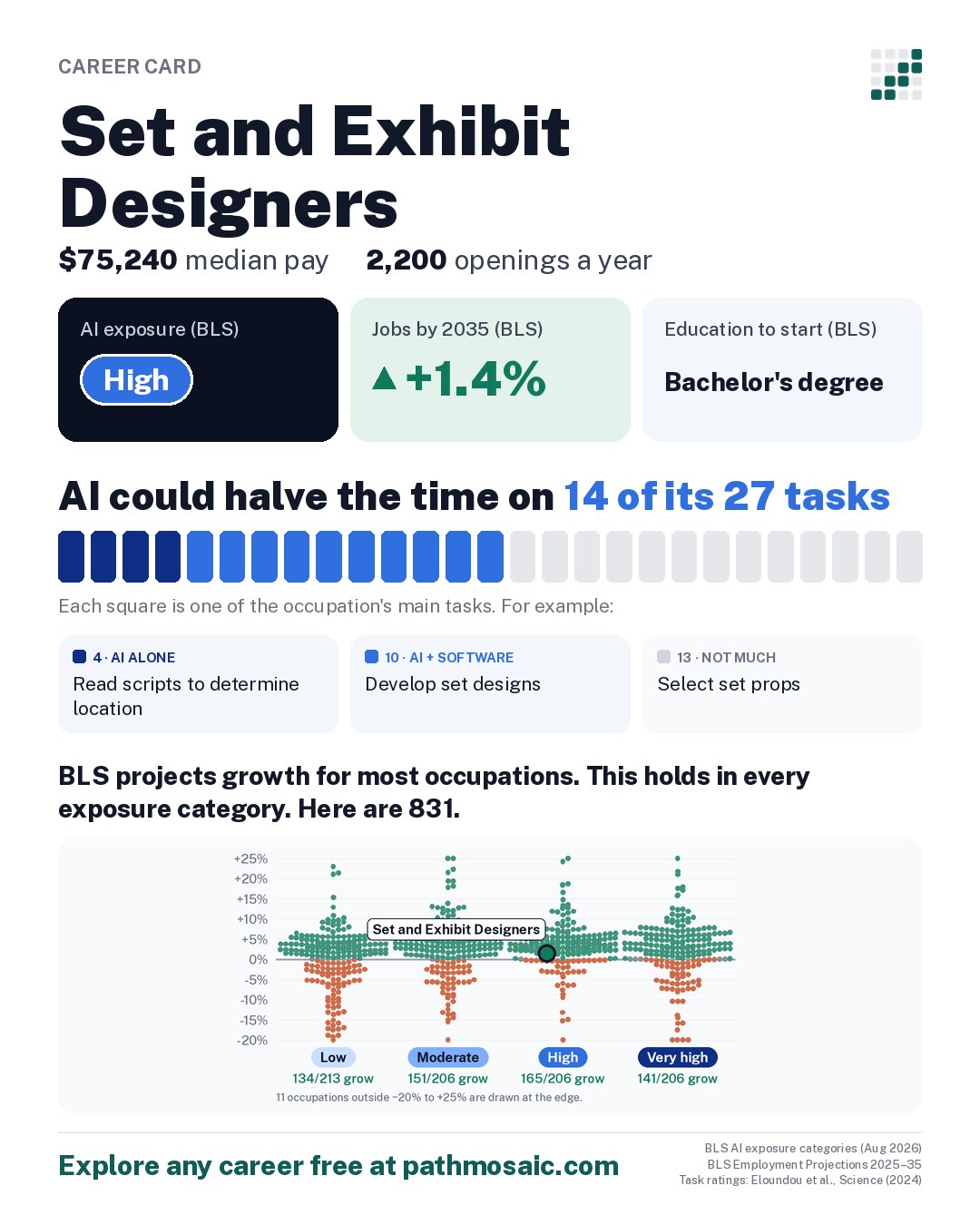
What the data says: AI could halve the time on 14 of its 27 tasks, yet jobs are projected to grow 1.4% by 2035. How to think about this →
About this projection
BLS builds AI into its projections where the research supports it: “BLS generally applies adjustments based on this research conservatively, where there is convincing evidence for a change.”
It also notes a limit: “BLS projection methods are not designed to capture extremely rapid technological change.”
On its AI exposure groups, BLS says exposure “does not imply job loss.”
Recent conditions
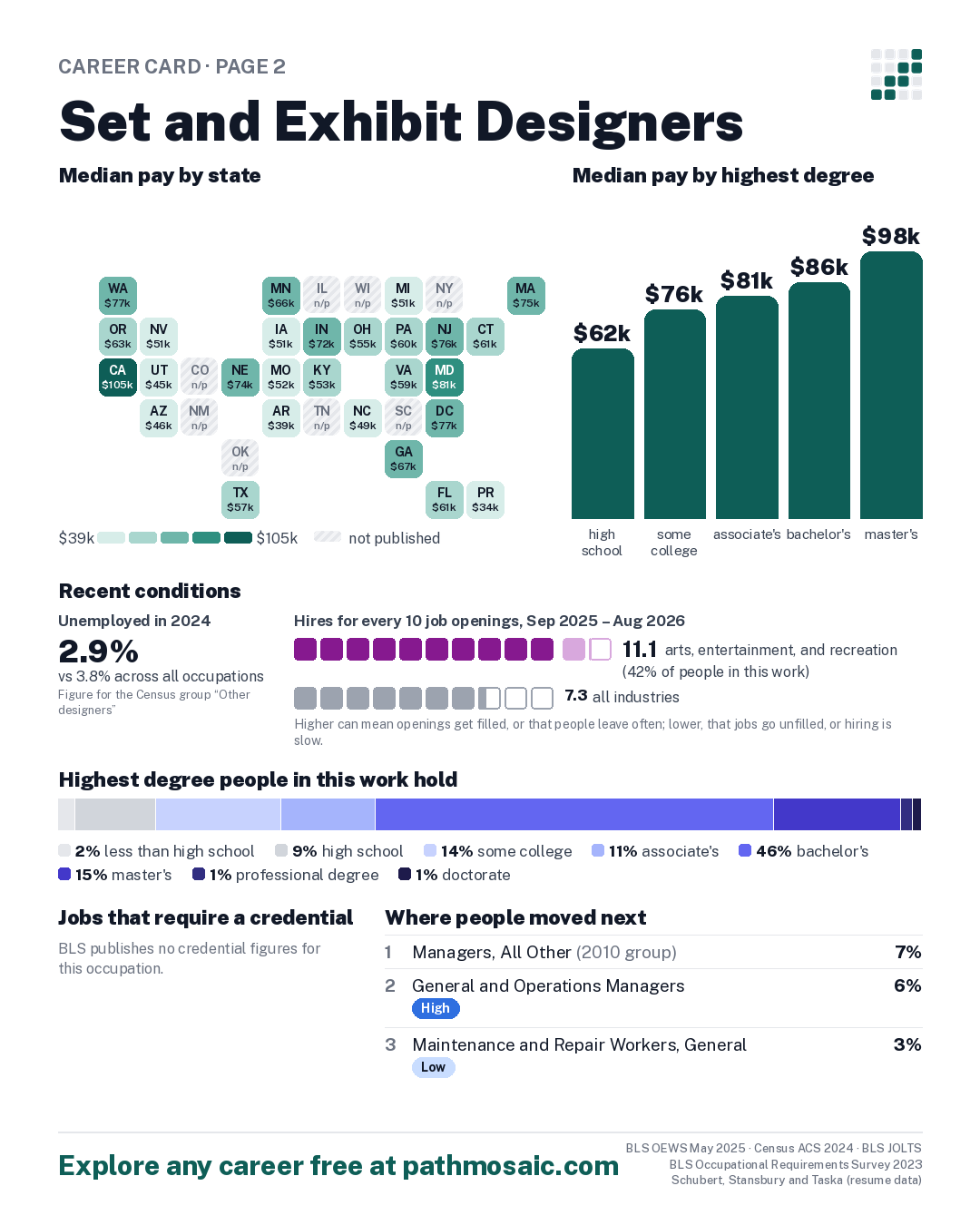
- In 2024, 2.9% of people in this work were unemployed, against 3.8% across all occupations Census ACS 2024, all workers in the Census group “Other designers”
- From Sep 2025 to Aug 2026, 11.1 hires for every 10 job openings in arts, entertainment, and recreation, which employs about 42% of people in this work, against 7.3 across all industries BLS JOLTS
One box per opening, filled for each hire; hires beyond the openings are added in a lighter shade. Higher can mean openings get filled, or that people leave often; lower, that jobs go unfilled, or hiring is slow.11.1 this industry7.3 all industries
Median pay by state BLS OEWS May 2025, state estimates
Tap a state for its figures.
Median pay in every state
| State | Median | Middle half earn | Jobs |
|---|---|---|---|
| Arizona | $46,280 | $40,200 to $60,610 | 70 |
| Arkansas | $38,700 | $35,200 to $48,430 | 50 |
| California | $105,030 | $73,200 to $134,030 | 2,690 |
| Colorado | not published | not published | 170 |
| Connecticut | $60,680 | $54,800 to $75,270 | 70 |
| District of Columbia | $76,900 | $63,600 to $104,330 | 190 |
| Florida | $60,750 | $48,650 to $77,960 | 740 |
| Georgia | $67,210 | $40,060 to $80,960 | 310 |
| Illinois | not published | not published | 330 |
| Indiana | $72,200 | $46,940 to $74,990 | 110 |
| Iowa | $50,640 | $50,640 to $61,270 | 60 |
| Kentucky | $53,260 | $41,930 to $55,360 | 40 |
| Maryland | $80,540 | $64,490 to $88,080 | 420 |
| Massachusetts | $74,540 | $56,400 to $100,200 | 230 |
| Michigan | $50,910 | $38,150 to $63,610 | 140 |
| Minnesota | $66,090 | $62,560 to $75,140 | 150 |
| Missouri | $51,610 | $37,780 to $65,840 | 290 |
| Nebraska | $73,980 | $57,770 to $80,140 | 50 |
| Nevada | $50,860 | $39,320 to $79,610 | 180 |
| New Jersey | $76,380 | $61,610 to $98,560 | 220 |
| New Mexico | not published | not published | 70 |
| New York | not published | not published | 1,690 |
| North Carolina | $49,410 | $42,370 to $60,150 | not published |
| Ohio | $54,560 | $40,340 to $65,630 | 290 |
| Oklahoma | not published | not published | 50 |
| Oregon | $62,770 | $62,770 to $62,770 | 280 |
| Pennsylvania | $59,670 | $51,110 to $68,520 | 120 |
| Puerto Rico | $34,260 | $30,600 to $42,380 | not published |
| South Carolina | not published | not published | 50 |
| Tennessee | not published | not published | 230 |
| Texas | $56,930 | $44,420 to $74,500 | 210 |
| Utah | $44,540 | $40,160 to $65,320 | 340 |
| Virginia | $58,650 | $46,870 to $83,200 | 120 |
| Washington | $77,230 | $59,990 to $129,280 | 170 |
| Wisconsin | not published | not published | 50 |
Nationally: $75,240. Shades run from the lowest state median to the highest; a territory below that range takes the lightest. How to read this
How AI touches the work
What AI could speed up, task by task, and where people already use it.
AI could halve the time on 14 of its 27 tasks
| AI rating | Its main tasks | Share of Claude conversations May 2026 |
|---|---|---|
| AI + software | Develop set designs, based on evaluation of scripts, budgets, research information, and available locations. | under 0.01% |
| AI + software | Prepare rough drafts and scale working drawings of sets, including floor plans, scenery, and properties to be constructed. | Not published |
| AI + software | Prepare preliminary renderings of proposed exhibits, including detailed construction, layout, and material specifications, and diagrams relating to aspects such as special effects or lighting. | Not published |
| AI alone | Read scripts to determine location, set, and design requirements. | Not published |
| AI + software | Submit plans for approval, and adapt plans to serve intended purposes, or to conform to budget or fabrication restrictions. | Not published |
| Not much | Attend rehearsals and production meetings to obtain and share information related to sets. | Not published |
See all 27 tasks
| AI + software | Confer with clients and staff to gather information about exhibit space, proposed themes and content, timelines, budgets, materials, or promotion requirements. | Not published |
| AI alone | Research architectural and stylistic elements appropriate to the time period to be depicted, consulting experts for information, as necessary. | Not published |
| AI + software | Collaborate with those in charge of lighting and sound so that those production aspects can be coordinated with set designs or exhibit layouts. | Not published |
| Not much | Observe sets during rehearsals in order to ensure that set elements do not interfere with performance aspects such as cast movement and camera angles. | Not published |
| Not much | Select set props, such as furniture, pictures, lamps, and rugs. | Not published |
| Not much | Design and build scale models of set designs, or miniature sets used in filming backgrounds or special effects. | Not published |
| AI alone | Examine objects to be included in exhibits to plan where and how to display them. | under 0.01% |
| AI + software | Assign staff to complete design ideas and prepare sketches, illustrations, and detailed drawings of sets, or graphics and animation. | Not published |
| Not much | Inspect installed exhibits for conformance to specifications and satisfactory operation of special-effects components. | Not published |
| AI + software | Plan for location-specific issues, such as space limitations, traffic flow patterns, and safety concerns. | Not published |
| Not much | Acquire, or arrange for acquisition of, specimens or graphics required to complete exhibits. | Not published |
| AI + software | Estimate set- or exhibit-related costs, including materials, construction, and rental of props or locations. | Not published |
| Not much | Direct and coordinate construction, erection, or decoration activities to ensure that sets or exhibits meet design, budget, and schedule requirements. | Not published |
| Not much | Design and produce displays and materials that can be used to decorate windows, interior displays, or event locations, such as streets and fairgrounds. | under 0.01% |
| AI + software | Confer with conservators to determine how to handle an exhibit's environmental aspects, such as lighting, temperature, and humidity, so that objects will be protected and exhibits will be enhanced. | Not published |
| Not much | Coordinate the transportation of sets that are built off-site, and coordinate their setup at the site of use. | Not published |
| Not much | Arrange for outside contractors to construct exhibit structures. | Not published |
| Not much | Select and purchase lumber and hardware necessary for set construction. | Not published |
| Not much | Coordinate the removal of sets, props, and exhibits after productions or events are complete. | Not published |
| Not much | Incorporate security systems into exhibit layouts. | Not published |
| AI alone | Provide supportive materials for exhibits and displays, such as press kits, advertising, publicity notices, posters, brochures, catalogues, and invitations. | Not published |
Ordered by how important O*NET's respondents rate each task (1 to 5) times the share who say it is part of their job. The ordering is ours. 3 of the 27 have a published share of Claude conversations; “not published” means too few conversations for Anthropic to publish a figure.
Where people already use AI
The tasks above say what AI could speed up. This shows what people are using it for. Its 27 tasks fall under 20 work activities that many occupations share, and Microsoft counted how often each one came up in 200,000 conversations with its Copilot assistant in 2024.
- #4 Maintain current knowledge in area of expertise
- #7 Explain technical details of products or services
- #14 Create visual designs or displays
- and 5 more, in the table below
| Work activity | This occupation's tasks under it | People asked AI for help in 10,000 conversations |
AI did it for them in 10,000 conversations |
|---|---|---|---|
| Direct construction or extraction activities | |||
| Create visual designs or displays | |||
| Create artistic designs or performances | |||
| Communicate with others about specifications or project details | |||
| Select materials or equipment for operations or projects | |||
| Inspect completed work or finished products | |||
| Replenish inventories of materials, equipment, or products | |||
| Maintain current knowledge in area of expertise |
Show all 20 activities
| Explain technical details of products or services | |||
| Determine operational methods or procedures | |||
| Study details of artistic productions | |||
| Confer with clients to determine needs or order specifications | |||
| Create decorative objects or parts of objects | |||
| Promote products, services, or programs | |||
| Maintain safety or security | |||
| Estimate project development or operational costs | |||
| Assemble products or work aids | |||
| Direct organizational operations, activities, or procedures | |||
| Build structures | |||
| Direct scientific or technical activities |
How people in this work use Claude
What people in this work made with Claude % of conversations
- A document or report22%
- Creative writing13%
- Ideas or a brainstorm10%
- A plan or strategy8%
- An analysis or summary6%
How they worked with Claude
51% of these conversations were about work. Anthropic Economic Index, May 2026.
How to read this
Work activities come from O*NET, which links every task to the broader activities it involves. Microsoft's figures are for the activity across everyone who used Copilot, not for set and exhibit designers specifically. Copilot is a general chat assistant; dedicated coding tools are not included, so programming help is under-counted here. Activities are listed by how many of this occupation's tasks fall under them.
The task ratings say whether AI could halve the time a task takes: on its own (“AI alone”), or with software built on it (“AI + software”). They were made by people in 2023 (Eloundou et al.). Claude's share is the task's share of all Claude.ai conversations in May 2026; Anthropic doesn't publish a task with too few conversations. None of these add up to the BLS exposure group, which combines five research measures.
More in the Guide: task ratings · task order · work activities · Copilot figures · Claude
High exposure doesn't mean fewer jobs
BLS projects most occupations in its two most exposed groups to grow: 141 of 206 rated Very high and 165 of 206 rated High. Each dot is one of the 831 occupations BLS rates.
Career moves into and out of this occupation
From moves between occupations found in online resumes, 2002–2016. Career changes only: a first job after school isn't a move.
Where people moved next
of 3,448 moves out
- 1 Managers, All Other (2010 group) an older group BLS has since split; no exposure group today 7%
- 2 General and Operations Managers High +5.0% 6%
- 3 Maintenance and Repair Workers, General Low +4.2% 3%
- 4 Heavy and Tractor-Trailer Truck Drivers Moderate +3.8% 3%
- 5 Postsecondary Teachers, All Other Very high +2.0% 3%
Where people moved in from
of 3,501 moves in
- 1 Maintenance and Repair Workers, General Low +4.2% 6%
- 2 Managers, All Other (2010 group) an older group BLS has since split; no exposure group today 5%
- 3 General and Operations Managers High +5.0% 4%
- 4 Medical Records and Health Information Technicians (2010 group) an older group BLS has since split; no exposure group today 4%
- 5 Compliance Officers Very high +3.8% 3%
Resumes over-represent younger, white-collar job-seekers and moves into management. Schubert, Stansbury and Taska (resume data).
Education and training for the occupation
O*NET survey of workers in this occupation
- 10% some college
- 5% associate's
- 33% bachelor's
- 33% master's
- 10% post-master's certificate
- 5% professional doctorate
- 5% research doctorate
O*NET 31.0 survey of workers in this occupation · 21 people answered.
Census survey (American Community Survey)
- 2% less than high school
- 9% high school
- 14% some college
- 11% associate's
- 46% bachelor's
- 15% master's
- 1% professional degree
- 1% doctorate
Census ACS 2024, all workers in the Census group “Other designers” · 4,155 people surveyed.
Why the two can differ
O*NET asks about 20 people in each occupation, which makes its shares uncertain, but it reports the exact occupation and counts certificates. The Census survey reaches thousands, but it groups some occupations together and counts degrees only. More in the Guide
Median pay by highest degree full-time, year-round · Census ACS 2024, all workers in the Census group “Other designers”
3 programs: Design and Visual Communications, General, Illustration and Technical Theatre/Theatre Design and Technology.
Jobs that require a credential BLS Occupational Requirements Survey 2023
BLS publishes no credential figures for this occupation.
Look up certifications, training and licenses U.S. Department of Labor
- Certification Finder ↗ certifications CareerOneStop lists for this occupation
- Training Finder ↗ schools and programs, nationwide; narrow the place there
- License Finder ↗ licenses by state
- Apprenticeship Finder ↗ DOL lists 1 registered apprenticeship in this occupation (DISPLAY DESIGNER (Prof & Kin)). Apprenticeship.gov can't be linked to one occupation, so search for “Set and Exhibit Designers” there.
These open in a new tab and send only the occupation's public code. More in the Guide
BLS AI exposure categories (Aug 2026) · BLS Employment Projections 2025–35 · O*NET 31.0 · Task ratings: Eloundou et al., Science (2024) · Microsoft "Working with AI" v1.1 · Anthropic Economic Index (2026-06-26) · Schubert, Stansbury and Taska · NCES CIP–SOC · Census ACS 2024 · BLS JOLTS
See it online, and explore any career: https://www.pathmosaic.com/card/27-1027.00