Roofers
Also called: Commercial Roofer, Roof Mechanic, Roofing Technician (Roofing Tech), Single Ply RooferCover roofs of structures with shingles, slate, asphalt, aluminum, wood, or related materials. May spray roofs, sidings, and walls with material to bind, seal, insulate, or soundproof sections of structures.
On a phone, press and hold a picture to save it to Photos.
opens your phone's share sheet, where you can save both to Photos
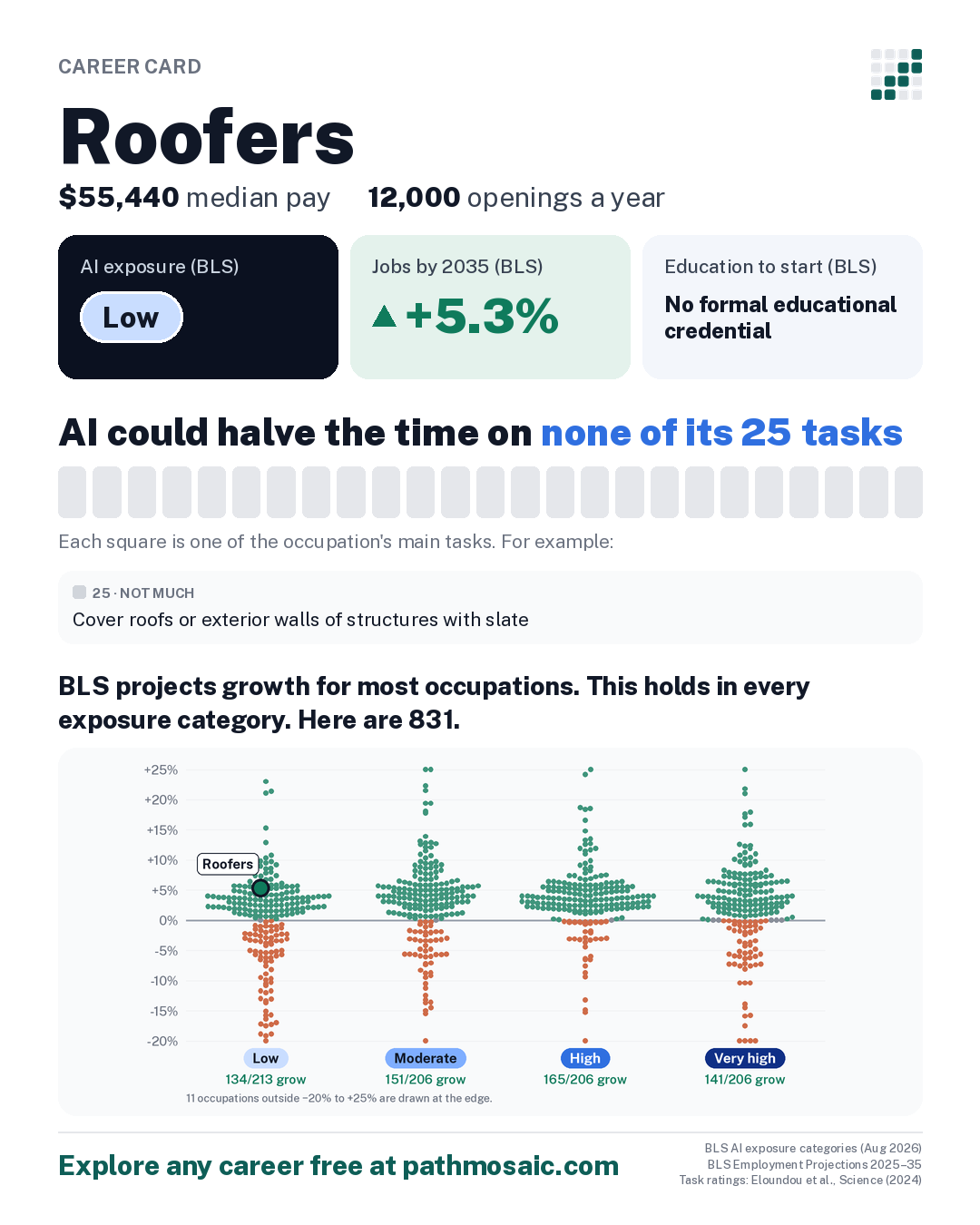
What the data says: AI couldn't halve the time on any of its 25 tasks, and jobs are projected to grow 5.3% by 2035. How to think about this →
About this projection
BLS builds AI into its projections where the research supports it: “BLS generally applies adjustments based on this research conservatively, where there is convincing evidence for a change.”
It also notes a limit: “BLS projection methods are not designed to capture extremely rapid technological change.”
On its AI exposure groups, BLS says exposure “does not imply job loss.”
Recent conditions
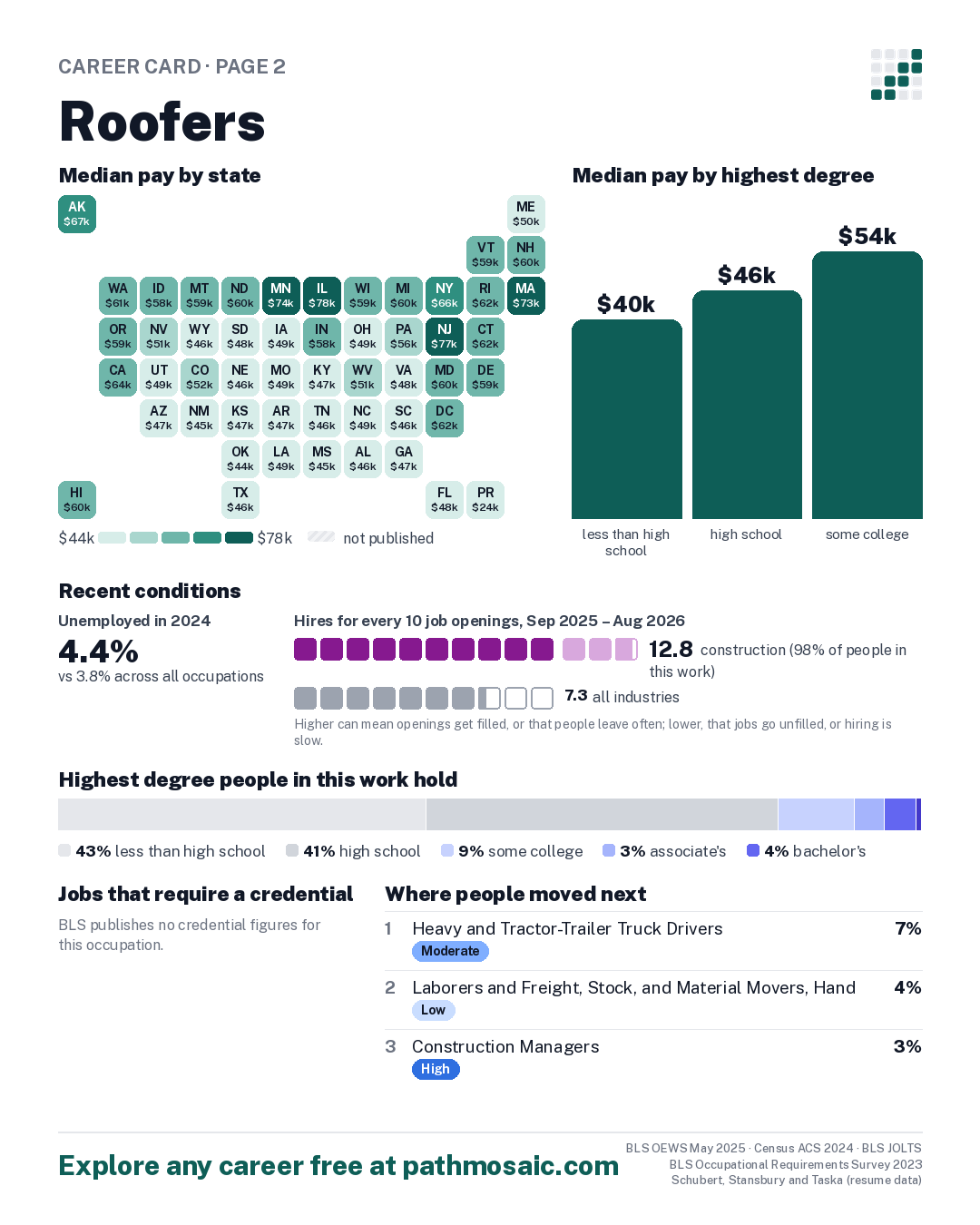
- In 2024, 4.4% of people in this work were unemployed, against 3.8% across all occupations Census ACS 2024
- From Sep 2025 to Aug 2026, 12.8 hires for every 10 job openings in construction, which employs about 98% of people in this work, against 7.3 across all industries BLS JOLTS
One box per opening, filled for each hire; hires beyond the openings are added in a lighter shade. Higher can mean openings get filled, or that people leave often; lower, that jobs go unfilled, or hiring is slow.12.8 this industry7.3 all industries
Median pay by state BLS OEWS May 2025, state estimates
Tap a state for its figures.
Median pay in every state
| State | Median | Middle half earn | Jobs |
|---|---|---|---|
| Alabama | $45,670 | $42,340 to $53,340 | 1,010 |
| Alaska | $66,750 | $56,810 to $80,600 | 310 |
| Arizona | $47,340 | $39,860 to $59,130 | 3,420 |
| Arkansas | $47,470 | $37,170 to $51,210 | 950 |
| California | $63,600 | $59,420 to $75,450 | 21,190 |
| Colorado | $51,750 | $47,700 to $61,150 | 3,340 |
| Connecticut | $62,070 | $51,580 to $93,450 | 790 |
| Delaware | $59,440 | $42,430 to $63,630 | 230 |
| District of Columbia | $61,750 | $48,610 to $101,570 | 100 |
| Florida | $47,590 | $38,040 to $57,660 | 23,550 |
| Georgia | $46,940 | $38,870 to $54,840 | 2,160 |
| Hawaii | $59,580 | $47,750 to $73,690 | 1,110 |
| Idaho | $57,790 | $41,430 to $63,580 | 1,190 |
| Illinois | $77,900 | $57,850 to $103,040 | 5,300 |
| Indiana | $57,980 | $45,330 to $76,210 | 2,980 |
| Iowa | $48,660 | $46,410 to $61,370 | 930 |
| Kansas | $47,190 | $44,150 to $61,330 | 900 |
| Kentucky | $46,940 | $44,150 to $59,600 | 1,080 |
| Louisiana | $48,760 | $38,970 to $56,190 | 760 |
| Maine | $50,120 | $47,060 to $59,080 | 610 |
| Maryland | $60,090 | $48,260 to $75,050 | 2,050 |
| Massachusetts | $72,750 | $59,870 to $83,100 | 1,950 |
| Michigan | $59,530 | $47,890 to $78,120 | 3,090 |
| Minnesota | $74,490 | $55,670 to $91,620 | 1,890 |
| Mississippi | $44,940 | $36,450 to $49,000 | 480 |
| Missouri | $48,570 | $42,730 to $64,710 | 2,050 |
| Montana | $59,030 | $48,190 to $64,660 | 370 |
| Nebraska | $46,460 | $39,580 to $55,650 | 1,730 |
| Nevada | $51,090 | $48,510 to $64,630 | 2,120 |
| New Hampshire | $59,830 | $48,660 to $72,370 | 270 |
| New Jersey | $76,600 | $49,680 to $99,760 | 1,860 |
| New Mexico | $45,300 | $38,450 to $56,030 | 1,160 |
| New York | $66,020 | $58,470 to $77,440 | 4,570 |
| North Carolina | $49,010 | $44,960 to $56,530 | 3,060 |
| North Dakota | $59,740 | $48,010 to $72,130 | 290 |
| Ohio | $49,390 | $46,060 to $63,230 | 4,610 |
| Oklahoma | $43,680 | $38,260 to $55,630 | 1,260 |
| Oregon | $58,970 | $48,720 to $69,090 | 3,430 |
| Pennsylvania | $55,710 | $47,320 to $62,370 | 3,830 |
| Puerto Rico | $24,100 | $23,150 to $28,560 | 550 |
| Rhode Island | $61,630 | $49,350 to $76,570 | 360 |
| South Carolina | $45,760 | $37,990 to $52,760 | 850 |
| South Dakota | $47,710 | $37,510 to $57,270 | 400 |
| Tennessee | $45,690 | $38,130 to $48,940 | 2,110 |
| Texas | $46,030 | $37,430 to $53,630 | 5,740 |
| Utah | $48,680 | $44,490 to $62,260 | 2,710 |
| Vermont | $59,040 | $48,750 to $61,110 | 210 |
| Virginia | $48,420 | $45,760 to $57,590 | 2,070 |
| Washington | $60,640 | $52,310 to $79,470 | 5,890 |
| West Virginia | $51,170 | $36,270 to $66,750 | 440 |
| Wisconsin | $59,370 | $47,850 to $65,330 | 2,400 |
| Wyoming | $45,650 | $37,930 to $60,610 | 330 |
Nationally: $55,440. Shades run from the lowest state median to the highest; a territory below that range takes the lightest. How to read this
How AI touches the work
What AI could speed up, task by task, and where people already use it.
AI could halve the time on none of its 25 tasks
| AI rating | Its main tasks | Share of Claude conversations May 2026 |
|---|---|---|
| Not much | Cover exposed nailheads with roofing cement or caulking to prevent water leakage or rust. | Not published |
| Not much | Install, repair, or replace single-ply roofing systems, using waterproof sheet materials such as modified plastics, elastomeric, or other asphaltic compositions. | Not published |
| Not much | Cover roofs or exterior walls of structures with slate, asphalt, aluminum, wood, gravel, gypsum, or related materials, using brushes, knives, punches, hammers, or other tools. | Not published |
| Not much | Remove snow, water, or debris from roofs prior to applying roofing materials. | Not published |
| Not much | Cut felt, shingles, or strips of flashing to fit angles formed by walls, vents, or intersecting roof surfaces. | Not published |
| Not much | Attach roofing paper to roofs in overlapping strips to form bases for other materials. | Not published |
See all 25 tasks
| Not much | Install vapor barriers or layers of insulation on flat roofs. | Not published |
| Not much | Waterproof or damp-proof walls, floors, roofs, foundations, or basements by painting or spraying surfaces with waterproof coatings or by attaching waterproofing membranes to surfaces. | Not published |
| Not much | Inspect problem roofs to determine the best repair procedures. | Not published |
| Not much | Smooth rough spots to prepare surfaces for waterproofing, using hammers, chisels, or rubbing bricks. | Not published |
| Not much | Install attic ventilation systems, such as turbine vents, gable or ridge vents, or conventional or solar-powered exhaust fans. | Not published |
| Not much | Set up scaffolding to provide safe access to roofs. | Not published |
| Not much | Install partially overlapping layers of material over roof insulation surfaces, using chalk lines, gauges on shingling hatchets, or lines on shingles. | Not published |
| Not much | Cement or nail flashing strips of metal or shingle over joints to make them watertight. | Not published |
| Not much | Apply reflective roof coatings, such as special paints or single-ply roofing sheets, to existing roofs to reduce solar heat absorption. | Not published |
| Not much | Punch holes in slate, tile, terra cotta, or wooden shingles, using punches and hammers. | Not published |
| Not much | Apply plastic coatings, membranes, fiberglass, or felt over sloped roofs before applying shingles. | Not published |
| Not much | Install skylights on roofs to increase natural light inside structures or to reduce energy costs. | Not published |
| Not much | Glaze top layers to make a smooth finish or embed gravel in the bitumen for rough surfaces. | Not published |
| Not much | Apply gravel or pebbles over top layers of roofs, using rakes or stiff-bristled brooms. | Not published |
| Not much | Mop or pour hot asphalt or tar onto roof bases. | Not published |
| Not much | Apply alternate layers of hot asphalt or tar and roofing paper to roofs. | Not published |
| Not much | Estimate materials and labor required to complete roofing jobs. | Not published |
| Not much | Spray roofs, sidings, or walls to bind, seal, insulate, or soundproof sections of structures, using spray guns, air compressors, or heaters. | Not published |
| Not much | Attach solar panels to existing roofs, according to specifications and without damaging roofing materials or the structural integrity of buildings. | Not published |
Ordered by how important O*NET's respondents rate each task (1 to 5) times the share who say it is part of their job. The ordering is ours. 0 of the 25 have a published share of Claude conversations; “not published” means too few conversations for Anthropic to publish a figure.
Where people already use AI
The tasks above say what AI could speed up. This shows what people are using it for. Its 25 tasks fall under 10 work activities that many occupations share, and Microsoft counted how often each one came up in 200,000 conversations with its Copilot assistant in 2024.
| Work activity | This occupation's tasks under it | People asked AI for help in 10,000 conversations |
AI did it for them in 10,000 conversations |
|---|---|---|---|
| Build structures | |||
| Apply protective solutions or coatings | |||
| Perform general construction or extraction activities | |||
| Determine resource needs of projects or operations | |||
| Dispose of waste or debris | |||
| Cut materials | |||
| Inspect facilities or equipment | |||
| Smooth surfaces of objects or equipment |
Show all 10 activities
| Drill holes in earth or materials | |||
| Install energy or heating equipment |
How people in this work use Claude
What people in this work made with Claude % of conversations
- An explanation or answer19%
- Math or a calculation19%
- Data or a spreadsheet12%
- A document or report12%
- Advice or a recommendation6%
How they worked with Claude
62% of these conversations were about work. Anthropic Economic Index, May 2026.
How to read this
Work activities come from O*NET, which links every task to the broader activities it involves. Microsoft's figures are for the activity across everyone who used Copilot, not for roofers specifically. Copilot is a general chat assistant; dedicated coding tools are not included, so programming help is under-counted here. Activities are listed by how many of this occupation's tasks fall under them.
The task ratings say whether AI could halve the time a task takes: on its own (“AI alone”), or with software built on it (“AI + software”). They were made by people in 2023 (Eloundou et al.). Claude's share is the task's share of all Claude.ai conversations in May 2026; Anthropic doesn't publish a task with too few conversations. None of these add up to the BLS exposure group, which combines five research measures.
More in the Guide: task ratings · task order · work activities · Copilot figures · Claude
High exposure doesn't mean fewer jobs
BLS projects most occupations in its two most exposed groups to grow: 141 of 206 rated Very high and 165 of 206 rated High. Each dot is one of the 831 occupations BLS rates.
Career moves into and out of this occupation
From moves between occupations found in online resumes, 2002–2016. Career changes only: a first job after school isn't a move.
Where people moved next
of 5,493 moves out
- 1 Heavy and Tractor-Trailer Truck Drivers Moderate +3.8% 7%
- 2 Laborers and Freight, Stock, and Material Movers, Hand Low +1.8% 4%
- 3 Construction Managers High +9.1% 3%
- 4 Carpenters Low +3.9% 3%
- 5 Managers, All Other (2010 group) an older group BLS has since split; no exposure group today 3%
Where people moved in from
of 3,958 moves in
- 1 Secretaries and Administrative Assistants, Except Legal, Medical, and Executive Very high -6.0% 6%
- 2 Laborers and Freight, Stock, and Material Movers, Hand Low +1.8% 5%
- 3 Heavy and Tractor-Trailer Truck Drivers Moderate +3.8% 5%
- 4 Carpenters Low +3.9% 4%
- 5 Executive Secretaries and Executive Administrative Assistants Very high +0.0% 4%
Resumes over-represent younger, white-collar job-seekers and moves into management. Schubert, Stansbury and Taska (resume data).
Education and training for the occupation
Census survey (American Community Survey)
- 43% less than high school
- 41% high school
- 9% some college
- 3% associate's
- 4% bachelor's
- 1% master's
Census ACS 2024, all workers in this occupation · 1,470 people surveyed.
Median pay by highest degree full-time, year-round · Census ACS 2024, all workers in this occupation
1 program: Roofer.
Jobs that require a credential BLS Occupational Requirements Survey 2023
BLS publishes no credential figures for this occupation.
Look up certifications, training and licenses U.S. Department of Labor
- Certification Finder ↗ certifications CareerOneStop lists for this occupation
- Training Finder ↗ schools and programs, nationwide; narrow the place there
- License Finder ↗ licenses by state
- Apprenticeship Finder ↗ DOL lists 2 registered apprenticeships in this occupation (ROOFER; Roofer). Apprenticeship.gov can't be linked to one occupation, so search for “Roofers” there.
These open in a new tab and send only the occupation's public code. More in the Guide
BLS AI exposure categories (Aug 2026) · BLS Employment Projections 2025–35 · O*NET 31.0 · Task ratings: Eloundou et al., Science (2024) · Microsoft "Working with AI" v1.1 · Anthropic Economic Index (2026-06-26) · Schubert, Stansbury and Taska · NCES CIP–SOC · Census ACS 2024 · BLS JOLTS
See it online, and explore any career: https://www.pathmosaic.com/card/47-2181.00