Crematory Operators
Operate crematory equipment to reduce human or animal remains to bone fragments in accordance with state and local regulations. Duties may include preparing the body for cremation and performing general maintenance on crematory equipment. May use traditional flame-based cremation, calcination, or alkaline hydrolysis.
On a phone, press and hold a picture to save it to Photos.
opens your phone's share sheet, where you can save both to Photos
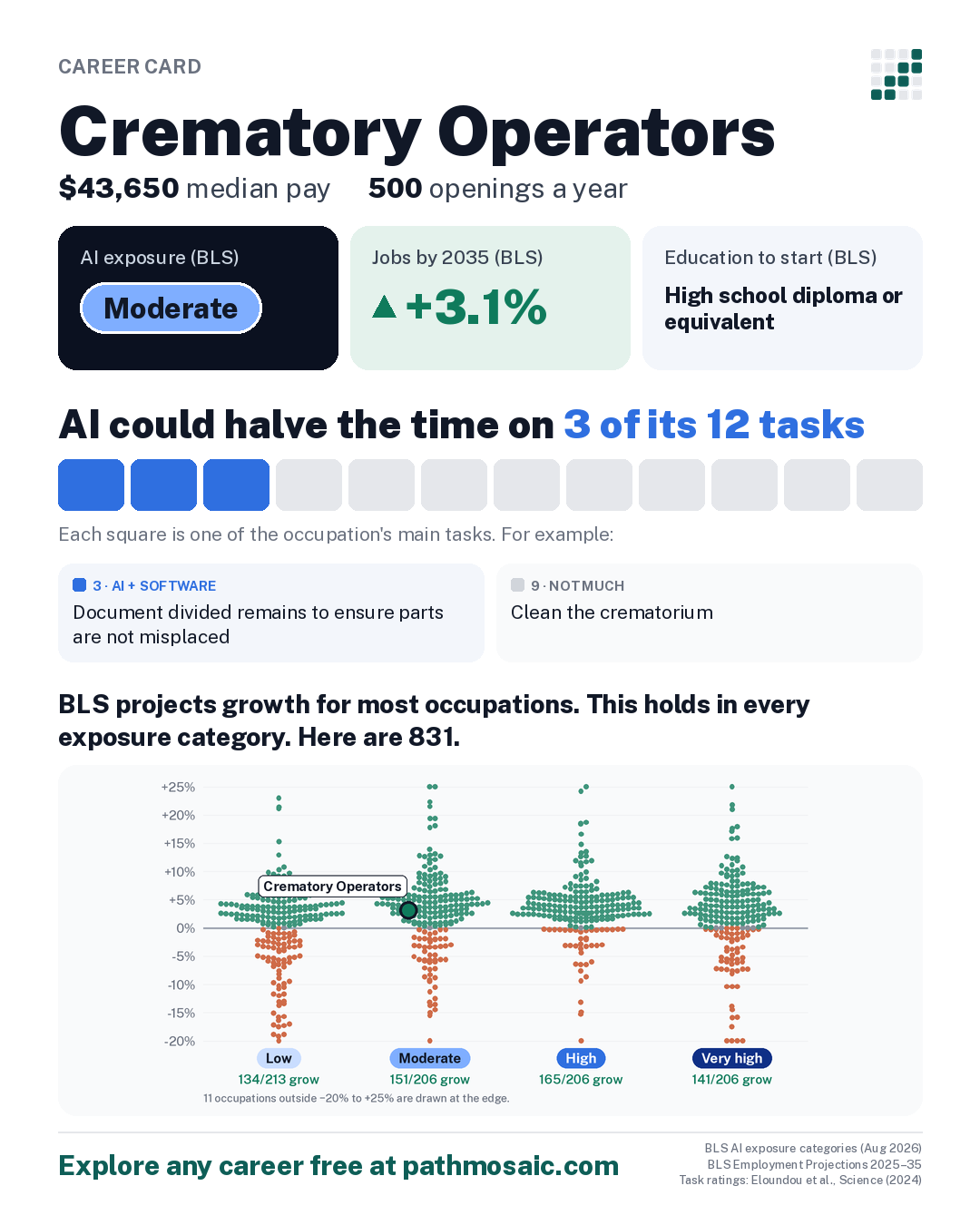
What the data says: AI could halve the time on 3 of its 12 tasks, and jobs are projected to grow 3.1% by 2035. How to think about this →
About this projection
BLS builds AI into its projections where the research supports it: “BLS generally applies adjustments based on this research conservatively, where there is convincing evidence for a change.”
It also notes a limit: “BLS projection methods are not designed to capture extremely rapid technological change.”
On its AI exposure groups, BLS says exposure “does not imply job loss.”
Recent conditions
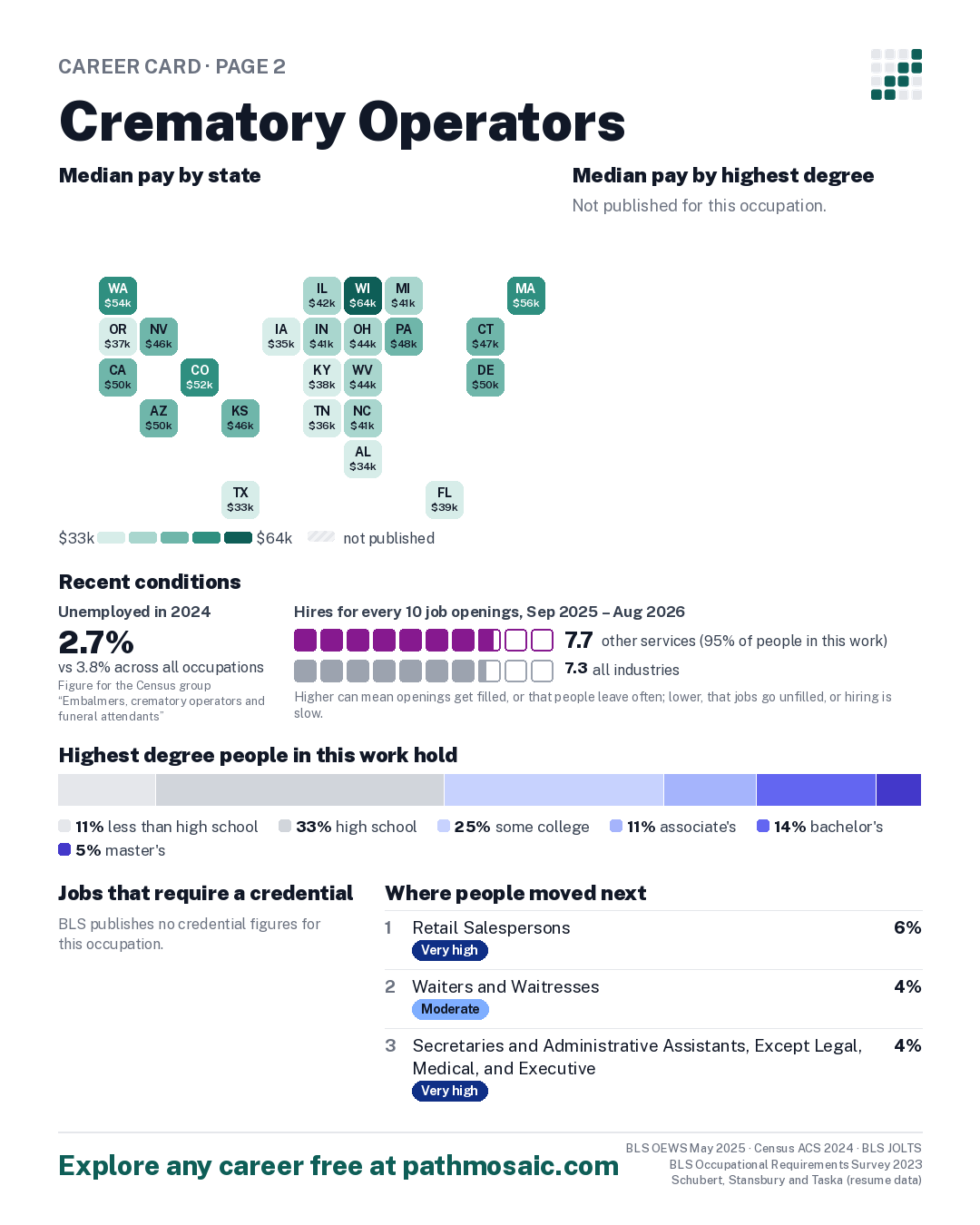
- In 2024, 2.7% of people in this work were unemployed, against 3.8% across all occupations Census ACS 2024, all workers in the Census group “Embalmers, crematory operators and funeral attendants”
- From Sep 2025 to Aug 2026, 7.7 hires for every 10 job openings in other services, which employs about 95% of people in this work, against 7.3 across all industries BLS JOLTS
One box per opening, filled for each hire; hires beyond the openings are added in a lighter shade. Higher can mean openings get filled, or that people leave often; lower, that jobs go unfilled, or hiring is slow.7.7 this industry7.3 all industries
Median pay by state BLS OEWS May 2025, state estimates
Tap a state for its figures.
Median pay in every state
| State | Median | Middle half earn | Jobs |
|---|---|---|---|
| Alabama | $33,840 | $33,840 to $47,800 | 40 |
| Arizona | $49,970 | $43,740 to $57,180 | 40 |
| California | $49,780 | $46,680 to $60,190 | 240 |
| Colorado | $52,060 | $47,150 to $63,190 | 70 |
| Connecticut | $47,160 | $46,120 to $66,750 | 100 |
| Delaware | $50,320 | $48,010 to $50,620 | 30 |
| Florida | $38,710 | $37,360 to $43,180 | 320 |
| Illinois | $41,740 | $37,450 to $42,980 | 190 |
| Indiana | $40,650 | $38,170 to $57,640 | 190 |
| Iowa | $35,120 | $33,610 to $35,980 | not published |
| Kansas | $46,490 | $45,710 to $57,310 | 50 |
| Kentucky | $37,740 | $34,200 to $41,170 | 50 |
| Massachusetts | $56,050 | $46,040 to $59,510 | 30 |
| Michigan | $40,970 | $34,160 to $46,660 | 130 |
| Nevada | $46,190 | $43,670 to $47,680 | 80 |
| North Carolina | $41,350 | $35,970 to $48,300 | 150 |
| Ohio | $43,530 | $39,350 to $45,940 | 60 |
| Oregon | $37,020 | $35,970 to $44,010 | 100 |
| Pennsylvania | $47,980 | $43,040 to $49,720 | 140 |
| Tennessee | $35,880 | $35,570 to $38,380 | not published |
| Texas | $33,270 | $30,830 to $37,320 | 270 |
| Washington | $53,580 | $48,140 to $58,960 | 70 |
| West Virginia | $43,840 | $41,670 to $44,250 | 30 |
| Wisconsin | $64,220 | $61,590 to $68,300 | not published |
Nationally: $43,650. Shades run from the lowest state median to the highest; a territory below that range takes the lightest. How to read this
How AI touches the work
What AI could speed up, task by task, and where people already use it.
AI could halve the time on 3 of its 12 tasks
| AI rating | Its main tasks | Share of Claude conversations May 2026 |
|---|---|---|
| Not much | Clean the crematorium, including tables, floors, and equipment. | Not published |
| AI + software | Document divided remains to ensure parts are not misplaced. | Not published |
| Not much | Embalm, dress, or otherwise prepare the deceased for viewing. | Not published |
| Not much | Explain the cremation process to family or friends of the deceased. | Not published |
| AI + software | Offer counsel and comfort to bereaved families or friends. | 0.01% |
| Not much | Pick up and handle human or pet remains in a respectful manner. | Not published |
See all 12 tasks
| Not much | Place corpses into crematory machines to reduce remains to bone fragments using flame, heat, or alkaline hydrolysis. | Not published |
| Not much | Pulverize remaining bone fragments into smaller pieces, using specialized equipment, such as a cremulator or grinder. | Not published |
| AI + software | Read documentation to confirm the identity of the deceased. | Not published |
| Not much | Remove jewelry, watches, or other personal items from the deceased prior to cremation. | Not published |
| Not much | Sweep or vacuum the cremation chamber to retrieve remains for storage in an urn or other container. | Not published |
| Not much | Transport the deceased to a funeral home or crematory using a van, hearse, or other vehicle. | Not published |
O*NET hasn't rated these tasks, so they're in O*NET's own order. 1 of the 12 have a published share of Claude conversations; “not published” means too few conversations for Anthropic to publish a figure.
Where people already use AI
The tasks above say what AI could speed up. This shows what people are using it for. Its 12 tasks fall under 13 work activities that many occupations share, and Microsoft counted how often each one came up in 200,000 conversations with its Copilot assistant in 2024.
- #7 Explain technical details of products or services
| Work activity | This occupation's tasks under it | People asked AI for help in 10,000 conversations |
AI did it for them in 10,000 conversations |
|---|---|---|---|
| Clean tools, equipment, facilities, or work areas | |||
| Explain technical details of products or services | |||
| Evaluate the quality or accuracy of data | |||
| Adjust equipment to ensure adequate performance | |||
| Counsel others about personal matters | |||
| Maintain operational records | |||
| Apply hygienic or cosmetic agents to skin or hair | |||
| Operate transportation equipment or vehicles |
Show all 13 activities
| Move materials, equipment, or supplies | |||
| Operate cutting or grinding equipment | |||
| Load products, materials, or equipment for transportation or further processing | |||
| Embalm corpses | |||
| Assist healthcare practitioners during medical procedures |
How people in this work use Claude
What people in this work made with Claude % of conversations
- An explanation or answer26%
- An email or message23%
- Advice or a recommendation21%
- An analysis or summary4%
- A document or report4%
How they worked with Claude
4% of these conversations were about work. Anthropic Economic Index, May 2026.
How to read this
Work activities come from O*NET, which links every task to the broader activities it involves. Microsoft's figures are for the activity across everyone who used Copilot, not for crematory operators specifically. Copilot is a general chat assistant; dedicated coding tools are not included, so programming help is under-counted here. Activities are listed by how many of this occupation's tasks fall under them.
The task ratings say whether AI could halve the time a task takes: on its own (“AI alone”), or with software built on it (“AI + software”). They were made by people in 2023 (Eloundou et al.). Claude's share is the task's share of all Claude.ai conversations in May 2026; Anthropic doesn't publish a task with too few conversations. None of these add up to the BLS exposure group, which combines five research measures.
More in the Guide: task ratings · task order · work activities · Copilot figures · Claude
High exposure doesn't mean fewer jobs
BLS projects most occupations in its two most exposed groups to grow: 141 of 206 rated Very high and 165 of 206 rated High. Each dot is one of the 831 occupations BLS rates.
Career moves into and out of this occupation
From moves between occupations found in online resumes, 2002–2016. Career changes only: a first job after school isn't a move.
Where people moved next
of 3,273 moves out
- 1 Retail Salespersons Very high -0.3% 6%
- 2 Waiters and Waitresses Moderate +2.0% 4%
- 3 Secretaries and Administrative Assistants, Except Legal, Medical, and Executive Very high -6.0% 4%
- 4 Customer Service Representatives Very high -5.3% 3%
- 5 Managers, All Other (2010 group) an older group BLS has since split; no exposure group today 2%
Where people moved in from
of 2,541 moves in
- 1 Retail Salespersons Very high -0.3% 7%
- 2 Waiters and Waitresses Moderate +2.0% 5%
- 3 Cashiers High -6.5% 3%
- 4 Customer Service Representatives Very high -5.3% 3%
- 5 Hosts and Hostesses, Restaurant, Lounge, and Coffee Shop High +3.4% 3%
The resume data uses 2010 occupation codes. This occupation comes from “Personal Care and Service Workers, All Other”, which today also includes the occupation still called “Personal Care and Service Workers, All Other”, so these figures cover it too. Resumes over-represent younger, white-collar job-seekers and moves into management. Schubert, Stansbury and Taska (resume data).
Education and training for the occupation
Census survey (American Community Survey)
- 11% less than high school
- 33% high school
- 25% some college
- 11% associate's
- 14% bachelor's
- 5% master's
Census ACS 2024, all workers in the Census group “Embalmers, crematory operators and funeral attendants” · 213 people surveyed.
2 programs: Mortuary Science and Embalming/Embalmer and Funeral Service and Mortuary Science, Other.
Jobs that require a credential BLS Occupational Requirements Survey 2023
BLS publishes no credential figures for this occupation.
Look up certifications, training and licenses U.S. Department of Labor
- Certification Finder ↗ certifications CareerOneStop lists for this occupation
- Training Finder ↗ schools and programs, nationwide; narrow the place there
- License Finder ↗ licenses by state
- Apprenticeships: DOL's list of apprenticeable occupations doesn't include this one.
These open in a new tab and send only the occupation's public code. More in the Guide
BLS AI exposure categories (Aug 2026) · BLS Employment Projections 2025–35 · O*NET 31.0 · Task ratings: Eloundou et al., Science (2024) · Microsoft "Working with AI" v1.1 · Anthropic Economic Index (2026-06-26) · Schubert, Stansbury and Taska · NCES CIP–SOC · Census ACS 2024 · BLS JOLTS
See it online, and explore any career: https://www.pathmosaic.com/card/39-4012.00