Hydrologists
Also called: Groundwater Consultant, Hydrogeologist, Research Hydrologist, Source Water Protection SpecialistResearch the distribution, circulation, and physical properties of underground and surface waters; and study the form and intensity of precipitation and its rate of infiltration into the soil, movement through the earth, and return to the ocean and atmosphere.
On a phone, press and hold a picture to save it to Photos.
opens your phone's share sheet, where you can save both to Photos
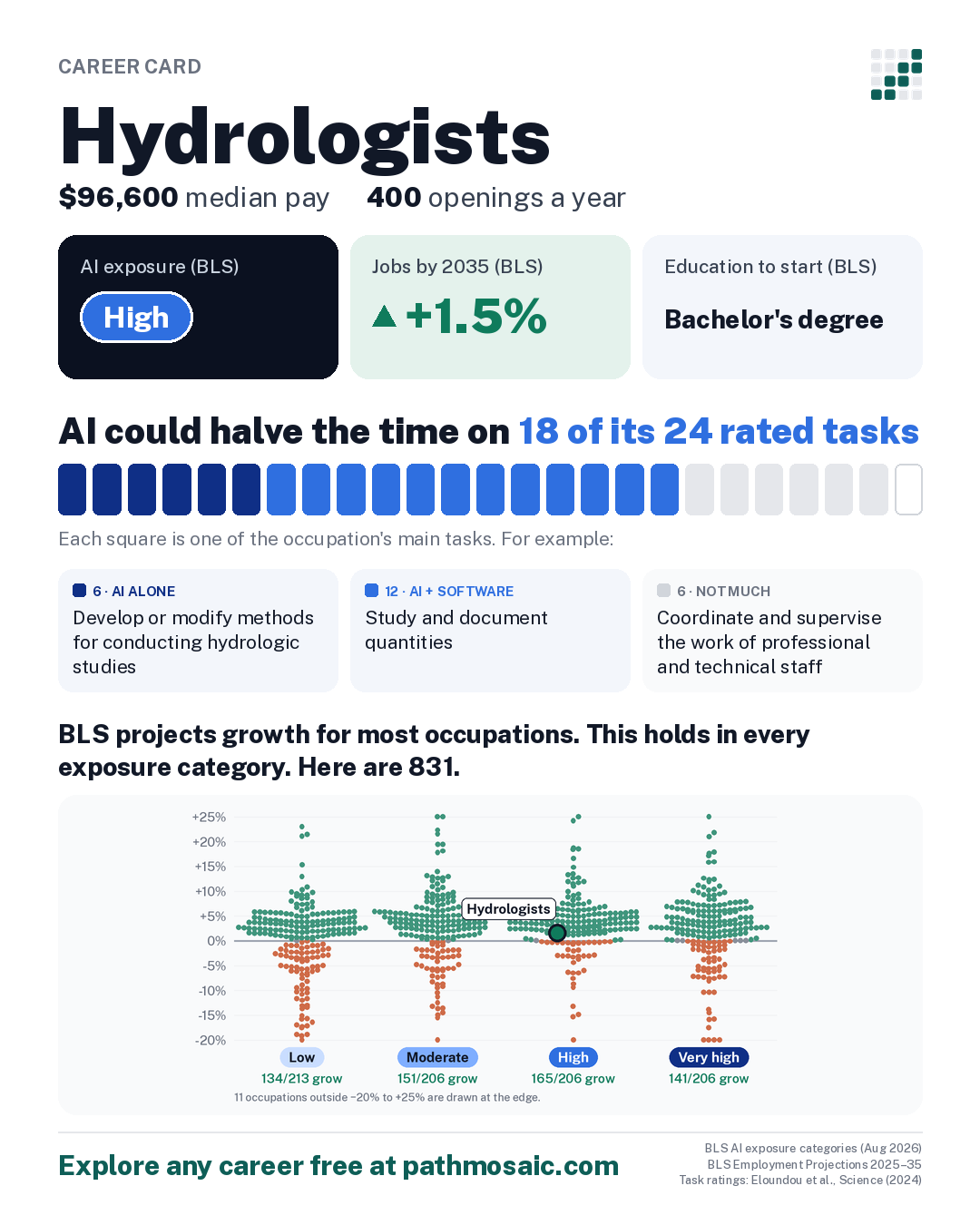
What the data says: AI could halve the time on 18 of its 24 rated tasks, yet jobs are projected to grow 1.5% by 2035. How to think about this →
About this projection
BLS builds AI into its projections where the research supports it: “BLS generally applies adjustments based on this research conservatively, where there is convincing evidence for a change.”
It also notes a limit: “BLS projection methods are not designed to capture extremely rapid technological change.”
On its AI exposure groups, BLS says exposure “does not imply job loss.”
Recent conditions
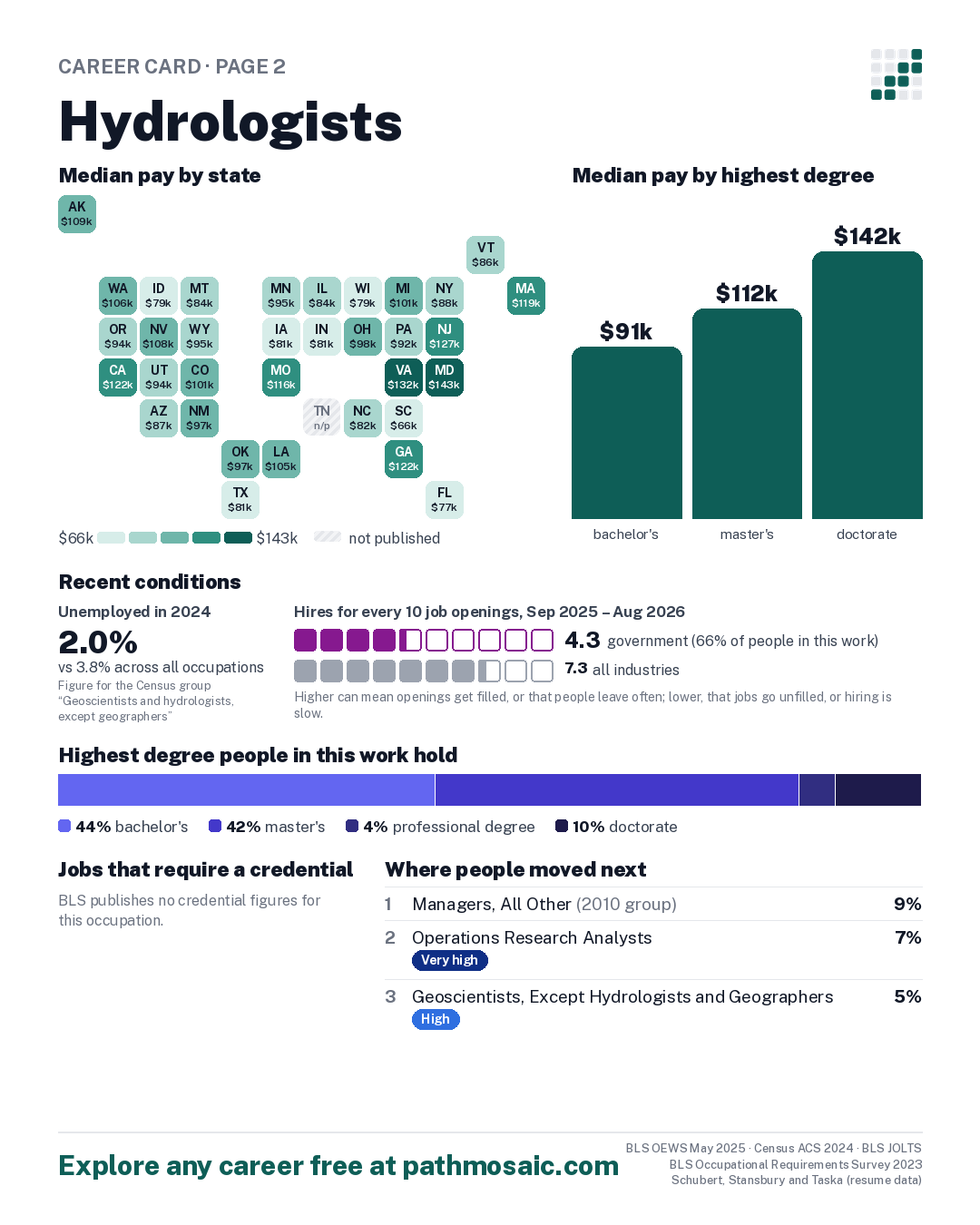
- In 2024, 2.0% of people in this work were unemployed, against 3.8% across all occupations Census ACS 2024, all workers in the Census group “Geoscientists and hydrologists, except geographers”
- From Sep 2025 to Aug 2026, 4.3 hires for every 10 job openings in government, which employs about 66% of people in this work, against 7.3 across all industries BLS JOLTS
One box per opening, filled for each hire; hires beyond the openings are added in a lighter shade. Higher can mean openings get filled, or that people leave often; lower, that jobs go unfilled, or hiring is slow.4.3 this industry7.3 all industries
Median pay by state BLS OEWS May 2025, state estimates
Tap a state for its figures.
Median pay in every state
| State | Median | Middle half earn | Jobs |
|---|---|---|---|
| Alaska | $108,660 | $87,330 to $126,920 | 60 |
| Arizona | $86,700 | $75,460 to $113,900 | 400 |
| California | $122,110 | $93,640 to $142,500 | 540 |
| Colorado | $100,840 | $91,250 to $141,460 | 360 |
| Florida | $76,850 | $68,100 to $91,560 | 280 |
| Georgia | $121,830 | $103,080 to $133,720 | 30 |
| Idaho | $78,850 | $63,370 to $109,300 | 160 |
| Illinois | $83,720 | $67,590 to $110,110 | 100 |
| Indiana | $80,700 | $70,570 to $86,200 | 50 |
| Iowa | $81,150 | $66,180 to $108,490 | 50 |
| Louisiana | $104,520 | $80,920 to $121,730 | not published |
| Maryland | $143,010 | $113,800 to $175,780 | 90 |
| Massachusetts | $119,350 | $106,160 to $132,480 | 50 |
| Michigan | $101,060 | $89,690 to $127,070 | 40 |
| Minnesota | $94,580 | $79,000 to $105,440 | 300 |
| Missouri | $116,100 | $105,060 to $117,080 | 50 |
| Montana | $84,500 | $81,330 to $104,740 | 190 |
| Nevada | $107,930 | $89,270 to $134,640 | 170 |
| New Jersey | $126,680 | $109,990 to $148,380 | not published |
| New Mexico | $97,470 | $76,400 to $120,720 | 100 |
| New York | $88,100 | $68,720 to $104,420 | 160 |
| North Carolina | $81,770 | $68,900 to $106,090 | 150 |
| Ohio | $98,200 | $74,650 to $108,100 | 390 |
| Oklahoma | $97,470 | $76,760 to $115,210 | 40 |
| Oregon | $93,690 | $79,660 to $113,350 | 300 |
| Pennsylvania | $91,730 | $61,490 to $117,330 | 160 |
| South Carolina | $65,770 | $57,830 to $78,510 | 100 |
| Tennessee | not published | not published | 150 |
| Texas | $81,080 | $64,920 to $104,160 | 220 |
| Utah | $94,190 | $76,400 to $114,580 | 80 |
| Vermont | $86,140 | $83,620 to $90,520 | 50 |
| Virginia | $132,080 | $80,520 to $136,660 | 40 |
| Washington | $105,600 | $88,630 to $153,960 | 350 |
| Wisconsin | $78,770 | $72,070 to $88,710 | 150 |
| Wyoming | $94,520 | $72,790 to $107,020 | 40 |
Nationally: $96,600. Shades run from the lowest state median to the highest; a territory below that range takes the lightest. How to read this
How AI touches the work
What AI could speed up, task by task, and where people already use it.
AI could halve the time on 18 of its 24 rated tasks
| AI rating | Its main tasks | Share of Claude conversations May 2026 |
|---|---|---|
| AI alone | Design and conduct scientific hydrogeological investigations to ensure that accurate and appropriate information is available for use in water resource management decisions. | Not published |
| Not rated | Prepare reports or presentations describing research results, using illustrations, maps, appendices, and other information. | Not published |
| AI + software | Study and document quantities, distribution, disposition, and development of underground and surface waters. | Not published |
| AI + software | Measure and graph phenomena such as lake levels, stream flows, and changes in water volumes. | Not published |
| AI + software | Apply research findings to help minimize the environmental impacts of pollution, waterborne diseases, erosion, and sedimentation. | Not published |
| Not much | Collect and analyze water samples as part of field investigations or to validate data from automatic monitors. | Not published |
See all 25 tasks
| AI + software | Study public water supply issues, including flood and drought risks, water quality, wastewater, and impacts on wetland habitats. | Not published |
| Not much | Install, maintain, and calibrate instruments such as those that monitor water levels, rainfall, and sediments. | Not published |
| Not much | Coordinate and supervise the work of professional and technical staff, including research assistants, technologists, and technicians. | Not published |
| AI + software | Conduct short- and long-term climate assessments and study storm occurrences. | Not published |
| AI alone | Conduct research and communicate information to promote the conservation and preservation of water resources. | Not published |
| AI + software | Develop computer models for hydrologic predictions. | Not published |
| AI alone | Develop or modify methods for conducting hydrologic studies. | Not published |
| AI alone | Evaluate research data in terms of its impact on issues such as soil and water conservation, flood control planning, and water supply forecasting. | Not published |
| AI alone | Study and analyze the physical aspects of the earth in terms of hydrological components, including atmosphere, hydrosphere, and interior structure. | Not published |
| AI + software | Evaluate data and provide recommendations regarding the feasibility of municipal projects, such as hydroelectric power plants, irrigation systems, flood warning systems, and waste treatment facilities. | Not published |
| Not much | Investigate complaints or conflicts related to the alteration of public waters, gathering information, recommending alternatives, informing participants of progress, and preparing draft orders. | Not published |
| AI + software | Prepare hydrogeologic evaluations of known or suspected hazardous waste sites and land treatment and feedlot facilities. | Not published |
| AI + software | Answer questions and provide technical assistance and information to contractors or the public regarding issues such as well drilling, code requirements, hydrology, and geology. | Not published |
| AI alone | Investigate properties, origins, and activities of glaciers, ice, snow, and permafrost. | Not published |
| AI + software | Review applications for site plans and permits and recommend approval, denial, modification, or further investigative action. | Not published |
| Not much | Monitor the work of well contractors, exploratory borers, and engineers and enforce rules regarding their activities. | Not published |
| Not much | Compile and evaluate hydrologic information to prepare navigational charts and maps and to predict atmospheric conditions. | Not published |
| AI + software | Administer programs designed to ensure the proper sealing of abandoned wells. | Not published |
| AI + software | Design civil works associated with hydrographic activities and supervise their construction, installation, and maintenance. | Not published |
Ordered by how important O*NET's respondents rate each task (1 to 5) times the share who say it is part of their job. The ordering is ours. 0 of the 25 have a published share of Claude conversations; “not published” means too few conversations for Anthropic to publish a figure.
Where people already use AI
The tasks above say what AI could speed up. This shows what people are using it for. Its 25 tasks fall under 25 work activities that many occupations share, and Microsoft counted how often each one came up in 200,000 conversations with its Copilot assistant in 2024.
- #3 Respond to customer problems or inquiries
- #5 Provide information or assistance to the public
- #14 Create visual designs or displays
- and 4 more, in the table below
| Work activity | This occupation's tasks under it | People asked AI for help in 10,000 conversations |
AI did it for them in 10,000 conversations |
|---|---|---|---|
| Research issues related to earth sciences | |||
| Direct construction or extraction activities | |||
| Develop research plans or methodologies | |||
| Maintain operational records | |||
| Analyze environmental or geospatial data | |||
| Investigate the environmental impact of industrial or development activities | |||
| Develop systems or practices to mitigate or resolve environmental problems | |||
| Respond to customer problems or inquiries |
Show all 25 activities
| Provide information or assistance to the public | |||
| Create visual designs or displays | |||
| Present research or technical information | |||
| Compile records, documentation, or other data | |||
| Purchase goods or services | |||
| Gather data about operational or development activities | |||
| Examine materials or documentation for accuracy or compliance | |||
| Adjust equipment to ensure adequate performance | |||
| Evaluate programs, practices, or processes | |||
| Communicate environmental or sustainability information | |||
| Maintain electronic, computer, or other technical equipment | |||
| Develop scientific or mathematical theories or models | |||
| Maintain tools or equipment | |||
| Monitor environmental conditions | |||
| Supervise personnel activities | |||
| Assess compliance with environmental standards or regulations | |||
| Collect environmental or biological samples |
How people in this work use Claude
What people in this work made with Claude % of conversations
- An explanation or answer55%
- A document or report10%
- A chart or visualization4%
- Advice or a recommendation4%
- Teaching material4%
How they worked with Claude
40% of these conversations were about work. Anthropic Economic Index, May 2026.
How to read this
Work activities come from O*NET, which links every task to the broader activities it involves. Microsoft's figures are for the activity across everyone who used Copilot, not for hydrologists specifically. Copilot is a general chat assistant; dedicated coding tools are not included, so programming help is under-counted here. Activities are listed by how many of this occupation's tasks fall under them.
The task ratings say whether AI could halve the time a task takes: on its own (“AI alone”), or with software built on it (“AI + software”). They were made by people in 2023 (Eloundou et al.). Claude's share is the task's share of all Claude.ai conversations in May 2026; Anthropic doesn't publish a task with too few conversations. None of these add up to the BLS exposure group, which combines five research measures.
More in the Guide: task ratings · task order · work activities · Copilot figures · Claude
High exposure doesn't mean fewer jobs
BLS projects most occupations in its two most exposed groups to grow: 141 of 206 rated Very high and 165 of 206 rated High. Each dot is one of the 831 occupations BLS rates.
Career moves into and out of this occupation
From moves between occupations found in online resumes, 2002–2016. Career changes only: a first job after school isn't a move.
Where people moved next
of 818 moves out
- 1 Managers, All Other (2010 group) an older group BLS has since split; no exposure group today 9%
- 2 Operations Research Analysts Very high +11.9% 7%
- 3 Geoscientists, Except Hydrologists and Geographers High +5.1% 5%
- 4 Sales and Related Workers, All Other Very high +1.1% 5%
- 5 Postsecondary Teachers, All Other Very high +2.0% 5%
Where people moved in from
of 1,072 moves in
- 1 Sales and Related Workers, All Other Very high +1.1% 10%
- 2 Operations Research Analysts Very high +11.9% 9%
- 3 Managers, All Other (2010 group) an older group BLS has since split; no exposure group today 8%
- 4 Shipping, Receiving, and Inventory Clerks High -7.6% 5%
- 5 Firefighters Low +3.7% 4%
Resumes over-represent younger, white-collar job-seekers and moves into management. Schubert, Stansbury and Taska (resume data).
Education and training for the occupation
Census survey (American Community Survey)
- 44% bachelor's
- 42% master's
- 4% professional degree
- 10% doctorate
Census ACS 2024, all workers in the Census group “Geoscientists and hydrologists, except geographers” · 528 people surveyed.
Median pay by highest degree full-time, year-round · Census ACS 2024, all workers in the Census group “Geoscientists and hydrologists, except geographers”
5 programs, such as Earth Systems Science, Environmental Geosciences and Geology/Earth Science, General.
See all
- Earth Systems Science
- Environmental Geosciences
- Geology/Earth Science, General
- Hydrology and Water Resources Science
- Oceanography, Chemical and Physical
Jobs that require a credential BLS Occupational Requirements Survey 2023
BLS publishes no credential figures for this occupation.
Look up certifications, training and licenses U.S. Department of Labor
- Certification Finder ↗ certifications CareerOneStop lists for this occupation
- Training Finder ↗ schools and programs, nationwide; narrow the place there
- License Finder ↗ licenses by state
- Apprenticeships: DOL's list of apprenticeable occupations doesn't include this one.
These open in a new tab and send only the occupation's public code. More in the Guide
BLS AI exposure categories (Aug 2026) · BLS Employment Projections 2025–35 · O*NET 31.0 · Task ratings: Eloundou et al., Science (2024) · Microsoft "Working with AI" v1.1 · Anthropic Economic Index (2026-06-26) · Schubert, Stansbury and Taska · NCES CIP–SOC · Census ACS 2024 · BLS JOLTS
See it online, and explore any career: https://www.pathmosaic.com/card/19-2043.00