Baggage Porters and Bellhops
Also called: Bell Captain, Bellman, Skycap, ValetHandle baggage for travelers at transportation terminals or for guests at hotels or similar establishments.
On a phone, press and hold a picture to save it to Photos.
opens your phone's share sheet, where you can save both to Photos
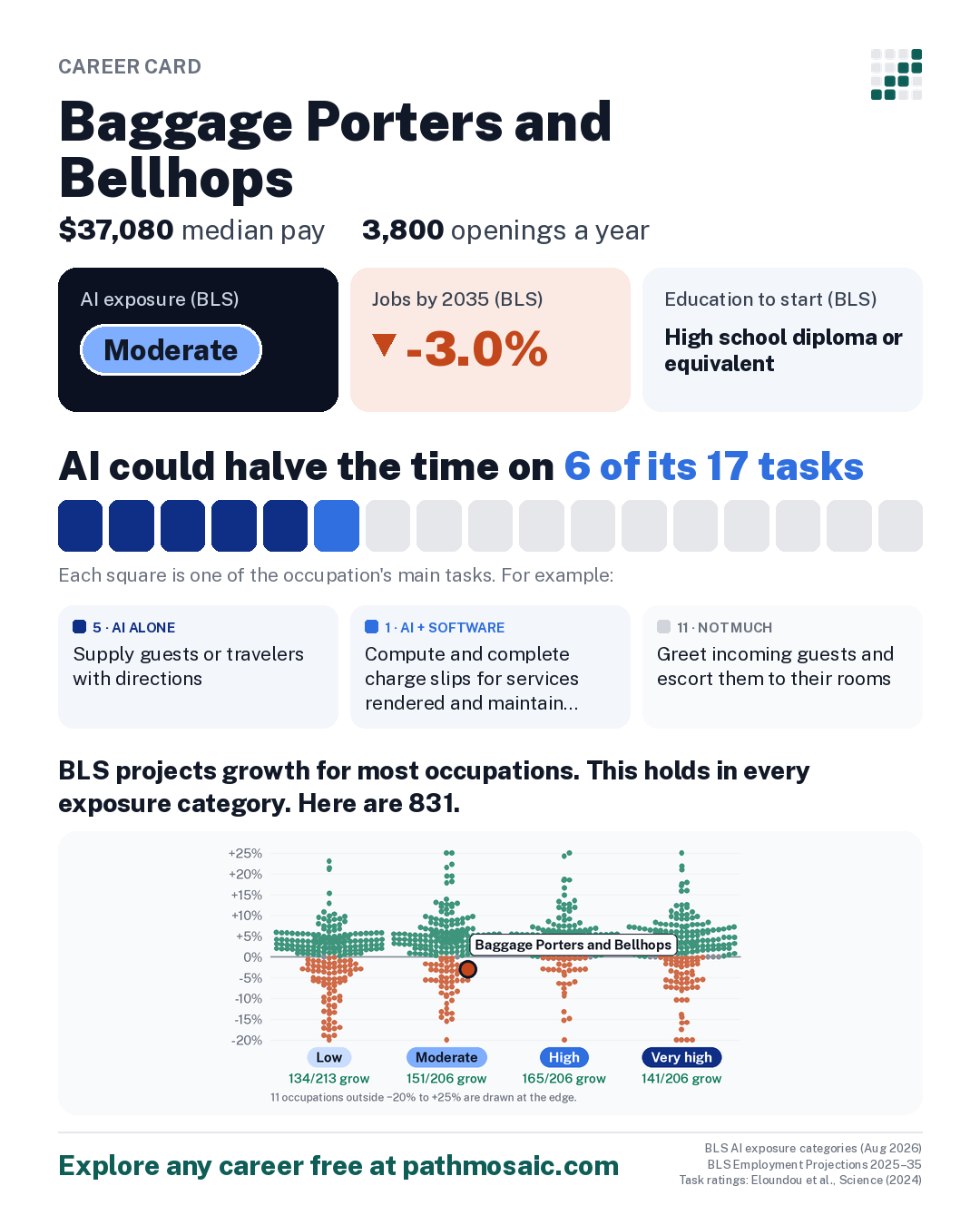
What the data says: AI could halve the time on 6 of its 17 tasks, and jobs are projected to shrink 3.0% by 2035. How to think about this →
About this projection
BLS builds AI into its projections where the research supports it: “BLS generally applies adjustments based on this research conservatively, where there is convincing evidence for a change.”
It also notes a limit: “BLS projection methods are not designed to capture extremely rapid technological change.”
On its AI exposure groups, BLS says exposure “does not imply job loss.”
Recent conditions
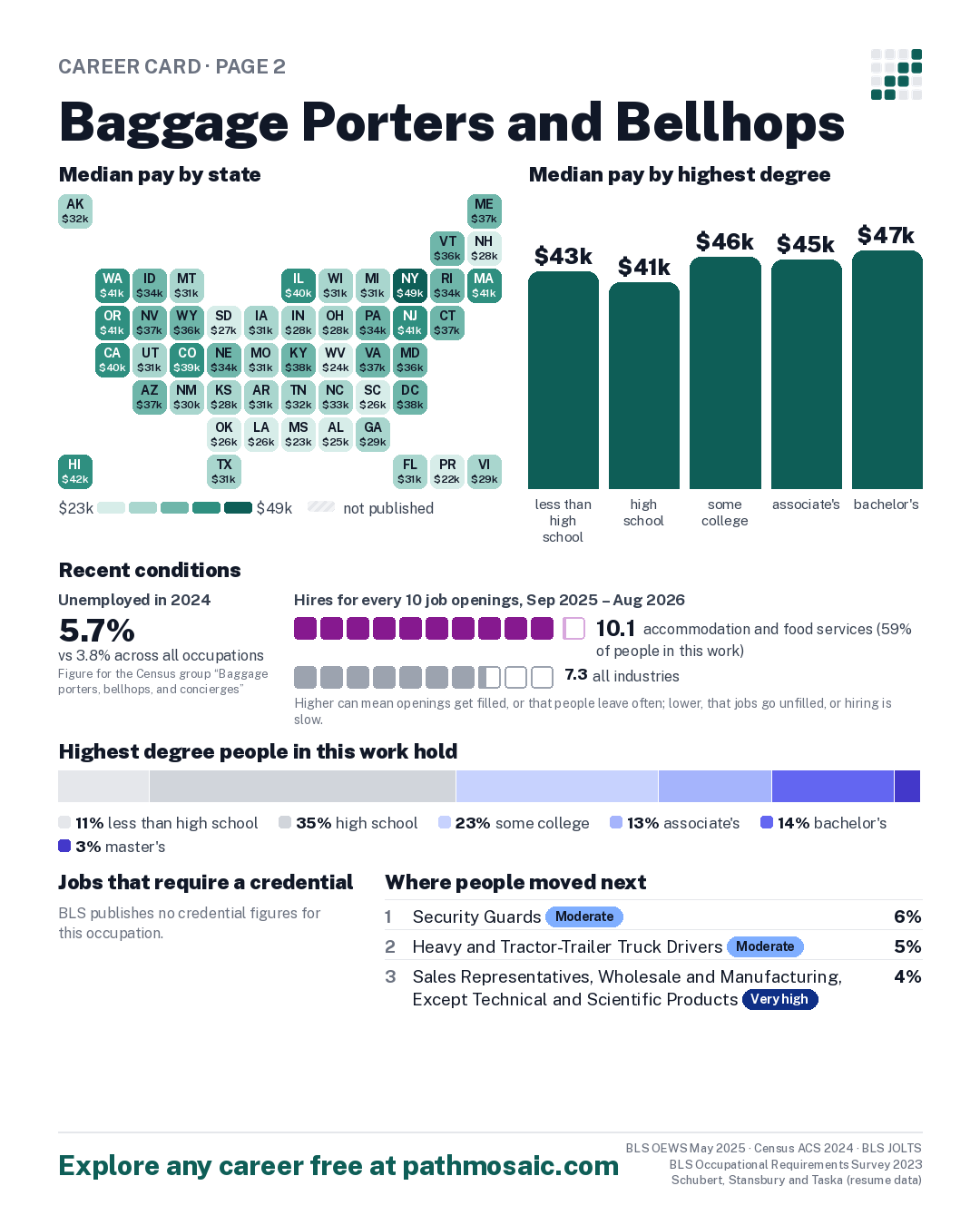
- In 2024, 5.7% of people in this work were unemployed, against 3.8% across all occupations Census ACS 2024, all workers in the Census group “Baggage porters, bellhops, and concierges”
- From Sep 2025 to Aug 2026, 10.1 hires for every 10 job openings in accommodation and food services, which employs about 59% of people in this work, against 7.3 across all industries BLS JOLTS
One box per opening, filled for each hire; hires beyond the openings are added in a lighter shade. Higher can mean openings get filled, or that people leave often; lower, that jobs go unfilled, or hiring is slow.10.1 this industry7.3 all industries
Median pay by state BLS OEWS May 2025, state estimates
Tap a state for its figures.
Median pay in every state
| State | Median | Middle half earn | Jobs |
|---|---|---|---|
| Alabama | $25,150 | $17,800 to $28,520 | 60 |
| Alaska | $32,150 | $28,220 to $33,360 | 70 |
| Arizona | $36,740 | $33,180 to $38,320 | 490 |
| Arkansas | $31,200 | $28,730 to $32,400 | 60 |
| California | $40,040 | $36,140 to $46,740 | 2,940 |
| Colorado | $39,160 | $37,910 to $39,870 | 410 |
| Connecticut | $37,420 | $35,730 to $41,830 | 130 |
| District of Columbia | $38,170 | $36,800 to $42,450 | 380 |
| Florida | $30,890 | $28,880 to $37,940 | 4,430 |
| Georgia | $29,070 | $22,880 to $34,320 | 370 |
| Hawaii | $42,240 | $36,840 to $51,600 | 1,370 |
| Idaho | $33,510 | $26,810 to $35,490 | 70 |
| Illinois | $40,390 | $37,080 to $44,420 | 1,480 |
| Indiana | $27,910 | $27,140 to $33,860 | 140 |
| Iowa | $31,150 | $24,760 to $34,370 | 30 |
| Kansas | $27,870 | $26,120 to $29,370 | 30 |
| Kentucky | $37,940 | $35,410 to $45,690 | 260 |
| Louisiana | $26,320 | $21,270 to $27,380 | 690 |
| Maine | $36,870 | $35,190 to $38,810 | 60 |
| Maryland | $36,310 | $34,180 to $38,900 | 520 |
| Massachusetts | $41,040 | $34,150 to $47,040 | 1,300 |
| Michigan | $30,930 | $28,570 to $33,810 | 410 |
| Mississippi | $22,560 | $21,600 to $29,360 | 220 |
| Missouri | $30,800 | $29,790 to $37,440 | 260 |
| Montana | $30,830 | $21,940 to $32,310 | 40 |
| Nebraska | $33,640 | $29,290 to $35,340 | 70 |
| Nevada | $36,880 | $30,020 to $44,250 | 2,170 |
| New Hampshire | $27,600 | $26,170 to $36,440 | 50 |
| New Jersey | $41,080 | $37,520 to $41,080 | 570 |
| New Mexico | $29,890 | $26,740 to $35,740 | 90 |
| New York | $48,610 | $41,690 to $56,600 | 3,610 |
| North Carolina | $32,940 | $30,300 to $35,110 | 650 |
| Ohio | $28,200 | $27,530 to $29,350 | 80 |
| Oklahoma | $26,260 | $18,500 to $27,510 | 130 |
| Oregon | $40,660 | $36,930 to $42,690 | 240 |
| Pennsylvania | $34,270 | $28,830 to $39,450 | 700 |
| Puerto Rico | $21,840 | $21,840 to $31,450 | 210 |
| Rhode Island | $34,300 | $31,200 to $47,210 | 40 |
| South Carolina | $25,850 | $22,080 to $30,120 | 330 |
| South Dakota | $27,490 | $27,010 to $29,040 | 40 |
| Tennessee | $32,060 | $17,730 to $35,550 | 570 |
| Texas | $31,080 | $22,700 to $35,980 | 1,050 |
| Utah | $30,730 | $29,600 to $37,290 | 240 |
| Vermont | $36,490 | $35,640 to $36,710 | 90 |
| Virgin Islands | $28,720 | $27,060 to $32,850 | 80 |
| Virginia | $36,530 | $32,750 to $40,480 | 800 |
| Washington | $41,010 | $38,680 to $46,310 | 270 |
| West Virginia | $24,090 | $24,090 to $31,080 | 50 |
| Wisconsin | $31,200 | $29,750 to $33,510 | 310 |
| Wyoming | $36,260 | $35,580 to $38,990 | 60 |
Nationally: $37,080. Shades run from the lowest state median to the highest; a territory below that range takes the lightest. How to read this
How AI touches the work
What AI could speed up, task by task, and where people already use it.
AI could halve the time on 6 of its 17 tasks
| AI rating | Its main tasks | Share of Claude conversations May 2026 |
|---|---|---|
| AI alone | Supply guests or travelers with directions, travel information, and other information, such as available services and points of interest. | 0.01% |
| Not much | Transfer luggage, trunks, and packages to and from rooms, loading areas, vehicles, or transportation terminals, by hand or using baggage carts. | Not published |
| Not much | Greet incoming guests and escort them to their rooms. | Not published |
| Not much | Receive and mark baggage by completing and attaching claim checks. | Not published |
| Not much | Assist travelers and guests with disabilities. | Not published |
| Not much | Transport guests about premises and local areas, or arrange for transportation. | Not published |
See all 17 tasks
| Not much | Pick up and return items for laundry and valet service. | Not published |
| AI alone | Explain the operation of room features, such as locks, ventilation systems, and televisions. | Not published |
| Not much | Maintain clean lobbies or entrance areas for travelers or guests. | Not published |
| Not much | Deliver messages and room service orders, and run errands for guests. | Not published |
| Not much | Act as part of the security team at transportation terminals, hotels, or similar establishments. | Not published |
| AI alone | Page guests in hotel lobbies, dining rooms, or other areas. | under 0.01% |
| Not much | Inspect guests' rooms to ensure that they are adequately stocked, orderly, and comfortable. | Not published |
| AI + software | Compute and complete charge slips for services rendered and maintain records. | Not published |
| AI alone | Arrange for shipments of baggage, express mail, and parcels by providing weighing and billing services. | Not published |
| Not much | Set up conference rooms, display tables, racks, or shelves, and arrange merchandise displays for sales personnel. | Not published |
| AI alone | Complete baggage insurance forms. | under 0.01% |
Ordered by how important O*NET's respondents rate each task (1 to 5) times the share who say it is part of their job. The ordering is ours. 3 of the 17 have a published share of Claude conversations; “not published” means too few conversations for Anthropic to publish a figure.
Where people already use AI
The tasks above say what AI could speed up. This shows what people are using it for. Its 17 tasks fall under 12 work activities that many occupations share, and Microsoft counted how often each one came up in 200,000 conversations with its Copilot assistant in 2024.
- #11 Provide information to guests, clients, or customers
- #12 Explain regulations, policies, or procedures
- #19 Provide general assistance to others, such as customers, patrons, or motorists
- and 1 more, in the table below
| Work activity | This occupation's tasks under it | People asked AI for help in 10,000 conversations |
AI did it for them in 10,000 conversations |
|---|---|---|---|
| Move materials, equipment, or supplies | |||
| Provide information to guests, clients, or customers | |||
| Provide general assistance to others, such as customers, patrons, or motorists | |||
| Escort others | |||
| Explain regulations, policies, or procedures | |||
| Perform administrative or clerical activities | |||
| Arrange displays or decorations | |||
| Monitor individual behavior or performance |
Show all 12 activities
| Clean tools, equipment, facilities, or work areas | |||
| Inspect facilities or equipment | |||
| Maintain sales or financial records | |||
| Assist individuals with special needs |
How people in this work use Claude
What people in this work made with Claude % of conversations
- Advice or a recommendation21%
- A document or report19%
- An explanation or answer16%
- A plan or strategy14%
- An email or message3%
How they worked with Claude
28% of these conversations were about work. Anthropic Economic Index, May 2026.
How to read this
Work activities come from O*NET, which links every task to the broader activities it involves. Microsoft's figures are for the activity across everyone who used Copilot, not for baggage porters and bellhops specifically. Copilot is a general chat assistant; dedicated coding tools are not included, so programming help is under-counted here. Activities are listed by how many of this occupation's tasks fall under them.
The task ratings say whether AI could halve the time a task takes: on its own (“AI alone”), or with software built on it (“AI + software”). They were made by people in 2023 (Eloundou et al.). Claude's share is the task's share of all Claude.ai conversations in May 2026; Anthropic doesn't publish a task with too few conversations. None of these add up to the BLS exposure group, which combines five research measures.
More in the Guide: task ratings · task order · work activities · Copilot figures · Claude
High exposure doesn't mean fewer jobs
BLS projects most occupations in its two most exposed groups to grow: 141 of 206 rated Very high and 165 of 206 rated High. Each dot is one of the 831 occupations BLS rates.
Career moves into and out of this occupation
From moves between occupations found in online resumes, 2002–2016. Career changes only: a first job after school isn't a move.
Where people moved next
of 7,323 moves out
- 1 Security Guards Moderate +0.9% 6%
- 2 Heavy and Tractor-Trailer Truck Drivers Moderate +3.8% 5%
- 3 Sales Representatives, Wholesale and Manufacturing, Except Technical and Scientific Products Very high -0.9% 4%
- 4 Hotel, Motel, and Resort Desk Clerks Very high +1.8% 4%
- 5 Compensation and Benefits Managers High +1.1% 4%
Where people moved in from
of 6,260 moves in
- 1 Security Guards Moderate +0.9% 6%
- 2 Fast Food and Counter Workers Moderate +5.8% 5%
- 3 Hotel, Motel, and Resort Desk Clerks Very high +1.8% 5%
- 4 First-Line Supervisors of Retail Sales Workers High -3.7% 3%
- 5 Waiters and Waitresses Moderate +2.0% 3%
Resumes over-represent younger, white-collar job-seekers and moves into management. Schubert, Stansbury and Taska (resume data).
Education and training for the occupation
O*NET survey of workers in this occupation
- 42% less than high school
- 41% high school
- 8% postsecondary certificate
- 9% some college
O*NET 31.0 survey of workers in this occupation · 19 people answered.
Census survey (American Community Survey)
- 11% less than high school
- 35% high school
- 23% some college
- 13% associate's
- 14% bachelor's
- 3% master's
Census ACS 2024, all workers in the Census group “Baggage porters, bellhops, and concierges” · 852 people surveyed.
Why the two can differ
O*NET asks about 20 people in each occupation, which makes its shares uncertain, but it reports the exact occupation and counts certificates. The Census survey reaches thousands, but it groups some occupations together and counts degrees only. More in the Guide
Median pay by highest degree full-time, year-round · Census ACS 2024, all workers in the Census group “Baggage porters, bellhops, and concierges”
Jobs that require a credential BLS Occupational Requirements Survey 2023
BLS publishes no credential figures for this occupation.
Look up certifications, training and licenses U.S. Department of Labor
- Certification Finder ↗ certifications CareerOneStop lists for this occupation
- Training Finder ↗ schools and programs, nationwide; narrow the place there
- License Finder ↗ licenses by state
- Apprenticeships: DOL's list of apprenticeable occupations doesn't include this one.
These open in a new tab and send only the occupation's public code. More in the Guide
BLS AI exposure categories (Aug 2026) · BLS Employment Projections 2025–35 · O*NET 31.0 · Task ratings: Eloundou et al., Science (2024) · Microsoft "Working with AI" v1.1 · Anthropic Economic Index (2026-06-26) · Schubert, Stansbury and Taska · NCES CIP–SOC · Census ACS 2024 · BLS JOLTS
See it online, and explore any career: https://www.pathmosaic.com/card/39-6011.00