Foresters
Also called: Area Forester, Procurement Forester, Silviculturist, Urban ForesterManage public and private forested lands for economic, recreational, and conservation purposes. May inventory the type, amount, and location of standing timber, appraise the timber's worth, negotiate the purchase, and draw up contracts for procurement. May determine how to conserve wildlife habitats, creek beds, water quality, and soil stability, and how best to comply with environmental regulations. May devise plans for planting and growing new trees, monitor trees for healthy growth, and determine optimal harvesting schedules.
On a phone, press and hold a picture to save it to Photos.
opens your phone's share sheet, where you can save both to Photos
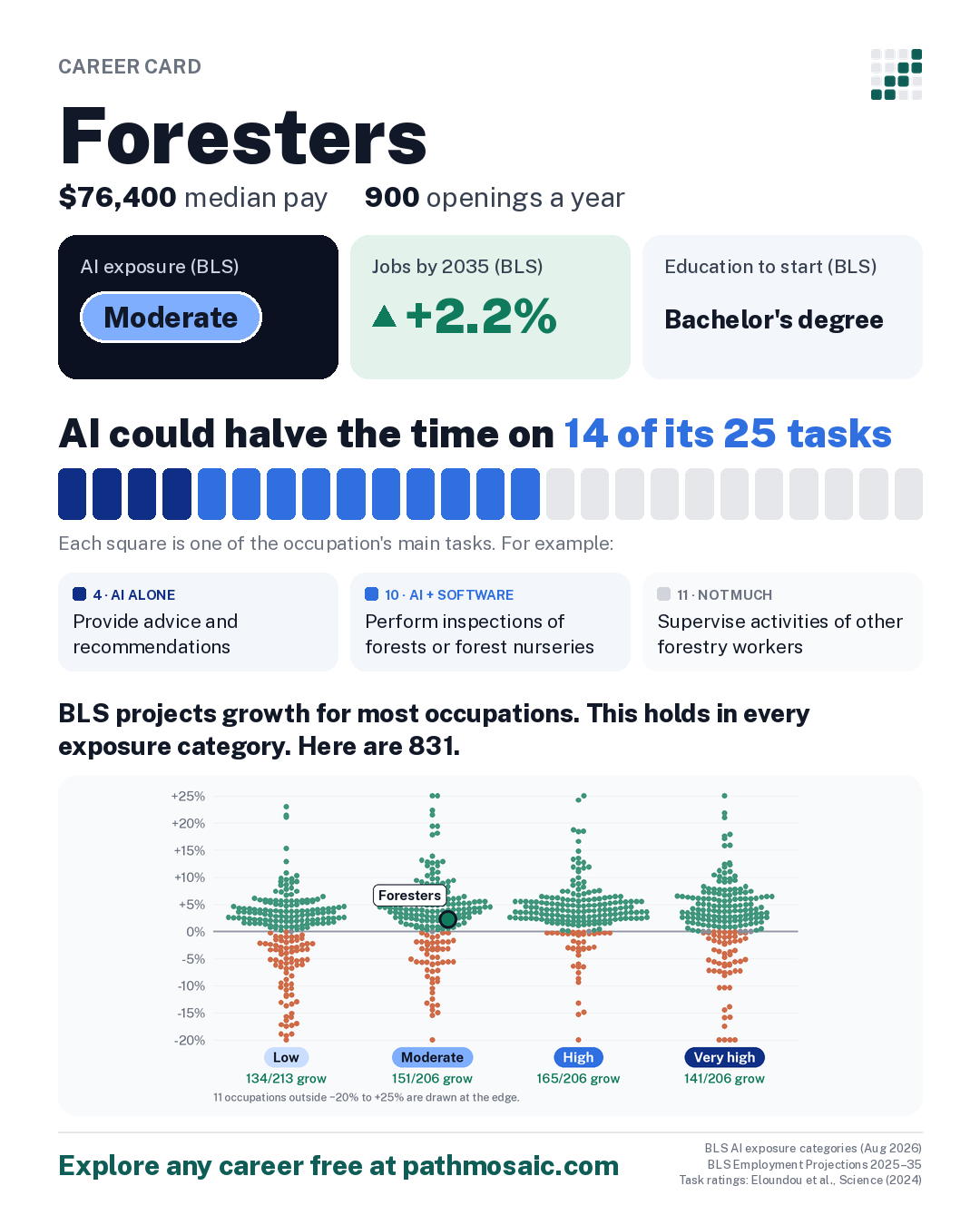
What the data says: AI could halve the time on 14 of its 25 tasks, yet jobs are projected to grow 2.2% by 2035. How to think about this →
About this projection
BLS builds AI into its projections where the research supports it: “BLS generally applies adjustments based on this research conservatively, where there is convincing evidence for a change.”
It also notes a limit: “BLS projection methods are not designed to capture extremely rapid technological change.”
On its AI exposure groups, BLS says exposure “does not imply job loss.”
Recent conditions
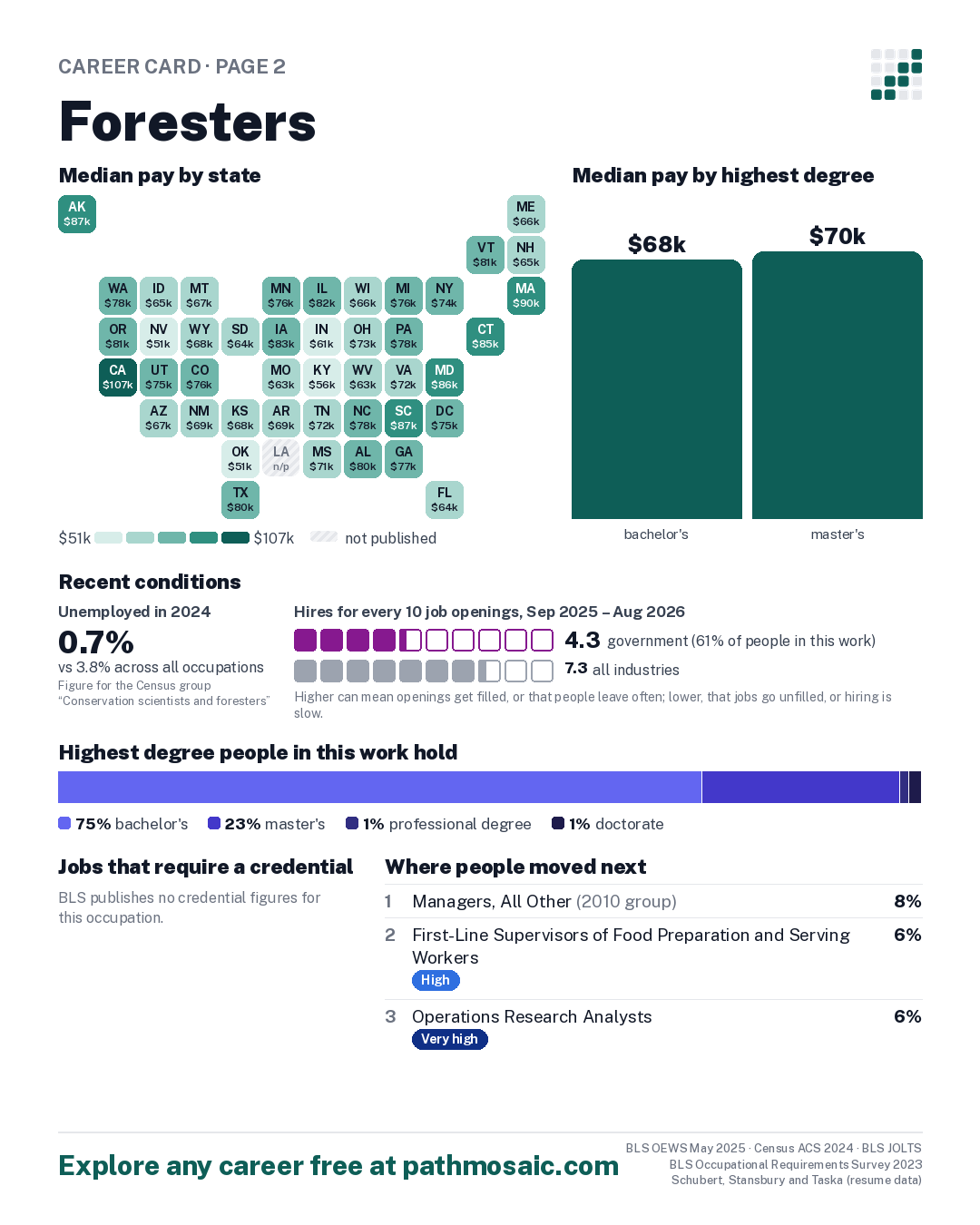
- In 2024, 0.7% of people in this work were unemployed, against 3.8% across all occupations Census ACS 2024, all workers in the Census group “Conservation scientists and foresters”
- From Sep 2025 to Aug 2026, 4.3 hires for every 10 job openings in government, which employs about 61% of people in this work, against 7.3 across all industries BLS JOLTS
One box per opening, filled for each hire; hires beyond the openings are added in a lighter shade. Higher can mean openings get filled, or that people leave often; lower, that jobs go unfilled, or hiring is slow.4.3 this industry7.3 all industries
Median pay by state BLS OEWS May 2025, state estimates
Tap a state for its figures.
Median pay in every state
| State | Median | Middle half earn | Jobs |
|---|---|---|---|
| Alabama | $79,530 | $60,040 to $87,050 | 240 |
| Alaska | $87,210 | $73,990 to $98,420 | 80 |
| Arizona | $67,200 | $61,110 to $79,440 | 70 |
| Arkansas | $69,240 | $56,360 to $78,850 | 130 |
| California | $107,120 | $91,170 to $130,430 | 820 |
| Colorado | $76,400 | $64,190 to $85,180 | 210 |
| Connecticut | $84,820 | $82,310 to $91,530 | 60 |
| District of Columbia | $74,710 | $74,700 to $75,450 | not published |
| Florida | $64,130 | $51,500 to $88,380 | 380 |
| Georgia | $76,970 | $60,980 to $109,690 | 370 |
| Idaho | $65,170 | $57,410 to $72,900 | 280 |
| Illinois | $82,160 | $73,490 to $105,580 | 220 |
| Indiana | $61,110 | $51,170 to $86,230 | 160 |
| Iowa | $83,000 | $68,470 to $94,800 | 50 |
| Kansas | $67,540 | $62,400 to $87,230 | 40 |
| Kentucky | $56,460 | $51,160 to $69,240 | 120 |
| Louisiana | not published | not published | 130 |
| Maine | $66,480 | $59,470 to $73,380 | 70 |
| Maryland | $86,100 | $62,260 to $95,150 | 120 |
| Massachusetts | $89,650 | $74,680 to $98,760 | 130 |
| Michigan | $75,920 | $63,860 to $85,430 | 340 |
| Minnesota | $76,490 | $67,370 to $88,000 | 390 |
| Mississippi | $71,280 | $53,770 to $92,170 | 110 |
| Missouri | $63,220 | $52,850 to $76,290 | 120 |
| Montana | $67,200 | $63,130 to $81,430 | 240 |
| Nevada | $51,070 | $47,360 to $58,510 | not published |
| New Hampshire | $65,170 | $49,340 to $86,070 | 110 |
| New Mexico | $69,240 | $61,760 to $79,710 | 50 |
| New York | $73,710 | $69,570 to $82,640 | 280 |
| North Carolina | $77,870 | $48,180 to $77,870 | not published |
| Ohio | $73,320 | $62,180 to $84,120 | 160 |
| Oklahoma | $50,990 | $50,830 to $68,590 | 120 |
| Oregon | $81,450 | $67,170 to $93,640 | 670 |
| Pennsylvania | $78,280 | $64,810 to $91,770 | 310 |
| South Carolina | $86,780 | $65,060 to $97,610 | 250 |
| South Dakota | $64,460 | $54,660 to $74,200 | 120 |
| Tennessee | $71,990 | $62,140 to $80,720 | 120 |
| Texas | $80,370 | $70,690 to $95,350 | 210 |
| Utah | $75,210 | $66,330 to $82,200 | 40 |
| Vermont | $80,750 | $70,200 to $89,320 | 80 |
| Virginia | $71,990 | $59,680 to $85,330 | 340 |
| Washington | $78,460 | $67,270 to $103,760 | 950 |
| West Virginia | $62,550 | $47,090 to $79,430 | 100 |
| Wisconsin | $66,010 | $60,880 to $78,880 | 570 |
| Wyoming | $68,180 | $63,130 to $79,820 | 60 |
Nationally: $76,400. Shades run from the lowest state median to the highest; a territory below that range takes the lightest. How to read this
How AI touches the work
What AI could speed up, task by task, and where people already use it.
AI could halve the time on 14 of its 25 tasks
| AI rating | Its main tasks | Share of Claude conversations May 2026 |
|---|---|---|
| AI + software | Establish short- and long-term plans for management of forest lands and forest resources. | Not published |
| AI + software | Monitor contract compliance and results of forestry activities to assure adherence to government regulations. | Not published |
| AI + software | Perform inspections of forests or forest nurseries. | Not published |
| Not much | Supervise activities of other forestry workers. | Not published |
| AI alone | Determine methods of cutting and removing timber with minimum waste and environmental damage. | Not published |
| Not much | Negotiate terms and conditions of agreements and contracts for forest harvesting, forest management and leasing of forest lands. | Not published |
See all 25 tasks
| AI + software | Plan cutting programs and manage timber sales from harvested areas, assisting companies to achieve production goals. | Not published |
| AI + software | Map forest area soils and vegetation to estimate the amount of standing timber and future value and growth. | Not published |
| Not much | Plan and supervise forestry projects, such as determining the type, number and placement of trees to be planted, managing tree nurseries, thinning forest and monitoring growth of new seedlings. | Not published |
| AI alone | Plan and direct forest surveys and related studies and prepare reports and recommendations. | Not published |
| AI alone | Provide advice and recommendations, as a consultant on forestry issues, to private woodlot owners, firefighters, government agencies or to companies. | Not published |
| AI + software | Develop techniques for measuring and identifying trees. | Not published |
| Not much | Choose and prepare sites for new trees, using controlled burning, bulldozers, or herbicides to clear weeds, brush, and logging debris. | Not published |
| Not much | Study different tree species' classification, life history, light and soil requirements, adaptation to new environmental conditions and resistance to disease and insects. | Not published |
| AI + software | Plan and implement projects for conservation of wildlife habitats and soil and water quality. | Not published |
| AI + software | Monitor forest-cleared lands to ensure that they are reclaimed to their most suitable end use. | Not published |
| Not much | Subcontract with loggers or pulpwood cutters for tree removal and to aid in road layout. | Not published |
| Not much | Conduct public educational programs on forest care and conservation. | Not published |
| AI alone | Analyze effect of forest conditions on tree growth rates and tree species prevalence and the yield, duration, seed production, growth viability, and germination of different species. | Not published |
| AI + software | Monitor wildlife populations and assess the impacts of forest operations on population and habitats. | Not published |
| Not much | Direct, and participate in, forest fire suppression. | Not published |
| Not much | Procure timber from private landowners. | Not published |
| Not much | Contact local forest owners and gain permission to take inventory of the type, amount, and location of all standing timber on the property. | Not published |
| Not much | Plan and direct construction and maintenance of recreation facilities, fire towers, trails, roads and bridges, ensuring that they comply with guidelines and regulations set for forested public lands. | Not published |
| AI + software | Develop new techniques for wood or residue use. | Not published |
Ordered by how important O*NET's respondents rate each task (1 to 5) times the share who say it is part of their job. The ordering is ours. 0 of the 25 have a published share of Claude conversations; “not published” means too few conversations for Anthropic to publish a figure.
Where people already use AI
The tasks above say what AI could speed up. This shows what people are using it for. Its 25 tasks fall under 19 work activities that many occupations share, and Microsoft counted how often each one came up in 200,000 conversations with its Copilot assistant in 2024.
- #36 Purchase goods or services
- #37 Determine operational methods or procedures
- #45 Research biological or ecological phenomena
| Work activity | This occupation's tasks under it | People asked AI for help in 10,000 conversations |
AI did it for them in 10,000 conversations |
|---|---|---|---|
| Manage agricultural or forestry operations | |||
| Develop plans for managing or preserving natural resources | |||
| Develop operational or technical procedures or standards | |||
| Monitor environmental conditions | |||
| Investigate the environmental impact of industrial or development activities | |||
| Negotiate contracts or agreements | |||
| Purchase goods or services | |||
| Determine operational methods or procedures |
Show all 19 activities
| Research biological or ecological phenomena | |||
| Obtain formal documentation or authorization | |||
| Develop professional relationships or networks | |||
| Develop research plans or methodologies | |||
| Research agricultural processes or practices | |||
| Develop educational programs, plans, or procedures | |||
| Perform agricultural activities | |||
| Advise others on environmental sustainability or green practices | |||
| Direct scientific or technical activities | |||
| Perform recruiting or hiring activities | |||
| Assess compliance with environmental standards or regulations |
How to read this
Work activities come from O*NET, which links every task to the broader activities it involves. Microsoft's figures are for the activity across everyone who used Copilot, not for foresters specifically. Copilot is a general chat assistant; dedicated coding tools are not included, so programming help is under-counted here. Activities are listed by how many of this occupation's tasks fall under them.
The task ratings say whether AI could halve the time a task takes: on its own (“AI alone”), or with software built on it (“AI + software”). They were made by people in 2023 (Eloundou et al.). Claude's share is the task's share of all Claude.ai conversations in May 2026; Anthropic doesn't publish a task with too few conversations. None of these add up to the BLS exposure group, which combines five research measures.
More in the Guide: task ratings · task order · work activities · Copilot figures · Claude
High exposure doesn't mean fewer jobs
BLS projects most occupations in its two most exposed groups to grow: 141 of 206 rated Very high and 165 of 206 rated High. Each dot is one of the 831 occupations BLS rates.
Career moves into and out of this occupation
From moves between occupations found in online resumes, 2002–2016. Career changes only: a first job after school isn't a move.
Where people moved next
of 1,153 moves out
- 1 Managers, All Other (2010 group) an older group BLS has since split; no exposure group today 8%
- 2 First-Line Supervisors of Food Preparation and Serving Workers High +5.4% 6%
- 3 Operations Research Analysts Very high +11.9% 6%
- 4 Forest Fire Inspectors and Prevention Specialists Moderate +13.1% 5%
- 5 Fast Food and Counter Workers Moderate +5.8% 5%
Where people moved in from
of 1,273 moves in
- 1 Fast Food and Counter Workers Moderate +5.8% 9%
- 2 First-Line Supervisors of Food Preparation and Serving Workers High +5.4% 7%
- 3 Teacher Assistants (2010 group) an older group BLS has since split; no exposure group today 5%
- 4 Operations Research Analysts Very high +11.9% 5%
- 5 Medical Records and Health Information Technicians (2010 group) an older group BLS has since split; no exposure group today 4%
Resumes over-represent younger, white-collar job-seekers and moves into management. Schubert, Stansbury and Taska (resume data).
Education and training for the occupation
Census survey (American Community Survey)
- 75% bachelor's
- 23% master's
- 1% professional degree
- 1% doctorate
Census ACS 2024, all workers in the Census group “Conservation scientists and foresters” · 400 people surveyed.
Median pay by highest degree full-time, year-round · Census ACS 2024, all workers in the Census group “Conservation scientists and foresters”
9 programs, such as Natural Resources/Conservation, General, Environmental/Natural Resources Management and Policy, General and Forestry, General.
See all
- Natural Resources/Conservation, General
- Environmental/Natural Resources Management and Policy, General
- Forestry, General
- Forest Sciences and Biology
- Forest Management/Forest Resources Management
- Urban Forestry
- Wood Science and Wood Products/Pulp and Paper Technology/Technician
- Forest Resources Production and Management
- Forestry, Other
Jobs that require a credential BLS Occupational Requirements Survey 2023
BLS publishes no credential figures for this occupation.
Look up certifications, training and licenses U.S. Department of Labor
- Certification Finder ↗ certifications CareerOneStop lists for this occupation
- Training Finder ↗ schools and programs, nationwide; narrow the place there
- License Finder ↗ licenses by state
- Apprenticeships: DOL's list of apprenticeable occupations doesn't include this one.
These open in a new tab and send only the occupation's public code. More in the Guide
BLS AI exposure categories (Aug 2026) · BLS Employment Projections 2025–35 · O*NET 31.0 · Task ratings: Eloundou et al., Science (2024) · Microsoft "Working with AI" v1.1 · Anthropic Economic Index (2026-06-26) · Schubert, Stansbury and Taska · NCES CIP–SOC · Census ACS 2024 · BLS JOLTS
See it online, and explore any career: https://www.pathmosaic.com/card/19-1032.00