Hydrologic Technicians
Collect and organize data concerning the distribution and circulation of ground and surface water, and data on its physical, chemical, and biological properties. Measure and report on flow rates and ground water levels, maintain field equipment, collect water samples, install and collect sampling equipment, and process samples for shipment to testing laboratories. May collect data on behalf of hydrologists, engineers, developers, government agencies, or agriculture.
On a phone, press and hold a picture to save it to Photos.
opens your phone's share sheet, where you can save both to Photos
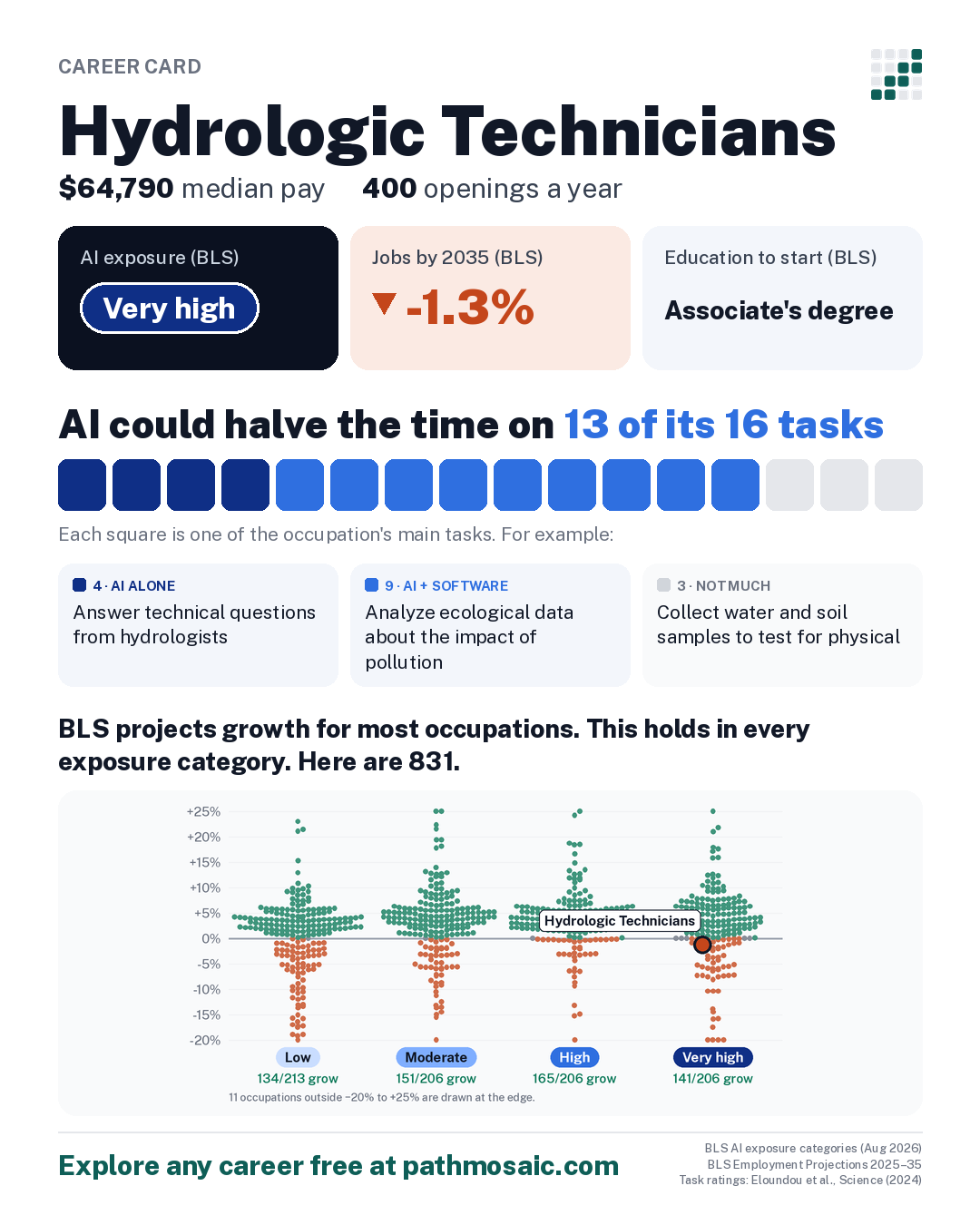
What the data says: AI could halve the time on 13 of its 16 tasks, and jobs are projected to shrink 1.3% by 2035. In the most exposed occupations, the squeeze shows up first among early-career workers. How to think about this →
About this projection
BLS builds AI into its projections where the research supports it: “BLS generally applies adjustments based on this research conservatively, where there is convincing evidence for a change.”
It also notes a limit: “BLS projection methods are not designed to capture extremely rapid technological change.”
On its AI exposure groups, BLS says exposure “does not imply job loss.”
Recent conditions
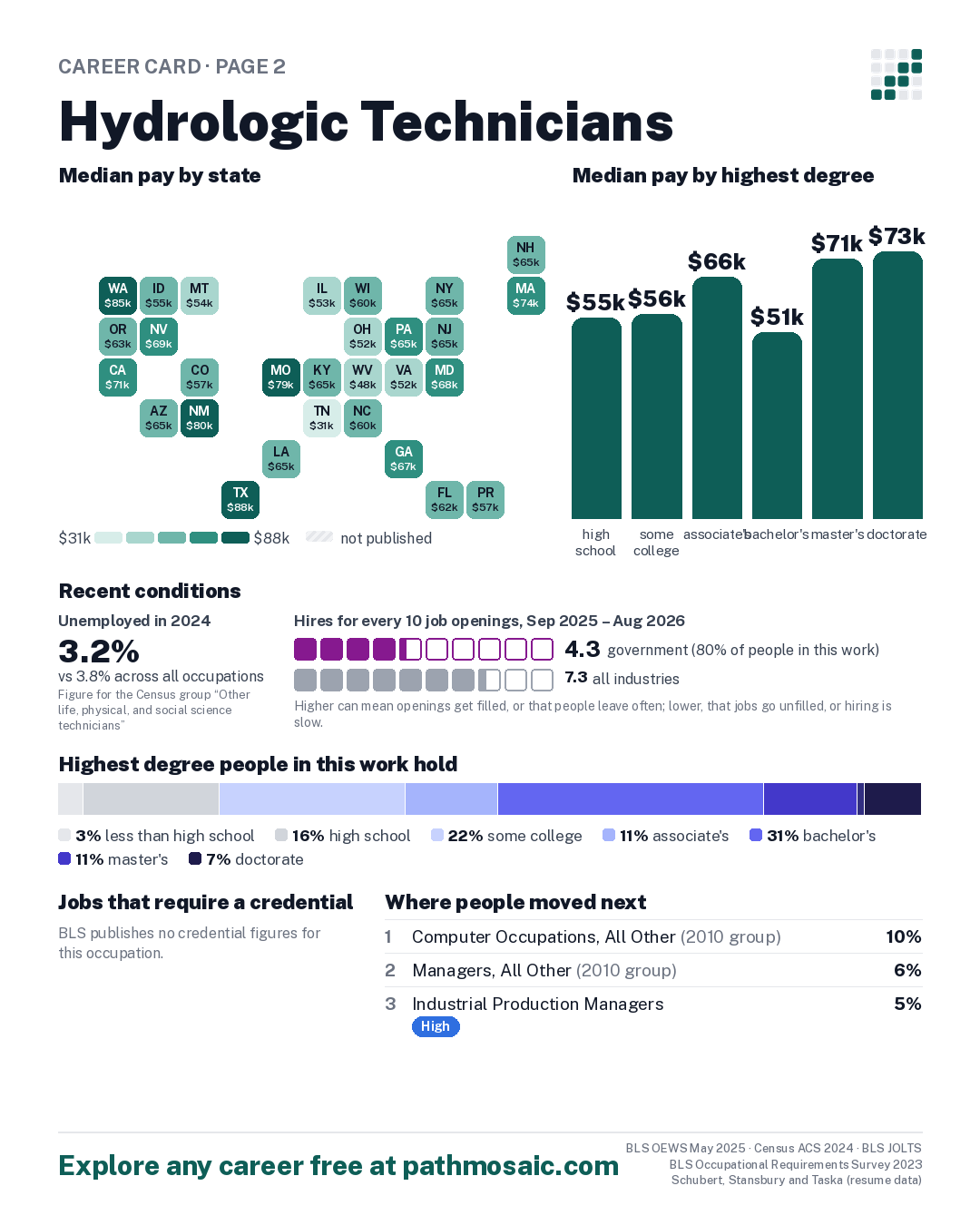
- In 2024, 3.2% of people in this work were unemployed, against 3.8% across all occupations Census ACS 2024, all workers in the Census group “Other life, physical, and social science technicians”
- From Sep 2025 to Aug 2026, 4.3 hires for every 10 job openings in government, which employs about 80% of people in this work, against 7.3 across all industries BLS JOLTS
One box per opening, filled for each hire; hires beyond the openings are added in a lighter shade. Higher can mean openings get filled, or that people leave often; lower, that jobs go unfilled, or hiring is slow.4.3 this industry7.3 all industries
Median pay by state BLS OEWS May 2025, state estimates
Tap a state for its figures.
Median pay in every state
| State | Median | Middle half earn | Jobs |
|---|---|---|---|
| Arizona | $65,170 | $52,110 to $84,560 | 50 |
| California | $70,790 | $55,370 to $88,900 | 300 |
| Colorado | $56,780 | $52,300 to $76,400 | not published |
| Florida | $61,820 | $50,210 to $79,950 | 240 |
| Georgia | $66,770 | $49,050 to $83,780 | 60 |
| Idaho | $54,950 | $47,690 to $74,010 | 50 |
| Illinois | $52,870 | $52,870 to $55,330 | not published |
| Kentucky | $65,170 | $55,330 to $80,090 | 30 |
| Louisiana | $65,170 | $54,950 to $81,330 | 40 |
| Maryland | $67,520 | $49,210 to $84,700 | 50 |
| Massachusetts | $73,820 | $60,910 to $92,490 | 60 |
| Missouri | $79,440 | $55,430 to $87,880 | 40 |
| Montana | $53,550 | $44,950 to $67,200 | 70 |
| Nevada | $68,660 | $57,220 to $90,630 | 30 |
| New Hampshire | $64,790 | $62,770 to $82,620 | 50 |
| New Jersey | $65,190 | $52,920 to $84,570 | 40 |
| New Mexico | $79,710 | $59,650 to $97,580 | 50 |
| New York | $65,190 | $53,290 to $83,780 | 50 |
| North Carolina | $59,590 | $51,460 to $70,750 | 110 |
| Ohio | $52,120 | $37,790 to $74,900 | 80 |
| Oregon | $62,510 | $55,330 to $79,750 | 80 |
| Pennsylvania | $65,420 | $49,510 to $91,730 | 100 |
| Puerto Rico | $57,160 | $27,390 to $65,170 | 30 |
| Tennessee | $30,780 | $27,730 to $76,400 | not published |
| Texas | $88,400 | $59,530 to $115,210 | 270 |
| Virginia | $52,190 | $46,950 to $74,010 | 40 |
| Washington | $85,240 | $64,250 to $93,270 | 70 |
| West Virginia | $48,230 | $40,230 to $58,790 | not published |
| Wisconsin | $60,100 | $49,900 to $81,330 | 50 |
Nationally: $64,790. Shades run from the lowest state median to the highest; a territory below that range takes the lightest. How to read this
How AI touches the work
What AI could speed up, task by task, and where people already use it.
AI could halve the time on 13 of its 16 tasks
| AI rating | Its main tasks | Share of Claude conversations May 2026 |
|---|---|---|
| AI + software | Analyze ecological data about the impact of pollution, erosion, floods, and other environmental problems on bodies of water. | under 0.01% |
| AI alone | Answer technical questions from hydrologists, policymakers, or other customers developing water conservation plans. | Not published |
| AI + software | Apply research findings to minimize the environmental impacts of pollution, waterborne diseases, erosion, or sedimentation. | Not published |
| AI + software | Assist in designing programs to ensure the proper sealing of abandoned wells. | Not published |
| Not much | Collect water and soil samples to test for physical, chemical, or biological properties, such as pH, oxygen level, temperature, and pollution. | Not published |
| AI + software | Develop computer models for hydrologic predictions. | Not published |
See all 16 tasks
| AI + software | Estimate the costs and benefits of municipal projects, such as hydroelectric power plants, irrigation systems, and wastewater treatment facilities. | under 0.01% |
| AI + software | Investigate complaints or conflicts related to the alteration of public waters by gathering information, recommending alternatives, or preparing legal documents. | Not published |
| AI alone | Investigate the properties, origins, or activities of glaciers, ice, snow, or permafrost. | Not published |
| AI + software | Locate and deliver information or data as requested by customers, such as contractors, government entities, and members of the public. | 0.04% |
| Not much | Measure the properties of bodies of water, such as water levels, volume, and flow. | Not published |
| AI alone | Perform quality control checks on data to be used by hydrologists. | Not published |
| Not much | Prepare, install, maintain, or repair equipment used for hydrologic study, such as water level recorders, stream flow gauges, and water analyzers. | Not published |
| AI + software | Provide real time data to emergency management and weather service personnel during flood events. | Not published |
| AI alone | Write groundwater contamination reports on known, suspected, or potential hazardous waste sites. | Not published |
| AI + software | Write materials for research publications, such as maps, tables, and reports, to disseminate findings. | 0.01% |
O*NET hasn't rated these tasks, so they're in O*NET's own order. 4 of the 16 have a published share of Claude conversations; “not published” means too few conversations for Anthropic to publish a figure.
Where people already use AI
The tasks above say what AI could speed up. This shows what people are using it for. Its 16 tasks fall under 18 work activities that many occupations share, and Microsoft counted how often each one came up in 200,000 conversations with its Copilot assistant in 2024.
- #1 Gather information from physical or electronic sources
- #14 Create visual designs or displays
- #20 Present research or technical information
- and 1 more, in the table below
| Work activity | This occupation's tasks under it | People asked AI for help in 10,000 conversations |
AI did it for them in 10,000 conversations |
|---|---|---|---|
| Present research or technical information | |||
| Advise others on environmental sustainability or green practices | |||
| Gather information from physical or electronic sources | |||
| Create visual designs or displays | |||
| Compile records, documentation, or other data | |||
| Evaluate the quality or accuracy of data | |||
| Research issues related to earth sciences | |||
| Evaluate designs, specifications, or other technical data |
Show all 18 activities
| Communicate environmental or sustainability information | |||
| Measure physical characteristics of materials, products, or equipment | |||
| Develop scientific or mathematical theories or models | |||
| Clean tools, equipment, facilities, or work areas | |||
| Assemble equipment or components | |||
| Analyze environmental or geospatial data | |||
| Develop systems or practices to mitigate or resolve environmental problems | |||
| Perform general construction or extraction activities | |||
| Advise others on workplace health or safety issues | |||
| Collect environmental or biological samples |
How people in this work use Claude
What people in this work made with Claude % of conversations
- An explanation or answer26%
- A document or report17%
- An analysis or summary16%
- Data or a spreadsheet6%
- An academic paper or thesis5%
How they worked with Claude
47% of these conversations were about work. Anthropic Economic Index, May 2026.
How to read this
Work activities come from O*NET, which links every task to the broader activities it involves. Microsoft's figures are for the activity across everyone who used Copilot, not for hydrologic technicians specifically. Copilot is a general chat assistant; dedicated coding tools are not included, so programming help is under-counted here. Activities are listed by how many of this occupation's tasks fall under them.
The task ratings say whether AI could halve the time a task takes: on its own (“AI alone”), or with software built on it (“AI + software”). They were made by people in 2023 (Eloundou et al.). Claude's share is the task's share of all Claude.ai conversations in May 2026; Anthropic doesn't publish a task with too few conversations. None of these add up to the BLS exposure group, which combines five research measures.
More in the Guide: task ratings · task order · work activities · Copilot figures · Claude
High exposure doesn't mean fewer jobs
BLS projects most occupations in its two most exposed groups to grow: 141 of 206 rated Very high and 165 of 206 rated High. Each dot is one of the 831 occupations BLS rates.
Career moves into and out of this occupation
From moves between occupations found in online resumes, 2002–2016. Career changes only: a first job after school isn't a move.
Where people moved next
of 108,739 moves out
- 1 Computer Occupations, All Other (2010 group) an older group BLS has since split; no exposure group today 10%
- 2 Managers, All Other (2010 group) an older group BLS has since split; no exposure group today 6%
- 3 Industrial Production Managers High +2.6% 5%
- 4 Inspectors, Testers, Sorters, Samplers, and Weighers Moderate +2.5% 4%
- 5 Management Analysts Very high +10.1% 3%
Where people moved in from
of 108,087 moves in
- 1 Computer Occupations, All Other (2010 group) an older group BLS has since split; no exposure group today 7%
- 2 Managers, All Other (2010 group) an older group BLS has since split; no exposure group today 5%
- 3 Customer Service Representatives Very high -5.3% 4%
- 4 Inspectors, Testers, Sorters, Samplers, and Weighers Moderate +2.5% 4%
- 5 Industrial Production Managers High +2.6% 3%
The resume data uses 2010 occupation codes. This occupation comes from “Geological and Petroleum Technicians” and “Life, Physical, and Social Science Technicians, All Other”, which today also include “Geological Technicians, Except Hydrologic Technicians” and the occupation still called “Life, Physical, and Social Science Technicians, All Other”, so these figures cover those too. Resumes over-represent younger, white-collar job-seekers and moves into management. Schubert, Stansbury and Taska (resume data).
Education and training for the occupation
Census survey (American Community Survey)
- 3% less than high school
- 16% high school
- 22% some college
- 11% associate's
- 31% bachelor's
- 11% master's
- 1% professional degree
- 7% doctorate
Census ACS 2024, all workers in the Census group “Other life, physical, and social science technicians” · 3,263 people surveyed.
Median pay by highest degree full-time, year-round · Census ACS 2024, all workers in the Census group “Other life, physical, and social science technicians”
4 programs, such as Hydrology and Water Resources Science, Science Technologies/Technicians, General and Physical Science Technologies/Technicians, Other.
See all
- Hydrology and Water Resources Science
- Science Technologies/Technicians, General
- Physical Science Technologies/Technicians, Other
- Science Technologies/Technicians, Other
Jobs that require a credential BLS Occupational Requirements Survey 2023
BLS publishes no credential figures for this occupation.
Look up certifications, training and licenses U.S. Department of Labor
- Certification Finder ↗ certifications CareerOneStop lists for this occupation
- Training Finder ↗ schools and programs, nationwide; narrow the place there
- License Finder ↗ licenses by state
- Apprenticeships: DOL's list of apprenticeable occupations doesn't include this one.
These open in a new tab and send only the occupation's public code. More in the Guide
BLS AI exposure categories (Aug 2026) · BLS Employment Projections 2025–35 · O*NET 31.0 · Task ratings: Eloundou et al., Science (2024) · Microsoft "Working with AI" v1.1 · Anthropic Economic Index (2026-06-26) · Schubert, Stansbury and Taska · NCES CIP–SOC · Census ACS 2024 · BLS JOLTS · Brynjolfsson, Chandar and Chen, Stanford (Aug 2026)
See it online, and explore any career: https://www.pathmosaic.com/card/19-4044.00