Rail-Track Laying and Maintenance Equipment Operators
Also called: Track Inspector, Track Laborer, Track Maintainer, Track RepairerLay, repair, and maintain track for standard or narrow-gauge railroad equipment used in regular railroad service or in plant yards, quarries, sand and gravel pits, and mines. Includes ballast cleaning machine operators and railroad bed tamping machine operators.
On a phone, press and hold a picture to save it to Photos.
opens your phone's share sheet, where you can save both to Photos
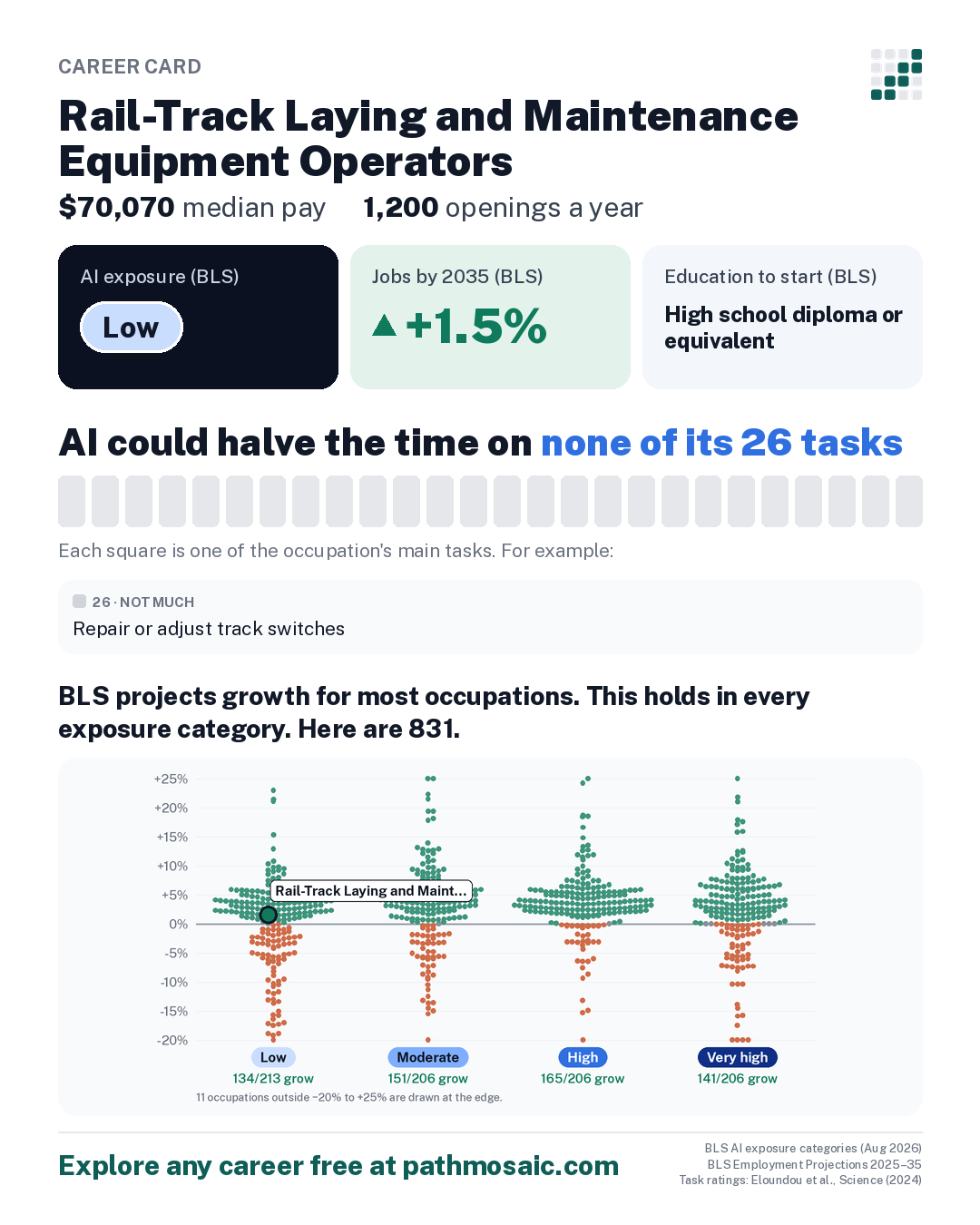
What the data says: AI couldn't halve the time on any of its 26 tasks, and jobs are projected to grow 1.5% by 2035. How to think about this →
About this projection
BLS builds AI into its projections where the research supports it: “BLS generally applies adjustments based on this research conservatively, where there is convincing evidence for a change.”
It also notes a limit: “BLS projection methods are not designed to capture extremely rapid technological change.”
On its AI exposure groups, BLS says exposure “does not imply job loss.”
Recent conditions
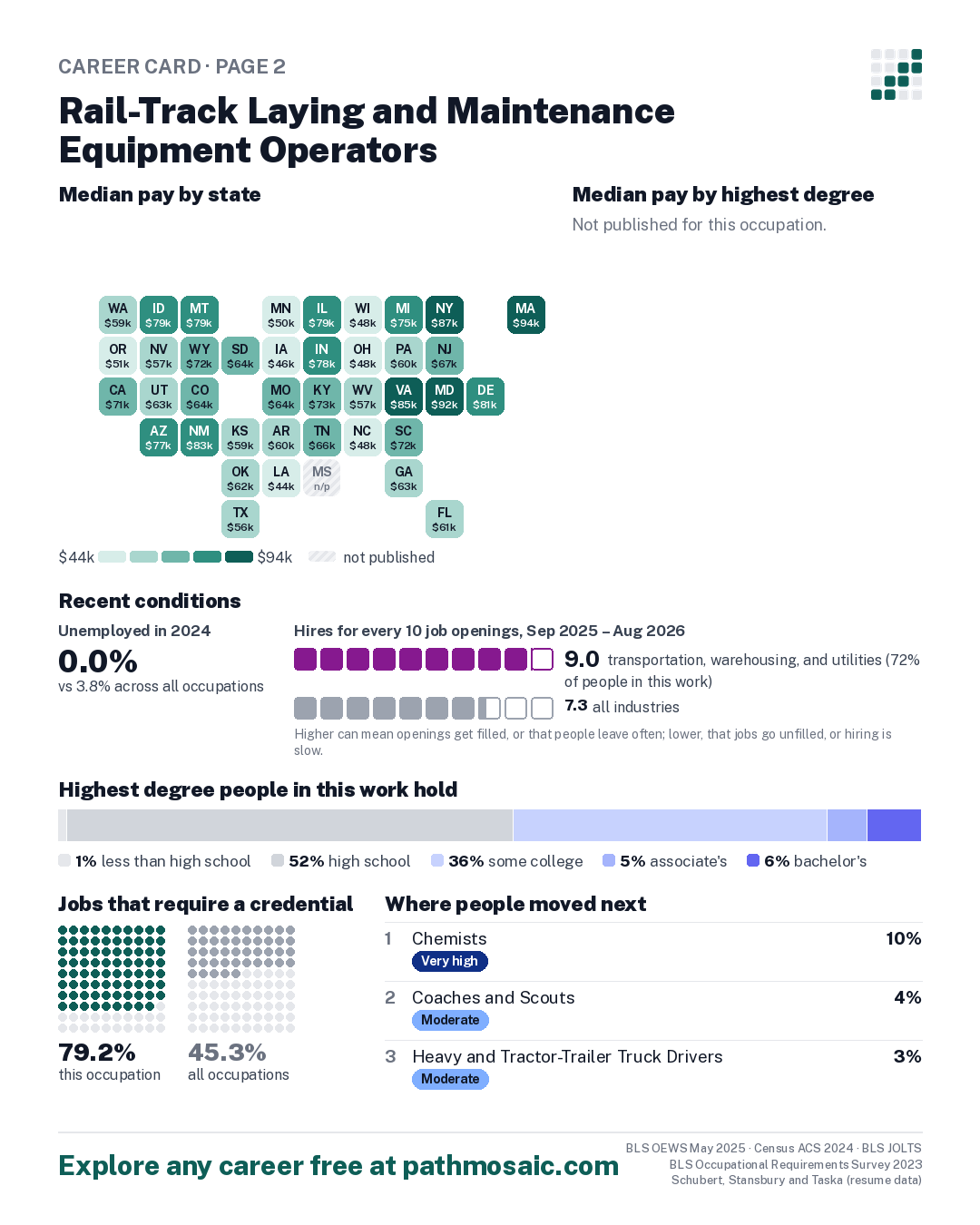
- In 2024, 0.0% of people in this work were unemployed, against 3.8% across all occupations Census ACS 2024
- From Sep 2025 to Aug 2026, 9.0 hires for every 10 job openings in transportation, warehousing, and utilities, which employs about 72% of people in this work, against 7.3 across all industries BLS JOLTS
One box per opening, filled for each hire; hires beyond the openings are added in a lighter shade. Higher can mean openings get filled, or that people leave often; lower, that jobs go unfilled, or hiring is slow.9.0 this industry7.3 all industries
Median pay by state BLS OEWS May 2025, state estimates
Tap a state for its figures.
Median pay in every state
| State | Median | Middle half earn | Jobs |
|---|---|---|---|
| Arizona | $76,620 | $54,720 to $82,260 | 170 |
| Arkansas | $60,230 | $50,680 to $70,830 | 150 |
| California | $71,170 | $57,820 to $75,290 | 770 |
| Colorado | $64,300 | $54,360 to $77,030 | 300 |
| Delaware | $80,610 | $55,230 to $92,150 | 130 |
| Florida | $61,220 | $45,710 to $61,340 | 490 |
| Georgia | $63,010 | $51,940 to $78,100 | 710 |
| Idaho | $79,020 | $49,390 to $81,820 | 90 |
| Illinois | $78,910 | $63,010 to $83,740 | 1,190 |
| Indiana | $78,020 | $74,730 to $80,560 | 320 |
| Iowa | $45,640 | $35,210 to $81,400 | 200 |
| Kansas | $58,590 | $58,310 to $71,440 | 310 |
| Kentucky | $73,120 | $51,040 to $73,200 | 270 |
| Louisiana | $44,150 | $42,660 to $45,200 | not published |
| Maryland | $92,030 | $80,290 to $100,490 | 320 |
| Massachusetts | $94,330 | $68,180 to $101,350 | 570 |
| Michigan | $75,450 | $57,920 to $80,810 | 290 |
| Minnesota | $49,640 | $45,090 to $80,840 | 760 |
| Mississippi | not published | not published | 310 |
| Missouri | $64,390 | $47,350 to $71,220 | 410 |
| Montana | $79,170 | $79,170 to $80,440 | 200 |
| Nevada | $56,740 | $48,120 to $73,810 | 40 |
| New Jersey | $66,540 | $61,250 to $82,520 | 230 |
| New Mexico | $83,370 | $58,020 to $83,400 | 80 |
| New York | $87,150 | $70,070 to $87,150 | 3,590 |
| North Carolina | $47,700 | $44,220 to $58,720 | 270 |
| Ohio | $47,980 | $47,920 to $51,780 | 1,130 |
| Oklahoma | $61,860 | $47,940 to $75,450 | 310 |
| Oregon | $50,930 | $46,950 to $72,020 | 190 |
| Pennsylvania | $59,800 | $56,700 to $81,630 | 830 |
| South Carolina | $71,770 | $71,770 to $73,120 | 30 |
| South Dakota | $64,500 | $62,940 to $66,130 | 110 |
| Tennessee | $66,390 | $51,950 to $77,670 | 260 |
| Texas | $56,470 | $47,580 to $70,630 | 940 |
| Utah | $63,190 | $53,110 to $83,310 | 60 |
| Virginia | $84,750 | $62,540 to $84,750 | 360 |
| Washington | $58,740 | $56,190 to $72,580 | 500 |
| West Virginia | $56,660 | $48,060 to $64,160 | 270 |
| Wisconsin | $47,920 | $47,850 to $72,780 | 180 |
| Wyoming | $71,580 | $66,360 to $79,810 | 220 |
Nationally: $70,070. Shades run from the lowest state median to the highest; a territory below that range takes the lightest. How to read this
How AI touches the work
What AI could speed up, task by task, and where people already use it.
AI could halve the time on none of its 26 tasks
| AI rating | Its main tasks | Share of Claude conversations May 2026 |
|---|---|---|
| Not much | Repair or adjust track switches, using wrenches and replacement parts. | Not published |
| Not much | Patrol assigned track sections so that damaged or broken track can be located and reported. | Not published |
| Not much | Engage mechanisms that lay tracks or rails to specified gauges. | Not published |
| Not much | Cut rails to specified lengths, using rail saws. | Not published |
| Not much | Operate track wrenches to tighten or loosen bolts at joints that hold ends of rails together. | Not published |
| Not much | Lubricate machines, change oil, or fill hydraulic reservoirs to specified levels. | Not published |
See all 26 tasks
| Not much | Drill holes through rails, tie plates, or fishplates for insertion of bolts or spikes, using power drills. | Not published |
| Not much | Clean tracks or clear ice or snow from tracks or switch boxes. | Not published |
| Not much | Dress and reshape worn or damaged railroad switch points or frogs, using portable power grinders. | Not published |
| Not much | Clean or make minor repairs to machines or equipment. | Not published |
| Not much | Clean, grade, or level ballast on railroad tracks. | Not published |
| Not much | Operate single- or multiple-head spike driving machines to drive spikes into ties and secure rails. | Not published |
| Not much | Spray ties, fishplates, or joints with oil to protect them from weathering. | Not published |
| Not much | Raise rails, using hydraulic jacks, to allow for tie removal and replacement. | Not published |
| Not much | Grind ends of new or worn rails to attain smooth joints, using portable grinders. | Not published |
| Not much | Operate single- or multiple-head spike pullers to pull old spikes from ties. | Not published |
| Not much | Weld sections of track together, such as switch points and frogs. | Not published |
| Not much | Observe leveling indicator arms to verify levelness and alignment of tracks. | Not published |
| Not much | Drive vehicles that automatically move and lay tracks or rails over sections of track to be constructed, repaired, or maintained. | Not published |
| Not much | Drive graders, tamping machines, brooms, or ballast spreading machines to redistribute gravel or ballast between rails. | Not published |
| Not much | String and attach wire-guidelines machine to rails so that tracks or rails can be aligned or leveled. | Not published |
| Not much | Push controls to close grasping devices on track or rail sections so that they can be raised or moved. | Not published |
| Not much | Paint railroad signs, such as speed limits or gate-crossing warnings. | Not published |
| Not much | Adjust controls of machines that spread, shape, raise, level, or align track, according to specifications. | Not published |
| Not much | Turn wheels of machines, using lever controls, to adjust guidelines for track alignments or grades, following specifications. | Not published |
| Not much | Operate tie-adzing machines to cut ties and permit insertion of fishplates that hold rails. | Not published |
Ordered by how important O*NET's respondents rate each task (1 to 5) times the share who say it is part of their job. The ordering is ours. 0 of the 26 have a published share of Claude conversations; “not published” means too few conversations for Anthropic to publish a figure.
Where people already use AI
The tasks above say what AI could speed up. This shows what people are using it for. Its 26 tasks fall under 12 work activities that many occupations share, and Microsoft counted how often each one came up in 200,000 conversations with its Copilot assistant in 2024.
| Work activity | This occupation's tasks under it | People asked AI for help in 10,000 conversations |
AI did it for them in 10,000 conversations |
|---|---|---|---|
| Operate construction or excavation equipment | |||
| Maintain tools or equipment | |||
| Clean tools, equipment, facilities, or work areas | |||
| Apply protective solutions or coatings | |||
| Cut materials | |||
| Perform general construction or extraction activities | |||
| Inspect completed work or finished products | |||
| Smooth surfaces of objects or equipment |
Show all 12 activities
| Inspect commercial, industrial, or production systems or equipment | |||
| Drill holes in earth or materials | |||
| Join parts using soldering, welding, or brazing techniques | |||
| Operate lifting or moving equipment |
How to read this
Work activities come from O*NET, which links every task to the broader activities it involves. Microsoft's figures are for the activity across everyone who used Copilot, not for rail-track laying and maintenance equipment operators specifically. Copilot is a general chat assistant; dedicated coding tools are not included, so programming help is under-counted here. Activities are listed by how many of this occupation's tasks fall under them.
The task ratings say whether AI could halve the time a task takes: on its own (“AI alone”), or with software built on it (“AI + software”). They were made by people in 2023 (Eloundou et al.). Claude's share is the task's share of all Claude.ai conversations in May 2026; Anthropic doesn't publish a task with too few conversations. None of these add up to the BLS exposure group, which combines five research measures.
More in the Guide: task ratings · task order · work activities · Copilot figures · Claude
High exposure doesn't mean fewer jobs
BLS projects most occupations in its two most exposed groups to grow: 141 of 206 rated Very high and 165 of 206 rated High. Each dot is one of the 831 occupations BLS rates.
Career moves into and out of this occupation
From moves between occupations found in online resumes, 2002–2016. Career changes only: a first job after school isn't a move.
Where people moved next
of 1,715 moves out
- 1 Chemists Very high +6.4% 10%
- 2 Coaches and Scouts Moderate +6.1% 4%
- 3 Heavy and Tractor-Trailer Truck Drivers Moderate +3.8% 3%
- 4 Managers, All Other (2010 group) an older group BLS has since split; no exposure group today 3%
- 5 Mechanical Engineering Technologists and Technicians High +1.3% 3%
Where people moved in from
of 1,331 moves in
- 1 Coaches and Scouts Moderate +6.1% 7%
- 2 Chemists Very high +6.4% 6%
- 3 Recreation Workers Moderate +4.3% 6%
- 4 Data Entry Keyers Very high -25.5% 4%
- 5 Heavy and Tractor-Trailer Truck Drivers Moderate +3.8% 3%
Resumes over-represent younger, white-collar job-seekers and moves into management. Schubert, Stansbury and Taska (resume data).
Education and training for the occupation
Census survey (American Community Survey)
- 1% less than high school
- 52% high school
- 36% some college
- 5% associate's
- 6% bachelor's
Census ACS 2024, all workers in this occupation · 86 people surveyed.
1 program: Construction/Heavy Equipment/Earthmoving Equipment Operation.
Jobs that require a credential BLS Occupational Requirements Survey 2023
79.2% this occupation
45.3% all occupations
| By kind | This occupation | All occupations |
|---|---|---|
| a license | 21.3% | 19.1% |
| a certification | <0.5% | 5.8% |
| an educational certificate | <0.5% | 2.8% |
Share of jobs whose employer requires it. BLS doesn't say which credential. How to read this
Look up certifications, training and licenses U.S. Department of Labor
- Certification Finder ↗ certifications CareerOneStop lists for this occupation
- Training Finder ↗ schools and programs, nationwide; narrow the place there
- License Finder ↗ licenses by state
- Apprenticeship Finder ↗ DOL lists 1 registered apprenticeship in this occupation (Rail-Track Laying and Maintenance Technician). Apprenticeship.gov can't be linked to one occupation, so search for “Rail-Track Laying and Maintenance Equipment Operators” there.
These open in a new tab and send only the occupation's public code. More in the Guide
BLS AI exposure categories (Aug 2026) · BLS Employment Projections 2025–35 · O*NET 31.0 · Task ratings: Eloundou et al., Science (2024) · Microsoft "Working with AI" v1.1 · Anthropic Economic Index (2026-06-26) · Schubert, Stansbury and Taska · NCES CIP–SOC · Census ACS 2024 · BLS JOLTS
See it online, and explore any career: https://www.pathmosaic.com/card/47-4061.00