Animal Trainers
Also called: Dog Trainer, Guide Dog Mobility Instructor (GDMI), Horse Trainer, TrainerTrain animals for riding, harness, security, performance, or obedience, or for assisting persons with disabilities. Accustom animals to human voice and contact, and condition animals to respond to commands. Train animals according to prescribed standards for show or competition. May train animals to carry pack loads or work as part of pack team.
On a phone, press and hold a picture to save it to Photos.
opens your phone's share sheet, where you can save both to Photos
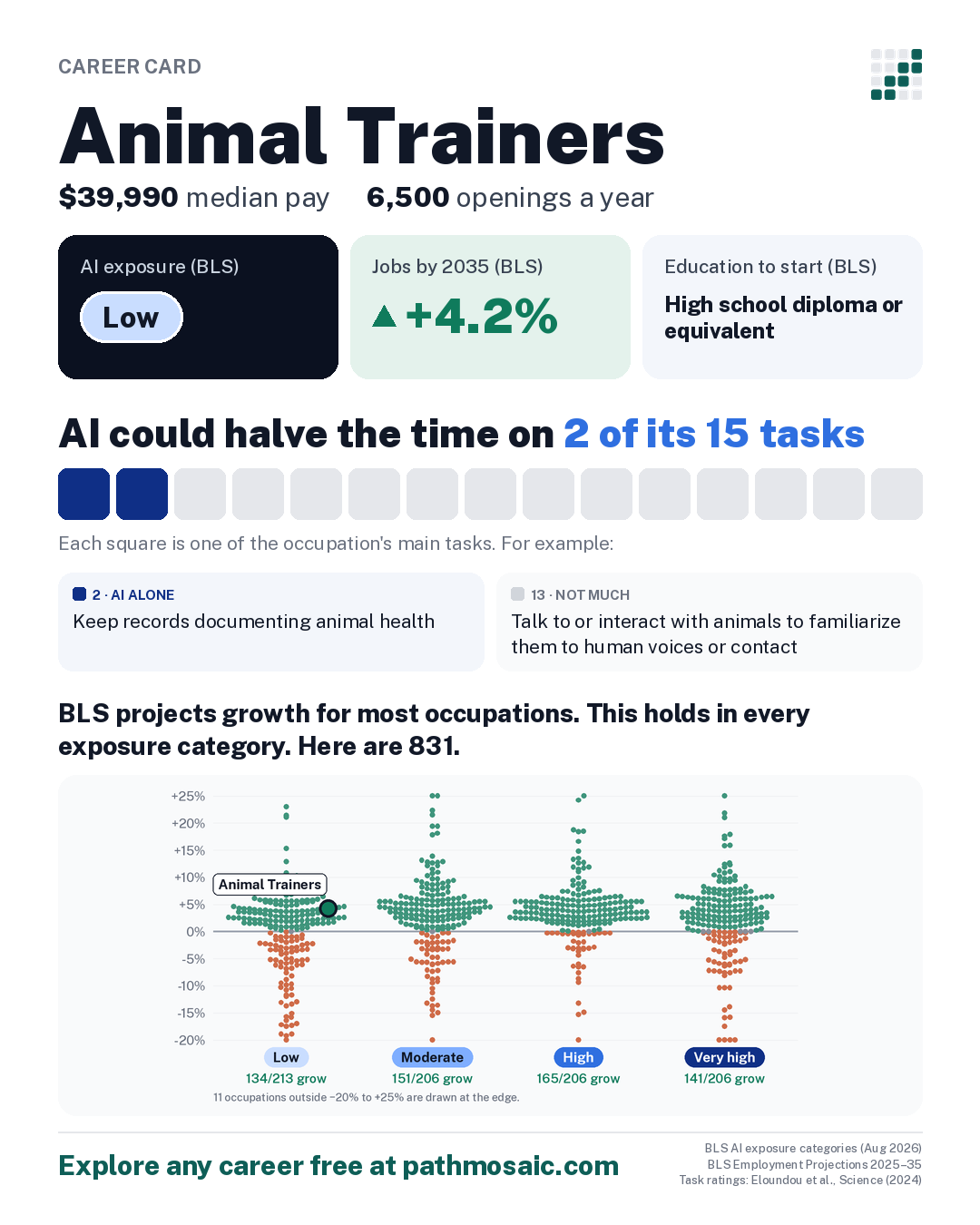
What the data says: AI could halve the time on 2 of its 15 tasks, and jobs are projected to grow 4.2% by 2035. How to think about this →
About this projection
BLS builds AI into its projections where the research supports it: “BLS generally applies adjustments based on this research conservatively, where there is convincing evidence for a change.”
It also notes a limit: “BLS projection methods are not designed to capture extremely rapid technological change.”
On its AI exposure groups, BLS says exposure “does not imply job loss.”
Recent conditions
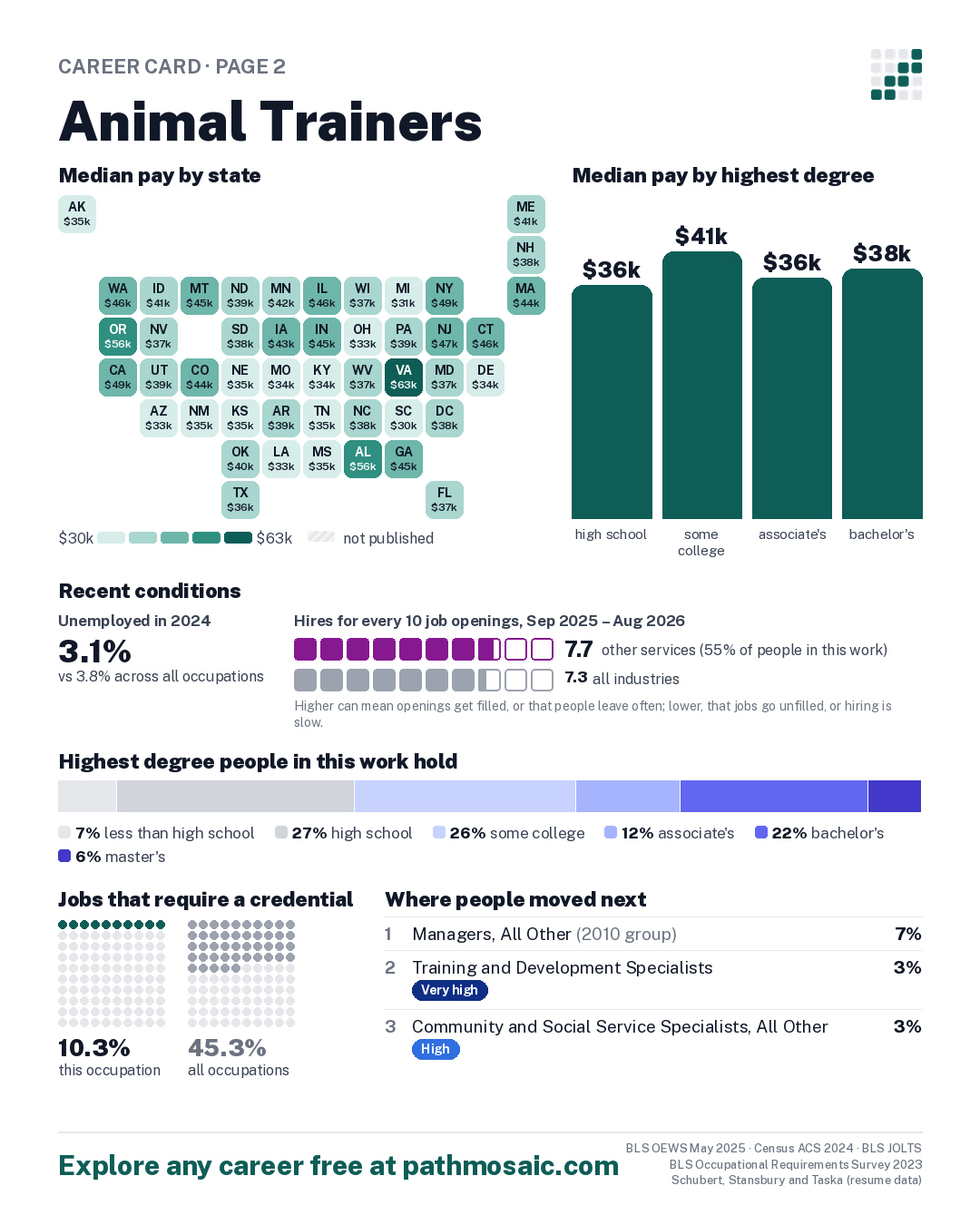
- In 2024, 3.1% of people in this work were unemployed, against 3.8% across all occupations Census ACS 2024
- From Sep 2025 to Aug 2026, 7.7 hires for every 10 job openings in other services, which employs about 55% of people in this work, against 7.3 across all industries BLS JOLTS
One box per opening, filled for each hire; hires beyond the openings are added in a lighter shade. Higher can mean openings get filled, or that people leave often; lower, that jobs go unfilled, or hiring is slow.7.7 this industry7.3 all industries
Median pay by state BLS OEWS May 2025, state estimates
Tap a state for its figures.
Median pay in every state
| State | Median | Middle half earn | Jobs |
|---|---|---|---|
| Alabama | $55,700 | $43,600 to $65,930 | 170 |
| Alaska | $34,900 | $34,900 to $36,480 | 50 |
| Arizona | $33,330 | $31,880 to $37,140 | not published |
| Arkansas | $39,400 | $34,300 to $54,030 | 110 |
| California | $49,060 | $39,730 to $64,280 | 2,270 |
| Colorado | $44,290 | $39,530 to $46,760 | 330 |
| Connecticut | $45,800 | $37,260 to $61,510 | 290 |
| Delaware | $33,810 | $32,140 to $38,380 | 90 |
| District of Columbia | $38,200 | $38,200 to $39,230 | not published |
| Florida | $36,870 | $33,320 to $44,680 | 1,090 |
| Georgia | $45,250 | $36,150 to $73,840 | 800 |
| Idaho | $40,770 | $33,220 to $42,870 | 180 |
| Illinois | $45,830 | $34,700 to $59,810 | 680 |
| Indiana | $45,270 | $36,910 to $82,680 | 380 |
| Iowa | $43,020 | $34,600 to $64,580 | 180 |
| Kansas | $34,720 | $30,630 to $42,770 | 250 |
| Kentucky | $34,030 | $29,140 to $46,730 | 470 |
| Louisiana | $32,720 | $22,690 to $38,990 | not published |
| Maine | $40,760 | $38,480 to $40,760 | 110 |
| Maryland | $37,430 | $32,690 to $65,090 | 890 |
| Massachusetts | $43,580 | $33,670 to $57,160 | 510 |
| Michigan | $30,820 | $28,970 to $35,210 | 800 |
| Minnesota | $41,690 | $35,370 to $57,240 | 300 |
| Mississippi | $35,130 | $32,910 to $53,870 | 40 |
| Missouri | $34,010 | $32,060 to $40,110 | 250 |
| Montana | $44,680 | $36,010 to $50,840 | 80 |
| Nebraska | $34,900 | $34,900 to $38,490 | 60 |
| Nevada | $36,760 | $26,790 to $42,550 | 170 |
| New Hampshire | $38,030 | $32,150 to $43,620 | 140 |
| New Jersey | $46,690 | $39,850 to $75,470 | 480 |
| New Mexico | $34,760 | $31,880 to $36,650 | 60 |
| New York | $48,790 | $40,100 to $62,050 | 970 |
| North Carolina | $37,680 | $33,700 to $57,860 | 640 |
| North Dakota | $38,970 | $35,180 to $39,430 | 30 |
| Ohio | $32,700 | $28,230 to $44,790 | 730 |
| Oklahoma | $40,310 | $31,160 to $50,600 | 250 |
| Oregon | $55,520 | $47,840 to $66,040 | 140 |
| Pennsylvania | $38,920 | $33,560 to $52,080 | 460 |
| South Carolina | $29,670 | $28,840 to $35,630 | 200 |
| South Dakota | $38,120 | $31,080 to $42,210 | 30 |
| Tennessee | $35,320 | $29,580 to $43,300 | 310 |
| Texas | $36,370 | $30,920 to $44,770 | 1,080 |
| Utah | $38,580 | $31,890 to $45,290 | 260 |
| Virginia | $62,960 | $41,910 to $107,830 | 720 |
| Washington | $46,420 | $40,540 to $52,660 | 360 |
| West Virginia | $37,080 | $33,430 to $48,710 | 100 |
| Wisconsin | $37,140 | $31,440 to $49,530 | 480 |
Nationally: $39,990. Shades run from the lowest state median to the highest; a territory below that range takes the lightest. How to read this
How AI touches the work
What AI could speed up, task by task, and where people already use it.
AI could halve the time on 2 of its 15 tasks
| AI rating | Its main tasks | Share of Claude conversations May 2026 |
|---|---|---|
| Not much | Talk to or interact with animals to familiarize them to human voices or contact. | Not published |
| Not much | Evaluate animals to determine their temperaments, abilities, or aptitude for training. | Not published |
| Not much | Conduct training programs to develop or maintain desired animal behaviors for competition, entertainment, obedience, security, riding, or related purposes. | Not published |
| Not much | Feed or exercise animals or provide other general care, such as cleaning or maintaining holding or performance areas. | Not published |
| Not much | Observe animals' physical conditions to detect illness or unhealthy conditions requiring medical care. | Not published |
| Not much | Evaluate animals for trainability and ability to perform. | Not published |
See all 15 tasks
| AI alone | Keep records documenting animal health, diet, or behavior. | Not published |
| Not much | Cue or signal animals during performances. | Not published |
| Not much | Administer prescribed medications to animals. | Not published |
| AI alone | Advise animal owners regarding the purchase of specific animals. | Not published |
| Not much | Train dogs in human assistance or property protection duties. | Not published |
| Not much | Organize or conduct animal shows. | Not published |
| Not much | Retrain horses to break bad habits, such as kicking, bolting, or resisting bridling or grooming. | Not published |
| Not much | Train horses or other equines for riding, harness, show, racing, or other work, using knowledge of breed characteristics, training methods, performance standards, and the peculiarities of each animal. | Not published |
| Not much | Use oral, spur, rein, or hand commands to condition horses to carry riders or to pull horse-drawn equipment. | Not published |
Ordered by how important O*NET's respondents rate each task (1 to 5) times the share who say it is part of their job. The ordering is ours. 0 of the 15 have a published share of Claude conversations; “not published” means too few conversations for Anthropic to publish a figure.
Where people already use AI
The tasks above say what AI could speed up. This shows what people are using it for. Its 15 tasks fall under 11 work activities that many occupations share, and Microsoft counted how often each one came up in 200,000 conversations with its Copilot assistant in 2024.
| Work activity | This occupation's tasks under it | People asked AI for help in 10,000 conversations |
AI did it for them in 10,000 conversations |
|---|---|---|---|
| Train animals | |||
| Evaluate personnel capabilities or performance | |||
| Confer with clients to determine needs or order specifications | |||
| Care for plants or animals | |||
| Maintain facilities or equipment | |||
| Monitor health conditions of humans or animals | |||
| Clean tools, equipment, facilities, or work areas | |||
| Coordinate group, community, or public activities |
Show all 11 activities
| Coordinate artistic or entertainment activities | |||
| Administer basic health care or medical treatments | |||
| Prepare health or medical documents |
How people in this work use Claude
What people in this work made with Claude % of conversations
- Advice or a recommendation61%
- An explanation or answer11%
- A plan or strategy11%
- A document or report4%
- An analysis or summary2%
How they worked with Claude
4% of these conversations were about work. Anthropic Economic Index, May 2026.
How to read this
Work activities come from O*NET, which links every task to the broader activities it involves. Microsoft's figures are for the activity across everyone who used Copilot, not for animal trainers specifically. Copilot is a general chat assistant; dedicated coding tools are not included, so programming help is under-counted here. Activities are listed by how many of this occupation's tasks fall under them.
The task ratings say whether AI could halve the time a task takes: on its own (“AI alone”), or with software built on it (“AI + software”). They were made by people in 2023 (Eloundou et al.). Claude's share is the task's share of all Claude.ai conversations in May 2026; Anthropic doesn't publish a task with too few conversations. None of these add up to the BLS exposure group, which combines five research measures.
More in the Guide: task ratings · task order · work activities · Copilot figures · Claude
High exposure doesn't mean fewer jobs
BLS projects most occupations in its two most exposed groups to grow: 141 of 206 rated Very high and 165 of 206 rated High. Each dot is one of the 831 occupations BLS rates.
Career moves into and out of this occupation
From moves between occupations found in online resumes, 2002–2016. Career changes only: a first job after school isn't a move.
Where people moved next
of 8,765 moves out
- 1 Managers, All Other (2010 group) an older group BLS has since split; no exposure group today 7%
- 2 Training and Development Specialists Very high +10.8% 3%
- 3 Community and Social Service Specialists, All Other High +5.5% 3%
- 4 Sales Managers High +4.5% 3%
- 5 Mental Health Counselors 3%
Where people moved in from
of 8,070 moves in
- 1 Medical Secretaries and Administrative Assistants Very high +4.8% 6%
- 2 Managers, All Other (2010 group) an older group BLS has since split; no exposure group today 5%
- 3 Laborers and Freight, Stock, and Material Movers, Hand Low +1.8% 3%
- 4 Animal Caretakers Moderate +12.1% 3%
- 5 Training and Development Specialists Very high +10.8% 2%
Resumes over-represent younger, white-collar job-seekers and moves into management. Schubert, Stansbury and Taska (resume data).
Education and training for the occupation
O*NET survey of workers in this occupation
- 23% less than high school
- 44% high school
- 8% postsecondary certificate
- 17% some college
- 7% associate's
- 2% bachelor's
O*NET 31.0 survey of workers in this occupation · 37 people answered.
Census survey (American Community Survey)
- 7% less than high school
- 27% high school
- 26% some college
- 12% associate's
- 22% bachelor's
- 6% master's
Census ACS 2024, all workers in this occupation · 655 people surveyed.
Why the two can differ
O*NET asks about 20 people in each occupation, which makes its shares uncertain, but it reports the exact occupation and counts certificates. The Census survey reaches thousands, but it groups some occupations together and counts degrees only. More in the Guide
Median pay by highest degree full-time, year-round · Census ACS 2024, all workers in this occupation
3 programs: Animal Training, Equestrian/Equine Studies and Anthrozoology.
Jobs that require a credential BLS Occupational Requirements Survey 2023
10.3% this occupation
45.3% all occupations
| By kind | This occupation | All occupations |
|---|---|---|
| a certification | 1.1% | 5.8% |
| a license | not published | |
| an educational certificate | not published |
Share of jobs whose employer requires it. BLS doesn't say which credential. How to read this
Look up certifications, training and licenses U.S. Department of Labor
- Certification Finder ↗ certifications CareerOneStop lists for this occupation
- Training Finder ↗ schools and programs, nationwide; narrow the place there
- License Finder ↗ licenses by state
- Apprenticeship Finder ↗ DOL lists 2 registered apprenticeships in this occupation (Animal Trainer; HORSE TRAINER). Apprenticeship.gov can't be linked to one occupation, so search for “Animal Trainers” there.
These open in a new tab and send only the occupation's public code. More in the Guide
BLS AI exposure categories (Aug 2026) · BLS Employment Projections 2025–35 · O*NET 31.0 · Task ratings: Eloundou et al., Science (2024) · Microsoft "Working with AI" v1.1 · Anthropic Economic Index (2026-06-26) · Schubert, Stansbury and Taska · NCES CIP–SOC · Census ACS 2024 · BLS JOLTS
See it online, and explore any career: https://www.pathmosaic.com/card/39-2011.00