Meat, Poultry, and Fish Cutters and Trimmers
Also called: Deboner, Meat Cutter, Trimmer, Wing ScorerUse hands or hand tools to perform routine cutting and trimming of meat, poultry, and seafood.
On a phone, press and hold a picture to save it to Photos.
opens your phone's share sheet, where you can save both to Photos
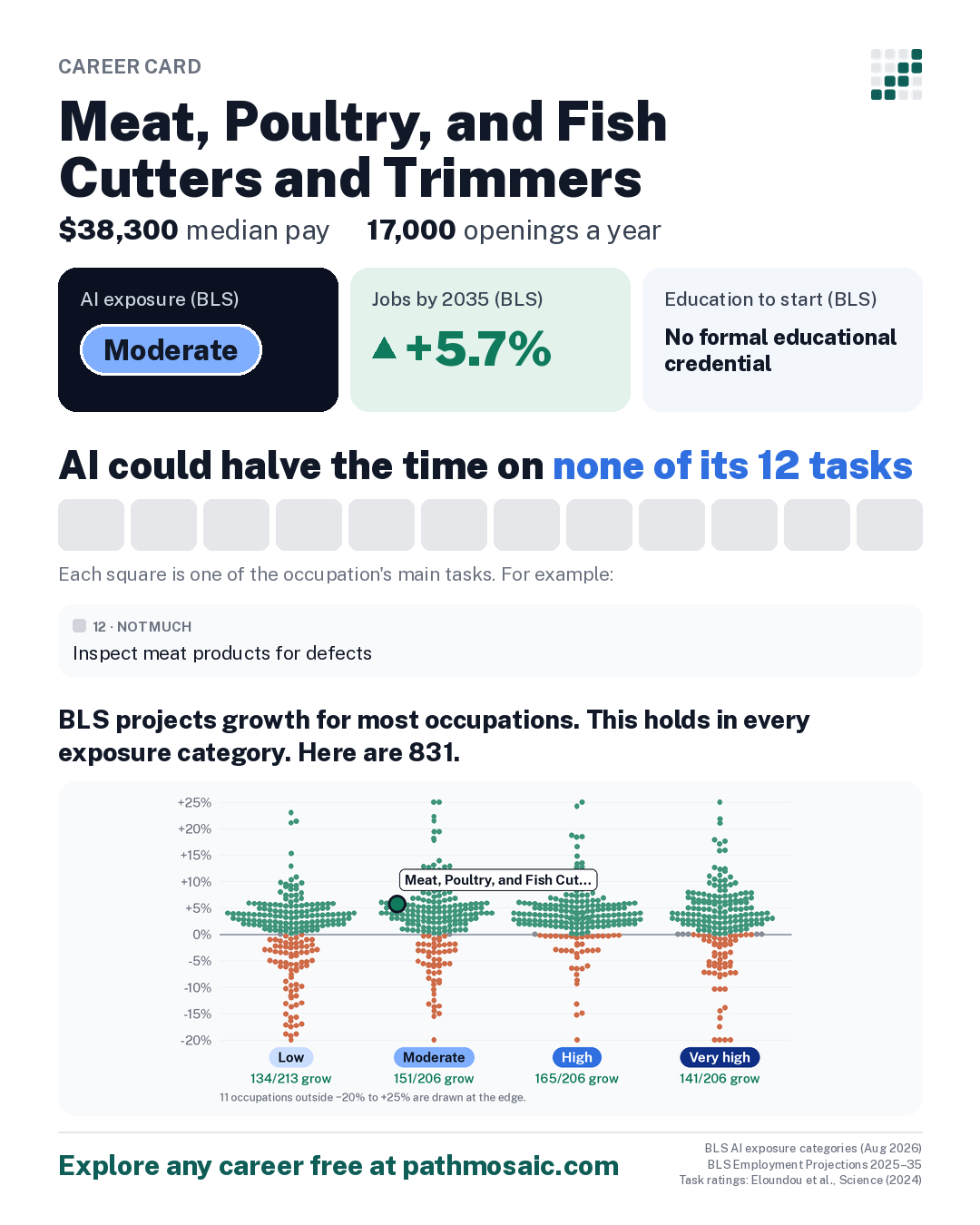
What the data says: AI couldn't halve the time on any of its 12 tasks, and jobs are projected to grow 5.7% by 2035. How to think about this →
About this projection
BLS builds AI into its projections where the research supports it: “BLS generally applies adjustments based on this research conservatively, where there is convincing evidence for a change.”
It also notes a limit: “BLS projection methods are not designed to capture extremely rapid technological change.”
On its AI exposure groups, BLS says exposure “does not imply job loss.”
Recent conditions
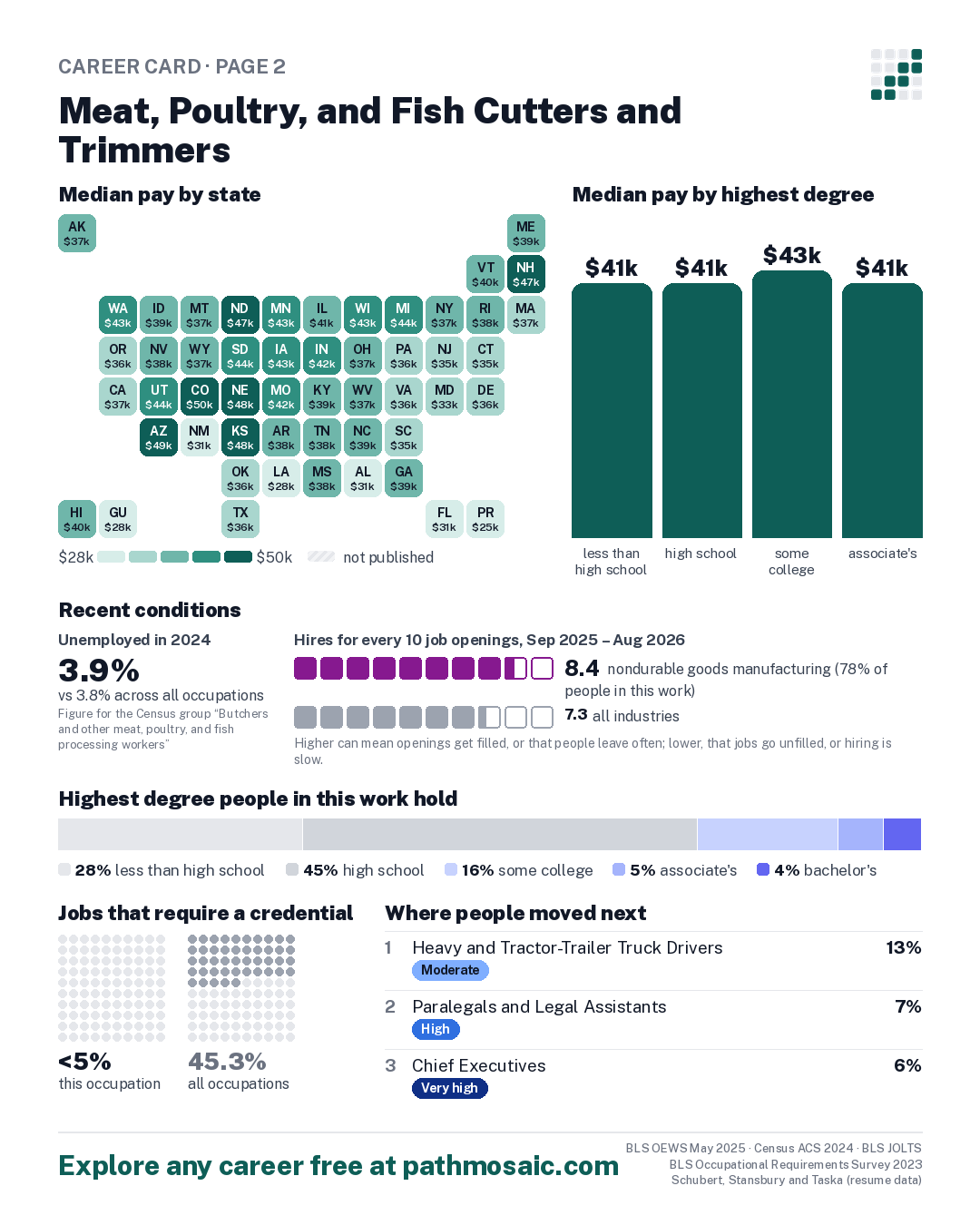
- In 2024, 3.9% of people in this work were unemployed, against 3.8% across all occupations Census ACS 2024, all workers in the Census group “Butchers and other meat, poultry, and fish processing workers”
- From Sep 2025 to Aug 2026, 8.4 hires for every 10 job openings in nondurable goods manufacturing, which employs about 78% of people in this work, against 7.3 across all industries BLS JOLTS
One box per opening, filled for each hire; hires beyond the openings are added in a lighter shade. Higher can mean openings get filled, or that people leave often; lower, that jobs go unfilled, or hiring is slow.8.4 this industry7.3 all industries
Median pay by state BLS OEWS May 2025, state estimates
Tap a state for its figures.
Median pay in every state
| State | Median | Middle half earn | Jobs |
|---|---|---|---|
| Alabama | $31,080 | $27,510 to $37,110 | 9,140 |
| Alaska | $37,180 | $36,570 to $37,550 | 970 |
| Arizona | $48,550 | $39,620 to $48,550 | 620 |
| Arkansas | $37,980 | $36,890 to $39,030 | 9,030 |
| California | $36,570 | $35,710 to $40,210 | 9,270 |
| Colorado | $50,390 | $49,320 to $57,280 | 2,470 |
| Connecticut | $34,780 | $34,010 to $36,930 | not published |
| Delaware | $35,500 | $34,320 to $35,970 | 5,430 |
| Florida | $31,160 | $27,680 to $39,750 | 2,310 |
| Georgia | $39,330 | $33,330 to $42,640 | 11,480 |
| Guam | $27,660 | $24,930 to $28,530 | not published |
| Hawaii | $40,260 | $36,540 to $46,000 | 800 |
| Idaho | $39,200 | $35,900 to $42,470 | 280 |
| Illinois | $40,690 | $37,590 to $45,360 | 4,040 |
| Indiana | $42,450 | $37,610 to $45,000 | 2,640 |
| Iowa | $43,190 | $41,250 to $43,730 | 3,970 |
| Kansas | $48,080 | $43,680 to $49,110 | 5,000 |
| Kentucky | $39,150 | $38,990 to $39,420 | 1,450 |
| Louisiana | $27,850 | $24,130 to $34,990 | 1,690 |
| Maine | $39,170 | $34,460 to $48,320 | 660 |
| Maryland | $32,950 | $31,200 to $37,960 | 680 |
| Massachusetts | $36,570 | $34,460 to $41,040 | 2,350 |
| Michigan | $44,430 | $37,940 to $44,430 | 920 |
| Minnesota | $43,400 | $36,700 to $45,810 | 3,790 |
| Mississippi | $37,890 | $34,360 to $39,290 | 6,470 |
| Missouri | $41,890 | $37,440 to $46,190 | 2,880 |
| Montana | $37,440 | $34,950 to $40,560 | 60 |
| Nebraska | $47,580 | $47,110 to $52,670 | 8,340 |
| Nevada | $37,920 | $33,830 to $46,380 | 360 |
| New Hampshire | $47,260 | $37,330 to $49,560 | not published |
| New Jersey | $34,930 | $33,760 to $38,480 | not published |
| New Mexico | $31,240 | $31,240 to $36,390 | 240 |
| New York | $37,330 | $34,550 to $45,680 | 2,420 |
| North Carolina | $39,170 | $35,360 to $40,360 | 9,750 |
| North Dakota | $47,250 | $40,500 to $47,250 | 390 |
| Ohio | $37,020 | $35,350 to $43,040 | 3,540 |
| Oklahoma | $36,300 | $36,170 to $46,180 | 1,530 |
| Oregon | $36,060 | $35,640 to $37,050 | 910 |
| Pennsylvania | $36,480 | $36,050 to $38,150 | 1,600 |
| Puerto Rico | $24,550 | $21,840 to $27,000 | 80 |
| Rhode Island | $37,740 | $35,290 to $44,770 | 320 |
| South Carolina | $34,790 | $34,790 to $35,660 | 2,750 |
| South Dakota | $44,290 | $44,290 to $46,220 | 2,080 |
| Tennessee | $37,590 | $31,310 to $40,440 | 2,970 |
| Texas | $35,890 | $29,120 to $43,260 | 8,590 |
| Utah | $44,150 | $44,030 to $44,760 | 1,080 |
| Vermont | $40,110 | $38,390 to $50,610 | 40 |
| Virginia | $36,170 | $30,710 to $37,250 | 2,740 |
| Washington | $43,010 | $38,030 to $47,170 | 3,630 |
| West Virginia | $36,870 | $36,870 to $46,840 | 220 |
| Wisconsin | $43,300 | $37,920 to $45,160 | 2,040 |
| Wyoming | $37,040 | $34,360 to $40,290 | 70 |
Nationally: $38,300. Shades run from the lowest state median to the highest; a territory below that range takes the lightest. How to read this
How AI touches the work
What AI could speed up, task by task, and where people already use it.
AI could halve the time on none of its 12 tasks
| AI rating | Its main tasks | Share of Claude conversations May 2026 |
|---|---|---|
| Not much | Inspect meat products for defects, bruises or blemishes and remove them along with any excess fat. | Not published |
| Not much | Cut and trim meat to prepare for packing. | Not published |
| Not much | Use knives, cleavers, meat saws, bandsaws, or other equipment to perform meat cutting and trimming. | Not published |
| Not much | Weigh meats and tag containers for weight and contents. | Not published |
| Not much | Separate meats and byproducts into specified containers and seal containers. | Not published |
| Not much | Process primal parts into cuts that are ready for retail use. | Not published |
See all 12 tasks
| Not much | Clean, trim, slice, and section carcasses for future processing. | Not published |
| Not much | Obtain and distribute specified meat or carcass. | Not published |
| Not much | Produce hamburger meat and meat trimmings. | Not published |
| Not much | Remove parts, such as skin, feathers, scales or bones, from carcass. | Not published |
| Not much | Prepare ready-to-heat foods by filleting meat or fish or cutting it into bite-sized pieces, preparing and adding vegetables or applying sauces or breading. | Not published |
| Not much | Clean and salt hides. | Not published |
Ordered by how important O*NET's respondents rate each task (1 to 5) times the share who say it is part of their job. The ordering is ours. 0 of the 12 have a published share of Claude conversations; “not published” means too few conversations for Anthropic to publish a figure.
Where people already use AI
The tasks above say what AI could speed up. This shows what people are using it for. Its 12 tasks fall under 7 work activities that many occupations share, and Microsoft counted how often each one came up in 200,000 conversations with its Copilot assistant in 2024.
| Work activity | This occupation's tasks under it | People asked AI for help in 10,000 conversations |
AI did it for them in 10,000 conversations |
|---|---|---|---|
| Prepare foods or beverages | |||
| Process animal carcasses | |||
| Measure physical characteristics of materials, products, or equipment | |||
| Sort materials or products | |||
| Inspect completed work or finished products | |||
| Mark materials or objects for identification | |||
| Distribute materials, supplies, or resources |
How to read this
Work activities come from O*NET, which links every task to the broader activities it involves. Microsoft's figures are for the activity across everyone who used Copilot, not for meat, poultry, and fish cutters and trimmers specifically. Copilot is a general chat assistant; dedicated coding tools are not included, so programming help is under-counted here. Activities are listed by how many of this occupation's tasks fall under them.
The task ratings say whether AI could halve the time a task takes: on its own (“AI alone”), or with software built on it (“AI + software”). They were made by people in 2023 (Eloundou et al.). Claude's share is the task's share of all Claude.ai conversations in May 2026; Anthropic doesn't publish a task with too few conversations. None of these add up to the BLS exposure group, which combines five research measures.
More in the Guide: task ratings · task order · work activities · Copilot figures · Claude
High exposure doesn't mean fewer jobs
BLS projects most occupations in its two most exposed groups to grow: 141 of 206 rated Very high and 165 of 206 rated High. Each dot is one of the 831 occupations BLS rates.
Career moves into and out of this occupation
From moves between occupations found in online resumes, 2002–2016. Career changes only: a first job after school isn't a move.
Where people moved next
of 1,211 moves out
- 1 Heavy and Tractor-Trailer Truck Drivers Moderate +3.8% 13%
- 2 Paralegals and Legal Assistants High -0.3% 7%
- 3 Chief Executives Very high +3.2% 6%
- 4 Managers, All Other (2010 group) an older group BLS has since split; no exposure group today 5%
- 5 Retail Salespersons Very high -0.3% 4%
Where people moved in from
of 950 moves in
- 1 Paralegals and Legal Assistants High -0.3% 15%
- 2 Heavy and Tractor-Trailer Truck Drivers Moderate +3.8% 7%
- 3 Food Service Managers Moderate +5.8% 6%
- 4 Retail Salespersons Very high -0.3% 4%
- 5 Customer Service Representatives Very high -5.3% 3%
Resumes over-represent younger, white-collar job-seekers and moves into management. Schubert, Stansbury and Taska (resume data).
Education and training for the occupation
O*NET survey of workers in this occupation
- 36% high school
- 1% research doctorate
- 62% not published
O*NET marks 62% of the answers as too uncertain to publish, so the parts shown don't add up to 100%.
O*NET 31.0 survey of workers in this occupation · 16 people answered.
Census survey (American Community Survey)
- 28% less than high school
- 45% high school
- 16% some college
- 5% associate's
- 4% bachelor's
Census ACS 2024, all workers in the Census group “Butchers and other meat, poultry, and fish processing workers” · 2,230 people surveyed.
Why the two can differ
O*NET asks about 20 people in each occupation, which makes its shares uncertain, but it reports the exact occupation and counts certificates. The Census survey reaches thousands, but it groups some occupations together and counts degrees only. More in the Guide
Median pay by highest degree full-time, year-round · Census ACS 2024, all workers in the Census group “Butchers and other meat, poultry, and fish processing workers”
Jobs that require a credential BLS Occupational Requirements Survey 2023
<5% this occupation
45.3% all occupations
| By kind | This occupation | All occupations |
|---|---|---|
| a license | not published | |
| a certification | not published | |
| an educational certificate | not published |
Share of jobs whose employer requires it. BLS doesn't say which credential. How to read this
Look up certifications, training and licenses U.S. Department of Labor
- Certification Finder ↗ certifications CareerOneStop lists for this occupation
- Training Finder ↗ schools and programs, nationwide; narrow the place there
- License Finder ↗ licenses by state
- Apprenticeships: DOL's list of apprenticeable occupations doesn't include this one.
These open in a new tab and send only the occupation's public code. More in the Guide
BLS AI exposure categories (Aug 2026) · BLS Employment Projections 2025–35 · O*NET 31.0 · Task ratings: Eloundou et al., Science (2024) · Microsoft "Working with AI" v1.1 · Anthropic Economic Index (2026-06-26) · Schubert, Stansbury and Taska · NCES CIP–SOC · Census ACS 2024 · BLS JOLTS
See it online, and explore any career: https://www.pathmosaic.com/card/51-3022.00