Nurse Anesthetists
Also called: Certified Registered Nurse Anesthetist (CRNA), Nurse Anesthetist, Staff Certified Registered Nurse Anesthetist (Staff CRNA), Staff Nurse AnesthetistAdminister anesthesia, monitor patient's vital signs, and oversee patient recovery from anesthesia. May assist anesthesiologists, surgeons, other physicians, or dentists. Must be registered nurses who have specialized graduate education.
On a phone, press and hold a picture to save it to Photos.
opens your phone's share sheet, where you can save both to Photos
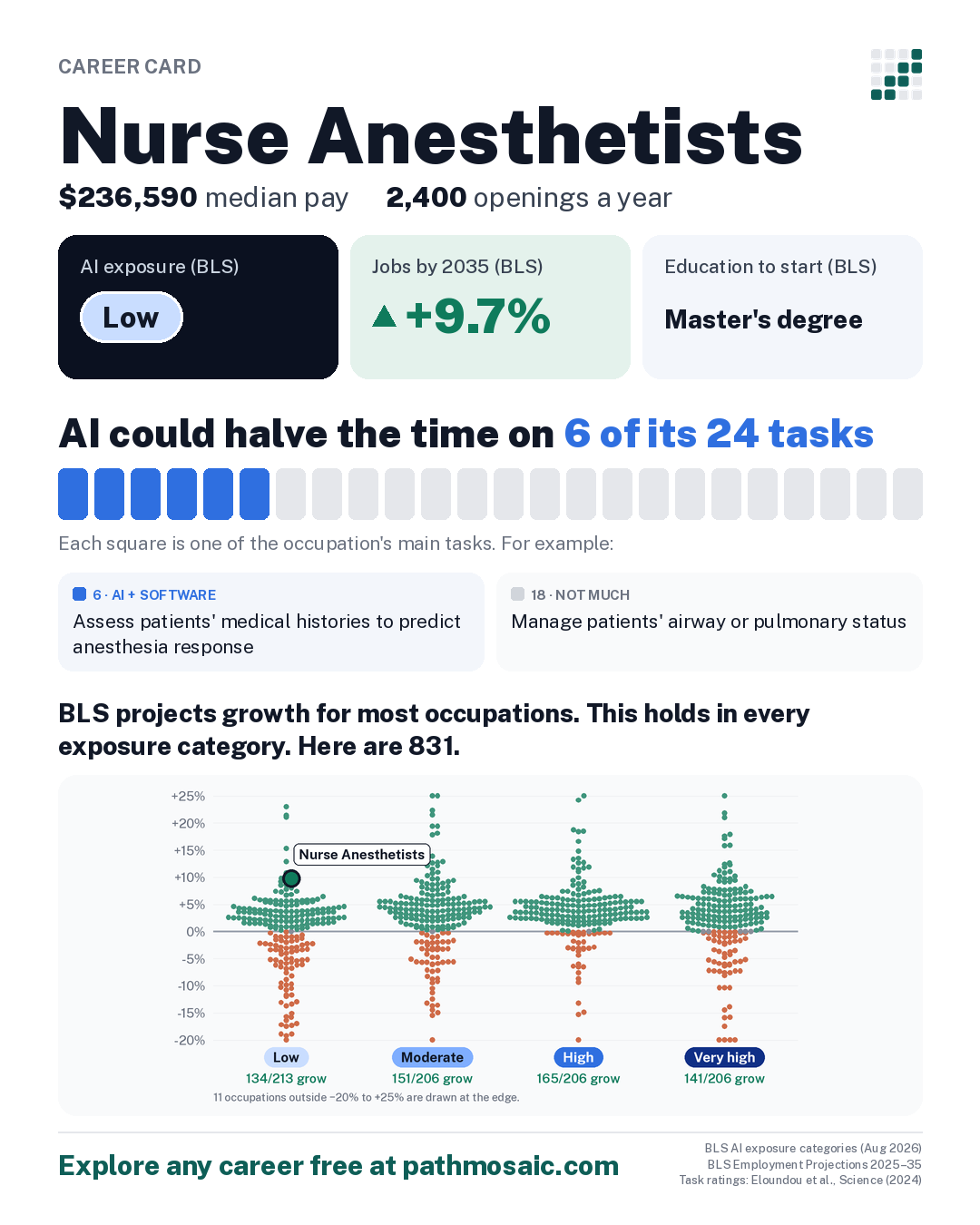
What the data says: AI could halve the time on 6 of its 24 tasks, and jobs are projected to grow 9.7% by 2035. How to think about this →
About this projection
BLS builds AI into its projections where the research supports it: “BLS generally applies adjustments based on this research conservatively, where there is convincing evidence for a change.”
It also notes a limit: “BLS projection methods are not designed to capture extremely rapid technological change.”
On its AI exposure groups, BLS says exposure “does not imply job loss.”
Recent conditions
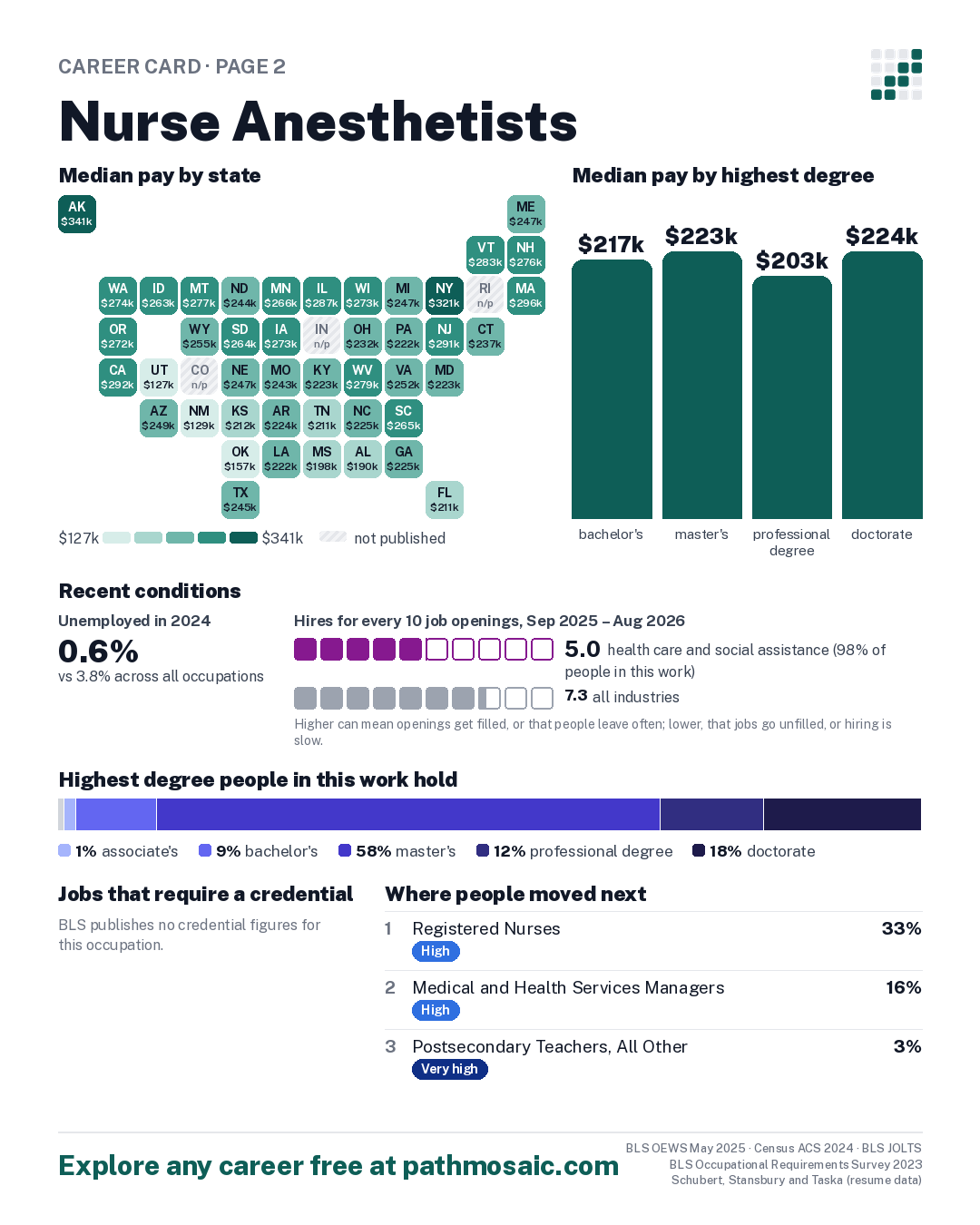
- In 2024, 0.6% of people in this work were unemployed, against 3.8% across all occupations Census ACS 2024
- From Sep 2025 to Aug 2026, 5.0 hires for every 10 job openings in health care and social assistance, which employs about 98% of people in this work, against 7.3 across all industries BLS JOLTS
One box per opening, filled for each hire; hires beyond the openings are added in a lighter shade. Higher can mean openings get filled, or that people leave often; lower, that jobs go unfilled, or hiring is slow.5.0 this industry7.3 all industries
Median pay by state BLS OEWS May 2025, state estimates
Tap a state for its figures.
Median pay in every state
| State | Median | Middle half earn | Jobs |
|---|---|---|---|
| Alabama | $190,300 | $169,250 to $213,590 | 1,810 |
| Alaska | $341,210 | $289,820 to $366,160 | 90 |
| Arizona | $248,660 | $228,390 to $268,580 | 310 |
| Arkansas | $224,280 | $128,690 to $260,400 | not published |
| California | $292,410 | $277,920 to $315,990 | 2,230 |
| Colorado | not published | not published | 800 |
| Connecticut | $236,960 | $212,920 to $278,830 | 480 |
| Florida | $210,570 | $174,580 to $286,000 | 4,600 |
| Georgia | $224,630 | $203,180 to $270,020 | 1,170 |
| Idaho | $263,130 | $227,990 to $312,880 | not published |
| Illinois | $286,830 | $209,370 to $315,650 | 1,140 |
| Indiana | not published | not published | 600 |
| Iowa | $273,070 | $225,770 to $299,920 | 380 |
| Kansas | $212,090 | $180,210 to $223,520 | 910 |
| Kentucky | $222,520 | $211,800 to $242,700 | 1,640 |
| Louisiana | $222,130 | $212,870 to $268,210 | 900 |
| Maine | $247,470 | $235,480 to $274,360 | 380 |
| Maryland | $223,140 | $191,640 to $274,290 | 840 |
| Massachusetts | $295,550 | $253,120 to $356,000 | 500 |
| Michigan | $247,010 | $228,810 to $269,110 | 2,300 |
| Minnesota | $266,190 | $238,060 to $272,980 | 2,130 |
| Mississippi | $198,410 | $181,690 to $264,310 | 480 |
| Missouri | $242,630 | $214,990 to $332,800 | 1,550 |
| Montana | $277,380 | $240,020 to $312,900 | not published |
| Nebraska | $246,730 | $216,030 to $289,830 | 430 |
| New Hampshire | $275,980 | $259,420 to $309,200 | 490 |
| New Jersey | $291,350 | $238,580 to $311,830 | not published |
| New Mexico | $129,370 | $67,000 to $220,740 | not published |
| New York | $321,030 | $279,930 to $325,210 | 2,450 |
| North Carolina | $224,610 | $167,090 to $278,040 | 3,340 |
| North Dakota | $244,240 | $241,620 to $262,150 | 250 |
| Ohio | $231,810 | $207,450 to $285,310 | 2,300 |
| Oklahoma | $156,830 | $156,830 to $209,550 | 990 |
| Oregon | $272,330 | $236,360 to $299,260 | 370 |
| Pennsylvania | $221,530 | $206,010 to $262,930 | 2,500 |
| Rhode Island | not published | not published | 120 |
| South Carolina | $265,480 | $229,140 to $302,230 | 1,010 |
| South Dakota | $263,930 | $220,920 to $269,480 | 400 |
| Tennessee | $211,450 | $192,910 to $243,240 | 1,690 |
| Texas | $244,990 | $209,380 to $323,140 | 4,060 |
| Utah | $126,600 | $111,780 to $171,140 | not published |
| Vermont | $283,060 | $268,320 to $310,100 | 40 |
| Virginia | $252,110 | $207,230 to $294,350 | 700 |
| Washington | $274,390 | $228,330 to $302,000 | 760 |
| West Virginia | $278,530 | $231,830 to $290,670 | 740 |
| Wisconsin | $273,170 | $245,730 to $288,540 | 990 |
| Wyoming | $255,250 | $188,660 to $276,300 | 80 |
Nationally: $236,590. Shades run from the lowest state median to the highest; a territory below that range takes the lightest. How to read this
How AI touches the work
What AI could speed up, task by task, and where people already use it.
AI could halve the time on 6 of its 24 tasks
| AI rating | Its main tasks | Share of Claude conversations May 2026 |
|---|---|---|
| Not much | Manage patients' airway or pulmonary status, using techniques such as endotracheal intubation, mechanical ventilation, pharmacological support, respiratory therapy, and extubation. | Not published |
| Not much | Respond to emergency situations by providing airway management, administering emergency fluids or drugs, or using basic or advanced cardiac life support techniques. | Not published |
| Not much | Monitor patients' responses, including skin color, pupil dilation, pulse, heart rate, blood pressure, respiration, ventilation, or urine output, using invasive and noninvasive techniques. | Not published |
| Not much | Select, order, or administer anesthetics, adjuvant drugs, accessory drugs, fluids or blood products as necessary. | Not published |
| Not much | Select, prepare, or use equipment, monitors, supplies, or drugs for the administration of anesthetics. | Not published |
| AI + software | Assess patients' medical histories to predict anesthesia response. | Not published |
See all 24 tasks
| Not much | Perform or manage regional anesthetic techniques, such as local, spinal, epidural, caudal, nerve blocks and intravenous blocks. | Not published |
| AI + software | Obtain informed consent from patients for anesthesia procedures. | Not published |
| Not much | Prepare prescribed solutions and administer local, intravenous, spinal, or other anesthetics, following specified methods and procedures. | Not published |
| Not much | Perform pre-anesthetic screenings, including physical evaluations and patient interviews, and document results. | Not published |
| Not much | Calibrate and test anesthesia equipment. | Not published |
| AI + software | Evaluate patients' post-surgical or post-anesthesia responses, taking appropriate corrective actions or requesting consultation if complications occur. | Not published |
| Not much | Administer post-anesthesia medications or fluids to support patients' cardiovascular systems. | Not published |
| Not much | Select and prescribe post-anesthesia medications or treatments to patients. | Not published |
| AI + software | Develop anesthesia care plans. | Not published |
| AI + software | Perform or evaluate the results of diagnostic tests, such as radiographs (x-rays) and electrocardiograms (EKGs). | under 0.01% |
| Not much | Select, order, or administer pre-anesthetic medications. | Not published |
| Not much | Insert peripheral or central intravenous catheters. | Not published |
| Not much | Insert arterial catheters or perform arterial punctures to obtain arterial blood samples. | Not published |
| AI + software | Read current literature, talk with colleagues, and participate in professional organizations or conferences to keep abreast of developments in nursing. | Not published |
| Not much | Request anesthesia equipment repairs, adjustments, or safety tests. | Not published |
| Not much | Discharge patients from post-anesthesia care. | Not published |
| Not much | Instruct nurses, residents, interns, students, or other staff on topics such as anesthetic techniques, pain management and emergency responses. | Not published |
| Not much | Disassemble and clean anesthesia equipment. | Not published |
Ordered by how important O*NET's respondents rate each task (1 to 5) times the share who say it is part of their job. The ordering is ours. 1 of the 24 have a published share of Claude conversations; “not published” means too few conversations for Anthropic to publish a figure.
Where people already use AI
The tasks above say what AI could speed up. This shows what people are using it for. Its 24 tasks fall under 21 work activities that many occupations share, and Microsoft counted how often each one came up in 200,000 conversations with its Copilot assistant in 2024.
- #4 Maintain current knowledge in area of expertise
- #30 Perform administrative or clerical activities
- #38 Select materials or equipment for operations or projects
| Work activity | This occupation's tasks under it | People asked AI for help in 10,000 conversations |
AI did it for them in 10,000 conversations |
|---|---|---|---|
| Administer basic health care or medical treatments | |||
| Prescribe medical treatments or devices | |||
| Perform administrative or clerical activities | |||
| Prepare mixtures or solutions | |||
| Analyze health or medical data | |||
| Monitor health conditions of humans or animals | |||
| Administer emergency medical treatment | |||
| Operate medical equipment |
Show all 21 activities
| Maintain medical equipment or instruments | |||
| Maintain current knowledge in area of expertise | |||
| Select materials or equipment for operations or projects | |||
| Collect information about patients or clients | |||
| Develop patient or client care or treatment plans | |||
| Examine people or animals to assess health conditions or physical characteristics | |||
| Inspect commercial, industrial, or production systems or equipment | |||
| Train others on health or medical topics | |||
| Confer with healthcare or other professionals about patient care | |||
| Collect environmental or biological samples | |||
| Maintain health or medical records | |||
| Prepare medical equipment or work areas for use | |||
| Clean medical equipment or facilities |
How people in this work use Claude
What people in this work made with Claude % of conversations
- An explanation or answer38%
- An analysis or summary33%
- A document or report21%
- Advice or a recommendation2%
- A game or something interactive2%
How they worked with Claude
62% of these conversations were about work. Anthropic Economic Index, May 2026.
How to read this
Work activities come from O*NET, which links every task to the broader activities it involves. Microsoft's figures are for the activity across everyone who used Copilot, not for nurse anesthetists specifically. Copilot is a general chat assistant; dedicated coding tools are not included, so programming help is under-counted here. Activities are listed by how many of this occupation's tasks fall under them.
The task ratings say whether AI could halve the time a task takes: on its own (“AI alone”), or with software built on it (“AI + software”). They were made by people in 2023 (Eloundou et al.). Claude's share is the task's share of all Claude.ai conversations in May 2026; Anthropic doesn't publish a task with too few conversations. None of these add up to the BLS exposure group, which combines five research measures.
More in the Guide: task ratings · task order · work activities · Copilot figures · Claude
High exposure doesn't mean fewer jobs
BLS projects most occupations in its two most exposed groups to grow: 141 of 206 rated Very high and 165 of 206 rated High. Each dot is one of the 831 occupations BLS rates.
Career moves into and out of this occupation
From moves between occupations found in online resumes, 2002–2016. Career changes only: a first job after school isn't a move.
Where people moved next
of 904 moves out
- 1 Registered Nurses High +5.6% 33%
- 2 Medical and Health Services Managers High +24.2% 16%
- 3 Postsecondary Teachers, All Other Very high +2.0% 3%
- 4 Shoe Machine Operators and Tenders Low -6.9% 3%
- 5 Chief Executives Very high +3.2% 3%
Where people moved in from
of 1,168 moves in
- 1 Registered Nurses High +5.6% 39%
- 2 Medical and Health Services Managers High +24.2% 16%
- 3 Shoe Machine Operators and Tenders Low -6.9% 3%
- 4 Licensed Practical and Licensed Vocational Nurses Low +3.0% 2%
- 5 General and Operations Managers High +5.0% 2%
Resumes over-represent younger, white-collar job-seekers and moves into management. Schubert, Stansbury and Taska (resume data).
Education and training for the occupation
O*NET survey of workers in this occupation
- 41% master's
- 4% professional doctorate
- 56% research doctorate
O*NET 31.0 survey of workers in this occupation · 27 people answered.
Census survey (American Community Survey)
- 1% high school
- 1% associate's
- 9% bachelor's
- 58% master's
- 12% professional degree
- 18% doctorate
Census ACS 2024, all workers in this occupation · 584 people surveyed.
Why the two can differ
O*NET asks about 20 people in each occupation, which makes its shares uncertain, but it reports the exact occupation and counts certificates. The Census survey reaches thousands, but it groups some occupations together and counts degrees only. More in the Guide
Median pay by highest degree full-time, year-round · Census ACS 2024, all workers in this occupation
1 program: Nurse Anesthetist.
Jobs that require a credential BLS Occupational Requirements Survey 2023
BLS publishes no credential figures for this occupation.
Look up certifications, training and licenses U.S. Department of Labor
- Certification Finder ↗ certifications CareerOneStop lists for this occupation
- Training Finder ↗ schools and programs, nationwide; narrow the place there
- License Finder ↗ licenses by state
- Apprenticeships: DOL's list of apprenticeable occupations doesn't include this one.
These open in a new tab and send only the occupation's public code. More in the Guide
BLS AI exposure categories (Aug 2026) · BLS Employment Projections 2025–35 · O*NET 31.0 · Task ratings: Eloundou et al., Science (2024) · Microsoft "Working with AI" v1.1 · Anthropic Economic Index (2026-06-26) · Schubert, Stansbury and Taska · NCES CIP–SOC · Census ACS 2024 · BLS JOLTS
See it online, and explore any career: https://www.pathmosaic.com/card/29-1151.00