Computer Systems Analysts
Also called: Business Systems Analyst, Computer Systems Analyst, Programmer Analyst, Systems AnalystAnalyze science, engineering, business, and other data processing problems to develop and implement solutions to complex applications problems, system administration issues, or network concerns. Perform systems management and integration functions, improve existing computer systems, and review computer system capabilities, workflow, and schedule limitations. May analyze or recommend commercially available software.
On a phone, press and hold a picture to save it to Photos.
opens your phone's share sheet, where you can save both to Photos
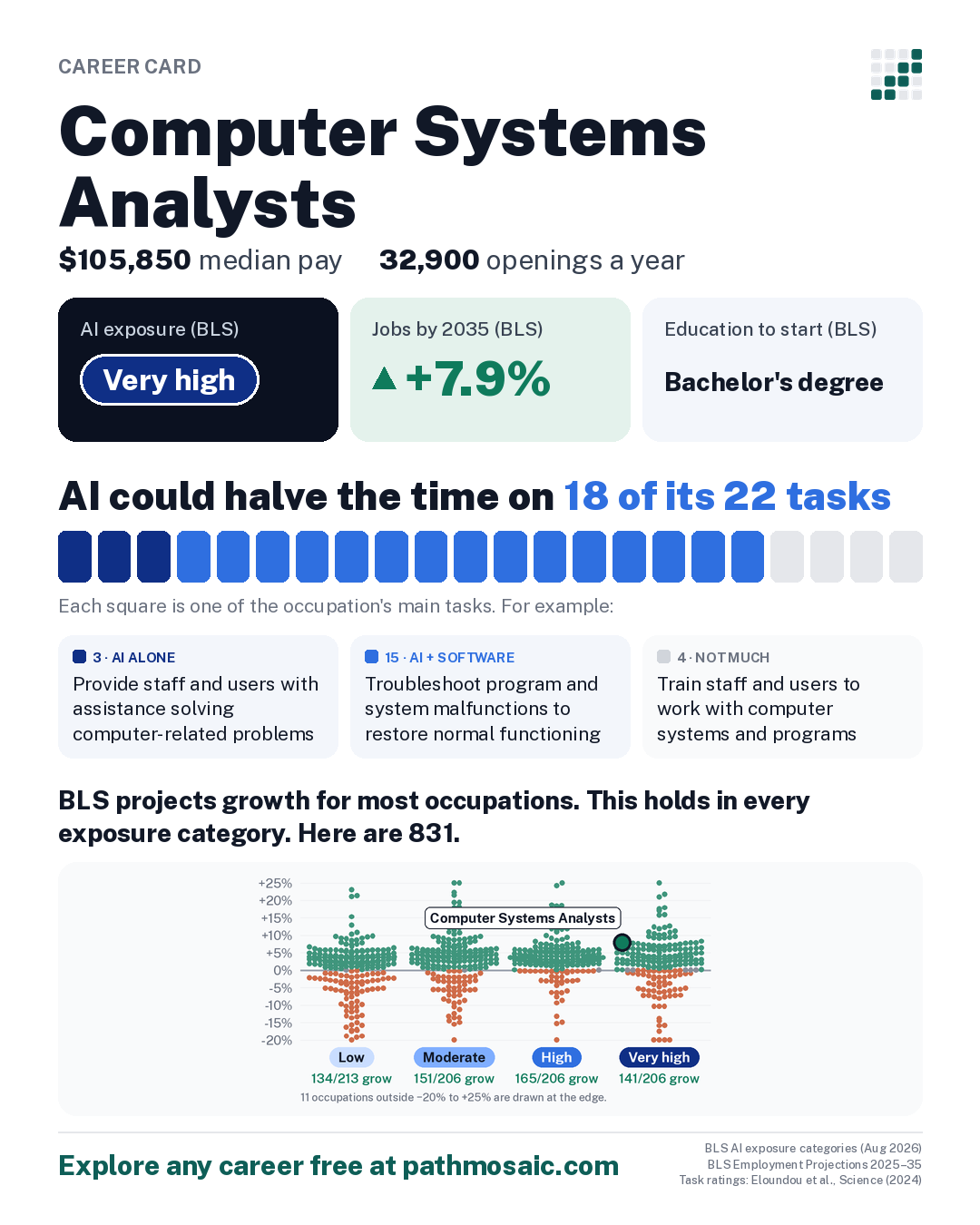
What the data says: AI could halve the time on 18 of its 22 tasks, yet jobs are projected to grow 7.9% by 2035. In the most exposed occupations, the squeeze shows up first among early-career workers. How to think about this →
About this projection
BLS builds AI into its projections where the research supports it: “BLS generally applies adjustments based on this research conservatively, where there is convincing evidence for a change.”
It also notes a limit: “BLS projection methods are not designed to capture extremely rapid technological change.”
On its AI exposure groups, BLS says exposure “does not imply job loss.”
BLS figures cover the broader occupation “Computer systems analysts”, which includes this one and others.
Recent conditions
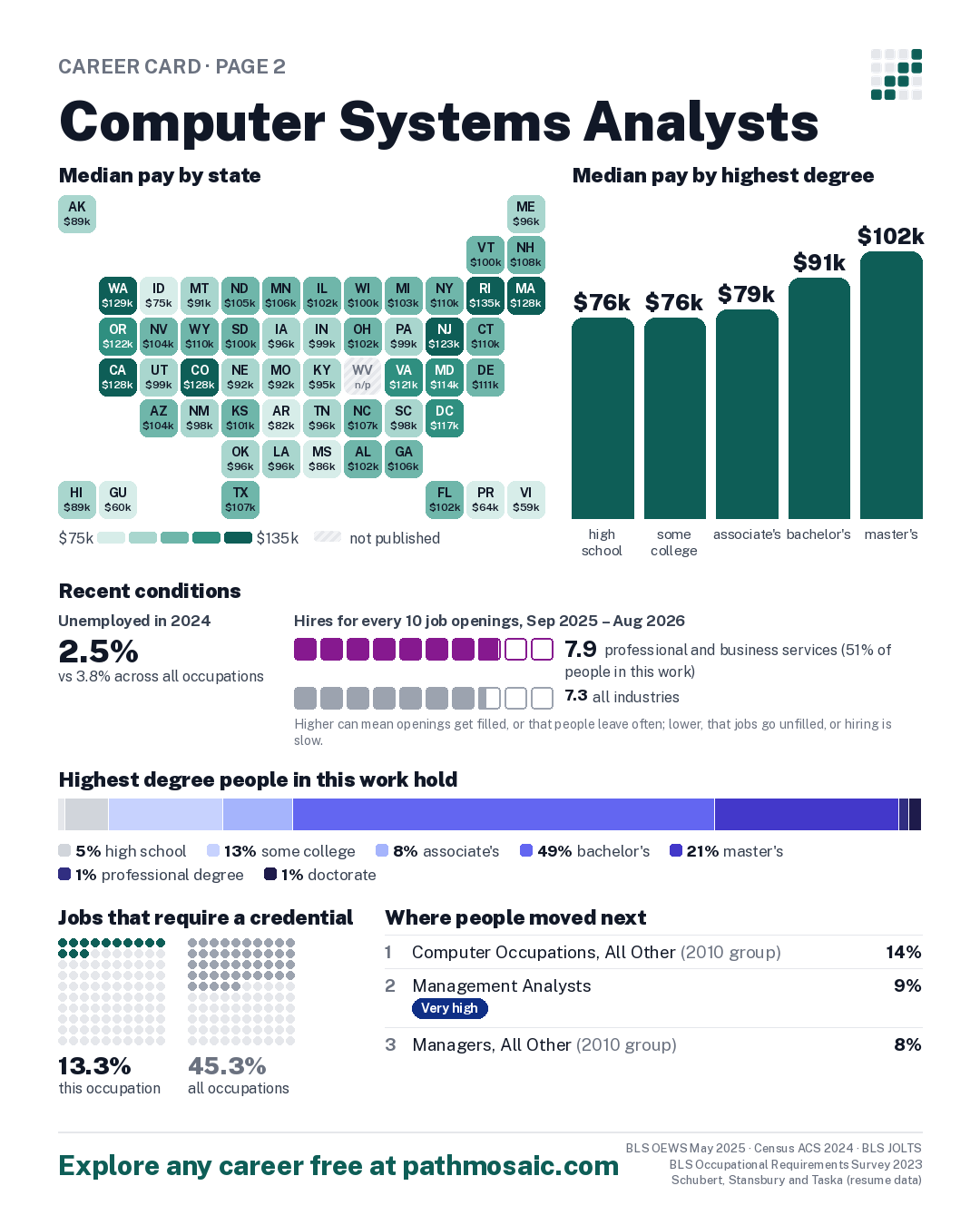
- In 2024, 2.5% of people in this work were unemployed, against 3.8% across all occupations Census ACS 2024
- From Sep 2025 to Aug 2026, 7.9 hires for every 10 job openings in professional and business services, which employs about 51% of people in this work, against 7.3 across all industries BLS JOLTS
One box per opening, filled for each hire; hires beyond the openings are added in a lighter shade. Higher can mean openings get filled, or that people leave often; lower, that jobs go unfilled, or hiring is slow.7.9 this industry7.3 all industries
Median pay by state BLS OEWS May 2025, state estimates
Tap a state for its figures.
Median pay in every state
| State | Median | Middle half earn | Jobs |
|---|---|---|---|
| Alabama | $101,770 | $80,680 to $128,680 | 6,560 |
| Alaska | $88,520 | $79,880 to $106,530 | 420 |
| Arizona | $103,530 | $78,820 to $132,030 | 11,330 |
| Arkansas | $81,760 | $63,230 to $102,910 | 4,100 |
| California | $127,720 | $101,150 to $160,440 | 59,060 |
| Colorado | $127,750 | $101,330 to $163,310 | 6,230 |
| Connecticut | $109,600 | $88,130 to $133,430 | 4,800 |
| Delaware | $110,560 | $90,850 to $136,500 | 2,140 |
| District of Columbia | $116,820 | $103,690 to $157,980 | 2,480 |
| Florida | $101,900 | $79,340 to $129,600 | 35,270 |
| Georgia | $106,240 | $82,840 to $133,140 | 11,640 |
| Guam | $59,900 | $49,730 to $69,470 | 60 |
| Hawaii | $88,640 | $76,780 to $108,230 | 1,670 |
| Idaho | $75,310 | $69,250 to $95,460 | 1,650 |
| Illinois | $101,570 | $80,350 to $128,030 | 20,610 |
| Indiana | $98,810 | $77,630 to $127,990 | 9,660 |
| Iowa | $95,920 | $77,170 to $110,390 | 4,760 |
| Kansas | $100,770 | $78,670 to $133,320 | 3,740 |
| Kentucky | $95,090 | $70,910 to $125,170 | 5,930 |
| Louisiana | $95,660 | $78,760 to $109,290 | 2,980 |
| Maine | $95,820 | $80,190 to $121,700 | 2,480 |
| Maryland | $113,610 | $87,360 to $147,460 | 15,340 |
| Massachusetts | $128,240 | $100,830 to $159,230 | 22,160 |
| Michigan | $103,410 | $82,850 to $127,090 | 14,070 |
| Minnesota | $106,350 | $93,410 to $132,200 | 11,330 |
| Mississippi | $86,280 | $64,200 to $120,420 | 1,990 |
| Missouri | $92,060 | $74,990 to $117,480 | 7,730 |
| Montana | $91,310 | $79,700 to $102,690 | 850 |
| Nebraska | $91,810 | $76,180 to $114,850 | 2,440 |
| Nevada | $104,060 | $79,660 to $124,190 | 2,540 |
| New Hampshire | $107,670 | $88,610 to $134,090 | 2,090 |
| New Jersey | $122,890 | $91,500 to $161,000 | 16,520 |
| New Mexico | $98,220 | $78,380 to $122,040 | 2,290 |
| New York | $109,610 | $85,450 to $137,690 | 24,100 |
| North Carolina | $106,850 | $86,080 to $132,910 | 20,910 |
| North Dakota | $105,470 | $87,470 to $111,250 | 280 |
| Ohio | $102,320 | $81,060 to $131,370 | 19,190 |
| Oklahoma | $95,930 | $77,570 to $119,860 | 3,710 |
| Oregon | $121,620 | $99,890 to $137,580 | 5,640 |
| Pennsylvania | $98,550 | $78,610 to $118,670 | 19,450 |
| Puerto Rico | $63,730 | $49,350 to $81,460 | 1,280 |
| Rhode Island | $134,630 | $101,020 to $135,380 | 1,850 |
| South Carolina | $98,280 | $76,070 to $122,570 | 7,700 |
| South Dakota | $99,790 | $78,790 to $134,520 | 1,110 |
| Tennessee | $95,630 | $76,450 to $119,250 | 10,220 |
| Texas | $107,390 | $85,960 to $136,170 | 47,990 |
| Utah | $98,770 | $79,420 to $116,540 | 2,950 |
| Vermont | $99,610 | $85,530 to $111,470 | 590 |
| Virgin Islands | $59,430 | $53,210 to $78,480 | 40 |
| Virginia | $120,840 | $92,490 to $150,680 | 23,190 |
| Washington | $129,410 | $100,800 to $161,730 | 24,120 |
| West Virginia | not published | not published | 1,030 |
| Wisconsin | $100,440 | $80,790 to $122,550 | 8,340 |
| Wyoming | $109,780 | $81,410 to $111,660 | 310 |
Nationally: $105,850. Shades run from the lowest state median to the highest; a territory below that range takes the lightest. How to read this
How AI touches the work
What AI could speed up, task by task, and where people already use it.
AI could halve the time on 18 of its 22 tasks
| AI rating | Its main tasks | Share of Claude conversations May 2026 |
|---|---|---|
| AI + software | Troubleshoot program and system malfunctions to restore normal functioning. | 0.93% |
| AI alone | Provide staff and users with assistance solving computer-related problems, such as malfunctions and program problems. | 0.71% |
| AI + software | Use the computer in the analysis and solution of business problems, such as development of integrated production and inventory control and cost analysis systems. | 0.03% |
| Not much | Test, maintain, and monitor computer programs and systems, including coordinating the installation of computer programs and systems. | under 0.01% |
| AI alone | Use object-oriented programming languages, as well as client and server applications development processes and multimedia and Internet technology. | 0.04% |
| Not much | Train staff and users to work with computer systems and programs. | under 0.01% |
See all 22 tasks
| AI + software | Consult with management to ensure agreement on system principles. | Not published |
| AI + software | Expand or modify system to serve new purposes or improve work flow. | 0.05% |
| AI + software | Assess the usefulness of pre-developed application packages and adapt them to a user environment. | 0.01% |
| AI + software | Coordinate and link the computer systems within an organization to increase compatibility so that information can be shared. | under 0.01% |
| AI + software | Determine computer software or hardware needed to set up or alter systems. | Not published |
| AI + software | Analyze information processing or computation needs and plan and design computer systems, using techniques such as structured analysis, data modeling, and information engineering. | 0.06% |
| AI + software | Develop, document, and revise system design procedures, test procedures, and quality standards. | Not published |
| Not much | Recommend new equipment or software packages. | under 0.01% |
| AI + software | Specify inputs accessed by the system and plan the distribution and use of the results. | Not published |
| AI alone | Read manuals, periodicals, and technical reports to learn how to develop programs that meet staff and user requirements. | 0.03% |
| AI + software | Review and analyze computer printouts and performance indicators to locate code problems, and correct errors by correcting codes. | under 0.01% |
| AI + software | Define the goals of the system and devise flow charts and diagrams describing logical operational steps of programs. | 0.03% |
| AI + software | Confer with clients regarding the nature of the information processing or computation needs a computer program is to address. | under 0.01% |
| AI + software | Prepare cost-benefit and return-on-investment analyses to aid in decisions on system implementation. | Not published |
| AI + software | Supervise computer programmers or other systems analysts or serve as project leaders for particular systems projects. | Not published |
| Not much | Interview or survey workers, observe job performance, or perform the job to determine what information is processed and how it is processed. | Not published |
Ordered by how important O*NET's respondents rate each task (1 to 5) times the share who say it is part of their job. The ordering is ours. 15 of the 22 have a published share of Claude conversations; “not published” means too few conversations for Anthropic to publish a figure.
Where people already use AI
The tasks above say what AI could speed up. This shows what people are using it for. Its 22 tasks fall under 22 work activities that many occupations share, and Microsoft counted how often each one came up in 200,000 conversations with its Copilot assistant in 2024.
- #8 Read documents or materials to inform work processes
- #14 Create visual designs or displays
- #15 Evaluate the characteristics, usefulness, or performance of products or technologies
- and 5 more, in the table below
| Work activity | This occupation's tasks under it | People asked AI for help in 10,000 conversations |
AI did it for them in 10,000 conversations |
|---|---|---|---|
| Design computer or information systems or applications | |||
| Communicate with others about specifications or project details | |||
| Advise others on the design or use of technologies | |||
| Direct scientific or technical activities | |||
| Read documents or materials to inform work processes | |||
| Create visual designs or displays | |||
| Evaluate the characteristics, usefulness, or performance of products or technologies | |||
| Resolve computer problems |
Show all 22 activities
| Program computer systems or production equipment | |||
| Select materials or equipment for operations or projects | |||
| Develop operational or technical procedures or standards | |||
| Set up computer systems, networks, or other information systems | |||
| Evaluate designs, specifications, or other technical data | |||
| Monitor operation of computer or information technologies | |||
| Document technical designs, procedures, or activities | |||
| Determine resource needs of projects or operations | |||
| Test performance of computer or information systems | |||
| Collect data about consumer needs or opinions | |||
| Estimate project development or operational costs | |||
| Analyze data to improve operations | |||
| Train others to use equipment or products | |||
| Supervise personnel activities |
How people in this work use Claude
What people in this work made with Claude % of conversations
- Code fixes or debugging24%
- An explanation or answer18%
- Configuration or infrastructure13%
- An app or website10%
- A script or snippet9%
How they worked with Claude
57% of these conversations were about work. Anthropic Economic Index, May 2026.
How to read this
Work activities come from O*NET, which links every task to the broader activities it involves. Microsoft's figures are for the activity across everyone who used Copilot, not for computer systems analysts specifically. Copilot is a general chat assistant; dedicated coding tools are not included, so programming help is under-counted here. Activities are listed by how many of this occupation's tasks fall under them.
The task ratings say whether AI could halve the time a task takes: on its own (“AI alone”), or with software built on it (“AI + software”). They were made by people in 2023 (Eloundou et al.). Claude's share is the task's share of all Claude.ai conversations in May 2026; Anthropic doesn't publish a task with too few conversations. None of these add up to the BLS exposure group, which combines five research measures.
More in the Guide: task ratings · task order · work activities · Copilot figures · Claude
High exposure doesn't mean fewer jobs
BLS projects most occupations in its two most exposed groups to grow: 141 of 206 rated Very high and 165 of 206 rated High. Each dot is one of the 831 occupations BLS rates.
Career moves into and out of this occupation
From moves between occupations found in online resumes, 2002–2016. Career changes only: a first job after school isn't a move.
Where people moved next
of 381,224 moves out
- 1 Computer Occupations, All Other (2010 group) an older group BLS has since split; no exposure group today 14%
- 2 Management Analysts Very high +10.1% 9%
- 3 Managers, All Other (2010 group) an older group BLS has since split; no exposure group today 8%
- 4 Software Developers, Applications (2010 group) an older group BLS has since split; no exposure group today 7%
- 5 Computer User Support Specialists Very high -3.5% 5%
Where people moved in from
of 397,036 moves in
- 1 Computer Occupations, All Other (2010 group) an older group BLS has since split; no exposure group today 12%
- 2 Software Developers, Applications (2010 group) an older group BLS has since split; no exposure group today 8%
- 3 Computer User Support Specialists Very high -3.5% 7%
- 4 Management Analysts Very high +10.1% 6%
- 5 Managers, All Other (2010 group) an older group BLS has since split; no exposure group today 6%
Resumes over-represent younger, white-collar job-seekers and moves into management. Schubert, Stansbury and Taska (resume data).
Education and training for the occupation
O*NET survey of workers in this occupation
- 1% high school
- 1% postsecondary certificate
- 5% some college
- 1% master's
- 93% not published
O*NET marks 93% of the answers as too uncertain to publish, so the parts shown don't add up to 100%.
O*NET 31.0 survey of workers in this occupation · 20 people answered.
Census survey (American Community Survey)
- 1% less than high school
- 5% high school
- 13% some college
- 8% associate's
- 49% bachelor's
- 21% master's
- 1% professional degree
- 1% doctorate
Census ACS 2024, all workers in this occupation · 6,698 people surveyed.
Why the two can differ
O*NET asks about 20 people in each occupation, which makes its shares uncertain, but it reports the exact occupation and counts certificates. The Census survey reaches thousands, but it groups some occupations together and counts degrees only. More in the Guide
Median pay by highest degree full-time, year-round · Census ACS 2024, all workers in this occupation
4 programs, such as Computer and Information Sciences, General, Information Technology and Computer Systems Analysis/Analyst.
See all
- Computer and Information Sciences, General
- Information Technology
- Computer Systems Analysis/Analyst
- Computer Systems Networking and Telecommunications
Jobs that require a credential BLS Occupational Requirements Survey 2023
13.3% this occupation
45.3% all occupations
| By kind | This occupation | All occupations |
|---|---|---|
| a license | <0.5% | 19.1% |
| a certification | 3.4% | 5.8% |
| an educational certificate | not published |
Share of jobs whose employer requires it. BLS doesn't say which credential. How to read this
Look up certifications, training and licenses U.S. Department of Labor
- Certification Finder ↗ certifications CareerOneStop lists for this occupation
- Training Finder ↗ schools and programs, nationwide; narrow the place there
- License Finder ↗ licenses by state
- Apprenticeship Finder ↗ DOL lists 5 registered apprenticeships in this occupation. Apprenticeship.gov can't be linked to one occupation, so search for “Computer Systems Analysts” there.
These open in a new tab and send only the occupation's public code. More in the Guide
BLS AI exposure categories (Aug 2026) · BLS Employment Projections 2025–35 · O*NET 31.0 · Task ratings: Eloundou et al., Science (2024) · Microsoft "Working with AI" v1.1 · Anthropic Economic Index (2026-06-26) · Schubert, Stansbury and Taska · NCES CIP–SOC · Census ACS 2024 · BLS JOLTS · Brynjolfsson, Chandar and Chen, Stanford (Aug 2026)
See it online, and explore any career: https://www.pathmosaic.com/card/15-1211.00