Petroleum Pump System Operators, Refinery Operators, and Gaugers
Also called: Gauger, Operator, Pumper, Refinery OperatorOperate or control petroleum refining or processing units. May specialize in controlling manifold and pumping systems, gauging or testing oil in storage tanks, or regulating the flow of oil into pipelines.
On a phone, press and hold a picture to save it to Photos.
opens your phone's share sheet, where you can save both to Photos
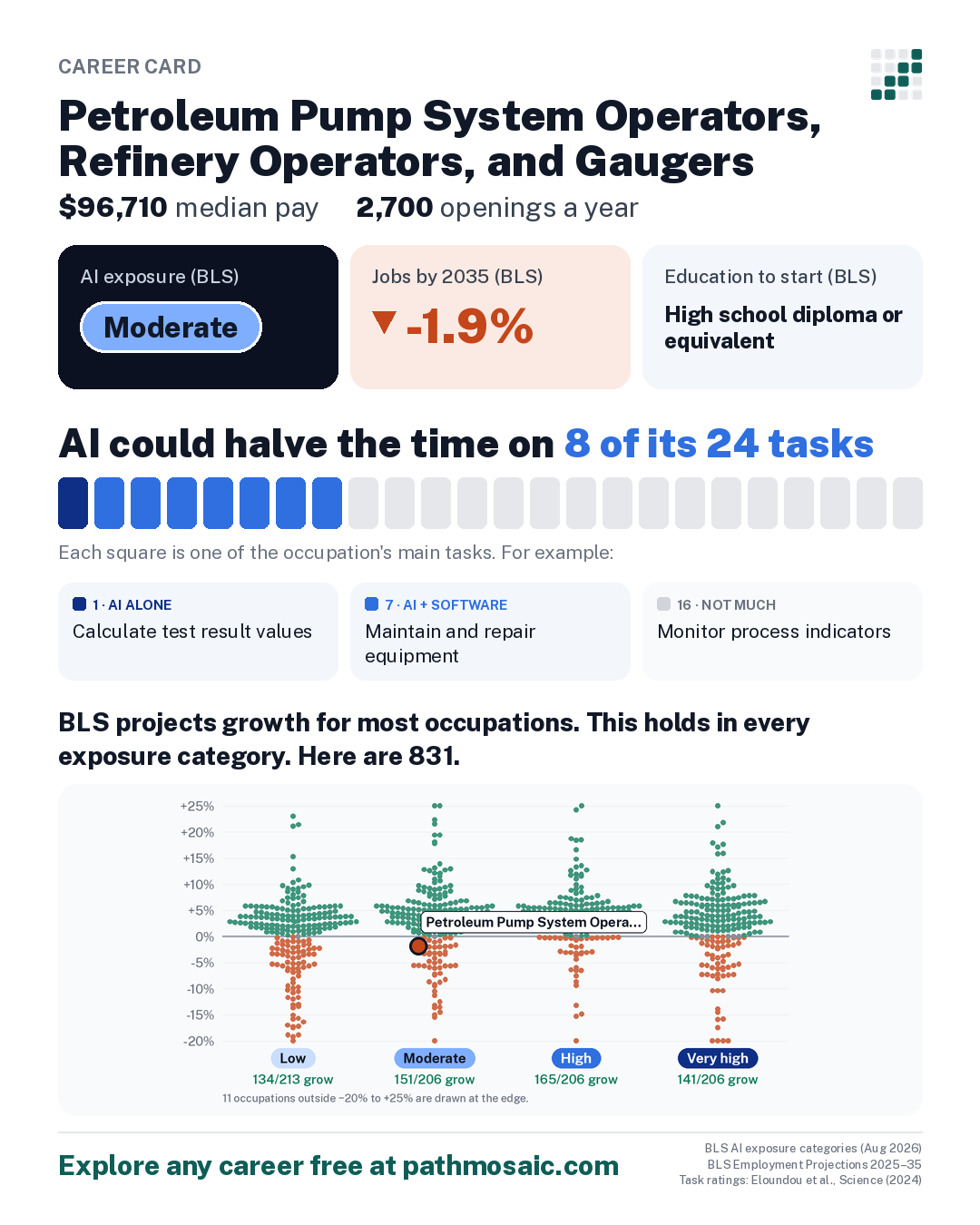
What the data says: AI could halve the time on 8 of its 24 tasks, and jobs are projected to shrink 1.9% by 2035. How to think about this →
About this projection
BLS builds AI into its projections where the research supports it: “BLS generally applies adjustments based on this research conservatively, where there is convincing evidence for a change.”
It also notes a limit: “BLS projection methods are not designed to capture extremely rapid technological change.”
On its AI exposure groups, BLS says exposure “does not imply job loss.”
Recent conditions
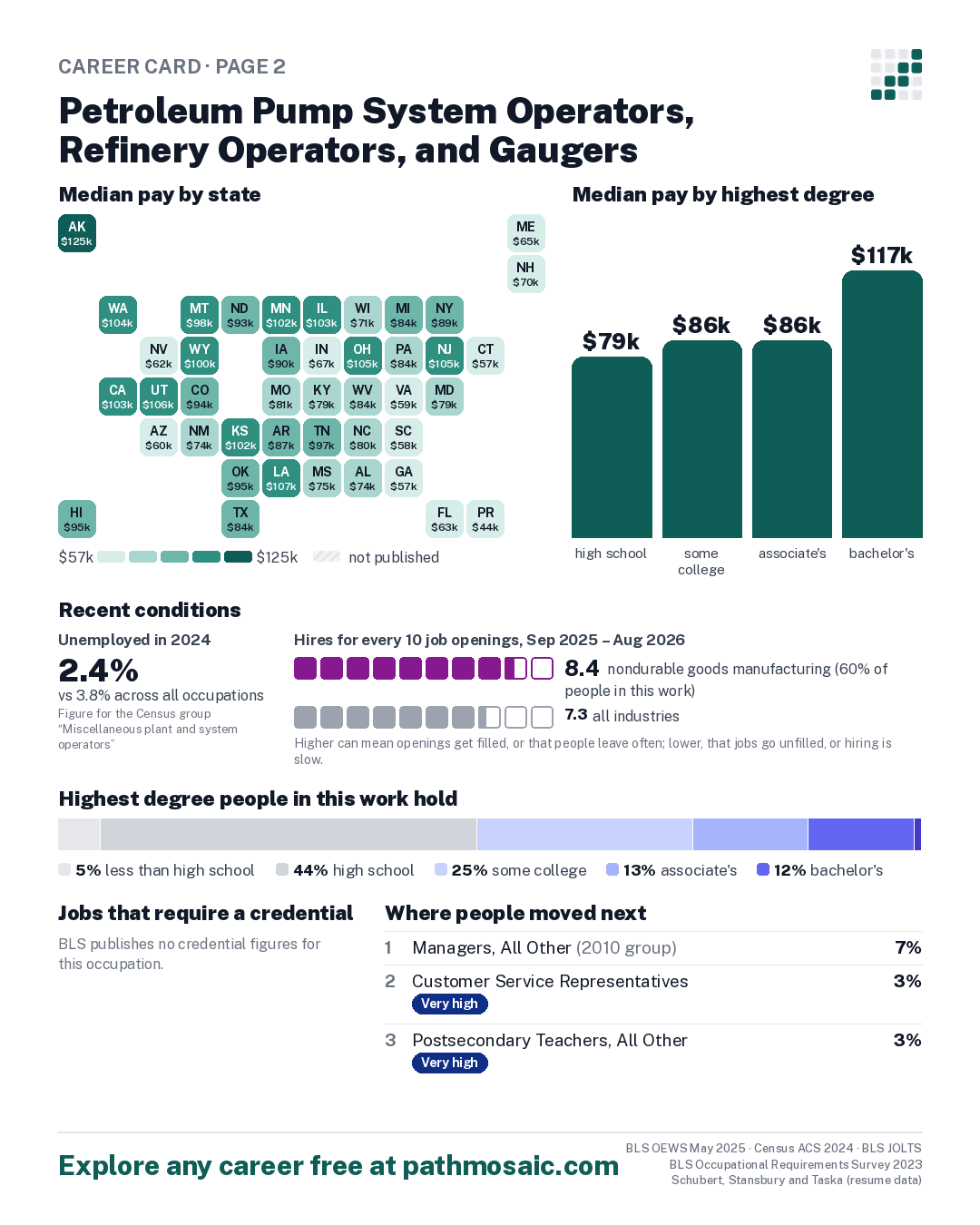
- In 2024, 2.4% of people in this work were unemployed, against 3.8% across all occupations Census ACS 2024, all workers in the Census group “Miscellaneous plant and system operators”
- From Sep 2025 to Aug 2026, 8.4 hires for every 10 job openings in nondurable goods manufacturing, which employs about 60% of people in this work, against 7.3 across all industries BLS JOLTS
One box per opening, filled for each hire; hires beyond the openings are added in a lighter shade. Higher can mean openings get filled, or that people leave often; lower, that jobs go unfilled, or hiring is slow.8.4 this industry7.3 all industries
Median pay by state BLS OEWS May 2025, state estimates
Tap a state for its figures.
Median pay in every state
| State | Median | Middle half earn | Jobs |
|---|---|---|---|
| Alabama | $73,510 | $48,180 to $87,870 | 90 |
| Alaska | $124,530 | $106,780 to $167,880 | 370 |
| Arizona | $60,070 | $41,620 to $98,480 | 180 |
| Arkansas | $86,580 | $70,690 to $93,940 | 220 |
| California | $103,250 | $96,810 to $119,200 | 3,360 |
| Colorado | $93,750 | $78,390 to $103,180 | 120 |
| Connecticut | $56,880 | $46,760 to $76,790 | not published |
| Florida | $63,480 | $56,290 to $75,980 | 170 |
| Georgia | $57,180 | $45,540 to $74,840 | 240 |
| Hawaii | $94,900 | $79,250 to $102,050 | 280 |
| Illinois | $102,890 | $101,310 to $111,370 | 1,070 |
| Indiana | $67,420 | $54,150 to $98,450 | 520 |
| Iowa | $90,160 | $70,890 to $98,340 | 70 |
| Kansas | $101,880 | $90,620 to $107,260 | 950 |
| Kentucky | $78,670 | $63,960 to $106,780 | 520 |
| Louisiana | $106,640 | $84,110 to $108,420 | 3,490 |
| Maine | $65,150 | $64,080 to $76,440 | 60 |
| Maryland | $78,580 | $66,260 to $100,980 | 90 |
| Michigan | $84,030 | $64,980 to $95,450 | 180 |
| Minnesota | $101,910 | $99,910 to $128,520 | 550 |
| Mississippi | $75,180 | $75,180 to $82,410 | 860 |
| Missouri | $80,960 | $70,100 to $98,770 | 100 |
| Montana | $98,310 | $78,900 to $103,200 | 550 |
| Nevada | $62,420 | $56,370 to $78,560 | 30 |
| New Hampshire | $70,050 | $61,510 to $78,000 | 120 |
| New Jersey | $104,540 | $104,440 to $104,540 | 420 |
| New Mexico | $74,340 | $62,800 to $101,770 | 420 |
| New York | $88,880 | $67,810 to $101,320 | 70 |
| North Carolina | $80,060 | $65,780 to $95,200 | 130 |
| North Dakota | $93,130 | $80,410 to $102,680 | 950 |
| Ohio | $105,150 | $85,350 to $107,520 | 800 |
| Oklahoma | $95,140 | $80,600 to $107,170 | 1,390 |
| Pennsylvania | $83,870 | $70,310 to $98,700 | 820 |
| Puerto Rico | $44,470 | $23,040 to $60,790 | 40 |
| South Carolina | $58,160 | $39,870 to $79,070 | 70 |
| Tennessee | $96,730 | $76,380 to $96,730 | 170 |
| Texas | $84,100 | $75,210 to $100,440 | 10,510 |
| Utah | $105,980 | $83,280 to $106,050 | 600 |
| Virginia | $58,970 | $46,980 to $78,900 | 250 |
| Washington | $103,620 | $88,410 to $105,640 | 930 |
| West Virginia | $83,910 | $81,090 to $89,570 | 330 |
| Wisconsin | $71,450 | $66,580 to $99,530 | not published |
| Wyoming | $100,350 | $87,080 to $114,040 | 560 |
Nationally: $96,710. Shades run from the lowest state median to the highest; a territory below that range takes the lightest. How to read this
How AI touches the work
What AI could speed up, task by task, and where people already use it.
AI could halve the time on 8 of its 24 tasks
| AI rating | Its main tasks | Share of Claude conversations May 2026 |
|---|---|---|
| AI + software | Maintain and repair equipment, or report malfunctioning equipment to supervisors so that repairs can be scheduled. | Not published |
| Not much | Monitor process indicators, instruments, gauges, and meters to detect and report any possible problems. | Not published |
| AI + software | Signal other workers by telephone or radio to operate pumps, open and close valves, and check temperatures. | Not published |
| Not much | Start pumps and open valves or use automated equipment to regulate the flow of oil in pipelines and into and out of tanks. | Not published |
| Not much | Verify that incoming and outgoing products are moving through the correct meters, and that meters are working properly. | Not published |
| Not much | Conduct general housekeeping of units, including wiping up oil spills and performing general cleaning duties. | Not published |
See all 24 tasks
| Not much | Collect product samples by turning bleeder valves, or by lowering containers into tanks to obtain oil samples. | Not published |
| Not much | Operate control panels to coordinate and regulate process variables such as temperature and pressure, and to direct product flow rate, according to process schedules. | Not published |
| AI + software | Plan movement of products through lines to processing, storage, and shipping units, using knowledge of system interconnections and capacities. | Not published |
| AI + software | Record and compile operating data, instrument readings, documentation, and results of laboratory analyses. | Not published |
| Not much | Patrol units to monitor the amount of oil in storage tanks, and to verify that activities and operations are safe, efficient, and in compliance with regulations. | Not published |
| Not much | Read automatic gauges at specified intervals to determine the flow rate of oil into or from tanks, and the amount of oil in tanks. | Not published |
| Not much | Control or operate manifold and pumping systems to circulate liquids through a petroleum refinery. | Not published |
| Not much | Operate auxiliary equipment and control multiple processing units during distilling or treating operations, moving controls that regulate valves, pumps, compressors, and auxiliary equipment. | Not published |
| Not much | Inspect pipelines, tightening connections and lubricating valves as necessary. | Not published |
| Not much | Synchronize activities with other pumphouses to ensure a continuous flow of products and a minimum of contamination between products. | Not published |
| AI + software | Read and analyze specifications, schedules, logs, test results, and laboratory recommendations to determine how to set equipment controls to produce the required qualities and quantities of products. | Not published |
| Not much | Perform tests to check the qualities and grades of products, such as assessing levels of bottom sediment, water, and foreign materials in oil samples, using centrifugal testers. | Not published |
| Not much | Coordinate shutdowns and major projects. | Not published |
| Not much | Clean interiors of processing units by circulating chemicals and solvents within units. | Not published |
| AI alone | Calculate test result values, using standard formulas. | Not published |
| Not much | Clamp seals around valves to secure tanks. | Not published |
| AI + software | Prepare calculations for receipts and deliveries of oil and oil products. | Not published |
| AI + software | Lower thermometers into tanks to obtain temperature readings. | Not published |
Ordered by how important O*NET's respondents rate each task (1 to 5) times the share who say it is part of their job. The ordering is ours. 0 of the 24 have a published share of Claude conversations; “not published” means too few conversations for Anthropic to publish a figure.
Where people already use AI
The tasks above say what AI could speed up. This shows what people are using it for. Its 24 tasks fall under 19 work activities that many occupations share, and Microsoft counted how often each one came up in 200,000 conversations with its Copilot assistant in 2024.
- #8 Read documents or materials to inform work processes
- #39 Determine values or prices of goods or services
| Work activity | This occupation's tasks under it | People asked AI for help in 10,000 conversations |
AI did it for them in 10,000 conversations |
|---|---|---|---|
| Monitor equipment operation | |||
| Maintain tools or equipment | |||
| Test characteristics of materials or products | |||
| Clean tools, equipment, facilities, or work areas | |||
| Direct organizational operations, activities, or procedures | |||
| Operate pumping systems or equipment | |||
| Read documents or materials to inform work processes | |||
| Determine values or prices of goods or services |
Show all 19 activities
| Plan work activities | |||
| Adjust equipment to ensure adequate performance | |||
| Measure physical characteristics of materials, products, or equipment | |||
| Maintain operational records | |||
| Notify others of emergencies or problems | |||
| Repair tools or equipment | |||
| Apply materials to fill gaps or imperfections | |||
| Inspect commercial, industrial, or production systems or equipment | |||
| Collect samples of products or materials | |||
| Signal others to coordinate work activities | |||
| Operate energy production or distribution equipment |
How to read this
Work activities come from O*NET, which links every task to the broader activities it involves. Microsoft's figures are for the activity across everyone who used Copilot, not for petroleum pump system operators, refinery operators, and gaugers specifically. Copilot is a general chat assistant; dedicated coding tools are not included, so programming help is under-counted here. Activities are listed by how many of this occupation's tasks fall under them.
The task ratings say whether AI could halve the time a task takes: on its own (“AI alone”), or with software built on it (“AI + software”). They were made by people in 2023 (Eloundou et al.). Claude's share is the task's share of all Claude.ai conversations in May 2026; Anthropic doesn't publish a task with too few conversations. None of these add up to the BLS exposure group, which combines five research measures.
More in the Guide: task ratings · task order · work activities · Copilot figures · Claude
High exposure doesn't mean fewer jobs
BLS projects most occupations in its two most exposed groups to grow: 141 of 206 rated Very high and 165 of 206 rated High. Each dot is one of the 831 occupations BLS rates.
Career moves into and out of this occupation
From moves between occupations found in online resumes, 2002–2016. Career changes only: a first job after school isn't a move.
Where people moved next
of 22,239 moves out
- 1 Managers, All Other (2010 group) an older group BLS has since split; no exposure group today 7%
- 2 Customer Service Representatives Very high -5.3% 3%
- 3 Postsecondary Teachers, All Other Very high +2.0% 3%
- 4 First-Line Supervisors of Police and Detectives Moderate +3.3% 3%
- 5 Teachers and Instructors, All Other (2010 group) an older group BLS has since split; no exposure group today 3%
Where people moved in from
of 12,182 moves in
- 1 Customer Service Representatives Very high -5.3% 5%
- 2 Retail Salespersons Very high -0.3% 4%
- 3 Security Guards Moderate +0.9% 4%
- 4 Managers, All Other (2010 group) an older group BLS has since split; no exposure group today 3%
- 5 Cashiers High -6.5% 3%
Resumes over-represent younger, white-collar job-seekers and moves into management. Schubert, Stansbury and Taska (resume data).
Education and training for the occupation
O*NET survey of workers in this occupation
- 97% high school
- 2% postsecondary certificate
- 1% some college
O*NET 31.0 survey of workers in this occupation · 21 people answered.
Census survey (American Community Survey)
- 5% less than high school
- 44% high school
- 25% some college
- 13% associate's
- 12% bachelor's
- 1% master's
Census ACS 2024, all workers in the Census group “Miscellaneous plant and system operators” · 513 people surveyed.
Why the two can differ
O*NET asks about 20 people in each occupation, which makes its shares uncertain, but it reports the exact occupation and counts certificates. The Census survey reaches thousands, but it groups some occupations together and counts degrees only. More in the Guide
Median pay by highest degree full-time, year-round · Census ACS 2024, all workers in the Census group “Miscellaneous plant and system operators”
Jobs that require a credential BLS Occupational Requirements Survey 2023
BLS publishes no credential figures for this occupation.
Look up certifications, training and licenses U.S. Department of Labor
- Certification Finder ↗ certifications CareerOneStop lists for this occupation
- Training Finder ↗ schools and programs, nationwide; narrow the place there
- License Finder ↗ licenses by state
- Apprenticeship Finder ↗ DOL lists 4 registered apprenticeships in this occupation. Apprenticeship.gov can't be linked to one occupation, so search for “Petroleum Pump System Operators, Refinery Operators, and Gaugers” there.
These open in a new tab and send only the occupation's public code. More in the Guide
BLS AI exposure categories (Aug 2026) · BLS Employment Projections 2025–35 · O*NET 31.0 · Task ratings: Eloundou et al., Science (2024) · Microsoft "Working with AI" v1.1 · Anthropic Economic Index (2026-06-26) · Schubert, Stansbury and Taska · NCES CIP–SOC · Census ACS 2024 · BLS JOLTS
See it online, and explore any career: https://www.pathmosaic.com/card/51-8093.00