Animal Breeders
Also called: Animal Technician, Artificial Insemination Technician (AI Technician), Breeder, Dog BreederSelect and breed animals according to their genealogy, characteristics, and offspring. May require knowledge of artificial insemination techniques and equipment use. May involve keeping records on heats, birth intervals, or pedigree.
On a phone, press and hold a picture to save it to Photos.
opens your phone's share sheet, where you can save both to Photos
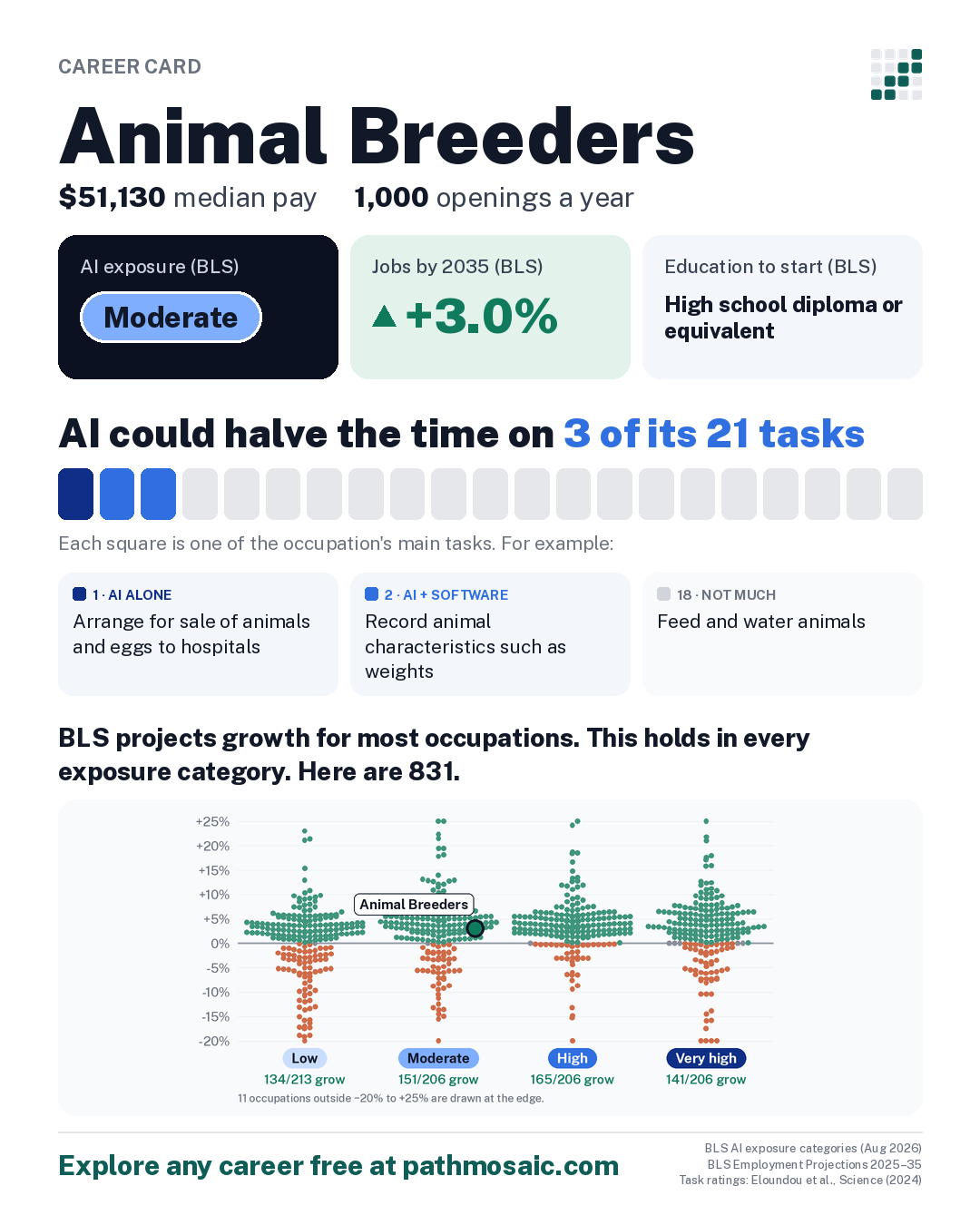
What the data says: AI could halve the time on 3 of its 21 tasks, and jobs are projected to grow 3.0% by 2035. How to think about this →
About this projection
BLS builds AI into its projections where the research supports it: “BLS generally applies adjustments based on this research conservatively, where there is convincing evidence for a change.”
It also notes a limit: “BLS projection methods are not designed to capture extremely rapid technological change.”
On its AI exposure groups, BLS says exposure “does not imply job loss.”
Recent conditions
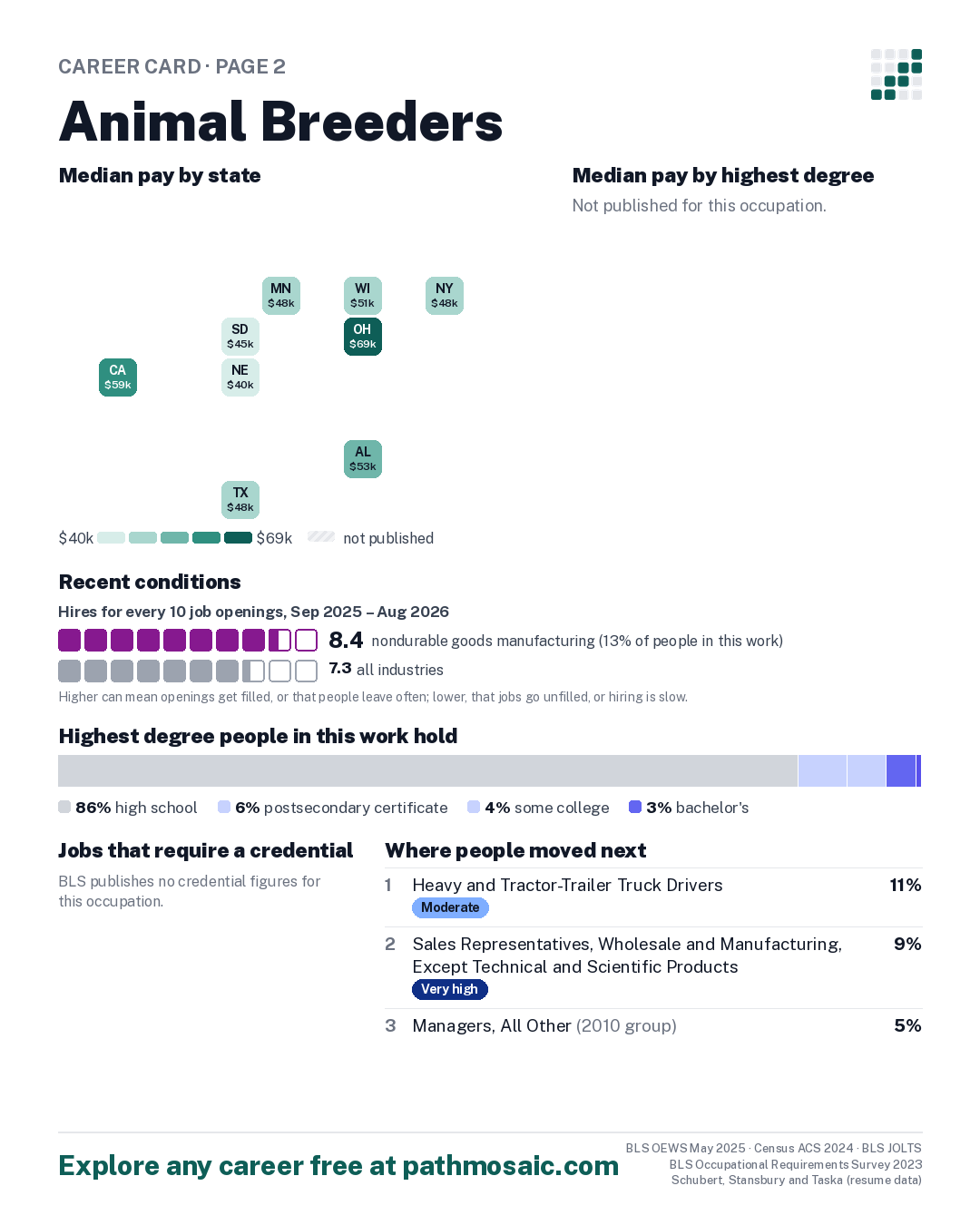
- From Sep 2025 to Aug 2026, 8.4 hires for every 10 job openings in nondurable goods manufacturing, which employs about 13% of people in this work, against 7.3 across all industries BLS JOLTS
One box per opening, filled for each hire; hires beyond the openings are added in a lighter shade. Higher can mean openings get filled, or that people leave often; lower, that jobs go unfilled, or hiring is slow.8.4 this industry7.3 all industries
Median pay by state BLS OEWS May 2025, state estimates
Tap a state for its figures.
Median pay in every state
| State | Median | Middle half earn | Jobs |
|---|---|---|---|
| Alabama | $53,200 | $26,860 to $63,930 | 60 |
| California | $59,280 | $55,120 to $73,320 | 410 |
| Minnesota | $47,900 | $47,630 to $49,340 | 170 |
| Nebraska | $40,220 | $39,710 to $42,660 | 40 |
| New York | $48,350 | $46,530 to $58,720 | 140 |
| Ohio | $68,980 | $49,300 to $111,150 | 80 |
| South Dakota | $44,850 | $43,260 to $45,980 | 40 |
| Texas | $48,410 | $44,380 to $62,100 | 60 |
| Wisconsin | $51,130 | $42,900 to $54,390 | 40 |
Nationally: $51,130. Shades run from the lowest state median to the highest; a territory below that range takes the lightest. How to read this
How AI touches the work
What AI could speed up, task by task, and where people already use it.
AI could halve the time on 3 of its 21 tasks
| AI rating | Its main tasks | Share of Claude conversations May 2026 |
|---|---|---|
| Not much | Feed and water animals, and clean and disinfect pens, cages, yards, and hutches. | Not published |
| Not much | Select animals to be bred, and semen specimens to be used, according to knowledge of animals, genealogies, traits, and desired offspring characteristics. | Not published |
| Not much | Observe animals in heat to detect approach of estrus and exercise animals to induce or hasten estrus, if necessary. | Not published |
| Not much | Purchase and stock supplies of feed and medicines. | Not published |
| Not much | Examine animals to detect symptoms of illness or injury. | Not published |
| Not much | Treat minor injuries and ailments and contact veterinarians to obtain treatment for animals with serious illnesses or injuries. | Not published |
See all 21 tasks
| Not much | Brand, tattoo, or tag animals to allow animal identification. | Not published |
| Not much | Build hutches, pens, and fenced yards. | Not published |
| Not much | Exercise animals to keep them in healthy condition. | Not published |
| AI + software | Record animal characteristics such as weights, growth patterns, and diets. | Not published |
| Not much | Bathe and groom animals. | Not published |
| Not much | Adjust controls to maintain specific building temperatures required for animals' health and safety. | Not published |
| Not much | Place vaccines in drinking water, inject vaccines, or dust air with vaccine powder to protect animals from diseases. | Not published |
| AI + software | Maintain logs of semen specimens used and animals bred. | Not published |
| Not much | Inject prepared animal semen into female animals for breeding purposes, by inserting nozzle of syringe into vagina and depressing syringe plunger. | Not published |
| Not much | Clip or shear hair on animals. | Not published |
| AI alone | Arrange for sale of animals and eggs to hospitals, research centers, pet shops, and food processing plants. | Not published |
| Not much | Exhibit animals at shows. | Not published |
| Not much | Measure specified amounts of semen into calibrated syringes, and insert syringes into inseminating guns. | Not published |
| Not much | Examine semen microscopically to assess and record density and motility of gametes, and dilute semen with prescribed diluents, according to formulas. | Not published |
| Not much | Package and label semen to be used for artificial insemination, recording information such as the date, source, quality, and concentration. | Not published |
Ordered by how important O*NET's respondents rate each task (1 to 5) times the share who say it is part of their job. The ordering is ours. 0 of the 21 have a published share of Claude conversations; “not published” means too few conversations for Anthropic to publish a figure.
Where people already use AI
The tasks above say what AI could speed up. This shows what people are using it for. Its 21 tasks fall under 14 work activities that many occupations share, and Microsoft counted how often each one came up in 200,000 conversations with its Copilot assistant in 2024.
- #36 Purchase goods or services
| Work activity | This occupation's tasks under it | People asked AI for help in 10,000 conversations |
AI did it for them in 10,000 conversations |
|---|---|---|---|
| Care for plants or animals | |||
| Maintain operational records | |||
| Monitor health conditions of humans or animals | |||
| Purchase goods or services | |||
| Adjust equipment to ensure adequate performance | |||
| Prepare mixtures or solutions | |||
| Promote products, services, or programs | |||
| Communicate with others about operational plans or activities |
Show all 14 activities
| Clean tools, equipment, facilities, or work areas | |||
| Mark materials or objects for identification | |||
| Sell products or services | |||
| Treat injuries, illnesses, or diseases | |||
| Build structures | |||
| Examine people or animals to assess health conditions or physical characteristics |
How to read this
Work activities come from O*NET, which links every task to the broader activities it involves. Microsoft's figures are for the activity across everyone who used Copilot, not for animal breeders specifically. Copilot is a general chat assistant; dedicated coding tools are not included, so programming help is under-counted here. Activities are listed by how many of this occupation's tasks fall under them.
The task ratings say whether AI could halve the time a task takes: on its own (“AI alone”), or with software built on it (“AI + software”). They were made by people in 2023 (Eloundou et al.). Claude's share is the task's share of all Claude.ai conversations in May 2026; Anthropic doesn't publish a task with too few conversations. None of these add up to the BLS exposure group, which combines five research measures.
More in the Guide: task ratings · task order · work activities · Copilot figures · Claude
High exposure doesn't mean fewer jobs
BLS projects most occupations in its two most exposed groups to grow: 141 of 206 rated Very high and 165 of 206 rated High. Each dot is one of the 831 occupations BLS rates.
Career moves into and out of this occupation
From moves between occupations found in online resumes, 2002–2016. Career changes only: a first job after school isn't a move.
Where people moved next
of 670 moves out
- 1 Heavy and Tractor-Trailer Truck Drivers Moderate +3.8% 11%
- 2 Sales Representatives, Wholesale and Manufacturing, Except Technical and Scientific Products Very high -0.9% 9%
- 3 Managers, All Other (2010 group) an older group BLS has since split; no exposure group today 5%
- 4 Chief Executives Very high +3.2% 4%
- 5 Transportation, Storage, and Distribution Managers Very high +6.1% 4%
Where people moved in from
of 633 moves in
- 1 Heavy and Tractor-Trailer Truck Drivers Moderate +3.8% 9%
- 2 Sales Representatives, Wholesale and Manufacturing, Except Technical and Scientific Products Very high -0.9% 8%
- 3 Secretaries and Administrative Assistants, Except Legal, Medical, and Executive Very high -6.0% 4%
- 4 Production Workers, All Other (2010 group) an older group BLS has since split; no exposure group today 4%
- 5 Transportation, Storage, and Distribution Managers Very high +6.1% 4%
Resumes over-represent younger, white-collar job-seekers and moves into management. Schubert, Stansbury and Taska (resume data).
Education and training for the occupation
O*NET survey of workers in this occupation
- 86% high school
- 6% postsecondary certificate
- 4% some college
- 3% bachelor's
- 1% post-bachelor's certificate
O*NET 31.0 survey of workers in this occupation · 20 people answered.
3 programs: Animal/Livestock Husbandry and Production, Horse Husbandry/Equine Science and Management and Apiculture.
Jobs that require a credential BLS Occupational Requirements Survey 2023
BLS publishes no credential figures for this occupation.
Look up certifications, training and licenses U.S. Department of Labor
- Certification Finder ↗ certifications CareerOneStop lists for this occupation
- Training Finder ↗ schools and programs, nationwide; narrow the place there
- License Finder ↗ licenses by state
- Apprenticeships: DOL's list of apprenticeable occupations doesn't include this one.
These open in a new tab and send only the occupation's public code. More in the Guide
BLS AI exposure categories (Aug 2026) · BLS Employment Projections 2025–35 · O*NET 31.0 · Task ratings: Eloundou et al., Science (2024) · Microsoft "Working with AI" v1.1 · Anthropic Economic Index (2026-06-26) · Schubert, Stansbury and Taska · NCES CIP–SOC · Census ACS 2024 · BLS JOLTS
See it online, and explore any career: https://www.pathmosaic.com/card/45-2021.00