Laundry and Dry-Cleaning Workers
Also called: Dry Cleaner, Laundry Aide, Laundry Attendant, Laundry WorkerOperate or tend washing or dry-cleaning machines to wash or dry-clean industrial or household articles, such as cloth garments, suede, leather, furs, blankets, draperies, linens, rugs, and carpets. Includes spotters and dyers of these articles.
On a phone, press and hold a picture to save it to Photos.
opens your phone's share sheet, where you can save both to Photos
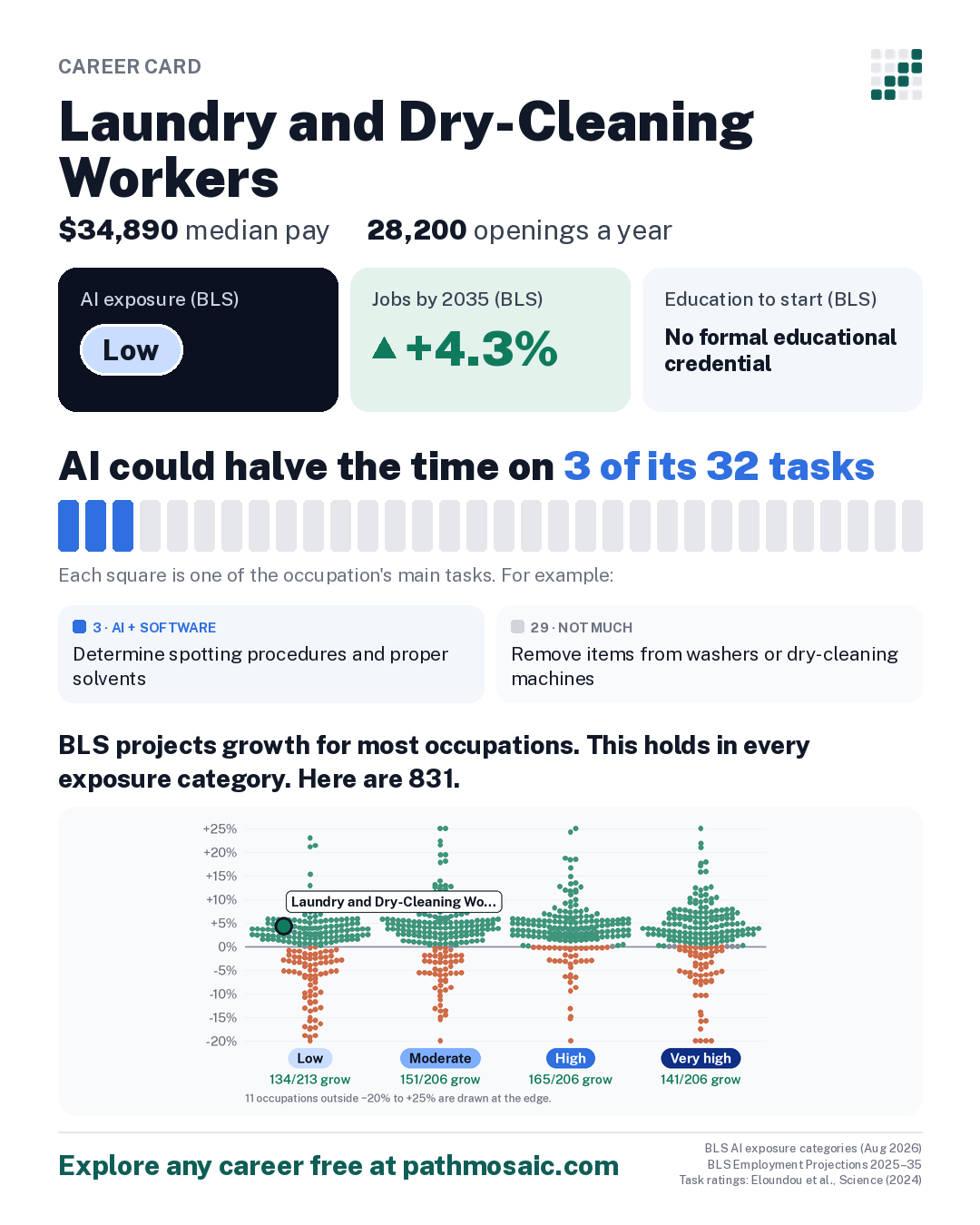
What the data says: AI could halve the time on 3 of its 32 tasks, and jobs are projected to grow 4.3% by 2035. How to think about this →
About this projection
BLS builds AI into its projections where the research supports it: “BLS generally applies adjustments based on this research conservatively, where there is convincing evidence for a change.”
It also notes a limit: “BLS projection methods are not designed to capture extremely rapid technological change.”
On its AI exposure groups, BLS says exposure “does not imply job loss.”
Recent conditions
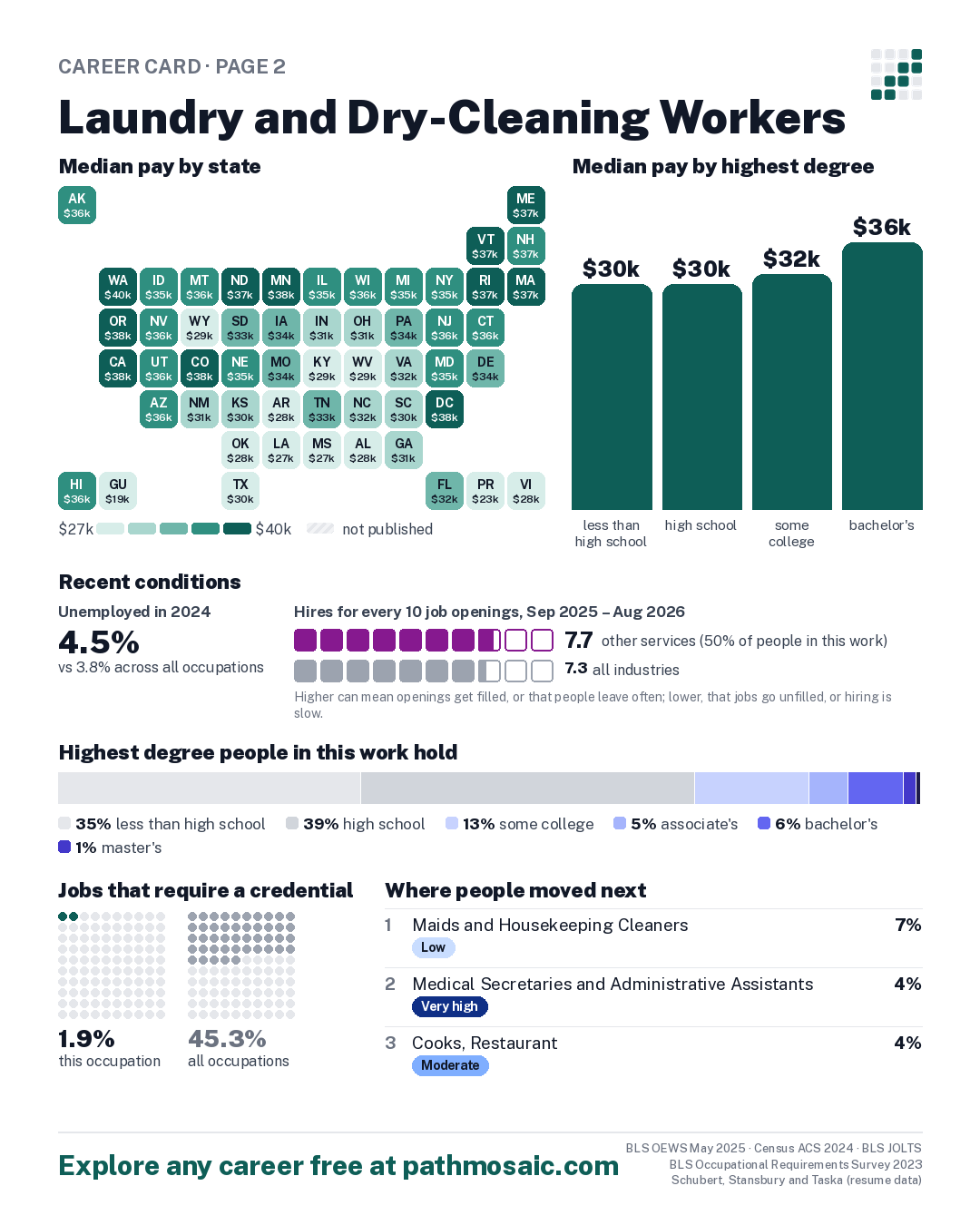
- In 2024, 4.5% of people in this work were unemployed, against 3.8% across all occupations Census ACS 2024
- From Sep 2025 to Aug 2026, 7.7 hires for every 10 job openings in other services, which employs about 50% of people in this work, against 7.3 across all industries BLS JOLTS
One box per opening, filled for each hire; hires beyond the openings are added in a lighter shade. Higher can mean openings get filled, or that people leave often; lower, that jobs go unfilled, or hiring is slow.7.7 this industry7.3 all industries
Median pay by state BLS OEWS May 2025, state estimates
Tap a state for its figures.
Median pay in every state
| State | Median | Middle half earn | Jobs |
|---|---|---|---|
| Alabama | $28,370 | $24,450 to $32,320 | 2,150 |
| Alaska | $36,050 | $32,700 to $39,320 | 750 |
| Arizona | $36,500 | $34,780 to $37,670 | 4,290 |
| Arkansas | $28,460 | $26,770 to $30,180 | 1,640 |
| California | $37,790 | $36,420 to $42,060 | 21,940 |
| Colorado | $37,680 | $35,800 to $42,950 | 3,370 |
| Connecticut | $36,310 | $35,340 to $37,990 | 1,830 |
| Delaware | $33,730 | $31,230 to $36,600 | 710 |
| District of Columbia | $37,790 | $36,960 to $42,850 | 320 |
| Florida | $32,340 | $30,110 to $35,100 | 14,150 |
| Georgia | $30,580 | $27,810 to $34,060 | 5,150 |
| Guam | $19,280 | $19,280 to $21,940 | 100 |
| Hawaii | $35,690 | $31,700 to $45,780 | 1,730 |
| Idaho | $35,140 | $28,450 to $38,650 | 1,350 |
| Illinois | $35,220 | $31,200 to $37,100 | 8,550 |
| Indiana | $30,930 | $28,690 to $35,250 | 3,190 |
| Iowa | $34,050 | $29,700 to $37,280 | 1,900 |
| Kansas | $30,120 | $27,860 to $34,330 | 2,160 |
| Kentucky | $29,220 | $26,900 to $33,280 | 2,350 |
| Louisiana | $27,460 | $22,970 to $30,250 | 2,950 |
| Maine | $37,380 | $35,920 to $39,550 | 820 |
| Maryland | $34,710 | $31,390 to $36,770 | 3,780 |
| Massachusetts | $37,490 | $35,920 to $38,930 | 3,700 |
| Michigan | $35,100 | $30,770 to $37,990 | 4,970 |
| Minnesota | $37,580 | $34,340 to $43,140 | 3,530 |
| Mississippi | $27,190 | $22,880 to $28,890 | 1,420 |
| Missouri | $33,870 | $29,940 to $36,410 | 3,930 |
| Montana | $36,250 | $33,760 to $38,690 | 1,030 |
| Nebraska | $34,790 | $31,250 to $37,810 | 1,060 |
| Nevada | $36,210 | $32,230 to $38,320 | 4,540 |
| New Hampshire | $36,860 | $35,890 to $38,670 | 890 |
| New Jersey | $36,050 | $34,490 to $37,280 | 6,110 |
| New Mexico | $30,850 | $28,560 to $34,580 | 1,320 |
| New York | $35,050 | $34,020 to $37,330 | 13,020 |
| North Carolina | $31,920 | $28,750 to $35,730 | 5,570 |
| North Dakota | $37,470 | $33,640 to $40,210 | 840 |
| Ohio | $30,520 | $28,010 to $36,400 | 6,990 |
| Oklahoma | $28,170 | $23,440 to $31,430 | 2,680 |
| Oregon | $37,800 | $36,020 to $43,280 | 1,890 |
| Pennsylvania | $34,060 | $29,360 to $36,570 | 6,290 |
| Puerto Rico | $22,630 | $21,840 to $23,650 | 620 |
| Rhode Island | $37,230 | $35,530 to $40,130 | 650 |
| South Carolina | $30,470 | $28,250 to $35,020 | 3,160 |
| South Dakota | $32,780 | $29,120 to $36,150 | 750 |
| Tennessee | $33,220 | $29,620 to $35,920 | 5,730 |
| Texas | $29,630 | $26,160 to $35,200 | 17,030 |
| Utah | $35,690 | $31,200 to $38,020 | 1,470 |
| Vermont | $37,300 | $36,310 to $41,720 | 280 |
| Virgin Islands | $28,090 | $25,470 to $34,580 | 150 |
| Virginia | $32,140 | $28,590 to $36,010 | 4,900 |
| Washington | $39,590 | $37,780 to $44,100 | 3,870 |
| West Virginia | $28,970 | $27,110 to $34,490 | 1,340 |
| Wisconsin | $35,700 | $30,820 to $37,260 | 3,310 |
| Wyoming | $28,630 | $27,820 to $33,870 | 690 |
Nationally: $34,890. Shades run from the lowest state median to the highest; a territory below that range takes the lightest. How to read this
How AI touches the work
What AI could speed up, task by task, and where people already use it.
AI could halve the time on 3 of its 32 tasks
| AI rating | Its main tasks | Share of Claude conversations May 2026 |
|---|---|---|
| Not much | Remove items from washers or dry-cleaning machines, or direct other workers to do so. | Not published |
| Not much | Load articles into washers or dry-cleaning machines, or direct other workers to perform loading. | Not published |
| Not much | Sort and count articles removed from dryers, and fold, wrap, or hang them. | Not published |
| Not much | Start washers, dry cleaners, driers, or extractors, and turn valves or levers to regulate machine processes and the volume of soap, detergent, water, bleach, starch, and other additives. | Not published |
| Not much | Examine and sort into lots articles to be cleaned, according to color, fabric, dirt content, and cleaning technique required. | Not published |
| Not much | Operate extractors and driers, or direct their operation. | Not published |
See all 32 tasks
| Not much | Sprinkle chemical solvents over stains, and pat areas with brushes or sponges to remove stains. | Not published |
| AI + software | Determine spotting procedures and proper solvents, based on fabric and stain types. | Not published |
| Not much | Inspect soiled articles to determine sources of stains, to locate color imperfections, and to identify items requiring special treatment. | Not published |
| Not much | Clean machine filters, and lubricate equipment. | Not published |
| Not much | Apply chemicals to neutralize the effects of solvents. | Not published |
| Not much | Pre-soak, sterilize, scrub, spot-clean, and dry contaminated or stained articles, using neutralizer solutions and portable machines. | Not published |
| AI + software | Receive and mark articles for laundry or dry cleaning with identifying code numbers or names, using hand or machine markers. | Not published |
| Not much | Apply bleaching powders to spots and spray them with steam to remove stains from fabrics that do not respond to other cleaning solvents. | Not published |
| Not much | Hang curtains, drapes, blankets, pants, and other garments on stretch frames to dry. | Not published |
| Not much | Mix and add detergents, dyes, bleaches, starches, and other solutions and chemicals to clean, color, dry, or stiffen articles. | Not published |
| Not much | Iron or press articles, fabrics, and furs, using hand irons or pressing machines. | Not published |
| Not much | Test fabrics in inconspicuous places to determine whether solvents will damage dyes or fabrics. | Not published |
| AI + software | Match sample colors, applying knowledge of bleaching agent and dye properties, and types, construction, conditions, and colors of articles. | Not published |
| Not much | Wash, dry-clean, or glaze delicate articles or fur garment linings by hand, using mild detergents or dry cleaning solutions. | Not published |
| Not much | Operate dry-cleaning machines to clean soiled articles. | Not published |
| Not much | Immerse articles in bleaching baths to strip colors. | Not published |
| Not much | Mix bleaching agents with hot water in vats, and soak material until it is bleached. | Not published |
| Not much | Mend and sew articles, using hand stitching, adhesive patches, or sewing machines. | Not published |
| Not much | Clean fabrics, using vacuums or air hoses. | Not published |
| Not much | Spray steam, water, or air over spots to flush out chemicals, dry material, raise naps, or brighten colors. | Not published |
| Not much | Identify articles' fabrics and original dyes by sight and touch, or by testing samples with fire or chemical reagents. | Not published |
| Not much | Operate machines that comb, dry and polish furs, clean, sterilize and fluff feathers and blankets, or roll and package towels. | Not published |
| Not much | Dye articles to change or restore their colors, using knowledge of textile compositions and the properties and effects of bleaches and dyes. | Not published |
| Not much | Start pumps to operate distilling systems that drain and reclaim dry cleaning solvents. | Not published |
| Not much | Rinse articles in water and acetic acid solutions to remove excess dye and to fix colors. | Not published |
| Not much | Spread soiled articles on work tables, and position stained portions over vacuum heads or on marble slabs. | Not published |
Ordered by how important O*NET's respondents rate each task (1 to 5) times the share who say it is part of their job. The ordering is ours. 0 of the 32 have a published share of Claude conversations; “not published” means too few conversations for Anthropic to publish a figure.
Where people already use AI
The tasks above say what AI could speed up. This shows what people are using it for. Its 32 tasks fall under 17 work activities that many occupations share, and Microsoft counted how often each one came up in 200,000 conversations with its Copilot assistant in 2024.
- #38 Select materials or equipment for operations or projects
| Work activity | This occupation's tasks under it | People asked AI for help in 10,000 conversations |
AI did it for them in 10,000 conversations |
|---|---|---|---|
| Clean workpieces, finished products, or other objects | |||
| Inspect characteristics or conditions of materials or products | |||
| Direct organizational operations, activities, or procedures | |||
| Sew garments or materials | |||
| Prepare mixtures or solutions | |||
| Sort materials or products | |||
| Test characteristics of materials or products | |||
| Position workpieces or materials on equipment |
Show all 17 activities
| Prepare industrial materials for processing or use | |||
| Operate pumping systems or equipment | |||
| Operate industrial processing or production equipment | |||
| Select materials or equipment for operations or projects | |||
| Maintain tools or equipment | |||
| Inspect completed work or finished products | |||
| Clean tools, equipment, facilities, or work areas | |||
| Mark materials or objects for identification | |||
| Remove workpieces from production equipment |
How to read this
Work activities come from O*NET, which links every task to the broader activities it involves. Microsoft's figures are for the activity across everyone who used Copilot, not for laundry and dry-cleaning workers specifically. Copilot is a general chat assistant; dedicated coding tools are not included, so programming help is under-counted here. Activities are listed by how many of this occupation's tasks fall under them.
The task ratings say whether AI could halve the time a task takes: on its own (“AI alone”), or with software built on it (“AI + software”). They were made by people in 2023 (Eloundou et al.). Claude's share is the task's share of all Claude.ai conversations in May 2026; Anthropic doesn't publish a task with too few conversations. None of these add up to the BLS exposure group, which combines five research measures.
More in the Guide: task ratings · task order · work activities · Copilot figures · Claude
High exposure doesn't mean fewer jobs
BLS projects most occupations in its two most exposed groups to grow: 141 of 206 rated Very high and 165 of 206 rated High. Each dot is one of the 831 occupations BLS rates.
Career moves into and out of this occupation
From moves between occupations found in online resumes, 2002–2016. Career changes only: a first job after school isn't a move.
Where people moved next
of 8,126 moves out
- 1 Maids and Housekeeping Cleaners Low +0.6% 7%
- 2 Medical Secretaries and Administrative Assistants Very high +4.8% 4%
- 3 Cooks, Restaurant Moderate +12.1% 4%
- 4 Janitors and Cleaners, Except Maids and Housekeeping Cleaners Low +2.2% 3%
- 5 Cutting and Slicing Machine Setters, Operators, and Tenders Moderate -0.9% 3%
Where people moved in from
of 8,235 moves in
- 1 Maids and Housekeeping Cleaners Low +0.6% 7%
- 2 Cashiers High -6.5% 7%
- 3 Medical Secretaries and Administrative Assistants Very high +4.8% 6%
- 4 Customer Service Representatives Very high -5.3% 5%
- 5 Cooks, Restaurant Moderate +12.1% 4%
Resumes over-represent younger, white-collar job-seekers and moves into management. Schubert, Stansbury and Taska (resume data).
Education and training for the occupation
Census survey (American Community Survey)
- 35% less than high school
- 39% high school
- 13% some college
- 5% associate's
- 6% bachelor's
- 1% master's
- 1% doctorate
Census ACS 2024, all workers in this occupation · 1,204 people surveyed.
Median pay by highest degree full-time, year-round · Census ACS 2024, all workers in this occupation
Jobs that require a credential BLS Occupational Requirements Survey 2023
1.9% this occupation
45.3% all occupations
| By kind | This occupation | All occupations |
|---|---|---|
| a license | <0.5% | 19.1% |
| a certification | <0.5% | 5.8% |
| an educational certificate | <0.5% | 2.8% |
Share of jobs whose employer requires it. BLS doesn't say which credential. How to read this
Look up certifications, training and licenses U.S. Department of Labor
- Certification Finder ↗ certifications CareerOneStop lists for this occupation
- Training Finder ↗ schools and programs, nationwide; narrow the place there
- License Finder ↗ licenses by state
- Apprenticeship Finder ↗ DOL lists 2 registered apprenticeships in this occupation (DRY CLEANER; DRY CLEANER). Apprenticeship.gov can't be linked to one occupation, so search for “Laundry and Dry-Cleaning Workers” there.
These open in a new tab and send only the occupation's public code. More in the Guide
BLS AI exposure categories (Aug 2026) · BLS Employment Projections 2025–35 · O*NET 31.0 · Task ratings: Eloundou et al., Science (2024) · Microsoft "Working with AI" v1.1 · Anthropic Economic Index (2026-06-26) · Schubert, Stansbury and Taska · NCES CIP–SOC · Census ACS 2024 · BLS JOLTS
See it online, and explore any career: https://www.pathmosaic.com/card/51-6011.00