Commercial Divers
Also called: Diver, Diver Tender, Salvage Diver, Saturation DiverWork below surface of water, using surface-supplied air or scuba equipment to inspect, repair, remove, or install equipment and structures. May use a variety of power and hand tools, such as drills, sledgehammers, torches, and welding equipment. May conduct tests or experiments, rig explosives, or photograph structures or marine life.
On a phone, press and hold a picture to save it to Photos.
opens your phone's share sheet, where you can save both to Photos
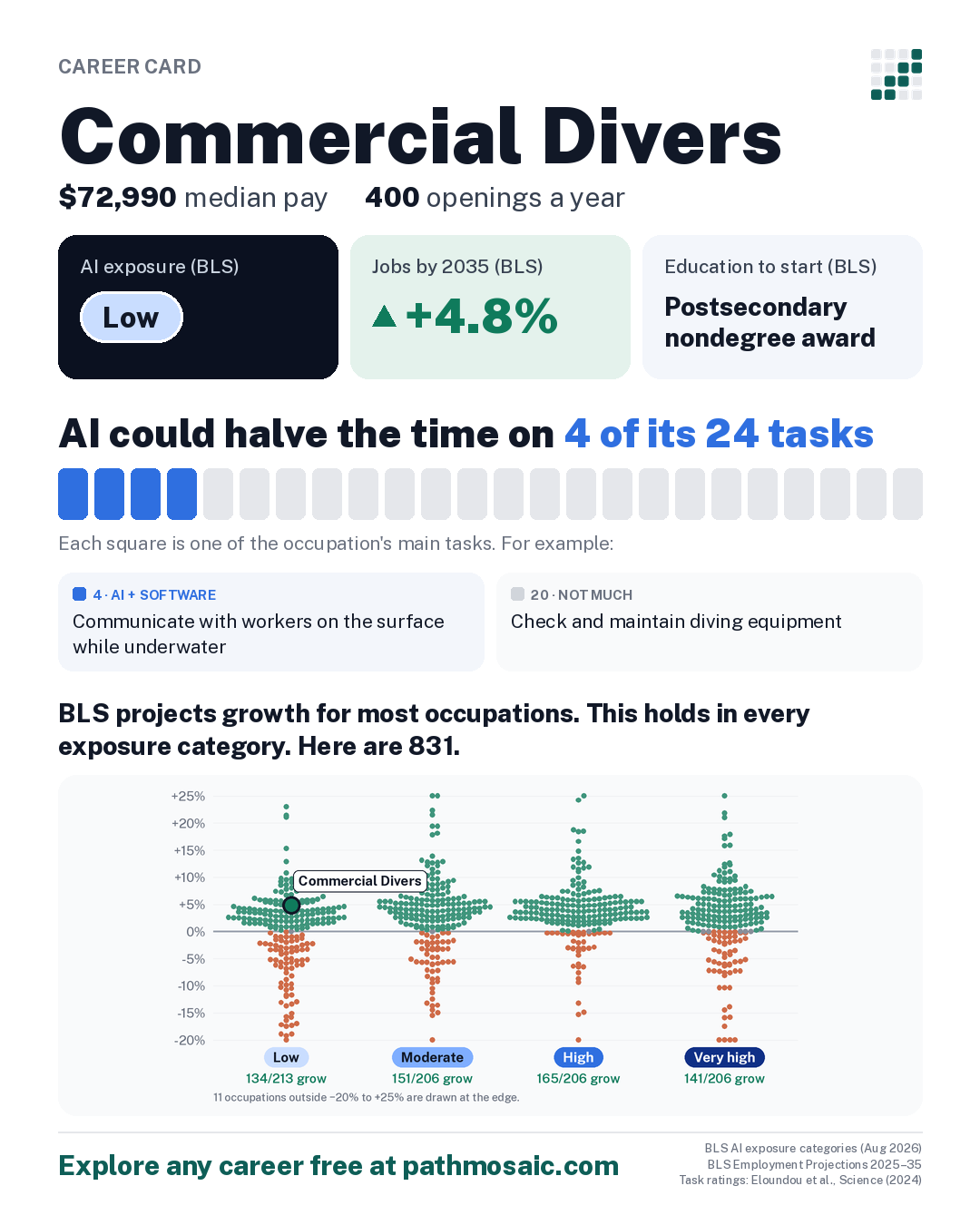
What the data says: AI could halve the time on 4 of its 24 tasks, and jobs are projected to grow 4.8% by 2035. How to think about this →
About this projection
BLS builds AI into its projections where the research supports it: “BLS generally applies adjustments based on this research conservatively, where there is convincing evidence for a change.”
It also notes a limit: “BLS projection methods are not designed to capture extremely rapid technological change.”
On its AI exposure groups, BLS says exposure “does not imply job loss.”
Recent conditions
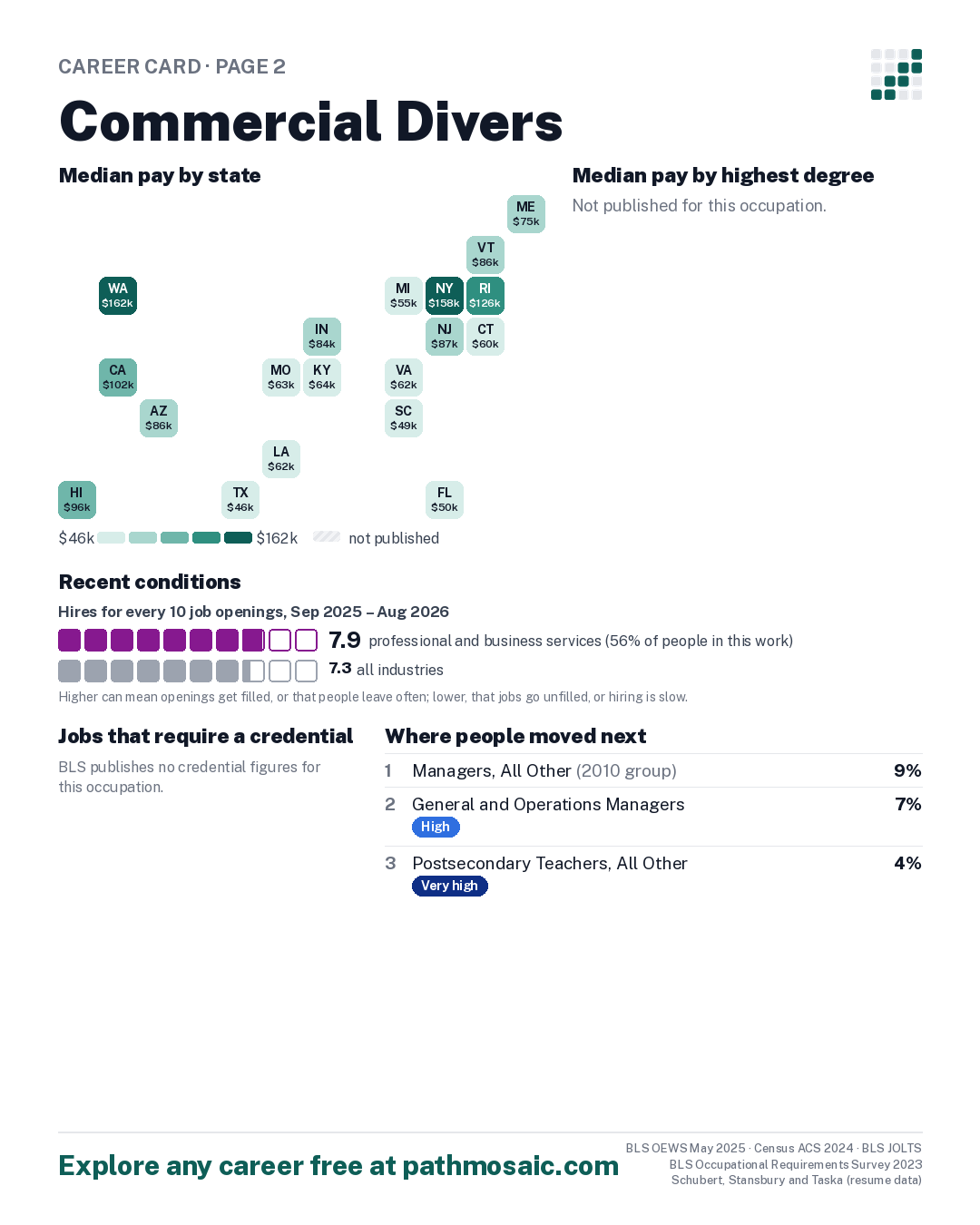
- From Sep 2025 to Aug 2026, 7.9 hires for every 10 job openings in professional and business services, which employs about 56% of people in this work, against 7.3 across all industries BLS JOLTS
One box per opening, filled for each hire; hires beyond the openings are added in a lighter shade. Higher can mean openings get filled, or that people leave often; lower, that jobs go unfilled, or hiring is slow.7.9 this industry7.3 all industries
Median pay by state BLS OEWS May 2025, state estimates
Tap a state for its figures.
Median pay in every state
| State | Median | Middle half earn | Jobs |
|---|---|---|---|
| Arizona | $85,990 | $85,810 to $85,990 | not published |
| California | $101,540 | $39,980 to $131,110 | 310 |
| Connecticut | $59,690 | $58,250 to $71,280 | 120 |
| Florida | $49,640 | $43,330 to $60,080 | 370 |
| Hawaii | $95,750 | $72,480 to $101,180 | 70 |
| Indiana | $83,510 | $79,040 to $87,370 | not published |
| Kentucky | $63,550 | $62,140 to $78,520 | not published |
| Louisiana | $62,230 | $48,890 to $74,470 | 230 |
| Maine | $74,610 | $38,140 to $80,100 | not published |
| Michigan | $54,620 | $53,640 to $62,490 | 80 |
| Missouri | $63,030 | $50,710 to $89,530 | not published |
| New Jersey | $86,920 | $66,860 to $89,130 | not published |
| New York | $157,800 | $97,820 to $157,820 | 170 |
| Rhode Island | $126,320 | $126,320 to $126,340 | not published |
| South Carolina | $49,260 | $43,110 to $52,260 | 30 |
| Texas | $46,490 | $41,600 to $60,530 | not published |
| Vermont | $85,780 | $83,260 to $101,690 | 80 |
| Virginia | $62,340 | $52,700 to $77,020 | not published |
| Washington | $161,800 | $136,260 to $250,940 | not published |
Nationally: $72,990. Shades run from the lowest state median to the highest; a territory below that range takes the lightest. How to read this
How AI touches the work
What AI could speed up, task by task, and where people already use it.
AI could halve the time on 4 of its 24 tasks
| AI rating | Its main tasks | Share of Claude conversations May 2026 |
|---|---|---|
| Not much | Check and maintain diving equipment, such as helmets, masks, air tanks, harnesses, or gauges. | Not published |
| AI + software | Communicate with workers on the surface while underwater, using signal lines or telephones. | Not published |
| Not much | Take appropriate safety precautions, such as monitoring dive lengths and depths and registering with authorities before diving expeditions begin. | Not published |
| Not much | Inspect and test docks, ships, buoyage systems, plant intakes or outflows, or underwater pipelines, cables, or sewers, using closed circuit television, still photography, and testing equipment. | Not published |
| Not much | Inspect the condition of underwater steel or wood structures. | Not published |
| AI + software | Obtain information about diving tasks and environmental conditions. | Not published |
See all 24 tasks
| Not much | Repair ships, bridge foundations, or other structures below the water line, using caulk, bolts, and hand tools. | Not published |
| Not much | Install, inspect, clean, or repair piping or valves. | Not published |
| Not much | Cut and weld steel, using underwater welding equipment, jigs, and supports. | Not published |
| AI + software | Take test samples or photographs to assess the condition of vessels or structures. | Not published |
| AI + software | Operate underwater video, sonar, recording, or related equipment to investigate underwater structures or marine life. | Not published |
| Not much | Perform activities related to underwater search and rescue, salvage, recovery, or cleanup operations. | Not published |
| Not much | Recover objects by placing rigging around sunken objects, hooking rigging to crane lines, and operating winches, derricks, or cranes to raise objects. | Not published |
| Not much | Descend into water with the aid of diver helpers, using scuba gear or diving suits. | Not published |
| Not much | Set or guide placement of pilings or sandbags to provide support for structures, such as docks, bridges, cofferdams, or platforms. | Not published |
| Not much | Carry out non-destructive testing, such as tests for cracks on the legs of oil rigs at sea. | Not published |
| Not much | Salvage wrecked ships or their cargo, using pneumatic power velocity and hydraulic tools and explosive charges, when necessary. | Not published |
| Not much | Install pilings or footings for piers or bridges. | Not published |
| Not much | Supervise or train other divers, including hobby divers. | Not published |
| Not much | Remove obstructions from strainers or marine railway or launching ways, using pneumatic or power hand tools. | Not published |
| Not much | Remove rubbish or pollution from the sea. | Not published |
| Not much | Perform offshore oil or gas exploration or extraction duties, such as conducting underwater surveys or repairing and maintaining drilling rigs or platforms. | Not published |
| Not much | Drill holes in rock and rig explosives for underwater demolitions. | Not published |
| Not much | Cultivate or harvest marine species or perform routine work on fish farms. | Not published |
Ordered by how important O*NET's respondents rate each task (1 to 5) times the share who say it is part of their job. The ordering is ours. 0 of the 24 have a published share of Claude conversations; “not published” means too few conversations for Anthropic to publish a figure.
Where people already use AI
The tasks above say what AI could speed up. This shows what people are using it for. Its 24 tasks fall under 24 work activities that many occupations share, and Microsoft counted how often each one came up in 200,000 conversations with its Copilot assistant in 2024.
- #44 Gather data about operational or development activities
| Work activity | This occupation's tasks under it | People asked AI for help in 10,000 conversations |
AI did it for them in 10,000 conversations |
|---|---|---|---|
| Clean tools, equipment, facilities, or work areas | |||
| Test performance of equipment or systems | |||
| Maintain facilities or equipment | |||
| Record images with photographic or audiovisual equipment | |||
| Build structures | |||
| Inspect commercial, industrial, or production systems or equipment | |||
| Operate lifting or moving equipment | |||
| Gather data about operational or development activities |
Show all 24 activities
| Set up equipment | |||
| Communicate with others about operational plans or activities | |||
| Maintain tools or equipment | |||
| Assess characteristics of land or property | |||
| Perform agricultural activities | |||
| Repair tools or equipment | |||
| Train others on operational or work procedures | |||
| Monitor safety or security of work areas, facilities, or properties | |||
| Operate transportation equipment or vehicles | |||
| Intervene in crisis situations or emergencies | |||
| Repair vehicle components | |||
| Supervise personnel activities | |||
| Drill holes in earth or materials | |||
| Install plumbing or piping equipment or systems | |||
| Join parts using soldering, welding, or brazing techniques | |||
| Operate agricultural or forestry equipment |
How to read this
Work activities come from O*NET, which links every task to the broader activities it involves. Microsoft's figures are for the activity across everyone who used Copilot, not for commercial divers specifically. Copilot is a general chat assistant; dedicated coding tools are not included, so programming help is under-counted here. Activities are listed by how many of this occupation's tasks fall under them.
The task ratings say whether AI could halve the time a task takes: on its own (“AI alone”), or with software built on it (“AI + software”). They were made by people in 2023 (Eloundou et al.). Claude's share is the task's share of all Claude.ai conversations in May 2026; Anthropic doesn't publish a task with too few conversations. None of these add up to the BLS exposure group, which combines five research measures.
More in the Guide: task ratings · task order · work activities · Copilot figures · Claude
High exposure doesn't mean fewer jobs
BLS projects most occupations in its two most exposed groups to grow: 141 of 206 rated Very high and 165 of 206 rated High. Each dot is one of the 831 occupations BLS rates.
Career moves into and out of this occupation
From moves between occupations found in online resumes, 2002–2016. Career changes only: a first job after school isn't a move.
Where people moved next
of 2,345 moves out
- 1 Managers, All Other (2010 group) an older group BLS has since split; no exposure group today 9%
- 2 General and Operations Managers High +5.0% 7%
- 3 Postsecondary Teachers, All Other Very high +2.0% 4%
- 4 Heavy and Tractor-Trailer Truck Drivers Moderate +3.8% 4%
- 5 Exercise Trainers and Group Fitness Instructors Moderate +7.3% 4%
Where people moved in from
of 1,963 moves in
- 1 Exercise Trainers and Group Fitness Instructors Moderate +7.3% 7%
- 2 Managers, All Other (2010 group) an older group BLS has since split; no exposure group today 7%
- 3 Cooks, Restaurant Moderate +12.1% 4%
- 4 General and Operations Managers High +5.0% 4%
- 5 First-Line Supervisors of Retail Sales Workers High -3.7% 4%
Resumes over-represent younger, white-collar job-seekers and moves into management. Schubert, Stansbury and Taska (resume data).
Education and training for the occupation
1 program: Diver, Professional and Instructor.
Jobs that require a credential BLS Occupational Requirements Survey 2023
BLS publishes no credential figures for this occupation.
Look up certifications, training and licenses U.S. Department of Labor
- Certification Finder ↗ certifications CareerOneStop lists for this occupation
- Training Finder ↗ schools and programs, nationwide; narrow the place there
- License Finder ↗ licenses by state
- Apprenticeship Finder ↗ DOL lists 1 registered apprenticeship in this occupation (Commercial Diver). Apprenticeship.gov can't be linked to one occupation, so search for “Commercial Divers” there.
These open in a new tab and send only the occupation's public code. More in the Guide
BLS AI exposure categories (Aug 2026) · BLS Employment Projections 2025–35 · O*NET 31.0 · Task ratings: Eloundou et al., Science (2024) · Microsoft "Working with AI" v1.1 · Anthropic Economic Index (2026-06-26) · Schubert, Stansbury and Taska · NCES CIP–SOC · Census ACS 2024 · BLS JOLTS
See it online, and explore any career: https://www.pathmosaic.com/card/49-9092.00