Explosives Workers, Ordnance Handling Experts, and Blasters
Also called: Blast Hole Driller, Blaster, Explosive Technician, PowdermanPlace and detonate explosives to demolish structures or to loosen, remove, or displace earth, rock, or other materials. May perform specialized handling, storage, and accounting procedures.
On a phone, press and hold a picture to save it to Photos.
opens your phone's share sheet, where you can save both to Photos
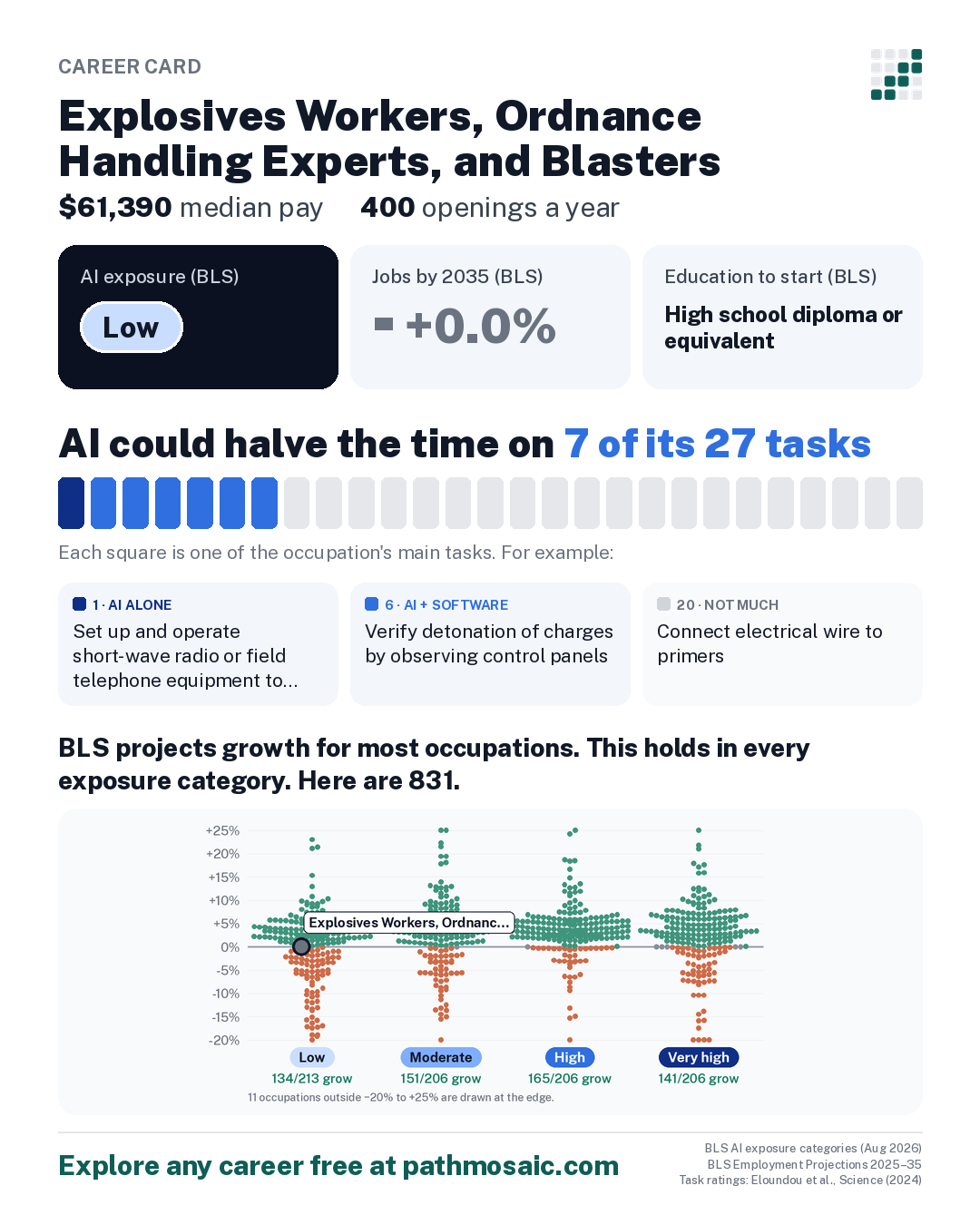
What the data says: AI could halve the time on 7 of its 27 tasks, and jobs are projected to hold steady to 2035. How to think about this →
About this projection
BLS builds AI into its projections where the research supports it: “BLS generally applies adjustments based on this research conservatively, where there is convincing evidence for a change.”
It also notes a limit: “BLS projection methods are not designed to capture extremely rapid technological change.”
On its AI exposure groups, BLS says exposure “does not imply job loss.”
Recent conditions
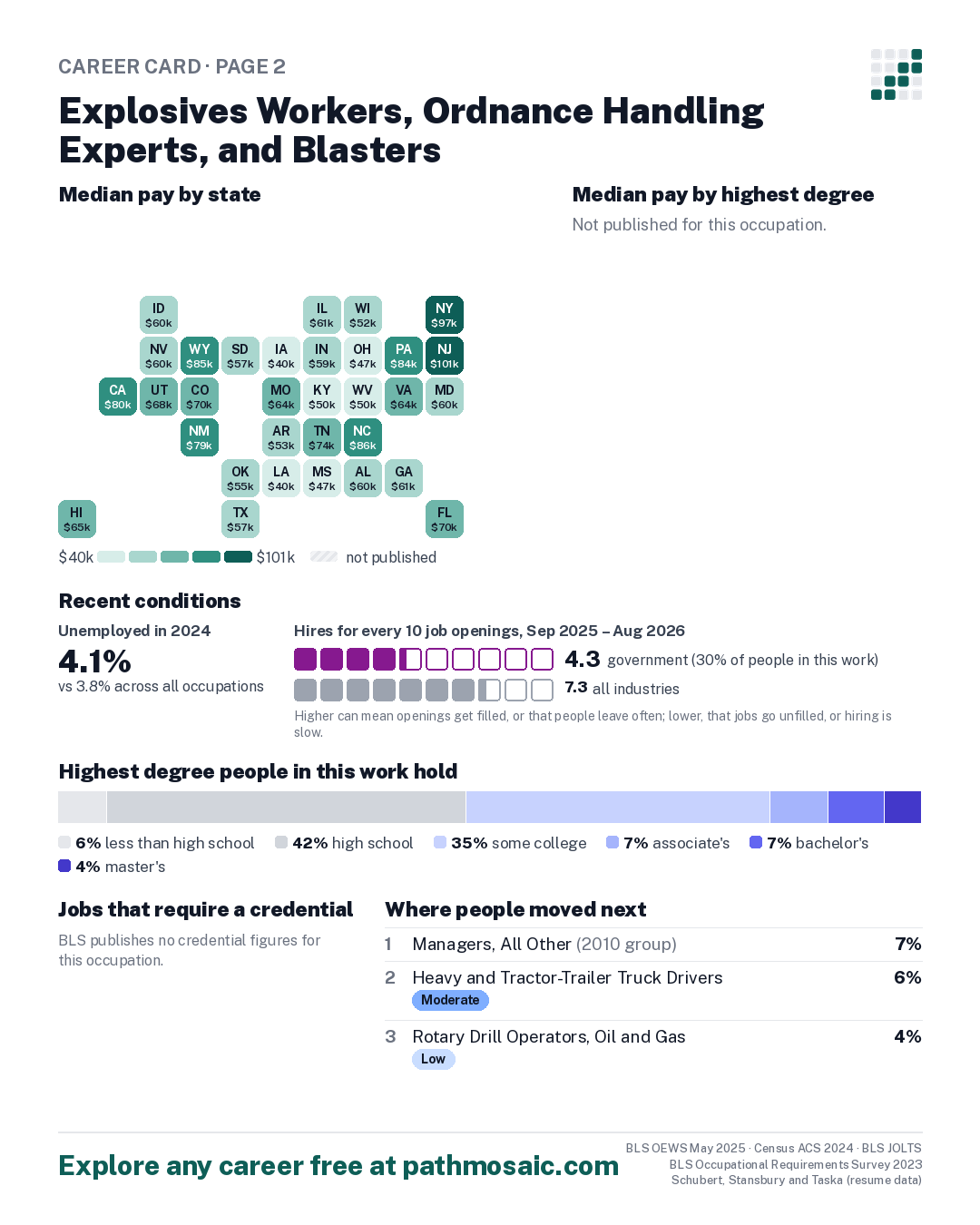
- In 2024, 4.1% of people in this work were unemployed, against 3.8% across all occupations Census ACS 2024
- From Sep 2025 to Aug 2026, 4.3 hires for every 10 job openings in government, which employs about 30% of people in this work, against 7.3 across all industries BLS JOLTS
One box per opening, filled for each hire; hires beyond the openings are added in a lighter shade. Higher can mean openings get filled, or that people leave often; lower, that jobs go unfilled, or hiring is slow.4.3 this industry7.3 all industries
Median pay by state BLS OEWS May 2025, state estimates
Tap a state for its figures.
Median pay in every state
| State | Median | Middle half earn | Jobs |
|---|---|---|---|
| Alabama | $59,820 | $57,480 to $68,350 | 100 |
| Arkansas | $53,120 | $46,920 to $63,900 | 90 |
| California | $80,370 | $34,320 to $102,170 | 220 |
| Colorado | $69,640 | $61,390 to $77,180 | 140 |
| Florida | $69,780 | $52,000 to $106,080 | 90 |
| Georgia | $61,480 | $49,190 to $93,050 | 70 |
| Hawaii | $64,560 | $62,940 to $83,470 | 110 |
| Idaho | $60,360 | $57,600 to $81,540 | not published |
| Illinois | $60,520 | $57,620 to $84,760 | 110 |
| Indiana | $59,110 | $50,480 to $68,970 | 330 |
| Iowa | $39,520 | $37,700 to $46,360 | 90 |
| Kentucky | $50,360 | $26,630 to $60,760 | 380 |
| Louisiana | $39,900 | $36,970 to $47,090 | 130 |
| Maryland | $59,720 | $49,330 to $96,720 | not published |
| Mississippi | $47,060 | $42,540 to $59,130 | 40 |
| Missouri | $64,040 | $61,310 to $68,060 | 150 |
| Nevada | $60,500 | $54,450 to $79,270 | 260 |
| New Jersey | $100,520 | $98,180 to $113,070 | not published |
| New Mexico | $78,960 | $45,810 to $84,130 | 80 |
| New York | $96,940 | $81,930 to $121,350 | not published |
| North Carolina | $85,630 | $78,310 to $95,420 | 160 |
| Ohio | $46,630 | $44,460 to $70,410 | 120 |
| Oklahoma | $55,180 | $46,070 to $64,380 | 330 |
| Pennsylvania | $84,400 | $68,760 to $97,910 | not published |
| South Dakota | $56,780 | $56,770 to $64,700 | not published |
| Tennessee | $74,190 | $44,720 to $81,870 | 70 |
| Texas | $56,600 | $44,060 to $62,700 | 460 |
| Utah | $67,910 | $59,740 to $73,090 | 50 |
| Virginia | $63,920 | $61,410 to $76,280 | 80 |
| West Virginia | $49,630 | $48,420 to $61,320 | 50 |
| Wisconsin | $52,400 | $49,470 to $64,020 | 60 |
| Wyoming | $85,070 | $69,640 to $88,000 | 60 |
Nationally: $61,390. Shades run from the lowest state median to the highest; a territory below that range takes the lightest. How to read this
How AI touches the work
What AI could speed up, task by task, and where people already use it.
AI could halve the time on 7 of its 27 tasks
| AI rating | Its main tasks | Share of Claude conversations May 2026 |
|---|---|---|
| AI + software | Examine blast areas to determine amounts and kinds of explosive charges needed and to ensure that safety laws are observed. | Not published |
| Not much | Place explosive charges in holes or other spots; then detonate explosives to demolish structures or to loosen, remove, or displace earth, rock, or other materials. | Not published |
| Not much | Connect electrical wire to primers, and cover charges or fill blast holes with clay, drill chips, sand, or other material. | Not published |
| Not much | Place safety cones around blast areas to alert other workers of danger zones, and signal workers as necessary to ensure that they clear blast sites prior to explosions. | Not published |
| Not much | Insert, pack, and pour explosives, such as dynamite, ammonium nitrate, black powder, or slurries into blast holes; then shovel drill cuttings, admit water into boreholes, and tamp material to compact charges. | Not published |
| Not much | Mark patterns, locations, and depths of charge holes for drilling, and issue drilling instructions. | Not published |
See all 27 tasks
| Not much | Move and store inventories of explosives, loaded perforating guns, and other materials, according to established safety procedures. | Not published |
| Not much | Measure depths of drilled blast holes, using weighted tape measures. | Not published |
| Not much | Assemble and position equipment, explosives, and blasting caps in holes at specified depths, or load perforating guns or torpedoes with explosives. | Not published |
| Not much | Drive trucks to transport explosives and blasting equipment to blasting sites. | Not published |
| AI + software | Verify detonation of charges by observing control panels, or by listening for the sounds of blasts. | Not published |
| AI + software | Compile and keep gun and explosives records in compliance with local and federal laws. | Not published |
| Not much | Maintain inventory levels, ordering new supplies as necessary. | Not published |
| Not much | Lay primacord between rows of charged blast holes, and tie cord into main lines to form blast patterns. | Not published |
| Not much | Tie specified lengths of delaying fuses into patterns in order to time sequences of explosions. | Not published |
| Not much | Light fuses, drop detonating devices into wells or boreholes, or activate firing devices with plungers, dials, or buttons, in order to set off single or multiple blasts. | Not published |
| Not much | Cut specified lengths of primacord and attach primers to cord ends. | Not published |
| Not much | Repair and service blasting, shooting, and automotive equipment, and electrical wiring and instruments, using hand tools. | Not published |
| AI alone | Set up and operate short-wave radio or field telephone equipment to transmit and receive blast information. | Not published |
| Not much | Lower perforating guns into wells, using hoists; then use measuring devices and instrument panels to position guns in correct positions for taking samples. | Not published |
| Not much | Insert waterproof sealers, bullets, and/or powder charges into guns, and screw gun ports back into place. | Not published |
| Not much | Clean, gauge, and lubricate gun ports. | Not published |
| AI + software | Create and lay out designs for drill and blast patterns. | Not published |
| AI + software | Document geological formations encountered during work. | Not published |
| Not much | Operate machines to flush earth cuttings or to blow dust from holes. | Not published |
| Not much | Set up and operate equipment such as hoists, jackhammers, and drills, in order to bore charge holes. | Not published |
| AI + software | Signal crane operators to move equipment. | Not published |
Ordered by how important O*NET's respondents rate each task (1 to 5) times the share who say it is part of their job. The ordering is ours. O*NET hasn't rated 5 of the tasks, so they come last, in O*NET's own order. 0 of the 27 have a published share of Claude conversations; “not published” means too few conversations for Anthropic to publish a figure.
Where people already use AI
The tasks above say what AI could speed up. This shows what people are using it for. Its 27 tasks fall under 26 work activities that many occupations share, and Microsoft counted how often each one came up in 200,000 conversations with its Copilot assistant in 2024.
- #36 Purchase goods or services
- #38 Select materials or equipment for operations or projects
| Work activity | This occupation's tasks under it | People asked AI for help in 10,000 conversations |
AI did it for them in 10,000 conversations |
|---|---|---|---|
| Prepare industrial materials for processing or use | |||
| Position tools or equipment | |||
| Maintain tools or equipment | |||
| Maintain operational records | |||
| Assemble equipment or components | |||
| Operate construction or excavation equipment | |||
| Purchase goods or services | |||
| Select materials or equipment for operations or projects |
Show all 26 activities
| Operate communications equipment or systems | |||
| Assess characteristics of land or property | |||
| Monitor operations to ensure adequate performance | |||
| Clean tools, equipment, facilities, or work areas | |||
| Dispose of waste or debris | |||
| Cut materials | |||
| Monitor operations to ensure compliance with regulations or standards | |||
| Position materials or components for assembly | |||
| Perform general construction or extraction activities | |||
| Operate transportation equipment or vehicles | |||
| Move materials, equipment, or supplies | |||
| Design industrial systems or equipment | |||
| Drill holes in earth or materials | |||
| Signal others to coordinate work activities | |||
| Stock supplies or products | |||
| Load products, materials, or equipment for transportation or further processing | |||
| Operate lifting or moving equipment | |||
| Direct construction or extraction activities |
How to read this
Work activities come from O*NET, which links every task to the broader activities it involves. Microsoft's figures are for the activity across everyone who used Copilot, not for explosives workers, ordnance handling experts, and blasters specifically. Copilot is a general chat assistant; dedicated coding tools are not included, so programming help is under-counted here. Activities are listed by how many of this occupation's tasks fall under them.
The task ratings say whether AI could halve the time a task takes: on its own (“AI alone”), or with software built on it (“AI + software”). They were made by people in 2023 (Eloundou et al.). Claude's share is the task's share of all Claude.ai conversations in May 2026; Anthropic doesn't publish a task with too few conversations. None of these add up to the BLS exposure group, which combines five research measures.
More in the Guide: task ratings · task order · work activities · Copilot figures · Claude
High exposure doesn't mean fewer jobs
BLS projects most occupations in its two most exposed groups to grow: 141 of 206 rated Very high and 165 of 206 rated High. Each dot is one of the 831 occupations BLS rates.
Career moves into and out of this occupation
From moves between occupations found in online resumes, 2002–2016. Career changes only: a first job after school isn't a move.
Where people moved next
of 3,317 moves out
- 1 Managers, All Other (2010 group) an older group BLS has since split; no exposure group today 7%
- 2 Heavy and Tractor-Trailer Truck Drivers Moderate +3.8% 6%
- 3 Rotary Drill Operators, Oil and Gas Low +0.8% 4%
- 4 Security Guards Moderate +0.9% 3%
- 5 General and Operations Managers High +5.0% 3%
Where people moved in from
of 2,832 moves in
- 1 Rotary Drill Operators, Oil and Gas Low +0.8% 10%
- 2 Managers, All Other (2010 group) an older group BLS has since split; no exposure group today 5%
- 3 Security Guards Moderate +0.9% 4%
- 4 Heavy and Tractor-Trailer Truck Drivers Moderate +3.8% 4%
- 5 Police and Sheriff's Patrol Officers High +3.5% 3%
The resume data uses 2010 occupation codes. This occupation comes from “Earth Drillers, Except Oil and Gas” and “Explosives Workers, Ordnance Handling Experts, and Blasters”, which today also include the occupation still called “Earth Drillers, Except Oil and Gas”, so these figures cover it too. Resumes over-represent younger, white-collar job-seekers and moves into management. Schubert, Stansbury and Taska (resume data).
Education and training for the occupation
O*NET survey of workers in this occupation
- 4% less than high school
- 62% high school
- 21% postsecondary certificate
- 8% some college
- 4% associate's
O*NET 31.0 survey of workers in this occupation · 24 people answered.
Census survey (American Community Survey)
- 6% less than high school
- 42% high school
- 35% some college
- 7% associate's
- 7% bachelor's
- 4% master's
Census ACS 2024, all workers in this occupation · 112 people surveyed.
Why the two can differ
O*NET asks about 20 people in each occupation, which makes its shares uncertain, but it reports the exact occupation and counts certificates. The Census survey reaches thousands, but it groups some occupations together and counts degrees only. More in the Guide
3 programs: Well Drilling/Driller, Blasting/Blaster and Construction/Heavy Equipment/Earthmoving Equipment Operation.
Jobs that require a credential BLS Occupational Requirements Survey 2023
BLS publishes no credential figures for this occupation.
Look up certifications, training and licenses U.S. Department of Labor
- Certification Finder ↗ certifications CareerOneStop lists for this occupation
- Training Finder ↗ schools and programs, nationwide; narrow the place there
- License Finder ↗ licenses by state
- Apprenticeship Finder ↗ DOL lists 2 registered apprenticeships in this occupation (Explosives and Weapons Technical Instructor; Munitions Systems). Apprenticeship.gov can't be linked to one occupation, so search for “Explosives Workers, Ordnance Handling Experts, and Blasters” there.
These open in a new tab and send only the occupation's public code. More in the Guide
BLS AI exposure categories (Aug 2026) · BLS Employment Projections 2025–35 · O*NET 31.0 · Task ratings: Eloundou et al., Science (2024) · Microsoft "Working with AI" v1.1 · Anthropic Economic Index (2026-06-26) · Schubert, Stansbury and Taska · NCES CIP–SOC · Census ACS 2024 · BLS JOLTS
See it online, and explore any career: https://www.pathmosaic.com/card/47-5032.00