Sailors and Marine Oilers
Also called: AB Seaman (Able Bodied Seaman), Able Seaman, Deckhand, Deckhand EngineerStand watch to look for obstructions in path of vessel, measure water depth, turn wheel on bridge, or use emergency equipment as directed by captain, mate, or pilot. Break out, rig, overhaul, and store cargo-handling gear, stationary rigging, and running gear. Perform a variety of maintenance tasks to preserve the painted surface of the ship and to maintain line and ship equipment. Must hold government-issued certification and tankerman certification when working aboard liquid-carrying vessels. Includes able seamen and ordinary seamen.
On a phone, press and hold a picture to save it to Photos.
opens your phone's share sheet, where you can save both to Photos
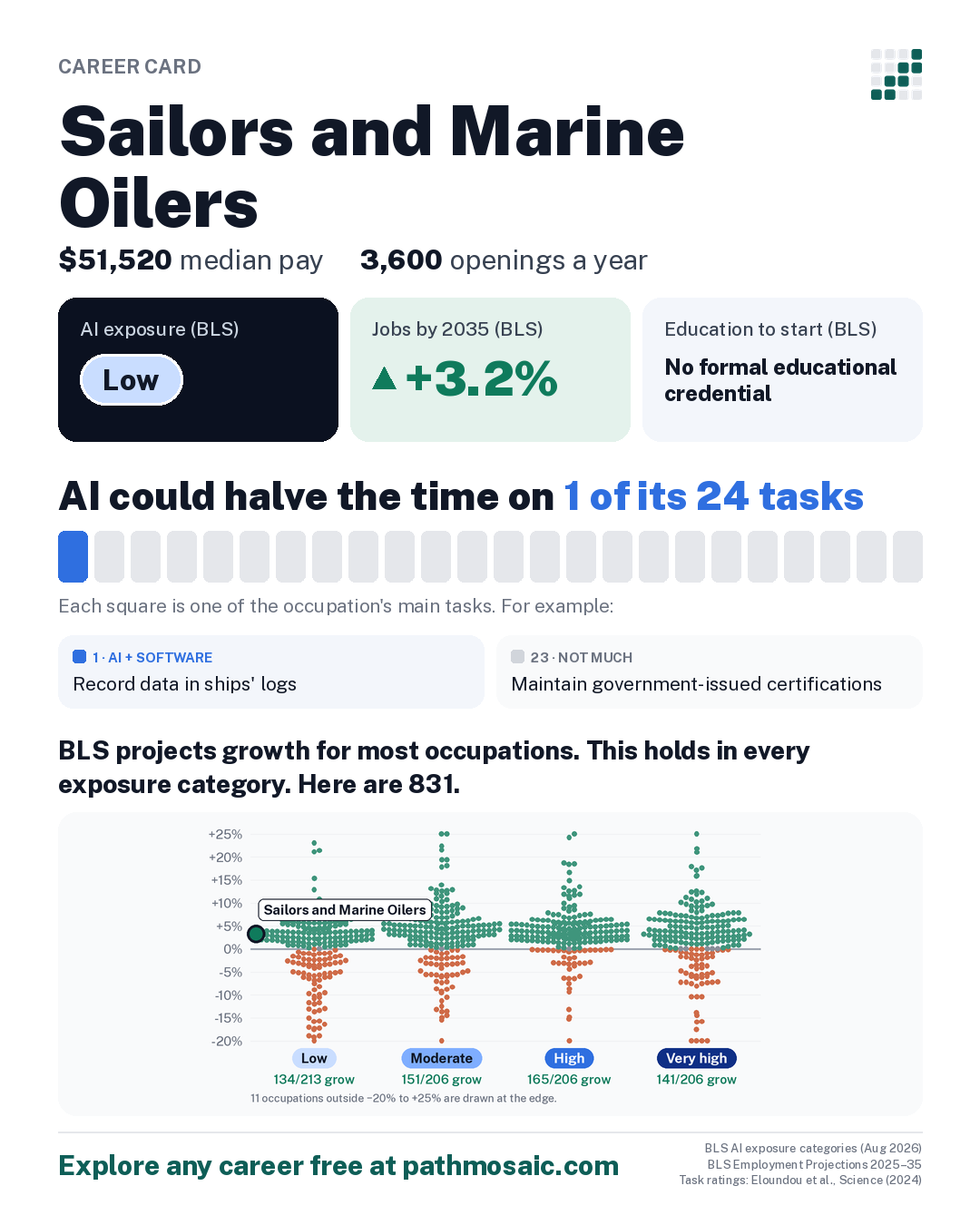
What the data says: AI could halve the time on 1 of its 24 tasks, and jobs are projected to grow 3.2% by 2035. How to think about this →
About this projection
BLS builds AI into its projections where the research supports it: “BLS generally applies adjustments based on this research conservatively, where there is convincing evidence for a change.”
It also notes a limit: “BLS projection methods are not designed to capture extremely rapid technological change.”
On its AI exposure groups, BLS says exposure “does not imply job loss.”
Recent conditions
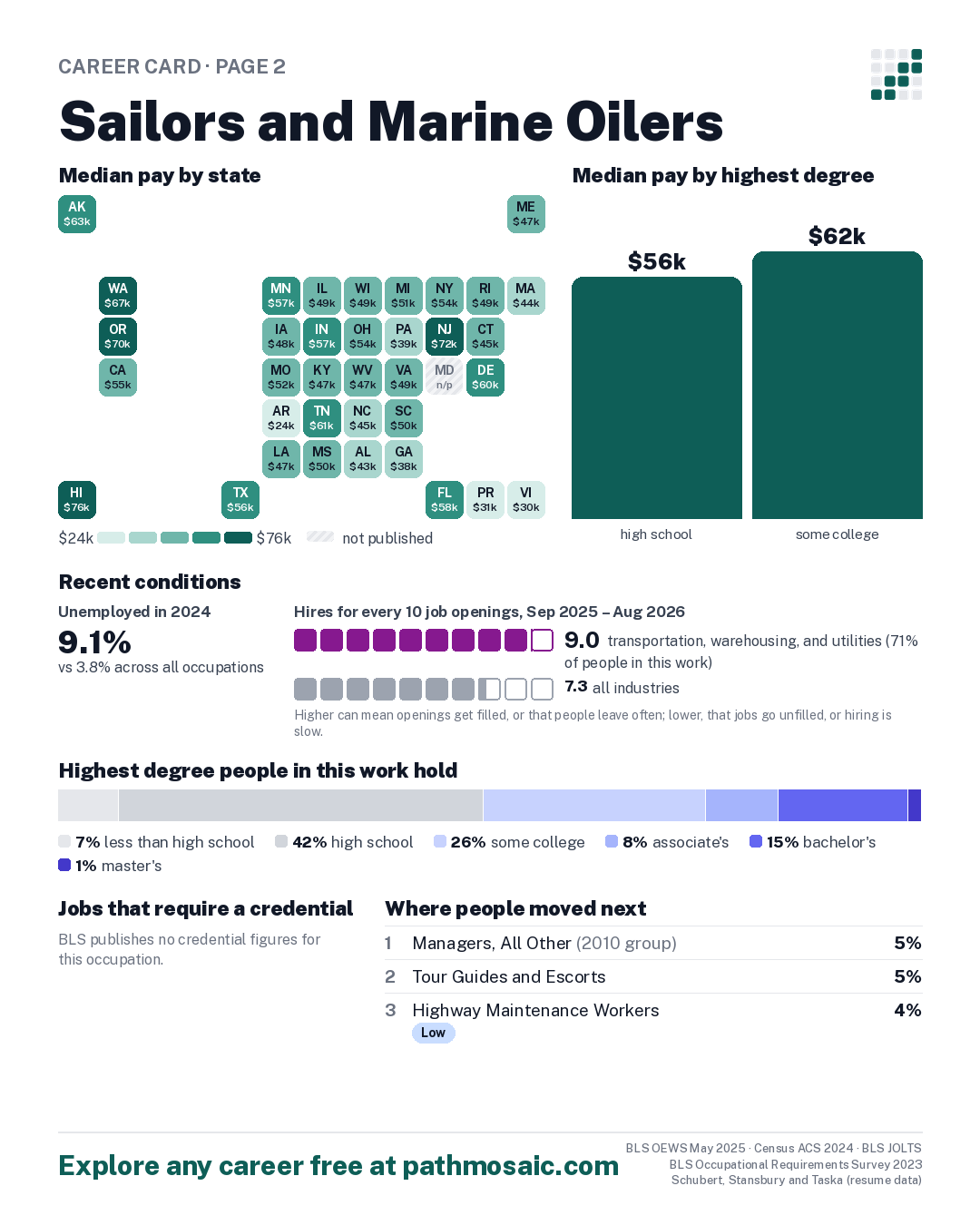
- In 2024, 9.1% of people in this work were unemployed, against 3.8% across all occupations Census ACS 2024
- From Sep 2025 to Aug 2026, 9.0 hires for every 10 job openings in transportation, warehousing, and utilities, which employs about 71% of people in this work, against 7.3 across all industries BLS JOLTS
One box per opening, filled for each hire; hires beyond the openings are added in a lighter shade. Higher can mean openings get filled, or that people leave often; lower, that jobs go unfilled, or hiring is slow.9.0 this industry7.3 all industries
Median pay by state BLS OEWS May 2025, state estimates
Tap a state for its figures.
Median pay in every state
| State | Median | Middle half earn | Jobs |
|---|---|---|---|
| Alabama | $43,000 | $38,370 to $60,980 | 290 |
| Alaska | $63,130 | $49,390 to $73,840 | 480 |
| Arkansas | $23,960 | $22,880 to $48,740 | 70 |
| California | $55,180 | $43,540 to $68,780 | 1,680 |
| Connecticut | $45,280 | $37,600 to $61,120 | 400 |
| Delaware | $60,040 | $58,960 to $63,860 | 80 |
| Florida | $57,930 | $43,520 to $73,760 | 2,710 |
| Georgia | $37,500 | $36,120 to $47,040 | 80 |
| Hawaii | $76,140 | $50,500 to $99,700 | 340 |
| Illinois | $49,090 | $38,260 to $56,140 | 420 |
| Indiana | $56,570 | $39,980 to $62,650 | 570 |
| Iowa | $48,100 | $44,530 to $51,720 | 70 |
| Kentucky | $47,460 | $39,220 to $60,620 | 1,470 |
| Louisiana | $46,610 | $37,570 to $61,700 | 7,580 |
| Maine | $46,800 | $44,860 to $58,760 | 240 |
| Maryland | not published | not published | 310 |
| Massachusetts | $44,070 | $38,570 to $57,890 | 420 |
| Michigan | $51,310 | $43,900 to $56,580 | 250 |
| Minnesota | $56,680 | $38,010 to $79,780 | 90 |
| Mississippi | $50,390 | $47,260 to $59,690 | 490 |
| Missouri | $51,940 | $45,090 to $62,460 | 220 |
| New Jersey | $71,880 | $49,400 to $75,070 | 520 |
| New York | $54,210 | $38,670 to $62,780 | 1,570 |
| North Carolina | $44,770 | $39,700 to $50,630 | 310 |
| Ohio | $53,520 | $44,910 to $57,250 | 140 |
| Oregon | $70,410 | $52,120 to $87,950 | 210 |
| Pennsylvania | $38,810 | $37,750 to $54,730 | 210 |
| Puerto Rico | $30,700 | $29,570 to $30,710 | not published |
| Rhode Island | $48,860 | $34,280 to $66,180 | 210 |
| South Carolina | $50,500 | $42,000 to $78,580 | 210 |
| Tennessee | $60,580 | $50,750 to $73,580 | 870 |
| Texas | $55,610 | $46,190 to $76,700 | 4,270 |
| Virgin Islands | $29,990 | $28,530 to $40,410 | 120 |
| Virginia | $49,120 | $40,210 to $57,930 | 2,970 |
| Washington | $66,700 | $56,680 to $79,870 | 1,590 |
| West Virginia | $47,370 | $35,420 to $64,380 | 100 |
| Wisconsin | $48,880 | $35,600 to $59,840 | 110 |
Nationally: $51,520. Shades run from the lowest state median to the highest; a territory below that range takes the lightest. How to read this
How AI touches the work
What AI could speed up, task by task, and where people already use it.
AI could halve the time on 1 of its 24 tasks
| AI rating | Its main tasks | Share of Claude conversations May 2026 |
|---|---|---|
| Not much | Maintain government-issued certifications, as required. | Not published |
| Not much | Handle lines to moor vessels to wharfs, to tie up vessels to other vessels, or to rig towing lines. | Not published |
| Not much | Splice and repair ropes, wire cables, or cordage, using marlinespikes, wire cutters, twine, and hand tools. | Not published |
| Not much | Sweep, mop, and wash down decks to remove oil, dirt, and debris, using brooms, mops, brushes, and hoses. | Not published |
| Not much | Stand watch in ships' bows or bridge wings to look for obstructions in a ship's path or to locate navigational aids, such as buoys or lighthouses. | Not published |
| Not much | Provide engineers with assistance in repairing or adjusting machinery. | Not published |
See all 24 tasks
| Not much | Chip and clean rust spots on decks, superstructures, or sides of ships, using wire brushes and hand or air chipping machines. | Not published |
| Not much | Paint or varnish decks, superstructures, lifeboats, or sides of ships. | Not published |
| Not much | Examine machinery to verify specified pressures or lubricant flows. | Not published |
| Not much | Lubricate machinery, equipment, or engine parts, such as gears, shafts, or bearings. | Not published |
| Not much | Attach hoses and operate pumps to transfer substances to and from liquid cargo tanks. | Not published |
| Not much | Read pressure and temperature gauges or displays and record data in engineering logs. | Not published |
| Not much | Tie barges together into tow units for tugboats to handle, inspecting barges periodically during voyages and disconnecting them when destinations are reached. | Not published |
| Not much | Break out, rig, and stow cargo-handling gear, stationary rigging, or running gear. | Not published |
| Not much | Operate, maintain, or repair ship equipment, such as winches, cranes, derricks, or weapons system. | Not published |
| Not much | Clean and polish wood trim, brass, or other metal parts. | Not published |
| Not much | Load or unload materials, vehicles, or passengers from vessels. | Not published |
| Not much | Lower and man lifeboats when emergencies occur. | Not published |
| Not much | Give directions to crew members engaged in cleaning wheelhouses or quarterdecks. O*NET flags this task's ratings as uncertain | Not published |
| Not much | Steer ships under the direction of commanders or navigating officers or direct helmsmen to steer, following designated courses. | Not published |
| Not much | Overhaul lifeboats or lifeboat gear and lower or raise lifeboats with winches or falls. | Not published |
| AI + software | Record data in ships' logs, such as weather conditions or distances traveled. | Not published |
| Not much | Maintain a ship's engines under the direction of the ship's engineering officers. | Not published |
| Not much | Measure depth of water in shallow or unfamiliar waters, using leadlines, and telephone or shout depth information to vessel bridges. | Not published |
Ordered by how important O*NET's respondents rate each task (1 to 5) times the share who say it is part of their job. The ordering is ours. 0 of the 24 have a published share of Claude conversations; “not published” means too few conversations for Anthropic to publish a figure.
Where people already use AI
The tasks above say what AI could speed up. This shows what people are using it for. Its 24 tasks fall under 18 work activities that many occupations share, and Microsoft counted how often each one came up in 200,000 conversations with its Copilot assistant in 2024.
- #4 Maintain current knowledge in area of expertise
| Work activity | This occupation's tasks under it | People asked AI for help in 10,000 conversations |
AI did it for them in 10,000 conversations |
|---|---|---|---|
| Maintain vehicles in working condition | |||
| Clean tools, equipment, facilities, or work areas | |||
| Maintain operational records | |||
| Inspect commercial, industrial, or production systems or equipment | |||
| Tend watercraft | |||
| Load products, materials, or equipment for transportation or further processing | |||
| Maintain current knowledge in area of expertise | |||
| Set up equipment |
Show all 18 activities
| Connect components or supply lines to equipment or tools | |||
| Measure physical characteristics of materials, products, or equipment | |||
| Apply protective solutions or coatings | |||
| Monitor equipment operation | |||
| Direct organizational operations, activities, or procedures | |||
| Monitor safety or security of work areas, facilities, or properties | |||
| Operate transportation equipment or vehicles | |||
| Intervene in crisis situations or emergencies | |||
| Operate pumping systems or equipment | |||
| Operate lifting or moving equipment |
How to read this
Work activities come from O*NET, which links every task to the broader activities it involves. Microsoft's figures are for the activity across everyone who used Copilot, not for sailors and marine oilers specifically. Copilot is a general chat assistant; dedicated coding tools are not included, so programming help is under-counted here. Activities are listed by how many of this occupation's tasks fall under them.
The task ratings say whether AI could halve the time a task takes: on its own (“AI alone”), or with software built on it (“AI + software”). They were made by people in 2023 (Eloundou et al.). Claude's share is the task's share of all Claude.ai conversations in May 2026; Anthropic doesn't publish a task with too few conversations. None of these add up to the BLS exposure group, which combines five research measures.
More in the Guide: task ratings · task order · work activities · Copilot figures · Claude
High exposure doesn't mean fewer jobs
BLS projects most occupations in its two most exposed groups to grow: 141 of 206 rated Very high and 165 of 206 rated High. Each dot is one of the 831 occupations BLS rates.
Career moves into and out of this occupation
From moves between occupations found in online resumes, 2002–2016. Career changes only: a first job after school isn't a move.
Where people moved next
of 11,269 moves out
- 1 Managers, All Other (2010 group) an older group BLS has since split; no exposure group today 5%
- 2 Tour Guides and Escorts 5%
- 3 Highway Maintenance Workers Low +3.4% 4%
- 4 Personal Financial Advisors Very high +1.4% 3%
- 5 General and Operations Managers High +5.0% 3%
Where people moved in from
of 7,101 moves in
- 1 Highway Maintenance Workers Low +3.4% 4%
- 2 Managers, All Other (2010 group) an older group BLS has since split; no exposure group today 4%
- 3 Tour Guides and Escorts 4%
- 4 Customer Service Representatives Very high -5.3% 3%
- 5 Security Guards Moderate +0.9% 3%
Resumes over-represent younger, white-collar job-seekers and moves into management. Schubert, Stansbury and Taska (resume data).
Education and training for the occupation
Census survey (American Community Survey)
- 7% less than high school
- 42% high school
- 26% some college
- 8% associate's
- 15% bachelor's
- 1% master's
Census ACS 2024, all workers in this occupation · 331 people surveyed.
Median pay by highest degree full-time, year-round · Census ACS 2024, all workers in this occupation
Jobs that require a credential BLS Occupational Requirements Survey 2023
BLS publishes no credential figures for this occupation.
Look up certifications, training and licenses U.S. Department of Labor
- Certification Finder ↗ certifications CareerOneStop lists for this occupation
- Training Finder ↗ schools and programs, nationwide; narrow the place there
- License Finder ↗ licenses by state
- Apprenticeship Finder ↗ DOL lists 1 registered apprenticeship in this occupation (Able Seaman). Apprenticeship.gov can't be linked to one occupation, so search for “Sailors and Marine Oilers” there.
These open in a new tab and send only the occupation's public code. More in the Guide
BLS AI exposure categories (Aug 2026) · BLS Employment Projections 2025–35 · O*NET 31.0 · Task ratings: Eloundou et al., Science (2024) · Microsoft "Working with AI" v1.1 · Anthropic Economic Index (2026-06-26) · Schubert, Stansbury and Taska · NCES CIP–SOC · Census ACS 2024 · BLS JOLTS
See it online, and explore any career: https://www.pathmosaic.com/card/53-5011.00