Telecommunications Equipment Installers and Repairers, Except Line Installers
Also called: Combination Technician (Combination Tech), Outside Plant Technician (Outside Plant Tech), Service Technician (Service Tech), Telecommunications Technician (Telecommunications Tech)Install, set up, rearrange, or remove switching, distribution, routing, and dialing equipment used in central offices or headends. Service or repair telephone, cable television, Internet, and other communications equipment on customers' property. May install communications equipment or communications wiring in buildings.
On a phone, press and hold a picture to save it to Photos.
opens your phone's share sheet, where you can save both to Photos
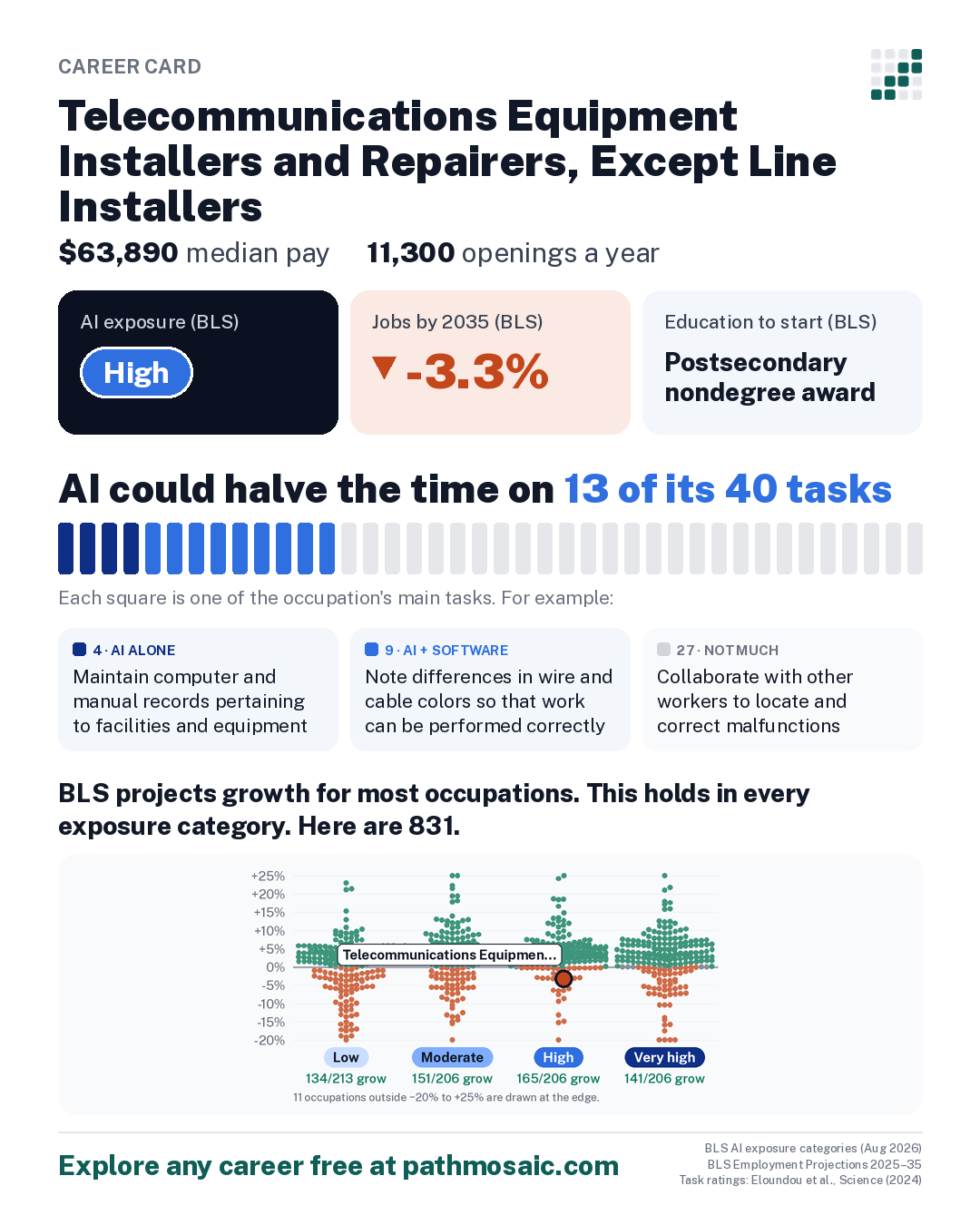
What the data says: AI could halve the time on 13 of its 40 tasks, and jobs are projected to shrink 3.3% by 2035. How to think about this →
About this projection
BLS builds AI into its projections where the research supports it: “BLS generally applies adjustments based on this research conservatively, where there is convincing evidence for a change.”
It also notes a limit: “BLS projection methods are not designed to capture extremely rapid technological change.”
On its AI exposure groups, BLS says exposure “does not imply job loss.”
Recent conditions
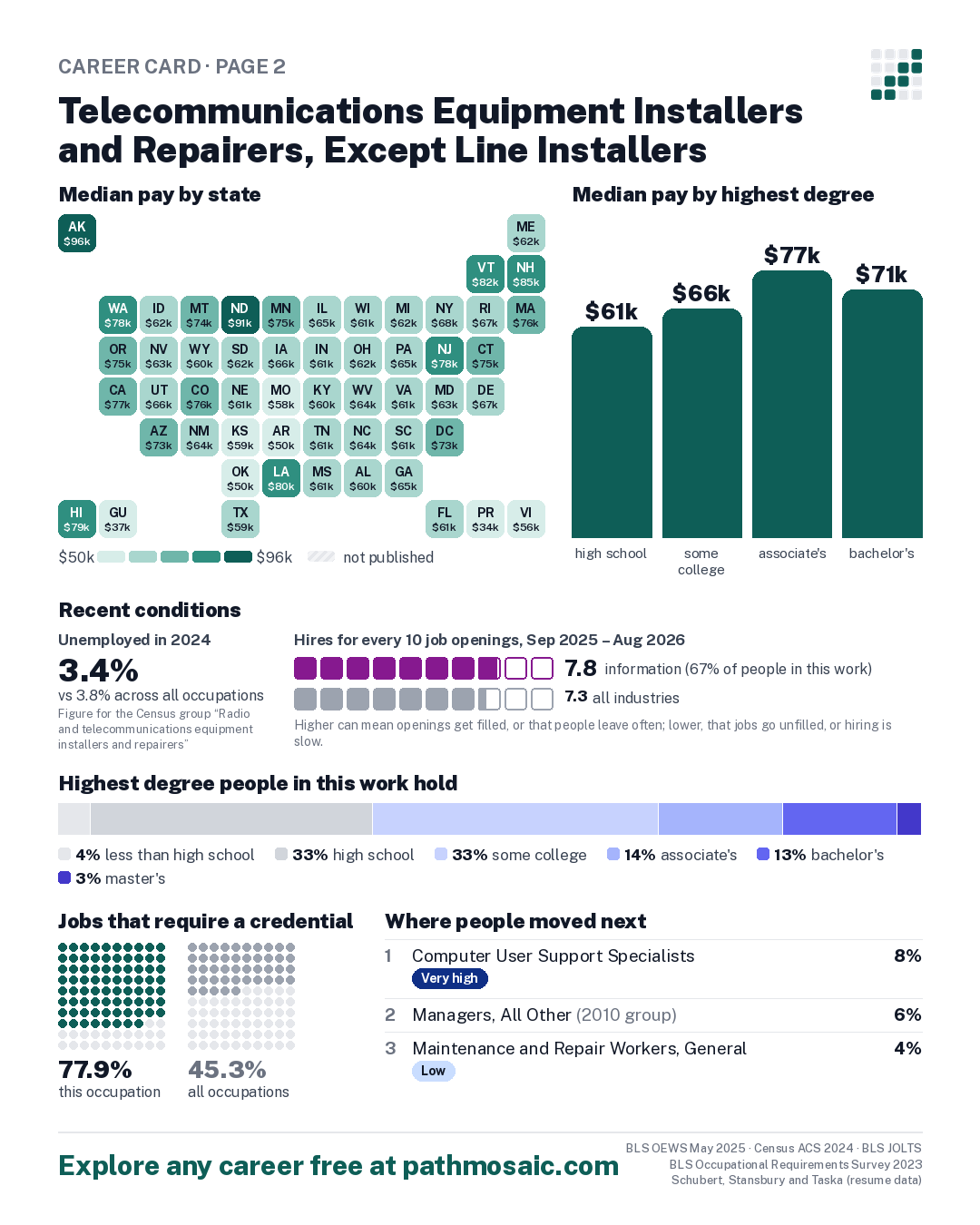
- In 2024, 3.4% of people in this work were unemployed, against 3.8% across all occupations Census ACS 2024, all workers in the Census group “Radio and telecommunications equipment installers and repairers”
- From Sep 2025 to Aug 2026, 7.8 hires for every 10 job openings in information, which employs about 67% of people in this work, against 7.3 across all industries BLS JOLTS
One box per opening, filled for each hire; hires beyond the openings are added in a lighter shade. Higher can mean openings get filled, or that people leave often; lower, that jobs go unfilled, or hiring is slow.7.8 this industry7.3 all industries
Median pay by state BLS OEWS May 2025, state estimates
Tap a state for its figures.
Median pay in every state
| State | Median | Middle half earn | Jobs |
|---|---|---|---|
| Alabama | $59,770 | $50,790 to $78,670 | 3,200 |
| Alaska | $95,850 | $61,610 to $101,720 | 520 |
| Arizona | $72,710 | $41,600 to $84,750 | 3,320 |
| Arkansas | $49,740 | $41,370 to $61,070 | 1,320 |
| California | $76,630 | $65,480 to $97,400 | 14,040 |
| Colorado | $76,410 | $62,760 to $82,840 | 3,180 |
| Connecticut | $75,200 | $60,120 to $80,880 | 1,910 |
| Delaware | $66,670 | $59,040 to $79,270 | 440 |
| District of Columbia | $73,130 | $58,830 to $99,270 | 300 |
| Florida | $61,030 | $49,520 to $72,140 | 11,820 |
| Georgia | $64,900 | $55,060 to $91,910 | 6,640 |
| Guam | $36,600 | $35,310 to $69,830 | 190 |
| Hawaii | $79,250 | $58,350 to $86,940 | 760 |
| Idaho | $62,440 | $48,200 to $81,610 | 1,080 |
| Illinois | $64,630 | $49,930 to $77,530 | 5,760 |
| Indiana | $61,030 | $49,180 to $73,110 | 2,050 |
| Iowa | $65,710 | $49,830 to $80,130 | 1,780 |
| Kansas | $58,690 | $47,830 to $64,680 | 1,480 |
| Kentucky | $59,700 | $46,840 to $75,400 | 2,210 |
| Louisiana | $80,210 | $59,710 to $91,370 | 3,060 |
| Maine | $61,720 | $49,550 to $73,850 | 400 |
| Maryland | $63,050 | $49,680 to $87,100 | 2,520 |
| Massachusetts | $76,500 | $60,920 to $93,190 | 2,890 |
| Michigan | $61,700 | $49,540 to $76,780 | 3,940 |
| Minnesota | $75,150 | $60,520 to $82,750 | 1,900 |
| Mississippi | $61,250 | $49,050 to $90,910 | 1,500 |
| Missouri | $57,610 | $46,050 to $69,160 | 2,260 |
| Montana | $73,970 | $60,880 to $81,240 | 630 |
| Nebraska | $60,520 | $46,550 to $76,850 | 1,430 |
| Nevada | $62,800 | $48,400 to $76,080 | 890 |
| New Hampshire | $85,240 | $78,700 to $93,660 | 550 |
| New Jersey | $78,000 | $63,700 to $97,490 | 2,690 |
| New Mexico | $63,600 | $47,340 to $82,140 | 1,100 |
| New York | $67,710 | $53,290 to $89,390 | 6,240 |
| North Carolina | $63,970 | $52,130 to $81,250 | 3,540 |
| North Dakota | $90,890 | $62,820 to $97,560 | 470 |
| Ohio | $61,680 | $51,290 to $79,750 | 3,560 |
| Oklahoma | $50,350 | $45,330 to $62,910 | 1,660 |
| Oregon | $75,270 | $60,790 to $84,540 | 1,710 |
| Pennsylvania | $64,960 | $47,650 to $78,260 | 5,220 |
| Puerto Rico | $33,760 | $27,330 to $36,470 | 480 |
| Rhode Island | $66,960 | $61,390 to $88,560 | 150 |
| South Carolina | $61,480 | $50,110 to $84,400 | 2,130 |
| South Dakota | $62,000 | $49,220 to $82,420 | 520 |
| Tennessee | $61,220 | $51,220 to $80,400 | 2,480 |
| Texas | $59,370 | $48,460 to $71,170 | 13,440 |
| Utah | $65,650 | $49,450 to $83,220 | 2,160 |
| Vermont | $81,800 | $61,170 to $88,360 | 310 |
| Virgin Islands | $55,960 | $45,720 to $60,650 | 60 |
| Virginia | $61,340 | $49,570 to $77,570 | 3,310 |
| Washington | $77,610 | $62,640 to $83,270 | 3,210 |
| West Virginia | $63,560 | $48,420 to $79,830 | 820 |
| Wisconsin | $60,770 | $53,540 to $73,330 | 2,120 |
| Wyoming | $60,250 | $51,360 to $81,500 | 310 |
Nationally: $63,890. Shades run from the lowest state median to the highest; a territory below that range takes the lightest. How to read this
How AI touches the work
What AI could speed up, task by task, and where people already use it.
AI could halve the time on 13 of its 40 tasks
| AI rating | Its main tasks | Share of Claude conversations May 2026 |
|---|---|---|
| AI + software | Note differences in wire and cable colors so that work can be performed correctly. | Not published |
| Not much | Assemble and install communication equipment such as data and telephone communication lines, wiring, switching equipment, wiring frames, power apparatus, computer systems, and networks. | Not published |
| Not much | Collaborate with other workers to locate and correct malfunctions. | Not published |
| Not much | Test circuits and components of malfunctioning telecommunications equipment to isolate sources of malfunctions, using test meters, circuit diagrams, polarity probes, and other hand tools. | Not published |
| Not much | Inspect equipment on a regular basis to ensure proper functioning. | Not published |
| Not much | Run wires between components and to outside cable systems, connecting them to wires from telephone poles or underground cable accesses. | Not published |
See all 40 tasks
| Not much | Repair or replace faulty equipment, such as defective and damaged telephones, wires, switching system components, and associated equipment. | Not published |
| Not much | Drive crew trucks to and from work areas. | Not published |
| Not much | Test connections to ensure that power supplies are adequate and that communications links function. | Not published |
| Not much | Remove and replace plug-in circuit equipment. | Not published |
| AI alone | Maintain computer and manual records pertaining to facilities and equipment. | under 0.01% |
| Not much | Climb poles and ladders, use truck-mounted booms, and enter areas such as manholes and cable vaults to install, maintain, or inspect equipment. | Not published |
| Not much | Remove loose wires and other debris after work is completed. | Not published |
| Not much | Clean and maintain tools, test equipment, and motor vehicles. | Not published |
| AI alone | Demonstrate equipment to customers and explain its use, responding to any inquiries or complaints. | 0.08% |
| Not much | Request support from technical service centers when on-site procedures fail to solve installation or maintenance problems. | Not published |
| Not much | Test repaired, newly installed, or updated equipment to ensure that it functions properly and conforms to specifications, using test equipment and observation. | Not published |
| AI alone | Designate cables available for use. | Not published |
| Not much | Adjust or modify equipment to enhance equipment performance or to respond to customer requests. | Not published |
| Not much | Remove and remake connections to change circuit layouts, following work orders or diagrams. | Not published |
| AI + software | Determine viability of sites through observation, and discuss site locations and construction requirements with customers. | Not published |
| Not much | Route and connect cables and lines to switches, switchboard equipment, and distributing frames, using wire-wrap guns or soldering irons to connect wires to terminals. | Not published |
| AI alone | Analyze test readings, computer printouts, and trouble reports to determine equipment repair needs and required repair methods. | under 0.01% |
| Not much | Communicate with bases, using telephones or two-way radios to receive instructions or technical advice, or to report equipment status. | Not published |
| Not much | Review manufacturer's instructions, manuals, technical specifications, building permits, and ordinances to determine communication equipment requirements and procedures. | Not published |
| AI + software | Refer to manufacturers' manuals to obtain maintenance instructions pertaining to specific malfunctions. | Not published |
| Not much | Dig holes or trenches as necessary for equipment installation and access. | Not published |
| Not much | Examine telephone transmission facilities to determine requirements for new or additional telephone services. | Not published |
| Not much | Measure distances from landmarks to identify exact installation sites for equipment. | under 0.01% |
| Not much | Diagnose and correct problems from remote locations, using special switchboards to find the sources of problems. | Not published |
| AI + software | Perform database verifications, using computers. | under 0.01% |
| AI + software | Install updated software and programs that maintain existing software or provide requested features, such as time-correlated call routing. | Not published |
| Not much | Perform routine maintenance on equipment, including adjusting and lubricating components and painting worn or exposed areas. | Not published |
| AI + software | Enter codes needed to correct electronic switching system programming. | Not published |
| AI + software | Program computerized switches and switchboards to provide requested features. | Not published |
| Not much | Clean switches and replace contact points, using vacuum hoses, solvents, and hand tools. | Not published |
| Not much | Install telephone station equipment, such as intercommunication systems, transmitters, receivers, relays, and ringers, and related apparatus, such as coin collectors, telephone booths, and switching-key equipment. | Not published |
| AI + software | Address special issues or situations, such as illegal or unauthorized use of equipment, or cases of electrical or acoustic shock. | Not published |
| AI + software | Provide input into the design and manufacturing of new equipment. | under 0.01% |
| Not much | Place intercept circuits on terminals to handle vacant lines in central office installations. | Not published |
Ordered by how important O*NET's respondents rate each task (1 to 5) times the share who say it is part of their job. The ordering is ours. 6 of the 40 have a published share of Claude conversations; “not published” means too few conversations for Anthropic to publish a figure.
Where people already use AI
The tasks above say what AI could speed up. This shows what people are using it for. Its 40 tasks fall under 29 work activities that many occupations share, and Microsoft counted how often each one came up in 200,000 conversations with its Copilot assistant in 2024.
- #7 Explain technical details of products or services
- #8 Read documents or materials to inform work processes
- #35 Process digital or online data
- and 3 more, in the table below
| Work activity | This occupation's tasks under it | People asked AI for help in 10,000 conversations |
AI did it for them in 10,000 conversations |
|---|---|---|---|
| Connect components or supply lines to equipment or tools | |||
| Coordinate with others to resolve problems | |||
| Test performance of equipment or systems | |||
| Clean tools, equipment, facilities, or work areas | |||
| Repair electrical or electronic equipment | |||
| Read documents or materials to inform work processes | |||
| Gather data about operational or development activities | |||
| Set up computer systems, networks, or other information systems |
Show all 29 activities
| Maintain tools or equipment | |||
| Inspect commercial, industrial, or production systems or equipment | |||
| Install commercial or production equipment | |||
| Explain technical details of products or services | |||
| Process digital or online data | |||
| Determine operational methods or procedures | |||
| Diagnose system or equipment problems | |||
| Evaluate the quality or accuracy of data | |||
| Adjust equipment to ensure adequate performance | |||
| Analyze performance of systems or equipment | |||
| Advise others on business or operational matters | |||
| Investigate criminal or legal matters | |||
| Determine resource needs of projects or operations | |||
| Measure physical characteristics of materials, products, or equipment | |||
| Apply protective solutions or coatings | |||
| Maintain operational records | |||
| Assemble equipment or components | |||
| Maintain vehicles in working condition | |||
| Perform general construction or extraction activities | |||
| Operate transportation equipment or vehicles | |||
| Climb equipment or structures |
How people in this work use Claude
What people in this work made with Claude % of conversations
- An explanation or answer70%
- Advice or a recommendation5%
- A chart or visualization4%
- An analysis or summary4%
- A document or report3%
How they worked with Claude
20% of these conversations were about work. Anthropic Economic Index, May 2026.
How to read this
Work activities come from O*NET, which links every task to the broader activities it involves. Microsoft's figures are for the activity across everyone who used Copilot, not for telecommunications equipment installers and repairers, except line installers specifically. Copilot is a general chat assistant; dedicated coding tools are not included, so programming help is under-counted here. Activities are listed by how many of this occupation's tasks fall under them.
The task ratings say whether AI could halve the time a task takes: on its own (“AI alone”), or with software built on it (“AI + software”). They were made by people in 2023 (Eloundou et al.). Claude's share is the task's share of all Claude.ai conversations in May 2026; Anthropic doesn't publish a task with too few conversations. None of these add up to the BLS exposure group, which combines five research measures.
More in the Guide: task ratings · task order · work activities · Copilot figures · Claude
High exposure doesn't mean fewer jobs
BLS projects most occupations in its two most exposed groups to grow: 141 of 206 rated Very high and 165 of 206 rated High. Each dot is one of the 831 occupations BLS rates.
Career moves into and out of this occupation
From moves between occupations found in online resumes, 2002–2016. Career changes only: a first job after school isn't a move.
Where people moved next
of 52,357 moves out
- 1 Computer User Support Specialists Very high -3.5% 8%
- 2 Managers, All Other (2010 group) an older group BLS has since split; no exposure group today 6%
- 3 Maintenance and Repair Workers, General Low +4.2% 4%
- 4 Heavy and Tractor-Trailer Truck Drivers Moderate +3.8% 4%
- 5 Network and Computer Systems Administrators Very high -4.1% 3%
Where people moved in from
of 45,841 moves in
- 1 Computer User Support Specialists Very high -3.5% 8%
- 2 Managers, All Other (2010 group) an older group BLS has since split; no exposure group today 4%
- 3 Maintenance and Repair Workers, General Low +4.2% 4%
- 4 Network and Computer Systems Administrators Very high -4.1% 3%
- 5 Heavy and Tractor-Trailer Truck Drivers Moderate +3.8% 3%
Resumes over-represent younger, white-collar job-seekers and moves into management. Schubert, Stansbury and Taska (resume data).
Education and training for the occupation
Census survey (American Community Survey)
- 4% less than high school
- 33% high school
- 33% some college
- 14% associate's
- 13% bachelor's
- 3% master's
Census ACS 2024, all workers in the Census group “Radio and telecommunications equipment installers and repairers” · 1,406 people surveyed.
Median pay by highest degree full-time, year-round · Census ACS 2024, all workers in the Census group “Radio and telecommunications equipment installers and repairers”
1 program: Communications Systems Installation and Repair Technology/Technician.
Jobs that require a credential BLS Occupational Requirements Survey 2023
77.9% this occupation
45.3% all occupations
| By kind | This occupation | All occupations |
|---|---|---|
| an educational certificate | <0.5% | 2.8% |
| a license | not published | |
| a certification | not published |
Share of jobs whose employer requires it. BLS doesn't say which credential. How to read this
Look up certifications, training and licenses U.S. Department of Labor
- Certification Finder ↗ certifications CareerOneStop lists for this occupation
- Training Finder ↗ schools and programs, nationwide; narrow the place there
- License Finder ↗ licenses by state
- Apprenticeship Finder ↗ DOL lists 15 registered apprenticeships in this occupation. Apprenticeship.gov can't be linked to one occupation, so search for “Telecommunications Equipment Installers and Repairers, Except Line Installers” there.
These open in a new tab and send only the occupation's public code. More in the Guide
BLS AI exposure categories (Aug 2026) · BLS Employment Projections 2025–35 · O*NET 31.0 · Task ratings: Eloundou et al., Science (2024) · Microsoft "Working with AI" v1.1 · Anthropic Economic Index (2026-06-26) · Schubert, Stansbury and Taska · NCES CIP–SOC · Census ACS 2024 · BLS JOLTS
See it online, and explore any career: https://www.pathmosaic.com/card/49-2022.00