Fishing and Hunting Workers
Also called: Deckhand, Lobster Fisherman, Nuisance Trapper, TrapperHunt, trap, catch, or gather wild animals or aquatic animals and plants. May use nets, traps, or other equipment. May haul catch onto ship or other vessel.
On a phone, press and hold a picture to save it to Photos.
opens your phone's share sheet, where you can save both to Photos
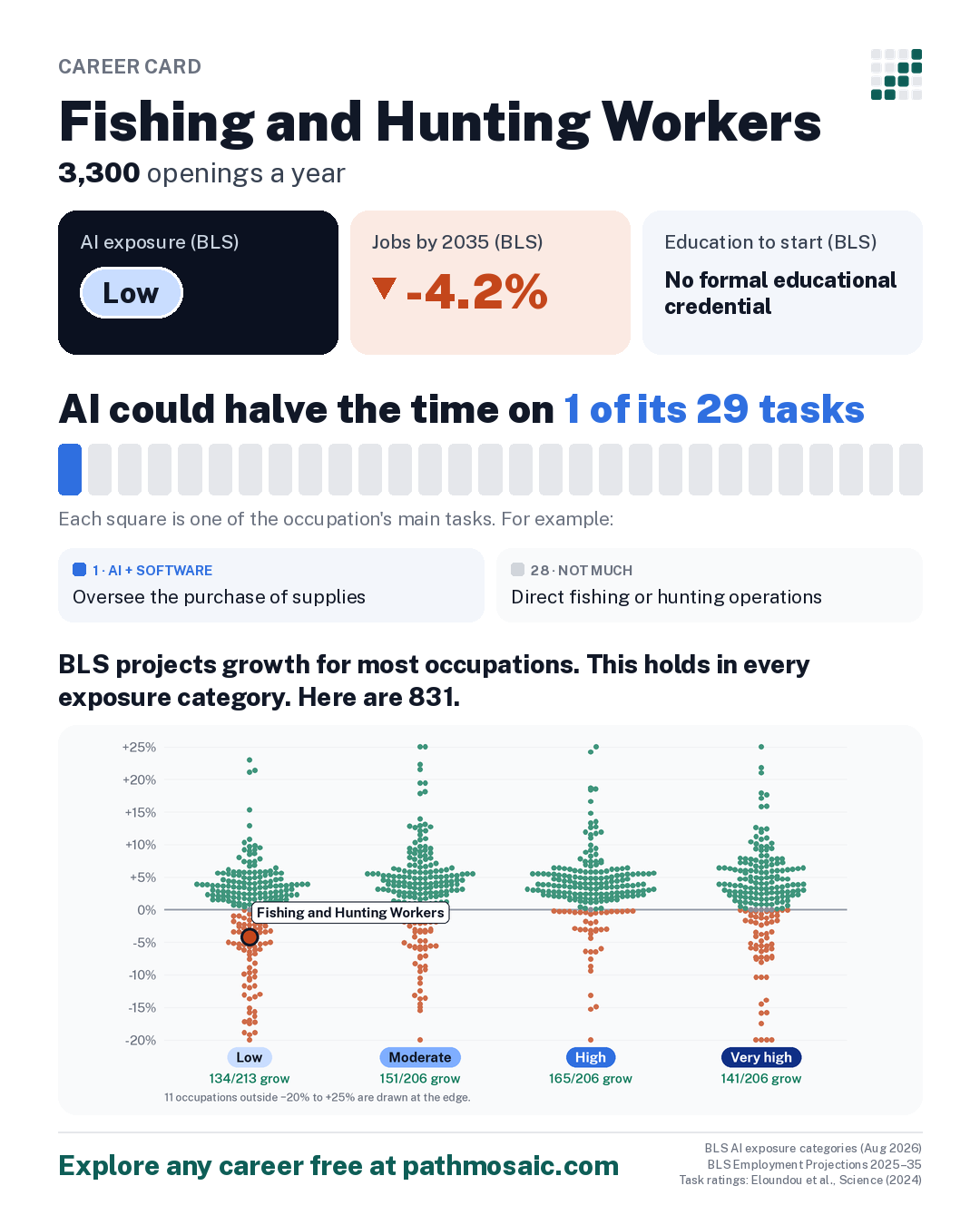
What the data says: AI could halve the time on 1 of its 29 tasks, and jobs are projected to shrink 4.2% by 2035. How to think about this →
About this projection
BLS builds AI into its projections where the research supports it: “BLS generally applies adjustments based on this research conservatively, where there is convincing evidence for a change.”
It also notes a limit: “BLS projection methods are not designed to capture extremely rapid technological change.”
On its AI exposure groups, BLS says exposure “does not imply job loss.”
Recent conditions
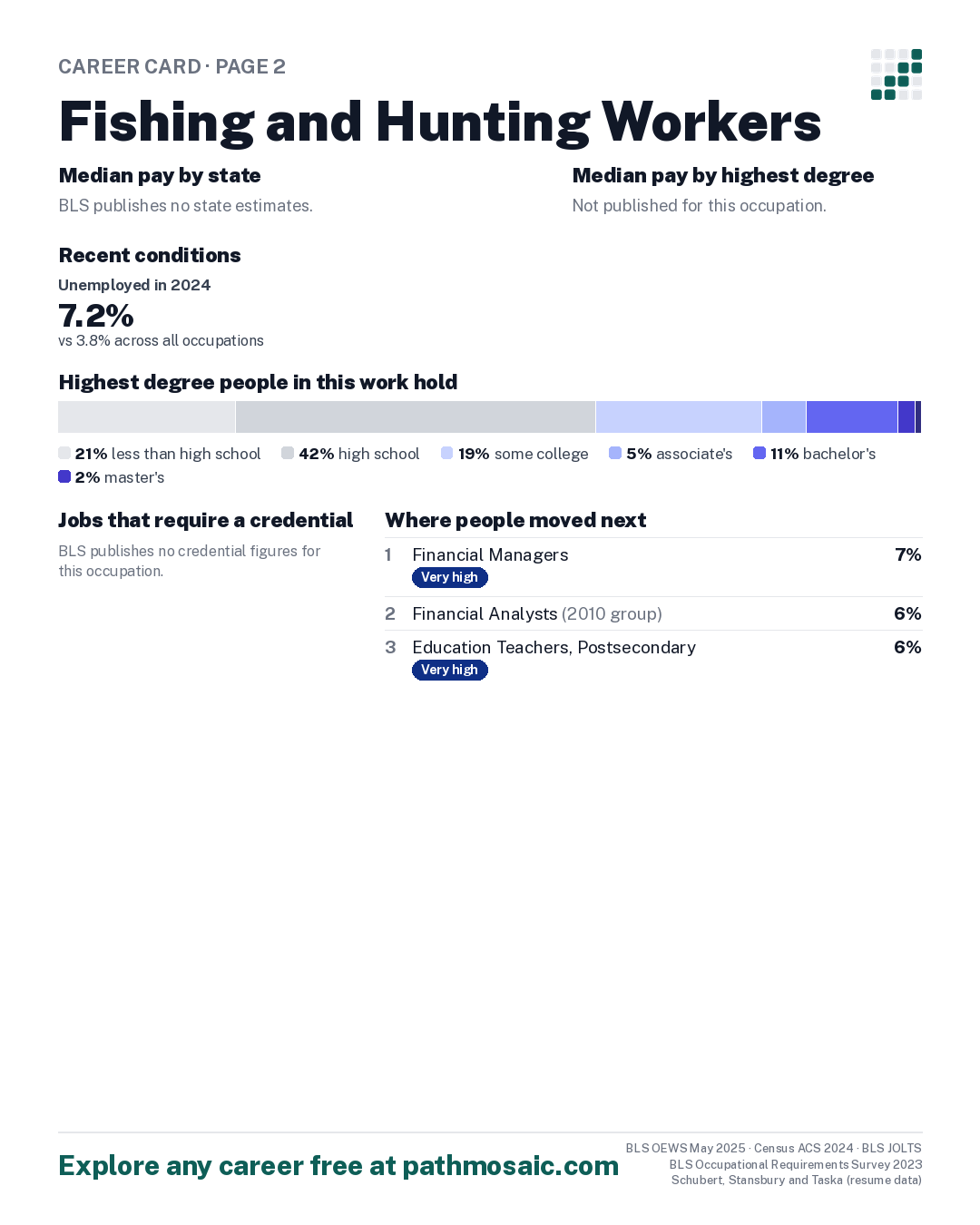
- In 2024, 7.2% of people in this work were unemployed, against 3.8% across all occupations Census ACS 2024
Median pay by state BLS OEWS May 2025, state estimates
BLS publishes no state estimates for this occupation.
How AI touches the work
What AI could speed up, task by task, and where people already use it.
AI could halve the time on 1 of its 29 tasks
| AI rating | Its main tasks | Share of Claude conversations May 2026 |
|---|---|---|
| Not much | Direct fishing or hunting operations, and supervise crew members. | Not published |
| Not much | Maintain engines, fishing gear, and other on-board equipment and perform minor repairs. | Not published |
| Not much | Steer vessels and operate navigational instruments. | Not published |
| Not much | Interpret weather and vessel conditions to determine appropriate responses. | Not published |
| Not much | Wash decks, conveyors, knives, and other equipment, using brushes, detergents, and water. | Not published |
| AI + software | Oversee the purchase of supplies, gear, and equipment. | Not published |
See all 29 tasks
| Not much | Remove catches from fishing equipment and measure them to ensure compliance with legal size. | Not published |
| Not much | Travel on foot, by vehicle, or by equipment such as boats, snowmobiles, helicopters, snowshoes, or skis to reach hunting areas. | Not published |
| Not much | Harvest marine life for human or animal consumption, using diving or dredging equipment, traps, barges, rods, reels, or tackle. | Not published |
| Not much | Connect accessories such as floats, weights, flags, lights, or markers to nets, lines, or traps. | Not published |
| Not much | Select, bait, and set traps, and lay poison along trails, according to species, size, habits, and environs of birds or animals and reasons for trapping them. | Not published |
| Not much | Locate fish, using fish-finding equipment. | Not published |
| Not much | Compute positions and plot courses on charts to navigate vessels, using instruments such as compasses, sextants, and charts. | Not published |
| Not much | Maintain and repair trapping equipment. | Not published |
| Not much | Load and unload vessel equipment and supplies, by hand or using hoisting equipment. | Not published |
| Not much | Patrol trap lines or nets to inspect settings, remove catch, and reset or relocate traps. | Not published |
| Not much | Participate in animal damage control, wildlife management, disease control, and research activities. | Not published |
| Not much | Transport fish to processing plants or to buyers. | Not published |
| Not much | Put fishing equipment into the water and anchor or tow equipment, according to the fishing method used. | Not published |
| Not much | Attach nets, slings, hooks, blades, or lifting devices to cables, booms, hoists, or dredges. | Not published |
| Not much | Sort, pack, and store catch in holds with salt and ice. | Not published |
| Not much | Obtain permission from landowners to hunt or trap on their land. | Not published |
| Not much | Teach or guide individuals or groups unfamiliar with specific hunting methods or types of prey. | Not published |
| Not much | Release quarry from traps or nets and transfer to cages. | Not published |
| Not much | Skin quarry, using knives, and stretch pelts on frames to be cured. | Not published |
| Not much | Scrape fat, blubber, or flesh from skin sides of pelts with knives or hand scrapers. | Not published |
| Not much | Track animals by checking for signs such as droppings or destruction of vegetation. | Not published |
| Not much | Kill or stun trapped quarry, using clubs, poisons, guns, or drowning methods. | Not published |
| Not much | Obtain required approvals for using poisons or traps, and notify persons in areas where traps and poison are set. | Not published |
Ordered by how important O*NET's respondents rate each task (1 to 5) times the share who say it is part of their job. The ordering is ours. 0 of the 29 have a published share of Claude conversations; “not published” means too few conversations for Anthropic to publish a figure.
Where people already use AI
The tasks above say what AI could speed up. This shows what people are using it for. Its 29 tasks fall under 17 work activities that many occupations share, and Microsoft counted how often each one came up in 200,000 conversations with its Copilot assistant in 2024.
| Work activity | This occupation's tasks under it | People asked AI for help in 10,000 conversations |
AI did it for them in 10,000 conversations |
|---|---|---|---|
| Hunt animals | |||
| Operate transportation equipment or vehicles | |||
| Set up equipment | |||
| Obtain formal documentation or authorization | |||
| Maintain tools or equipment | |||
| Position tools or equipment | |||
| Process animal carcasses | |||
| Communicate with others about operational plans or activities |
Show all 17 activities
| Sort materials or products | |||
| Clean tools, equipment, facilities, or work areas | |||
| Direct organizational operations, activities, or procedures | |||
| Train others on operational or work procedures | |||
| Develop systems or practices to mitigate or resolve environmental problems | |||
| Package objects | |||
| Move materials, equipment, or supplies | |||
| Load products, materials, or equipment for transportation or further processing | |||
| Manage agricultural or forestry operations |
How to read this
Work activities come from O*NET, which links every task to the broader activities it involves. Microsoft's figures are for the activity across everyone who used Copilot, not for fishing and hunting workers specifically. Copilot is a general chat assistant; dedicated coding tools are not included, so programming help is under-counted here. Activities are listed by how many of this occupation's tasks fall under them.
The task ratings say whether AI could halve the time a task takes: on its own (“AI alone”), or with software built on it (“AI + software”). They were made by people in 2023 (Eloundou et al.). Claude's share is the task's share of all Claude.ai conversations in May 2026; Anthropic doesn't publish a task with too few conversations. None of these add up to the BLS exposure group, which combines five research measures.
More in the Guide: task ratings · task order · work activities · Copilot figures · Claude
High exposure doesn't mean fewer jobs
BLS projects most occupations in its two most exposed groups to grow: 141 of 206 rated Very high and 165 of 206 rated High. Each dot is one of the 831 occupations BLS rates.
Career moves into and out of this occupation
From moves between occupations found in online resumes, 2002–2016. Career changes only: a first job after school isn't a move.
Where people moved next
of 4,198 moves out
- 1 Financial Managers Very high +9.7% 7%
- 2 Financial Analysts (2010 group) an older group BLS has since split; no exposure group today 6%
- 3 Education Teachers, Postsecondary Very high +2.5% 6%
- 4 Education Administrators, Postsecondary High +1.8% 5%
- 5 Heavy and Tractor-Trailer Truck Drivers Moderate +3.8% 4%
Where people moved in from
of 3,663 moves in
- 1 Financial Analysts (2010 group) an older group BLS has since split; no exposure group today 5%
- 2 Education Administrators, Postsecondary High +1.8% 4%
- 3 Office Clerks, General Very high -6.0% 3%
- 4 Education Teachers, Postsecondary Very high +2.5% 3%
- 5 Medical Records and Health Information Technicians (2010 group) an older group BLS has since split; no exposure group today 3%
Combined from the 2010 occupations “Fishers and Related Fishing Workers” and “Hunters and Trappers”, which BLS merged into yours. Resumes over-represent younger, white-collar job-seekers and moves into management. Schubert, Stansbury and Taska (resume data).
Education and training for the occupation
O*NET survey of workers in this occupation
- 45% less than high school
- 30% high school
- 5% postsecondary certificate
- 15% some college
- 5% bachelor's
O*NET 31.0 survey of workers in this occupation · 20 people answered.
Census survey (American Community Survey)
- 21% less than high school
- 42% high school
- 19% some college
- 5% associate's
- 11% bachelor's
- 2% master's
- 1% professional degree
Census ACS 2024, all workers in this occupation · 359 people surveyed.
Why the two can differ
O*NET asks about 20 people in each occupation, which makes its shares uncertain, but it reports the exact occupation and counts certificates. The Census survey reaches thousands, but it groups some occupations together and counts degrees only. More in the Guide
1 program: Fishing and Fisheries Sciences and Management.
Jobs that require a credential BLS Occupational Requirements Survey 2023
BLS publishes no credential figures for this occupation.
Look up certifications, training and licenses U.S. Department of Labor
- Certification Finder ↗ certifications CareerOneStop lists for this occupation
- Training Finder ↗ schools and programs, nationwide; narrow the place there
- License Finder ↗ licenses by state
- Apprenticeships: DOL's list of apprenticeable occupations doesn't include this one.
These open in a new tab and send only the occupation's public code. More in the Guide
BLS AI exposure categories (Aug 2026) · BLS Employment Projections 2025–35 · O*NET 31.0 · Task ratings: Eloundou et al., Science (2024) · Microsoft "Working with AI" v1.1 · Anthropic Economic Index (2026-06-26) · Schubert, Stansbury and Taska · NCES CIP–SOC · Census ACS 2024 · BLS JOLTS
See it online, and explore any career: https://www.pathmosaic.com/card/45-3031.00