Forensic Science Technicians
Also called: Crime Scene Technician (Crime Scene Tech), Criminalist, CSI (Crime Scene Investigator), Forensic ScientistCollect, identify, classify, and analyze physical evidence related to criminal investigations. Perform tests on weapons or substances, such as fiber, hair, and tissue to determine significance to investigation. May testify as expert witnesses on evidence or crime laboratory techniques. May serve as specialists in area of expertise, such as ballistics, fingerprinting, handwriting, or biochemistry.
On a phone, press and hold a picture to save it to Photos.
opens your phone's share sheet, where you can save both to Photos
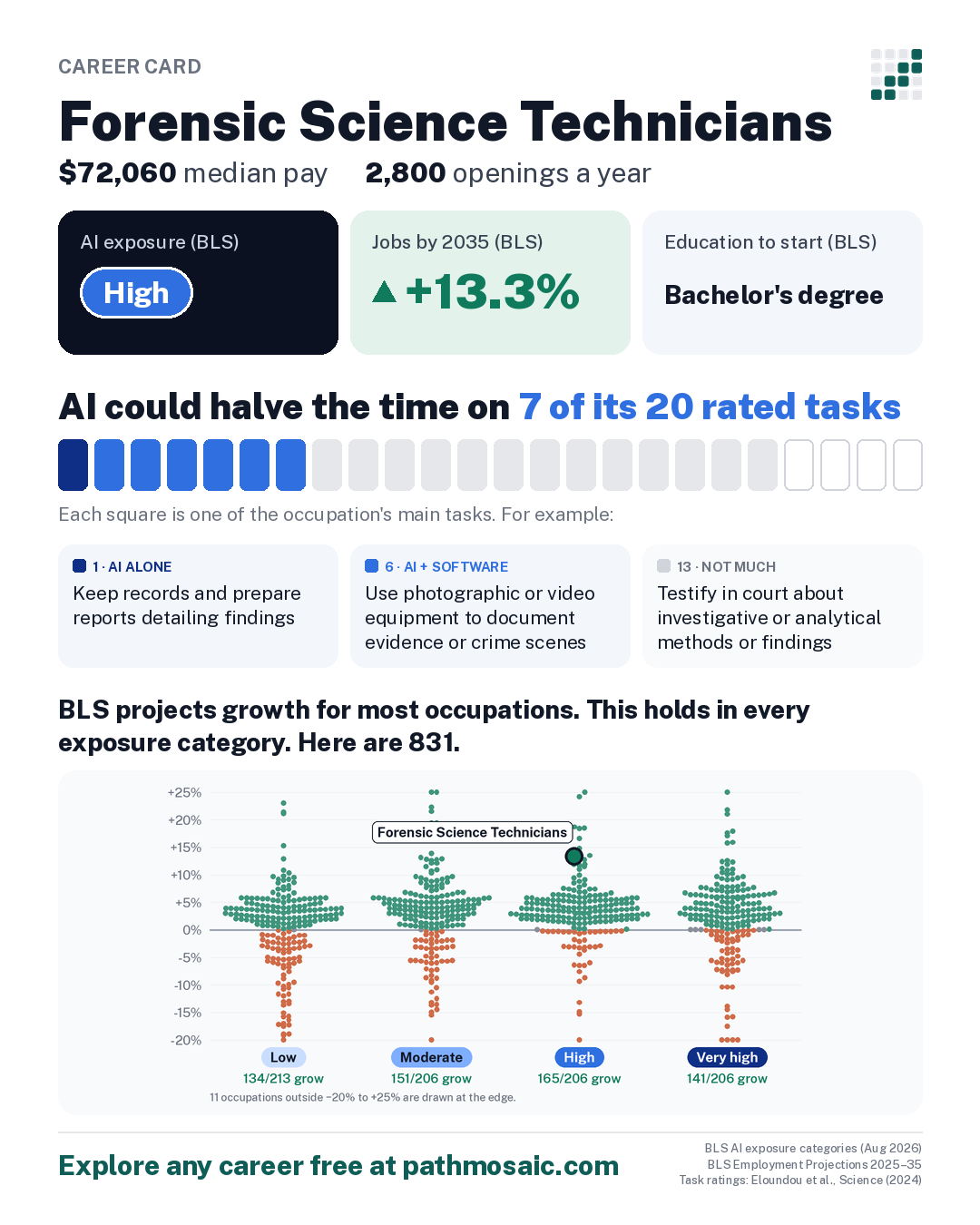
What the data says: AI could halve the time on 7 of its 20 rated tasks, and jobs are projected to grow 13.3% by 2035. How to think about this →
About this projection
BLS builds AI into its projections where the research supports it: “BLS generally applies adjustments based on this research conservatively, where there is convincing evidence for a change.”
It also notes a limit: “BLS projection methods are not designed to capture extremely rapid technological change.”
On its AI exposure groups, BLS says exposure “does not imply job loss.”
Recent conditions
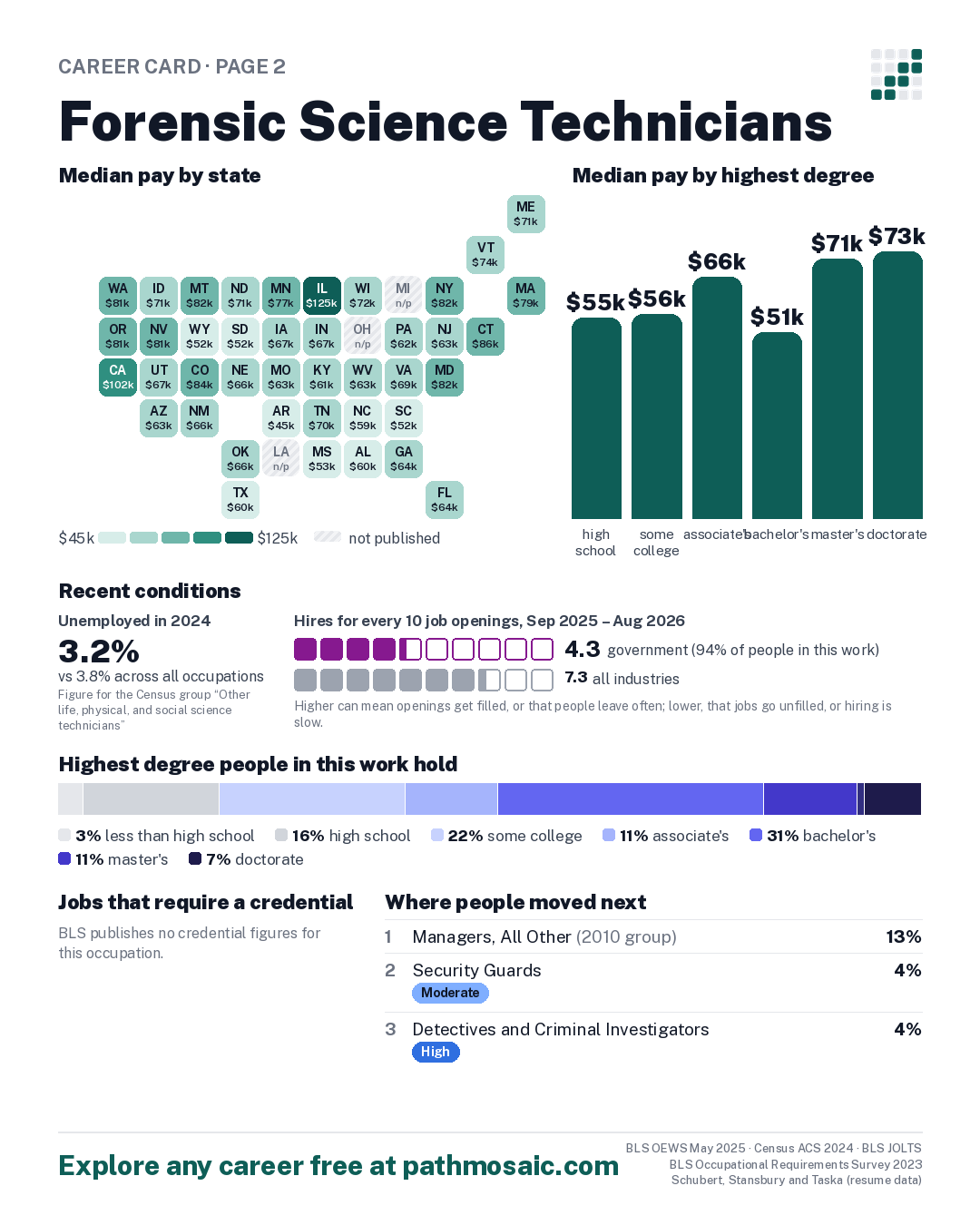
- In 2024, 3.2% of people in this work were unemployed, against 3.8% across all occupations Census ACS 2024, all workers in the Census group “Other life, physical, and social science technicians”
- From Sep 2025 to Aug 2026, 4.3 hires for every 10 job openings in government, which employs about 94% of people in this work, against 7.3 across all industries BLS JOLTS
One box per opening, filled for each hire; hires beyond the openings are added in a lighter shade. Higher can mean openings get filled, or that people leave often; lower, that jobs go unfilled, or hiring is slow.4.3 this industry7.3 all industries
Median pay by state BLS OEWS May 2025, state estimates
Tap a state for its figures.
Median pay in every state
| State | Median | Middle half earn | Jobs |
|---|---|---|---|
| Alabama | $59,560 | $49,000 to $74,290 | 160 |
| Arizona | $63,250 | $51,730 to $84,600 | 900 |
| Arkansas | $44,670 | $41,280 to $50,520 | 100 |
| California | $102,100 | $80,810 to $132,810 | 2,800 |
| Colorado | $84,010 | $71,850 to $105,350 | 510 |
| Connecticut | $85,910 | $66,150 to $104,800 | 120 |
| Florida | $64,140 | $52,010 to $80,600 | 1,920 |
| Georgia | $63,600 | $48,810 to $75,390 | 550 |
| Idaho | $71,160 | $58,700 to $94,100 | 160 |
| Illinois | $124,790 | $79,190 to $129,590 | 370 |
| Indiana | $66,520 | $58,420 to $83,280 | 320 |
| Iowa | $67,060 | $51,960 to $77,360 | 130 |
| Kentucky | $61,470 | $51,200 to $67,760 | 60 |
| Louisiana | not published | not published | 240 |
| Maine | $70,870 | $48,550 to $78,670 | 40 |
| Maryland | $82,140 | $65,170 to $105,300 | 460 |
| Massachusetts | $79,320 | $70,650 to $97,360 | 290 |
| Michigan | not published | not published | 650 |
| Minnesota | $76,960 | $64,980 to $86,490 | 140 |
| Mississippi | $52,850 | $42,350 to $70,260 | 140 |
| Missouri | $62,750 | $53,270 to $77,110 | 350 |
| Montana | $82,200 | $61,630 to $82,200 | 60 |
| Nebraska | $65,920 | $55,070 to $74,470 | 150 |
| Nevada | $81,090 | $65,490 to $103,930 | 360 |
| New Jersey | $63,220 | $49,630 to $72,430 | 60 |
| New Mexico | $65,570 | $52,470 to $81,740 | 200 |
| New York | $81,670 | $64,990 to $100,310 | 1,140 |
| North Carolina | $59,240 | $49,690 to $66,110 | 520 |
| North Dakota | $71,090 | $61,540 to $90,250 | 40 |
| Ohio | not published | not published | 470 |
| Oklahoma | $65,940 | $49,150 to $82,040 | 110 |
| Oregon | $80,950 | $63,880 to $102,160 | 110 |
| Pennsylvania | $61,580 | $54,430 to $84,530 | 360 |
| South Carolina | $51,830 | $45,990 to $57,990 | 160 |
| South Dakota | $51,690 | $43,680 to $62,310 | 30 |
| Tennessee | $70,500 | $54,030 to $95,940 | 300 |
| Texas | $59,870 | $49,460 to $70,130 | 1,900 |
| Utah | $66,780 | $55,530 to $81,900 | 220 |
| Vermont | $74,110 | $58,570 to $84,140 | 30 |
| Virginia | $68,900 | $52,970 to $99,330 | 770 |
| Washington | $81,310 | $70,720 to $97,350 | 390 |
| West Virginia | $63,330 | $52,740 to $72,430 | 110 |
| Wisconsin | $72,280 | $62,530 to $80,140 | 310 |
| Wyoming | $52,100 | $41,600 to $67,640 | 90 |
Nationally: $72,060. Shades run from the lowest state median to the highest; a territory below that range takes the lightest. How to read this
How AI touches the work
What AI could speed up, task by task, and where people already use it.
AI could halve the time on 7 of its 20 rated tasks
| AI rating | Its main tasks | Share of Claude conversations May 2026 |
|---|---|---|
| Not much | Testify in court about investigative or analytical methods or findings. | Not published |
| AI alone | Keep records and prepare reports detailing findings, investigative methods, and laboratory techniques. | Not published |
| AI + software | Use photographic or video equipment to document evidence or crime scenes. | Not published |
| Not much | Collect evidence from crime scenes, storing it in conditions that preserve its integrity. | Not published |
| Not much | Train new technicians or other personnel on forensic science techniques. | Not published |
| Not much | Visit morgues, examine scenes of crimes, or contact other sources to obtain evidence or information to be used in investigations. | Not published |
See all 24 tasks
| Not much | Collect impressions of dust from surfaces to obtain and identify fingerprints. | Not published |
| Not rated | Measure and sketch crime scenes to document evidence. | Not published |
| Not much | Operate and maintain laboratory equipment and apparatus. | Not published |
| Not much | Use chemicals or other substances to examine latent fingerprint evidence and compare developed prints to those of known persons in databases. | Not published |
| Not much | Confer with ballistics, fingerprinting, handwriting, documents, electronics, medical, chemical, or metallurgical experts concerning evidence and its interpretation. | Not published |
| Not much | Prepare solutions, reagents, or sample formulations needed for laboratory work. | Not published |
| AI + software | Analyze gunshot residue and bullet paths to determine how shootings occurred. | Not published |
| Not much | Examine and analyze blood stain patterns at crime scenes. | Not published |
| AI + software | Interpret laboratory findings or test results to identify and classify substances, materials, or other evidence collected at crime scenes. | Not published |
| AI + software | Reconstruct crime scenes to determine relationships among pieces of evidence. | Not published |
| Not rated | Examine footwear, tire tracks, or other types of impressions. | Not published |
| AI + software | Examine firearms to determine mechanical condition and legal status, performing restoration work on damaged firearms to obtain information, such as serial numbers. | Not published |
| AI + software | Review forensic analysts' reports for technical merit. | under 0.01% |
| Not much | Determine types of bullets and specific weapons used in shootings. O*NET flags this task's ratings as uncertain | Not published |
| Not much | Compare objects, such as tools, with impression marks to determine whether a specific object is responsible for a specific mark. | Not published |
| Not rated | Examine physical evidence, such as hair, biological fluids, fiber, wood, or soil residues to obtain information about its source and composition. | Not published |
| Not rated | Analyze data from computers or other digital media sources for evidence related to criminal activity. | Not published |
| Not much | Identify and quantify drugs or poisons found in biological fluids or tissues, in foods, or at crime scenes. | Not published |
Ordered by how important O*NET's respondents rate each task (1 to 5) times the share who say it is part of their job. The ordering is ours. 1 of the 24 have a published share of Claude conversations; “not published” means too few conversations for Anthropic to publish a figure.
Where people already use AI
The tasks above say what AI could speed up. This shows what people are using it for. Its 24 tasks fall under 16 work activities that many occupations share, and Microsoft counted how often each one came up in 200,000 conversations with its Copilot assistant in 2024.
- #20 Present research or technical information
- #28 Analyze scientific or applied data using mathematical principles
| Work activity | This occupation's tasks under it | People asked AI for help in 10,000 conversations |
AI did it for them in 10,000 conversations |
|---|---|---|---|
| Analyze biological or chemical substances or related data | |||
| Investigate criminal or legal matters | |||
| Present research or technical information | |||
| Analyze scientific or applied data using mathematical principles | |||
| Evaluate the quality or accuracy of data | |||
| Assist scientists, scholars, or technical specialists with projects or research | |||
| Maintain electronic, computer, or other technical equipment | |||
| Measure physical characteristics of materials, products, or equipment |
Show all 16 activities
| Record images with photographic or audiovisual equipment | |||
| Test characteristics of materials or products | |||
| Analyze data to improve operations | |||
| Maintain operational records | |||
| Train others on operational or work procedures | |||
| Prepare specimens or materials for testing | |||
| Operate laboratory or field equipment | |||
| Present information in legal proceedings |
How people in this work use Claude
What people in this work made with Claude % of conversations
- An explanation or answer45%
- An analysis or summary26%
- A document or report13%
- Teaching material6%
- Math or a calculation2%
How they worked with Claude
32% of these conversations were about work. Anthropic Economic Index, May 2026.
How to read this
Work activities come from O*NET, which links every task to the broader activities it involves. Microsoft's figures are for the activity across everyone who used Copilot, not for forensic science technicians specifically. Copilot is a general chat assistant; dedicated coding tools are not included, so programming help is under-counted here. Activities are listed by how many of this occupation's tasks fall under them.
The task ratings say whether AI could halve the time a task takes: on its own (“AI alone”), or with software built on it (“AI + software”). They were made by people in 2023 (Eloundou et al.). Claude's share is the task's share of all Claude.ai conversations in May 2026; Anthropic doesn't publish a task with too few conversations. None of these add up to the BLS exposure group, which combines five research measures.
More in the Guide: task ratings · task order · work activities · Copilot figures · Claude
High exposure doesn't mean fewer jobs
BLS projects most occupations in its two most exposed groups to grow: 141 of 206 rated Very high and 165 of 206 rated High. Each dot is one of the 831 occupations BLS rates.
Career moves into and out of this occupation
From moves between occupations found in online resumes, 2002–2016. Career changes only: a first job after school isn't a move.
Where people moved next
of 1,064 moves out
- 1 Managers, All Other (2010 group) an older group BLS has since split; no exposure group today 13%
- 2 Security Guards Moderate +0.9% 4%
- 3 Detectives and Criminal Investigators High +0.2% 4%
- 4 Customer Service Representatives Very high -5.3% 4%
- 5 Heavy and Tractor-Trailer Truck Drivers Moderate +3.8% 3%
Where people moved in from
of 1,476 moves in
- 1 Managers, All Other (2010 group) an older group BLS has since split; no exposure group today 17%
- 2 Teaching Assistants, Postsecondary Very high +2.7% 13%
- 3 Customer Service Representatives Very high -5.3% 7%
- 4 Security Guards Moderate +0.9% 5%
- 5 Detectives and Criminal Investigators High +0.2% 4%
Resumes over-represent younger, white-collar job-seekers and moves into management. Schubert, Stansbury and Taska (resume data).
Education and training for the occupation
O*NET survey of workers in this occupation
- 29% high school
- 36% postsecondary certificate
- 15% bachelor's
- 2% master's
- 17% not published
O*NET marks 17% of the answers as too uncertain to publish, so the parts shown don't add up to 100%.
O*NET 31.0 survey of workers in this occupation · 27 people answered.
Census survey (American Community Survey)
- 3% less than high school
- 16% high school
- 22% some college
- 11% associate's
- 31% bachelor's
- 11% master's
- 1% professional degree
- 7% doctorate
Census ACS 2024, all workers in the Census group “Other life, physical, and social science technicians” · 3,263 people surveyed.
Why the two can differ
O*NET asks about 20 people in each occupation, which makes its shares uncertain, but it reports the exact occupation and counts certificates. The Census survey reaches thousands, but it groups some occupations together and counts degrees only. More in the Guide
Median pay by highest degree full-time, year-round · Census ACS 2024, all workers in the Census group “Other life, physical, and social science technicians”
7 programs, such as Biology/Biological Sciences, General, Chemistry, General and Forensic Chemistry.
See all
- Biology/Biological Sciences, General
- Chemistry, General
- Forensic Chemistry
- Criminal Justice and Corrections, General
- Criminalistics and Criminal Science
- Forensic Science and Technology
- Forensic Anthropology
Jobs that require a credential BLS Occupational Requirements Survey 2023
BLS publishes no credential figures for this occupation.
Look up certifications, training and licenses U.S. Department of Labor
- Certification Finder ↗ certifications CareerOneStop lists for this occupation
- Training Finder ↗ schools and programs, nationwide; narrow the place there
- License Finder ↗ licenses by state
- Apprenticeship Finder ↗ DOL lists 1 registered apprenticeship in this occupation (CRIME SCENE TECHNICIAN). Apprenticeship.gov can't be linked to one occupation, so search for “Forensic Science Technicians” there.
These open in a new tab and send only the occupation's public code. More in the Guide
BLS AI exposure categories (Aug 2026) · BLS Employment Projections 2025–35 · O*NET 31.0 · Task ratings: Eloundou et al., Science (2024) · Microsoft "Working with AI" v1.1 · Anthropic Economic Index (2026-06-26) · Schubert, Stansbury and Taska · NCES CIP–SOC · Census ACS 2024 · BLS JOLTS
See it online, and explore any career: https://www.pathmosaic.com/card/19-4092.00