Music Directors and Composers
Also called: Choir Director, Conductor, Music Composer, Music DirectorConduct, direct, plan, and lead instrumental or vocal performances by musical artists or groups, such as orchestras, bands, choirs, and glee clubs; or create original works of music.
On a phone, press and hold a picture to save it to Photos.
opens your phone's share sheet, where you can save both to Photos
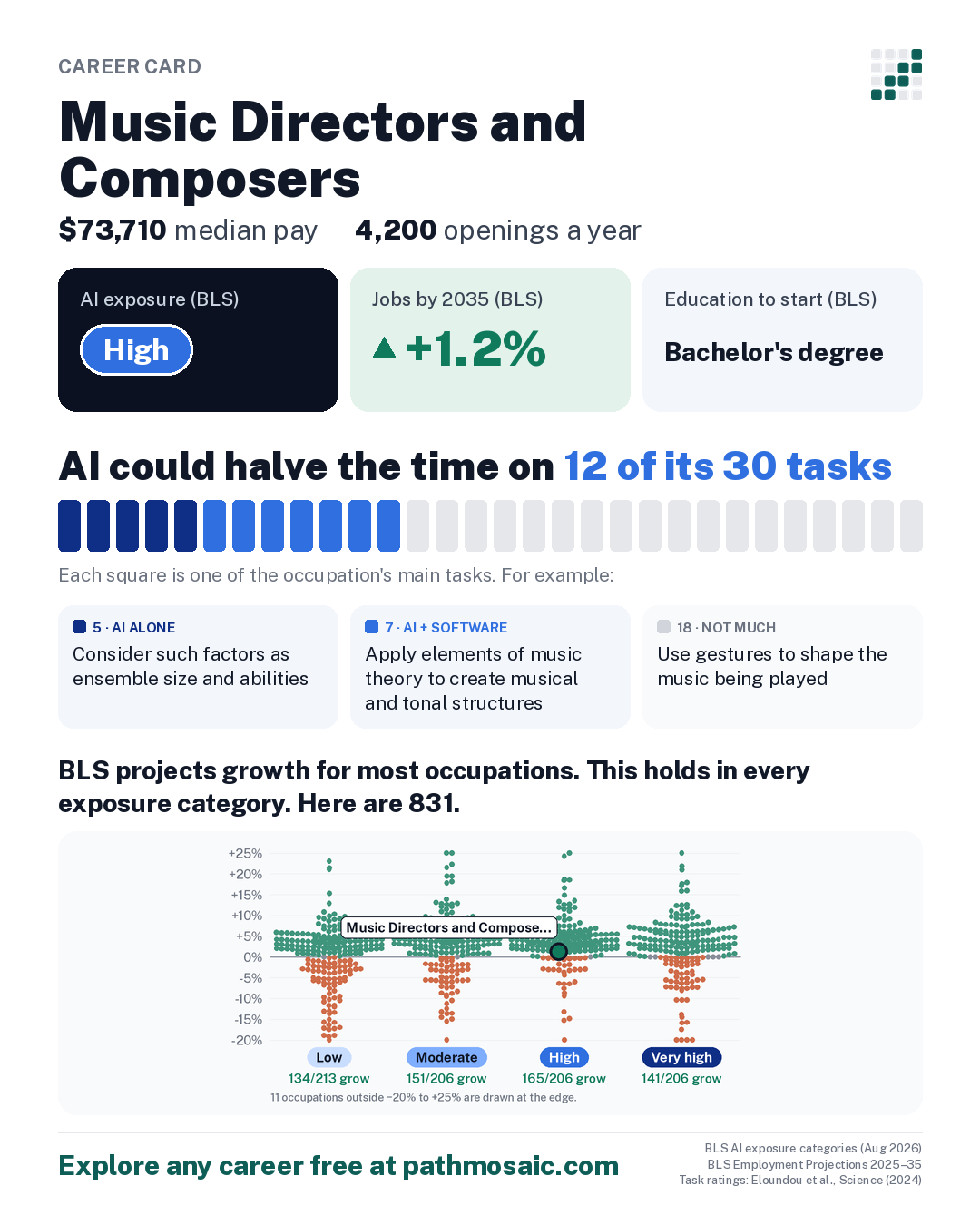
What the data says: AI could halve the time on 12 of its 30 tasks, and jobs are projected to grow 1.2% by 2035. How to think about this →
About this projection
BLS builds AI into its projections where the research supports it: “BLS generally applies adjustments based on this research conservatively, where there is convincing evidence for a change.”
It also notes a limit: “BLS projection methods are not designed to capture extremely rapid technological change.”
On its AI exposure groups, BLS says exposure “does not imply job loss.”
Recent conditions
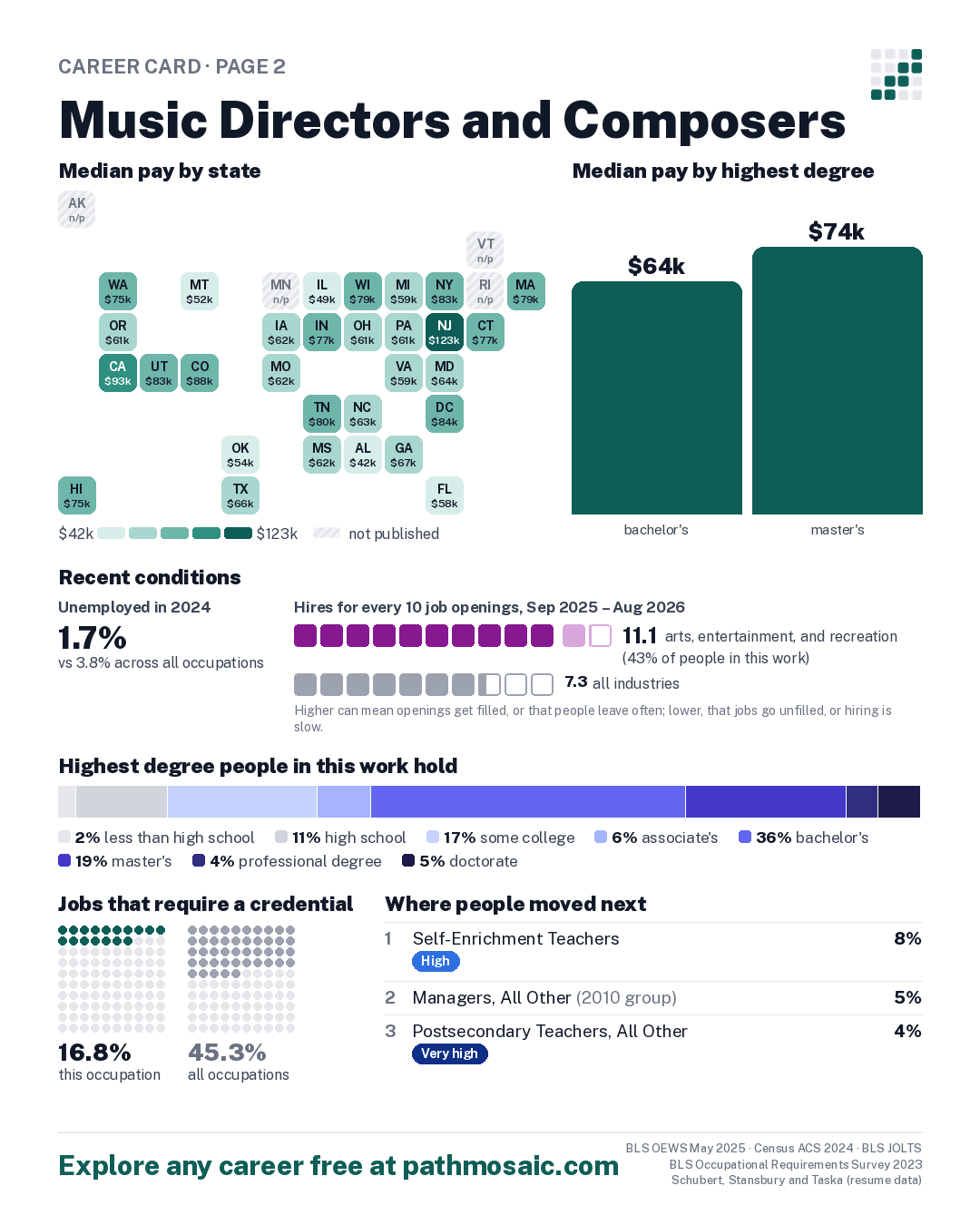
- In 2024, 1.7% of people in this work were unemployed, against 3.8% across all occupations Census ACS 2024
- From Sep 2025 to Aug 2026, 11.1 hires for every 10 job openings in arts, entertainment, and recreation, which employs about 43% of people in this work, against 7.3 across all industries BLS JOLTS
One box per opening, filled for each hire; hires beyond the openings are added in a lighter shade. Higher can mean openings get filled, or that people leave often; lower, that jobs go unfilled, or hiring is slow.11.1 this industry7.3 all industries
Median pay by state BLS OEWS May 2025, state estimates
Tap a state for its figures.
Median pay in every state
| State | Median | Middle half earn | Jobs |
|---|---|---|---|
| Alabama | $42,250 | $35,870 to $60,080 | 70 |
| Alaska | not published | not published | 60 |
| California | $93,090 | $66,810 to $126,430 | 2,510 |
| Colorado | $88,460 | $59,890 to $116,670 | 160 |
| Connecticut | $77,070 | $56,180 to $119,990 | 120 |
| District of Columbia | $84,040 | $77,740 to $131,260 | 140 |
| Florida | $57,830 | $45,710 to $75,520 | 570 |
| Georgia | $67,100 | $60,540 to $90,880 | not published |
| Hawaii | $74,570 | $63,230 to $92,400 | 90 |
| Illinois | $49,270 | $37,470 to $65,520 | not published |
| Indiana | $77,270 | $51,150 to $123,790 | 200 |
| Iowa | $61,740 | $51,570 to $73,080 | 120 |
| Maryland | $64,300 | $51,410 to $101,350 | 160 |
| Massachusetts | $78,620 | $63,800 to $114,150 | 340 |
| Michigan | $59,400 | $43,710 to $78,260 | 310 |
| Minnesota | not published | not published | 140 |
| Mississippi | $62,240 | $55,750 to $75,870 | 40 |
| Missouri | $61,670 | $48,030 to $82,030 | 60 |
| Montana | $51,530 | $47,750 to $58,220 | 110 |
| New Jersey | $122,750 | $99,410 to $171,070 | 210 |
| New York | $82,930 | $56,890 to $140,230 | 2,370 |
| North Carolina | $63,380 | $49,610 to $82,430 | 200 |
| Ohio | $61,380 | $49,670 to $81,360 | 440 |
| Oklahoma | $54,250 | $44,230 to $134,670 | 60 |
| Oregon | $60,800 | $41,600 to $86,880 | 500 |
| Pennsylvania | $61,160 | $47,130 to $79,440 | 580 |
| Rhode Island | not published | not published | 150 |
| Tennessee | $79,640 | $18,600 to $99,900 | 400 |
| Texas | $65,570 | $51,980 to $86,180 | 480 |
| Utah | $82,570 | $79,050 to $82,570 | 150 |
| Vermont | not published | not published | 30 |
| Virginia | $59,050 | $48,510 to $92,150 | 370 |
| Washington | $75,060 | $61,320 to $104,090 | 260 |
| Wisconsin | $78,690 | $56,850 to $105,860 | 200 |
Nationally: $73,710. Shades run from the lowest state median to the highest; a territory below that range takes the lightest. How to read this
How AI touches the work
What AI could speed up, task by task, and where people already use it.
AI could halve the time on 12 of its 30 tasks
| AI rating | Its main tasks | Share of Claude conversations May 2026 |
|---|---|---|
| Not much | Use gestures to shape the music being played, communicating desired tempo, phrasing, tone, color, pitch, volume, and other performance aspects. | Not published |
| Not much | Direct groups at rehearsals and live or recorded performances to achieve desired effects such as tonal and harmonic balance dynamics, rhythm, and tempo. | Not published |
| AI + software | Apply elements of music theory to create musical and tonal structures, including harmonies and melodies. | under 0.01% |
| AI + software | Study scores to learn the music in detail, and to develop interpretations. | Not published |
| Not much | Determine voices, instruments, harmonic structures, rhythms, tempos, and tone balances required to achieve the effects desired in a musical composition. | under 0.01% |
| AI alone | Consider such factors as ensemble size and abilities, availability of scores, and the need for musical variety, to select music to be performed. | under 0.01% |
See all 30 tasks
| Not much | Experiment with different sounds, and types and pieces of music, using synthesizers and computers as necessary to test and evaluate ideas. | under 0.01% |
| Not much | Transcribe ideas for musical compositions into musical notation, using instruments, pen and paper, or computers. | under 0.01% |
| Not much | Plan and schedule rehearsals and performances, and arrange details such as locations, accompanists, and instrumentalists. | Not published |
| Not much | Position members within groups to obtain balance among instrumental or vocal sections. | Not published |
| Not much | Fill in details of orchestral sketches, such as adding vocal parts to scores. | Not published |
| Not much | Audition and select performers for musical presentations. | Not published |
| AI alone | Write musical scores for orchestras, bands, choral groups, or individual instrumentalists or vocalists, using knowledge of music theory and of instrumental and vocal capabilities. | Not published |
| Not much | Transpose music from one voice or instrument to another to accommodate particular musicians. | Not published |
| Not much | Explore and develop musical ideas based on sources such as imagination or sounds in the environment. | under 0.01% |
| AI alone | Rewrite original musical scores in different musical styles by changing rhythms, harmonies, or tempos. | Not published |
| AI + software | Perform administrative tasks such as applying for grants, developing budgets, negotiating contracts, and designing and printing programs and other promotional materials. | Not published |
| Not much | Arrange music composed by others, changing the music to achieve desired effects. | under 0.01% |
| AI + software | Confer with producers and directors to define the nature and placement of film or television music. | Not published |
| Not much | Collaborate with other colleagues, such as copyists, to complete final scores. | Not published |
| AI alone | Copy parts from scores for individual performers. | Not published |
| Not much | Write music for commercial mediums, including advertising jingles or film soundtracks. | Not published |
| Not much | Create original musical forms, or write within circumscribed musical forms such as sonatas, symphonies, or operas. | Not published |
| AI alone | Study films or scripts to determine how musical scores can be used to create desired effects or moods. | Not published |
| Not much | Transcribe musical compositions and melodic lines to adapt them to a particular group, or to create a particular musical style. | under 0.01% |
| Not much | Meet with soloists and concertmasters to discuss and prepare for performances. | Not published |
| AI + software | Assign and review staff work in such areas as scoring, arranging, and copying music, and vocal coaching. | Not published |
| AI + software | Coordinate and organize tours, or hire touring companies to arrange concert dates, venues, accommodations, and transportation for longer tours. | Not published |
| Not much | Produce recordings of music. | Not published |
| AI + software | Stay abreast of the latest trends in music and music technology. | Not published |
Ordered by how important O*NET's respondents rate each task (1 to 5) times the share who say it is part of their job. The ordering is ours. O*NET hasn't rated 2 of the tasks, so they come last, in O*NET's own order. 8 of the 30 have a published share of Claude conversations; “not published” means too few conversations for Anthropic to publish a figure.
Where people already use AI
The tasks above say what AI could speed up. This shows what people are using it for. Its 30 tasks fall under 13 work activities that many occupations share, and Microsoft counted how often each one came up in 200,000 conversations with its Copilot assistant in 2024.
- #4 Maintain current knowledge in area of expertise
- #6 Develop news, entertainment, or artistic content
- #14 Create visual designs or displays
- and 3 more, in the table below
| Work activity | This occupation's tasks under it | People asked AI for help in 10,000 conversations |
AI did it for them in 10,000 conversations |
|---|---|---|---|
| Create artistic designs or performances | |||
| Coordinate artistic or entertainment activities | |||
| Study details of artistic productions | |||
| Present arts or entertainment performances | |||
| Maintain current knowledge in area of expertise | |||
| Develop news, entertainment, or artistic content | |||
| Create visual designs or displays | |||
| Communicate with others about specifications or project details |
Show all 13 activities
| Manage budgets or finances | |||
| Operate audiovisual or related equipment | |||
| Direct organizational operations, activities, or procedures | |||
| Negotiate contracts or agreements | |||
| Perform recruiting or hiring activities |
How people in this work use Claude
What people in this work made with Claude % of conversations
- Audio or music33%
- Creative writing20%
- An explanation or answer6%
- A plan or strategy4%
- A document or report4%
How they worked with Claude
18% of these conversations were about work. Anthropic Economic Index, May 2026.
How to read this
Work activities come from O*NET, which links every task to the broader activities it involves. Microsoft's figures are for the activity across everyone who used Copilot, not for music directors and composers specifically. Copilot is a general chat assistant; dedicated coding tools are not included, so programming help is under-counted here. Activities are listed by how many of this occupation's tasks fall under them.
The task ratings say whether AI could halve the time a task takes: on its own (“AI alone”), or with software built on it (“AI + software”). They were made by people in 2023 (Eloundou et al.). Claude's share is the task's share of all Claude.ai conversations in May 2026; Anthropic doesn't publish a task with too few conversations. None of these add up to the BLS exposure group, which combines five research measures.
More in the Guide: task ratings · task order · work activities · Copilot figures · Claude
High exposure doesn't mean fewer jobs
BLS projects most occupations in its two most exposed groups to grow: 141 of 206 rated Very high and 165 of 206 rated High. Each dot is one of the 831 occupations BLS rates.
Career moves into and out of this occupation
From moves between occupations found in online resumes, 2002–2016. Career changes only: a first job after school isn't a move.
Where people moved next
of 46,210 moves out
- 1 Self-Enrichment Teachers High +3.5% 8%
- 2 Managers, All Other (2010 group) an older group BLS has since split; no exposure group today 5%
- 3 Postsecondary Teachers, All Other Very high +2.0% 4%
- 4 Musicians and Singers Moderate +0.3% 3%
- 5 Chief Executives Very high +3.2% 3%
Where people moved in from
of 58,726 moves in
- 1 Self-Enrichment Teachers High +3.5% 8%
- 2 Managers, All Other (2010 group) an older group BLS has since split; no exposure group today 4%
- 3 Secretaries and Administrative Assistants, Except Legal, Medical, and Executive Very high -6.0% 4%
- 4 Musicians and Singers Moderate +0.3% 3%
- 5 Middle School Teachers, Except Special and Career/Technical Education High -0.4% 2%
Resumes over-represent younger, white-collar job-seekers and moves into management. Schubert, Stansbury and Taska (resume data).
Education and training for the occupation
O*NET survey of workers in this occupation
- 5% less than high school
- 4% high school
- 6% some college
- 8% associate's
- 24% bachelor's
- 2% post-bachelor's certificate
- 28% master's
- 2% post-master's certificate
- 21% research doctorate
O*NET 31.0 survey of workers in this occupation · 51 people answered.
Census survey (American Community Survey)
- 2% less than high school
- 11% high school
- 17% some college
- 6% associate's
- 36% bachelor's
- 19% master's
- 4% professional degree
- 5% doctorate
Census ACS 2024, all workers in this occupation · 532 people surveyed.
Why the two can differ
O*NET asks about 20 people in each occupation, which makes its shares uncertain, but it reports the exact occupation and counts certificates. The Census survey reaches thousands, but it groups some occupations together and counts degrees only. More in the Guide
Median pay by highest degree full-time, year-round · Census ACS 2024, all workers in this occupation
12 programs, such as Religious/Sacred Music, Worship Ministry and Musical Theatre.
See all
- Religious/Sacred Music
- Worship Ministry
- Musical Theatre
- Music Performance, General
- Music Theory and Composition
- Musicology and Ethnomusicology
- Conducting
- Voice and Opera
- Music Technology
- Sound Arts
- Music, Other
- Music Management
Jobs that require a credential BLS Occupational Requirements Survey 2023
16.8% this occupation
45.3% all occupations
| By kind | This occupation | All occupations |
|---|---|---|
| a license | 2.4% | 19.1% |
| a certification | <0.5% | 5.8% |
| an educational certificate | <0.5% | 2.8% |
Share of jobs whose employer requires it. BLS doesn't say which credential. How to read this
Look up certifications, training and licenses U.S. Department of Labor
- Certification Finder ↗ certifications CareerOneStop lists for this occupation
- Training Finder ↗ schools and programs, nationwide; narrow the place there
- License Finder ↗ licenses by state
- Apprenticeships: DOL's list of apprenticeable occupations doesn't include this one.
These open in a new tab and send only the occupation's public code. More in the Guide
BLS AI exposure categories (Aug 2026) · BLS Employment Projections 2025–35 · O*NET 31.0 · Task ratings: Eloundou et al., Science (2024) · Microsoft "Working with AI" v1.1 · Anthropic Economic Index (2026-06-26) · Schubert, Stansbury and Taska · NCES CIP–SOC · Census ACS 2024 · BLS JOLTS
See it online, and explore any career: https://www.pathmosaic.com/card/27-2041.00