Emergency Medicine Physicians
Also called: Attending Emergency Physician, Emergency Medicine Physician (EM Physician), Emergency Physician, PhysicianMake immediate medical decisions and act to prevent death or further disability. Provide immediate recognition, evaluation, care, stabilization, and disposition of patients. May direct emergency medical staff in an emergency department.
On a phone, press and hold a picture to save it to Photos.
opens your phone's share sheet, where you can save both to Photos
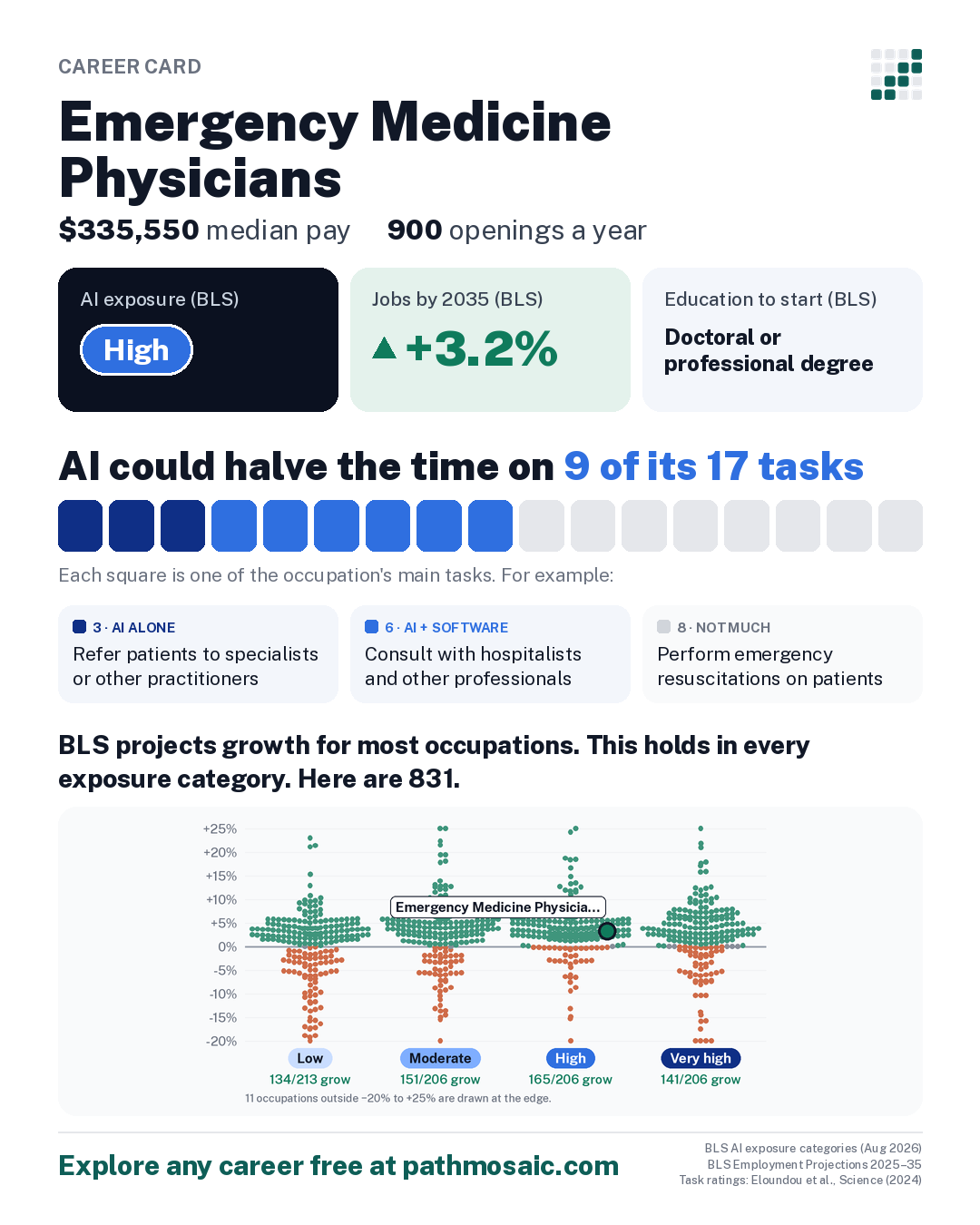
What the data says: AI could halve the time on 9 of its 17 tasks, yet jobs are projected to grow 3.2% by 2035. How to think about this →
About this projection
BLS builds AI into its projections where the research supports it: “BLS generally applies adjustments based on this research conservatively, where there is convincing evidence for a change.”
It also notes a limit: “BLS projection methods are not designed to capture extremely rapid technological change.”
On its AI exposure groups, BLS says exposure “does not imply job loss.”
Recent conditions
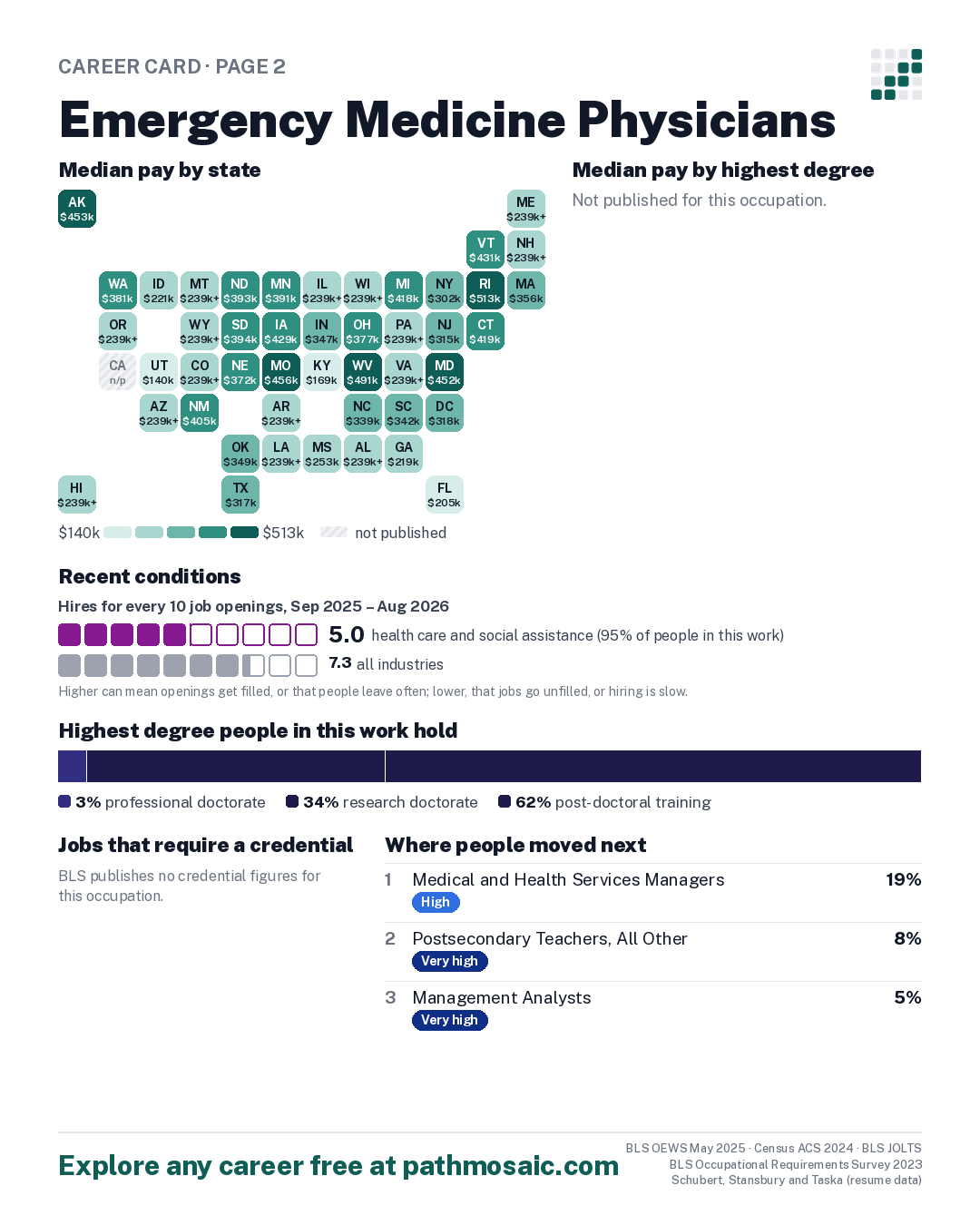
- From Sep 2025 to Aug 2026, 5.0 hires for every 10 job openings in health care and social assistance, which employs about 95% of people in this work, against 7.3 across all industries BLS JOLTS
One box per opening, filled for each hire; hires beyond the openings are added in a lighter shade. Higher can mean openings get filled, or that people leave often; lower, that jobs go unfilled, or hiring is slow.5.0 this industry7.3 all industries
Median pay by state BLS OEWS May 2025, state estimates
Tap a state for its figures.
Median pay in every state
| State | Median | Middle half earn | Jobs |
|---|---|---|---|
| Alabama | $239,200 or more | $239,200 or more to $239,200 or more | 90 |
| Alaska | $452,620 | $181,000 to $471,630 | 190 |
| Arizona | $239,200 or more | $239,200 or more to $239,200 or more | not published |
| Arkansas | $239,200 or more | $239,200 or more to $239,200 or more | 60 |
| California | not published | not published | 4,420 |
| Colorado | $239,200 or more | $239,200 or more to $239,200 or more | 780 |
| Connecticut | $418,940 | $117,240 to $514,660 | 470 |
| District of Columbia | $318,200 | $236,340 to $318,200 | 120 |
| Florida | $204,990 | $204,990 to $398,540 | 2,060 |
| Georgia | $219,010 | $134,990 to $345,550 | not published |
| Hawaii | $239,200 or more | $239,200 or more to $239,200 or more | 110 |
| Idaho | $221,430 | $126,440 to $320,600 | 380 |
| Illinois | $239,200 or more | $239,200 or more to $239,200 or more | 1,220 |
| Indiana | $347,060 | $284,420 to $448,080 | 1,170 |
| Iowa | $429,050 | $368,480 to $472,710 | 290 |
| Kentucky | $169,390 | $148,180 to $272,980 | 620 |
| Louisiana | $239,200 or more | $239,200 or more to $239,200 or more | 470 |
| Maine | $239,200 or more | $239,200 or more to $239,200 or more | 280 |
| Maryland | $451,620 | $333,730 to $479,180 | 550 |
| Massachusetts | $356,230 | $319,420 to $483,750 | 890 |
| Michigan | $417,760 | $335,660 to $465,750 | 910 |
| Minnesota | $390,940 | $336,340 to $474,960 | 990 |
| Mississippi | $252,960 | $174,990 to $424,740 | 450 |
| Missouri | $456,280 | $270,640 to $496,370 | not published |
| Montana | $239,200 or more | $239,200 or more to $239,200 or more | 140 |
| Nebraska | $371,880 | $273,450 to $497,170 | 390 |
| New Hampshire | $239,200 or more | $239,200 or more to $239,200 or more | 310 |
| New Jersey | $315,340 | $79,400 to $383,300 | 500 |
| New Mexico | $405,130 | $334,250 to $432,380 | 340 |
| New York | $301,690 | $99,100 to $369,510 | 3,980 |
| North Carolina | $339,350 | $321,320 to $390,030 | 710 |
| North Dakota | $392,890 | $333,370 to $623,420 | 150 |
| Ohio | $377,480 | $210,070 to $476,910 | 1,170 |
| Oklahoma | $348,540 | $206,870 to $348,540 | 60 |
| Oregon | $239,200 or more | $239,200 or more to $239,200 or more | 890 |
| Pennsylvania | $239,200 or more | $239,200 or more to $239,200 or more | 570 |
| Rhode Island | $512,730 | $310,300 to $566,150 | 290 |
| South Carolina | $341,960 | $171,700 to $385,790 | 80 |
| South Dakota | $393,870 | $244,370 to $406,760 | 170 |
| Texas | $316,830 | $81,920 to $330,850 | 780 |
| Utah | $140,370 | $137,250 to $147,740 | 140 |
| Vermont | $430,820 | $383,860 to $449,910 | 130 |
| Virginia | $239,200 or more | $239,200 or more to $239,200 or more | 920 |
| Washington | $380,870 | $314,200 to $420,410 | not published |
| West Virginia | $491,230 | $129,690 to $532,120 | 300 |
| Wisconsin | $239,200 or more | $239,200 or more to $239,200 or more | 1,260 |
| Wyoming | $239,200 or more | $239,200 or more to $239,200 or more | not published |
Nationally: $335,550. Shades run from the lowest state median to the highest; a territory below that range takes the lightest. How to read this
How AI touches the work
What AI could speed up, task by task, and where people already use it.
AI could halve the time on 9 of its 17 tasks
| AI rating | Its main tasks | Share of Claude conversations May 2026 |
|---|---|---|
| Not much | Select, request, perform, or interpret diagnostic procedures, such as laboratory tests, electrocardiograms, emergency ultrasounds, and radiographs. | Not published |
| AI + software | Evaluate patients' vital signs or laboratory data to determine emergency intervention needs and priority of treatment. | under 0.01% |
| Not much | Perform emergency resuscitations on patients. | Not published |
| Not much | Stabilize patients in critical condition. | Not published |
| Not much | Perform such medical procedures as emergent cricothyrotomy, endotracheal intubation, and emergency thoracotomy. | Not published |
| AI + software | Analyze records, examination information, or test results to diagnose medical conditions. | under 0.01% |
See all 17 tasks
| AI + software | Consult with hospitalists and other professionals, such as social workers, regarding patients' hospital admission, continued observation, transition of care, or discharge. | Not published |
| AI alone | Conduct primary patient assessments that include information from prior medical care. | under 0.01% |
| AI alone | Communicate likely outcomes of medical diseases or traumatic conditions to patients or their representatives. | 0.08% |
| Not much | Monitor patients' conditions, and reevaluate treatments, as necessary. | Not published |
| Not much | Direct and coordinate activities of nurses, assistants, specialists, residents, and other medical staff. | Not published |
| Not much | Select and prescribe medications to address patient needs. | Not published |
| AI + software | Collect and record patient information, such as medical history or examination results, in electronic or handwritten medical records. | Not published |
| AI + software | Discuss patients' treatment plans with physicians and other medical professionals. | Not published |
| AI + software | Identify factors that may affect patient management, such as age, gender, barriers to communication, and underlying disease. | 0.01% |
| Not much | Assess patients' pain levels or sedation requirements. | Not published |
| AI alone | Refer patients to specialists or other practitioners. | under 0.01% |
Ordered by how important O*NET's respondents rate each task (1 to 5) times the share who say it is part of their job. The ordering is ours. 6 of the 17 have a published share of Claude conversations; “not published” means too few conversations for Anthropic to publish a figure.
Where people already use AI
The tasks above say what AI could speed up. This shows what people are using it for. Its 17 tasks fall under 15 work activities that many occupations share, and Microsoft counted how often each one came up in 200,000 conversations with its Copilot assistant in 2024.
- #24 Assist others to access additional services or resources
| Work activity | This occupation's tasks under it | People asked AI for help in 10,000 conversations |
AI did it for them in 10,000 conversations |
|---|---|---|---|
| Analyze health or medical data | |||
| Evaluate patient or client condition or treatment options | |||
| Monitor health conditions of humans or animals | |||
| Confer with healthcare or other professionals about patient care | |||
| Administer emergency medical treatment | |||
| Assist others to access additional services or resources | |||
| Advise patients or clients on medical issues | |||
| Collect information about patients or clients |
Show all 15 activities
| Treat injuries, illnesses, or diseases | |||
| Diagnose health conditions or disorders | |||
| Supervise personnel activities | |||
| Order medical tests or procedures | |||
| Maintain health or medical records | |||
| Prescribe medical treatments or devices | |||
| Administer diagnostic tests to assess patient health |
How people in this work use Claude
What people in this work made with Claude % of conversations
- An explanation or answer58%
- Advice or a recommendation27%
- An analysis or summary5%
- A document or report5%
- An email or message2%
How they worked with Claude
8% of these conversations were about work. Anthropic Economic Index, May 2026.
How to read this
Work activities come from O*NET, which links every task to the broader activities it involves. Microsoft's figures are for the activity across everyone who used Copilot, not for emergency medicine physicians specifically. Copilot is a general chat assistant; dedicated coding tools are not included, so programming help is under-counted here. Activities are listed by how many of this occupation's tasks fall under them.
The task ratings say whether AI could halve the time a task takes: on its own (“AI alone”), or with software built on it (“AI + software”). They were made by people in 2023 (Eloundou et al.). Claude's share is the task's share of all Claude.ai conversations in May 2026; Anthropic doesn't publish a task with too few conversations. None of these add up to the BLS exposure group, which combines five research measures.
More in the Guide: task ratings · task order · work activities · Copilot figures · Claude
High exposure doesn't mean fewer jobs
BLS projects most occupations in its two most exposed groups to grow: 141 of 206 rated Very high and 165 of 206 rated High. Each dot is one of the 831 occupations BLS rates.
Career moves into and out of this occupation
From moves between occupations found in online resumes, 2002–2016. Career changes only: a first job after school isn't a move.
Where people moved next
of 36,033 moves out
- 1 Medical and Health Services Managers High +24.2% 19%
- 2 Postsecondary Teachers, All Other Very high +2.0% 8%
- 3 Management Analysts Very high +10.1% 5%
- 4 Health Specialties Teachers, Postsecondary Very high +17.9% 5%
- 5 Chief Executives Very high +3.2% 4%
Where people moved in from
of 41,353 moves in
- 1 Medical and Health Services Managers High +24.2% 16%
- 2 Postsecondary Teachers, All Other Very high +2.0% 4%
- 3 Registered Nurses High +5.6% 4%
- 4 Nursing Assistants Low +2.6% 3%
- 5 Health Specialties Teachers, Postsecondary Very high +17.9% 3%
The resume data uses 2010 occupation codes. This occupation comes from “Physicians and Surgeons, All Other”, which today also includes “Cardiologists”, “Dermatologists”, “Neurologists”, “Physicians, Pathologists”, “Radiologists”, “Physicians, All Other” and “Ophthalmologists, Except Pediatric”, so these figures cover those too. Resumes over-represent younger, white-collar job-seekers and moves into management. Schubert, Stansbury and Taska (resume data).
Education and training for the occupation
O*NET survey of workers in this occupation
- 3% professional doctorate
- 34% research doctorate
- 62% post-doctoral training
O*NET 31.0 survey of workers in this occupation · 29 people answered.
2 programs: Medicine and Osteopathic Medicine/Osteopathy.
Jobs that require a credential BLS Occupational Requirements Survey 2023
BLS publishes no credential figures for this occupation.
Look up certifications, training and licenses U.S. Department of Labor
- Certification Finder ↗ certifications CareerOneStop lists for this occupation
- Training Finder ↗ schools and programs, nationwide; narrow the place there
- License Finder ↗ licenses by state
- Apprenticeships: DOL's list of apprenticeable occupations doesn't include this one.
These open in a new tab and send only the occupation's public code. More in the Guide
BLS AI exposure categories (Aug 2026) · BLS Employment Projections 2025–35 · O*NET 31.0 · Task ratings: Eloundou et al., Science (2024) · Microsoft "Working with AI" v1.1 · Anthropic Economic Index (2026-06-26) · Schubert, Stansbury and Taska · NCES CIP–SOC · Census ACS 2024 · BLS JOLTS
See it online, and explore any career: https://www.pathmosaic.com/card/29-1214.00