Producers and Directors
Also called: Artistic Director, Director, News Producer, ProducerProduce or direct stage, television, radio, video, or film productions for entertainment, information, or instruction. Responsible for creative decisions, such as interpretation of script, choice of actors or guests, set design, sound, special effects, and choreography.
On a phone, press and hold a picture to save it to Photos.
opens your phone's share sheet, where you can save both to Photos
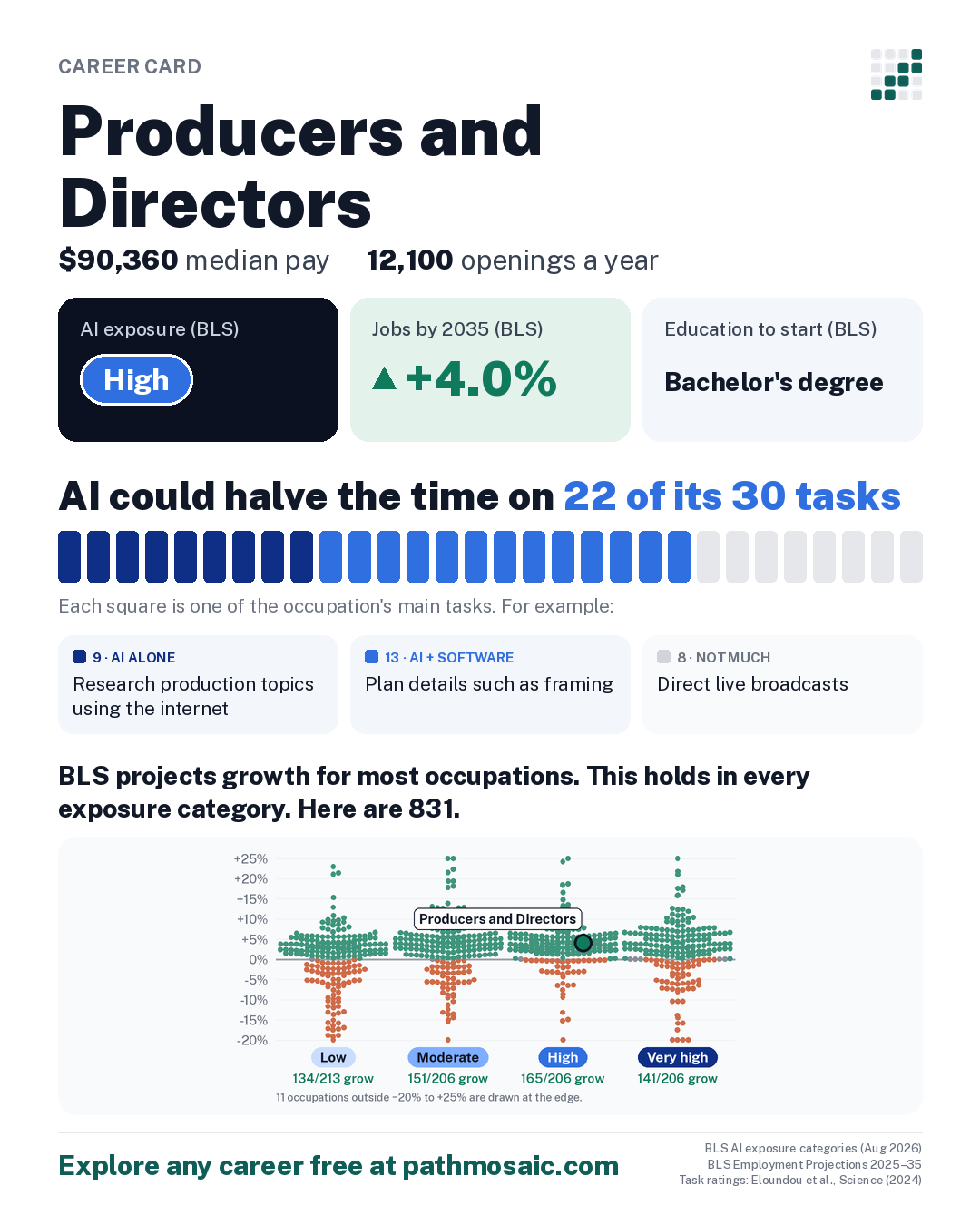
What the data says: AI could halve the time on 22 of its 30 tasks, yet jobs are projected to grow 4.0% by 2035. How to think about this →
About this projection
BLS builds AI into its projections where the research supports it: “BLS generally applies adjustments based on this research conservatively, where there is convincing evidence for a change.”
It also notes a limit: “BLS projection methods are not designed to capture extremely rapid technological change.”
On its AI exposure groups, BLS says exposure “does not imply job loss.”
BLS figures cover the broader occupation “Producers and directors”, which includes this one and others.
Recent conditions
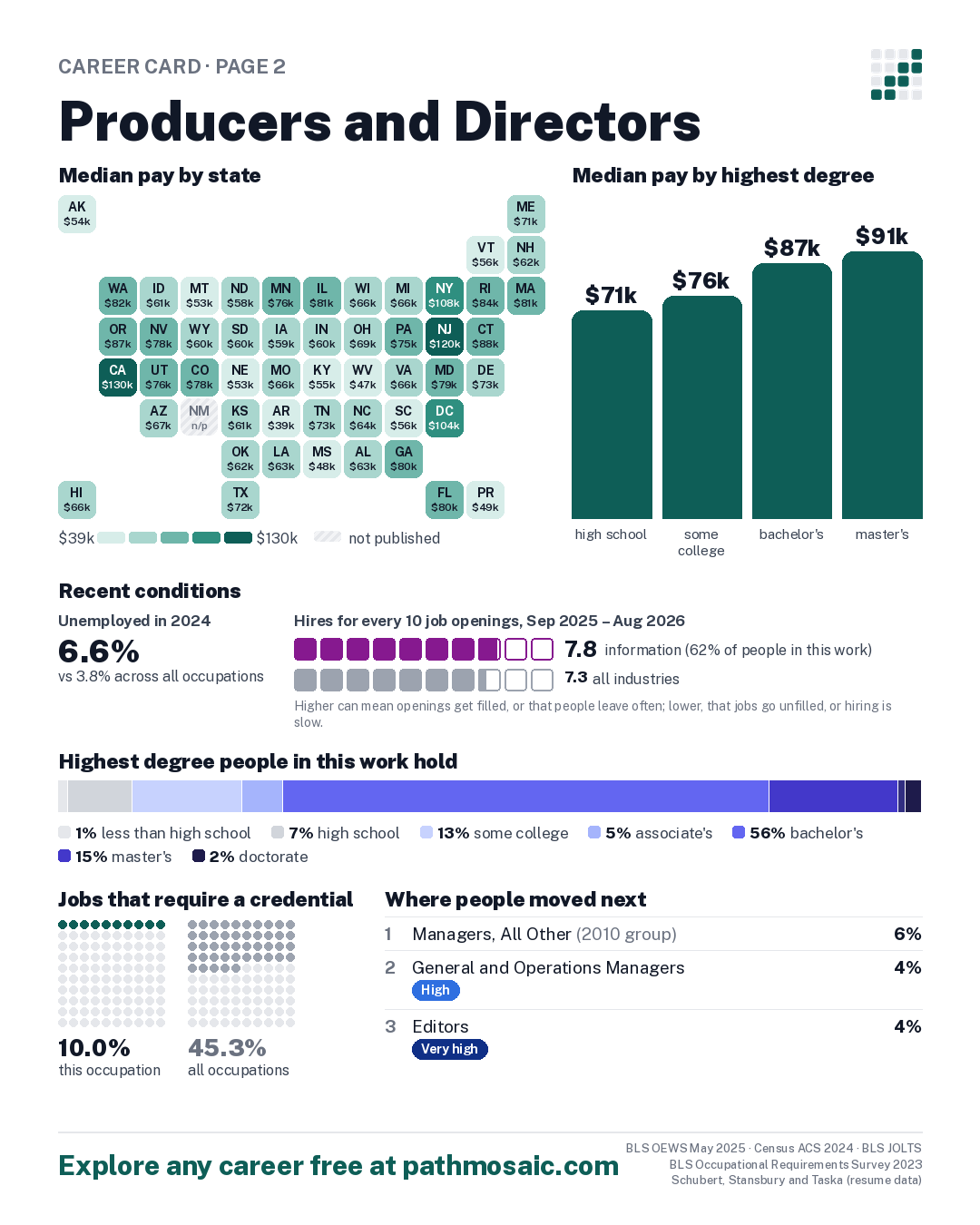
- In 2024, 6.6% of people in this work were unemployed, against 3.8% across all occupations Census ACS 2024
- From Sep 2025 to Aug 2026, 7.8 hires for every 10 job openings in information, which employs about 62% of people in this work, against 7.3 across all industries BLS JOLTS
One box per opening, filled for each hire; hires beyond the openings are added in a lighter shade. Higher can mean openings get filled, or that people leave often; lower, that jobs go unfilled, or hiring is slow.7.8 this industry7.3 all industries
Median pay by state BLS OEWS May 2025, state estimates
Tap a state for its figures.
Median pay in every state
| State | Median | Middle half earn | Jobs |
|---|---|---|---|
| Alabama | $63,340 | $45,780 to $81,000 | 1,040 |
| Alaska | $54,060 | $45,030 to $70,310 | 160 |
| Arizona | $67,320 | $49,640 to $105,330 | 1,720 |
| Arkansas | $38,820 | $27,000 to $54,180 | 700 |
| California | $129,790 | $83,110 to $172,410 | 34,110 |
| Colorado | $78,060 | $58,500 to $99,310 | 1,960 |
| Connecticut | $88,260 | $63,030 to $138,850 | 2,200 |
| Delaware | $72,650 | $59,640 to $158,510 | 150 |
| District of Columbia | $104,270 | $82,580 to $133,180 | 2,640 |
| Florida | $79,920 | $62,360 to $109,670 | 7,160 |
| Georgia | $79,950 | $64,540 to $125,780 | 5,010 |
| Hawaii | $66,190 | $49,620 to $82,750 | 510 |
| Idaho | $61,150 | $47,520 to $77,580 | 380 |
| Illinois | $81,080 | $58,790 to $106,320 | 3,170 |
| Indiana | $59,870 | $41,890 to $80,490 | 1,480 |
| Iowa | $58,550 | $42,980 to $75,650 | 720 |
| Kansas | $60,600 | $40,210 to $78,740 | 420 |
| Kentucky | $54,550 | $45,680 to $74,830 | 950 |
| Louisiana | $62,920 | $45,750 to $108,800 | 880 |
| Maine | $71,320 | $48,970 to $126,820 | 400 |
| Maryland | $79,350 | $58,580 to $111,990 | 1,610 |
| Massachusetts | $80,970 | $60,220 to $105,940 | 3,440 |
| Michigan | $65,720 | $49,900 to $94,590 | 2,310 |
| Minnesota | $76,360 | $53,510 to $100,300 | 1,390 |
| Mississippi | $48,100 | $41,370 to $63,090 | 390 |
| Missouri | $66,460 | $48,710 to $103,440 | 1,630 |
| Montana | $52,580 | $40,070 to $76,990 | 390 |
| Nebraska | $52,580 | $44,280 to $76,690 | 470 |
| Nevada | $78,480 | $54,630 to $119,620 | 1,630 |
| New Hampshire | $61,560 | $45,560 to $80,810 | 300 |
| New Jersey | $119,840 | $78,120 to $161,550 | 2,970 |
| New Mexico | not published | not published | 520 |
| New York | $107,550 | $79,700 to $169,260 | 27,990 |
| North Carolina | $63,700 | $40,230 to $88,430 | 3,500 |
| North Dakota | $57,870 | $42,910 to $75,600 | 170 |
| Ohio | $69,350 | $52,590 to $93,090 | 1,610 |
| Oklahoma | $61,600 | $45,590 to $89,010 | 770 |
| Oregon | $87,460 | $60,260 to $123,320 | 1,640 |
| Pennsylvania | $75,460 | $55,040 to $100,290 | 4,200 |
| Puerto Rico | $48,820 | $35,830 to $70,630 | 260 |
| Rhode Island | $84,250 | $58,050 to $98,910 | 560 |
| South Carolina | $56,030 | $45,540 to $84,990 | 1,190 |
| South Dakota | $60,260 | $47,320 to $72,610 | 170 |
| Tennessee | $73,020 | $49,650 to $99,220 | 2,920 |
| Texas | $71,710 | $49,020 to $99,100 | 6,610 |
| Utah | $76,350 | $50,000 to $118,520 | 1,670 |
| Vermont | $55,660 | $47,030 to $82,460 | 290 |
| Virginia | $65,900 | $47,550 to $93,180 | 2,820 |
| Washington | $81,550 | $62,760 to $128,030 | 2,270 |
| West Virginia | $46,660 | $39,650 to $75,520 | 230 |
| Wisconsin | $66,390 | $49,080 to $92,420 | 1,600 |
| Wyoming | $60,420 | $42,230 to $73,930 | 130 |
Nationally: $90,360. Shades run from the lowest state median to the highest; a territory below that range takes the lightest. How to read this
How AI touches the work
What AI could speed up, task by task, and where people already use it.
AI could halve the time on 22 of its 30 tasks
| AI rating | Its main tasks | Share of Claude conversations May 2026 |
|---|---|---|
| AI + software | Plan details such as framing, composition, camera movement, sound, and actor movement for each shot or scene. | under 0.01% |
| AI alone | Research production topics using the internet, video archives, and other informational sources. | under 0.01% |
| AI alone | Study and research scripts to determine how they should be directed. | Not published |
| Not much | Direct live broadcasts, films and recordings, or non-broadcast programming for public entertainment or education. | Not published |
| AI + software | Review film, recordings, or rehearsals to ensure conformance to production and broadcast standards. | Not published |
| AI + software | Establish pace of programs and sequences of scenes according to time requirements and cast and set accessibility. | under 0.01% |
See all 30 tasks
| AI + software | Confer with technical directors, managers, crew members, and writers to discuss details of production, such as photography, script, music, sets, and costumes. | Not published |
| AI + software | Conduct meetings with staff to discuss production progress and to ensure production objectives are attained. | Not published |
| Not much | Identify and approve equipment and elements required for productions, such as scenery, lights, props, costumes, choreography, and music. | Not published |
| AI + software | Consult with writers, producers, or actors about script changes or "workshop" scripts, through rehearsal with writers and actors to create final drafts. | Not published |
| Not much | Communicate to actors the approach, characterization, and movement needed for each scene in such a way that rehearsals and takes are minimized. | Not published |
| AI alone | Compile scripts, program notes, and other material related to productions. | under 0.01% |
| Not much | Supervise and coordinate the work of camera, lighting, design, and sound crew members. | Not published |
| AI + software | Resolve personnel problems that arise during the production process by acting as liaisons between dissenting parties when necessary. | Not published |
| Not much | Perform management activities, such as budgeting, scheduling, planning, and marketing. | Not published |
| Not much | Coordinate the activities of writers, directors, managers, and other personnel throughout the production process. | Not published |
| AI alone | Write and edit news stories from information collected by reporters and other sources. | under 0.01% |
| AI alone | Compose and edit scripts or provide screenwriters with story outlines from which scripts can be written. | 0.06% |
| AI + software | Obtain rights to scripts or to such items as existing video footage. | Not published |
| AI + software | Cut and edit film or tape to integrate component parts into desired sequences. | under 0.01% |
| AI + software | Perform administrative duties, such as preparing operational reports, distributing rehearsal call sheets and script copies, and arranging for rehearsal quarters. | Not published |
| AI + software | Negotiate with parties, including independent producers and the distributors and broadcasters who will be handling completed productions. | Not published |
| AI + software | Choose settings and locations for films and determine how scenes will be shot in these settings. | 0.04% |
| AI alone | Develop marketing plans for finished products, collaborating with sales associates to supervise product distribution. | Not published |
| AI alone | Write and submit proposals to bid on contracts for projects. | under 0.01% |
| AI + software | Review film daily to check on work in progress and to plan for future filming. | Not published |
| AI alone | Arrange financing for productions. | Not published |
| Not much | Hire principal cast members and crew members, such as art directors, cinematographers, and costume designers. | Not published |
| Not much | Hold auditions for parts or negotiate contracts with actors determined suitable for specific roles. | Not published |
| AI alone | Select plays, scripts, books, news content, or ideas to be produced. | Not published |
Ordered by how important O*NET's respondents rate each task (1 to 5) times the share who say it is part of their job. The ordering is ours. O*NET hasn't rated 3 of the tasks, so they come last, in O*NET's own order. 9 of the 30 have a published share of Claude conversations; “not published” means too few conversations for Anthropic to publish a figure.
Where people already use AI
The tasks above say what AI could speed up. This shows what people are using it for. Its 30 tasks fall under 20 work activities that many occupations share, and Microsoft counted how often each one came up in 200,000 conversations with its Copilot assistant in 2024.
- #4 Maintain current knowledge in area of expertise
- #6 Develop news, entertainment, or artistic content
- #9 Edit written materials or documents
- and 7 more, in the table below
| Work activity | This occupation's tasks under it | People asked AI for help in 10,000 conversations |
AI did it for them in 10,000 conversations |
|---|---|---|---|
| Direct organizational operations, activities, or procedures | |||
| Coordinate artistic or entertainment activities | |||
| Determine operational methods or procedures | |||
| Develop news, entertainment, or artistic content | |||
| Edit written materials or documents | |||
| Communicate with others about specifications or project details | |||
| Negotiate contracts or agreements | |||
| Perform recruiting or hiring activities |
Show all 20 activities
| Maintain current knowledge in area of expertise | |||
| Write material for artistic or commercial purposes | |||
| Prepare informational or instructional materials | |||
| Compile records, documentation, or other data | |||
| Select materials or equipment for operations or projects | |||
| Study details of artistic productions | |||
| Obtain formal documentation or authorization | |||
| Manage budgets or finances | |||
| Present arts or entertainment performances | |||
| Develop business or marketing plans | |||
| Alter audio or video recordings | |||
| Prepare proposals or grant applications |
How people in this work use Claude
What people in this work made with Claude % of conversations
- Creative writing20%
- A video or animation19%
- A document or report19%
- Marketing or social media content13%
- A machine-learning or AI system6%
How they worked with Claude
64% of these conversations were about work. Anthropic Economic Index, May 2026.
How to read this
Work activities come from O*NET, which links every task to the broader activities it involves. Microsoft's figures are for the activity across everyone who used Copilot, not for producers and directors specifically. Copilot is a general chat assistant; dedicated coding tools are not included, so programming help is under-counted here. Activities are listed by how many of this occupation's tasks fall under them.
The task ratings say whether AI could halve the time a task takes: on its own (“AI alone”), or with software built on it (“AI + software”). They were made by people in 2023 (Eloundou et al.). Claude's share is the task's share of all Claude.ai conversations in May 2026; Anthropic doesn't publish a task with too few conversations. None of these add up to the BLS exposure group, which combines five research measures.
More in the Guide: task ratings · task order · work activities · Copilot figures · Claude
High exposure doesn't mean fewer jobs
BLS projects most occupations in its two most exposed groups to grow: 141 of 206 rated Very high and 165 of 206 rated High. Each dot is one of the 831 occupations BLS rates.
Career moves into and out of this occupation
From moves between occupations found in online resumes, 2002–2016. Career changes only: a first job after school isn't a move.
Where people moved next
of 125,795 moves out
- 1 Managers, All Other (2010 group) an older group BLS has since split; no exposure group today 6%
- 2 General and Operations Managers High +5.0% 4%
- 3 Editors Very high -1.1% 4%
- 4 Management Analysts Very high +10.1% 3%
- 5 Chief Executives Very high +3.2% 3%
Where people moved in from
of 121,391 moves in
- 1 Managers, All Other (2010 group) an older group BLS has since split; no exposure group today 5%
- 2 Editors Very high -1.1% 4%
- 3 General and Operations Managers High +5.0% 3%
- 4 News Analysts, Reporters, and Journalists Very high -5.9% 3%
- 5 Writers and Authors Very high -0.3% 3%
Resumes over-represent younger, white-collar job-seekers and moves into management. Schubert, Stansbury and Taska (resume data).
Education and training for the occupation
O*NET survey of workers in this occupation
- 15% high school
- 11% postsecondary certificate
- 5% some college
- 13% associate's
- 57% bachelor's
O*NET 31.0 survey of workers in this occupation · 36 people answered.
Census survey (American Community Survey)
- 1% less than high school
- 7% high school
- 13% some college
- 5% associate's
- 56% bachelor's
- 15% master's
- 1% professional degree
- 2% doctorate
Census ACS 2024, all workers in this occupation · 2,388 people surveyed.
Why the two can differ
O*NET asks about 20 people in each occupation, which makes its shares uncertain, but it reports the exact occupation and counts certificates. The Census survey reaches thousands, but it groups some occupations together and counts degrees only. More in the Guide
Median pay by highest degree full-time, year-round · Census ACS 2024, all workers in this occupation
10 programs, such as Radio and Television, Drama and Dramatics/Theatre Arts, General and Directing and Theatrical Production.
See all
- Radio and Television
- Drama and Dramatics/Theatre Arts, General
- Directing and Theatrical Production
- Musical Theatre
- Theatre and Dance
- Dramatic/Theatre Arts and Stagecraft, Other
- Film/Cinema/Media Studies
- Cinematography and Film/Video Production
- Documentary Production
- Theatre/Theatre Arts Management
Jobs that require a credential BLS Occupational Requirements Survey 2023
10.0% this occupation
45.3% all occupations
| By kind | This occupation | All occupations |
|---|---|---|
| a license | <0.5% | 19.1% |
| a certification | <0.5% | 5.8% |
| an educational certificate | not published |
Share of jobs whose employer requires it. BLS doesn't say which credential. How to read this
Look up certifications, training and licenses U.S. Department of Labor
- Certification Finder ↗ certifications CareerOneStop lists for this occupation
- Training Finder ↗ schools and programs, nationwide; narrow the place there
- License Finder ↗ licenses by state
- Apprenticeship Finder ↗ DOL lists 3 registered apprenticeships in this occupation (DIRECTOR, TELEVISION; Multimedia Producer; PROGRAM ASSISTANT). Apprenticeship.gov can't be linked to one occupation, so search for “Producers and Directors” there.
These open in a new tab and send only the occupation's public code. More in the Guide
BLS AI exposure categories (Aug 2026) · BLS Employment Projections 2025–35 · O*NET 31.0 · Task ratings: Eloundou et al., Science (2024) · Microsoft "Working with AI" v1.1 · Anthropic Economic Index (2026-06-26) · Schubert, Stansbury and Taska · NCES CIP–SOC · Census ACS 2024 · BLS JOLTS
See it online, and explore any career: https://www.pathmosaic.com/card/27-2012.00