Stationary Engineers and Boiler Operators
Also called: Boiler Operator, Operating Engineer, Stationary Engineer, Utilities OperatorOperate or maintain stationary engines, boilers, or other mechanical equipment to provide utilities for buildings or industrial processes. Operate equipment such as steam engines, generators, motors, turbines, and steam boilers.
On a phone, press and hold a picture to save it to Photos.
opens your phone's share sheet, where you can save both to Photos
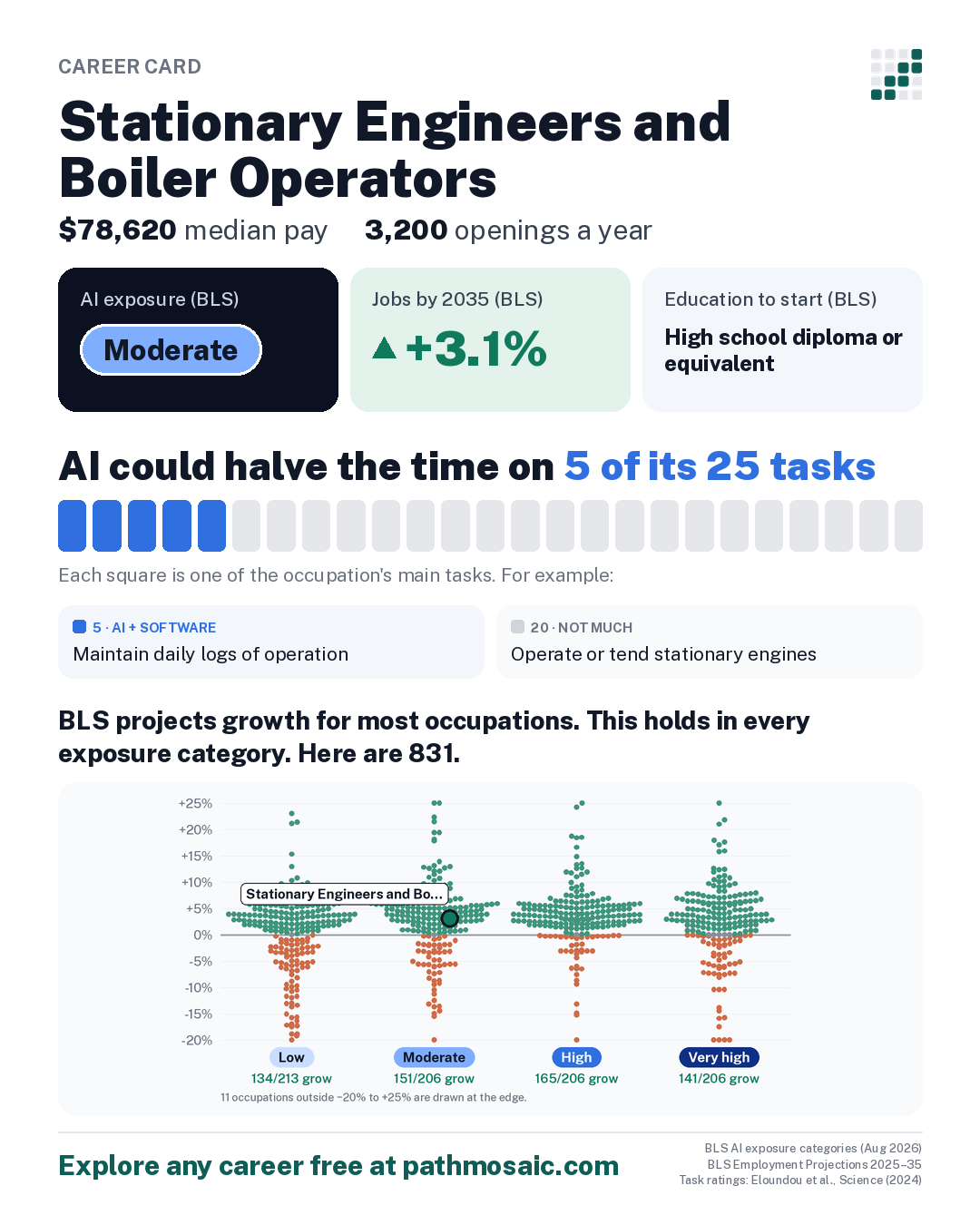
What the data says: AI could halve the time on 5 of its 25 tasks, and jobs are projected to grow 3.1% by 2035. How to think about this →
About this projection
BLS builds AI into its projections where the research supports it: “BLS generally applies adjustments based on this research conservatively, where there is convincing evidence for a change.”
It also notes a limit: “BLS projection methods are not designed to capture extremely rapid technological change.”
On its AI exposure groups, BLS says exposure “does not imply job loss.”
Recent conditions
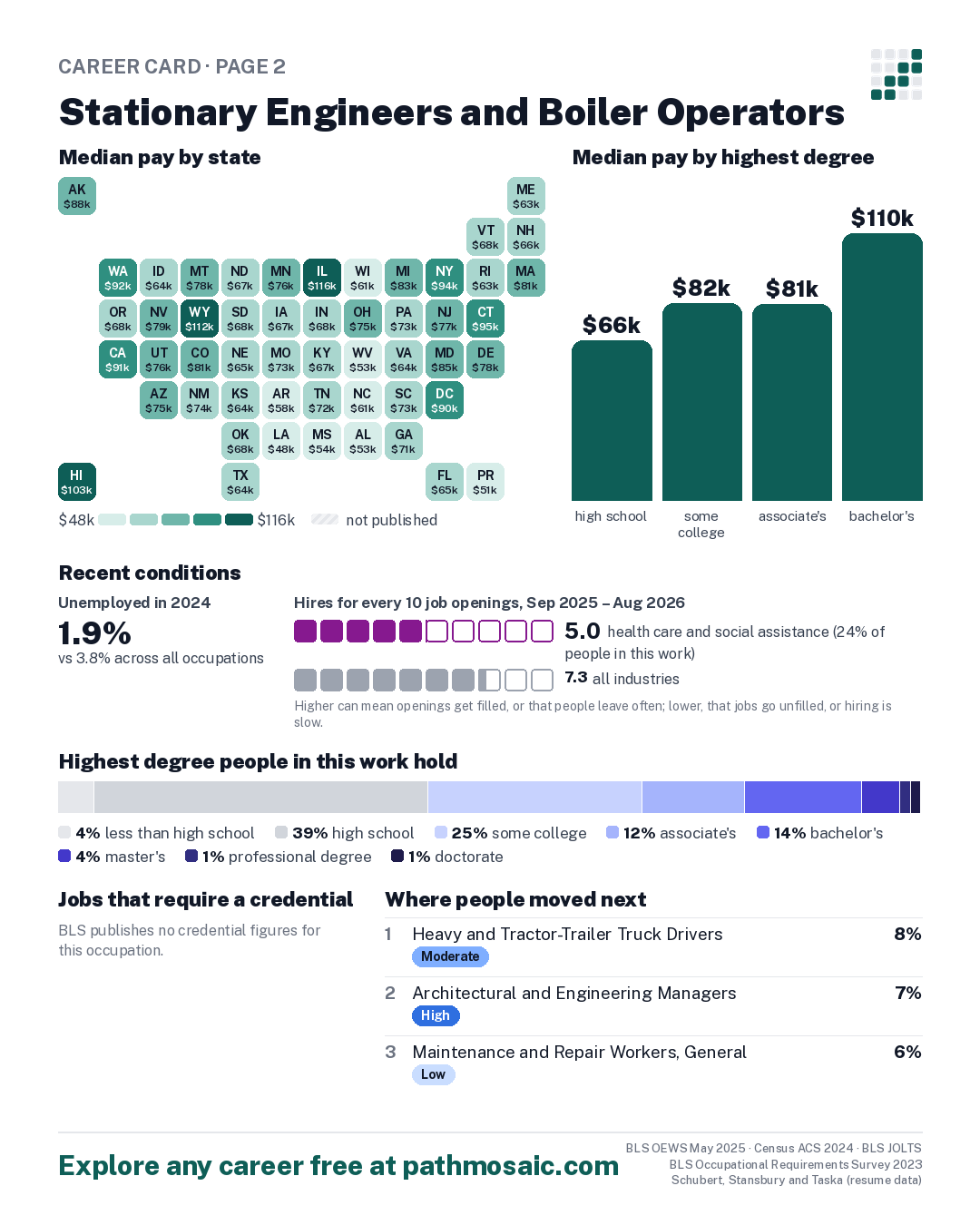
- In 2024, 1.9% of people in this work were unemployed, against 3.8% across all occupations Census ACS 2024
- From Sep 2025 to Aug 2026, 5.0 hires for every 10 job openings in health care and social assistance, which employs about 24% of people in this work, against 7.3 across all industries BLS JOLTS
One box per opening, filled for each hire; hires beyond the openings are added in a lighter shade. Higher can mean openings get filled, or that people leave often; lower, that jobs go unfilled, or hiring is slow.5.0 this industry7.3 all industries
Median pay by state BLS OEWS May 2025, state estimates
Tap a state for its figures.
Median pay in every state
| State | Median | Middle half earn | Jobs |
|---|---|---|---|
| Alabama | $53,470 | $47,360 to $67,720 | 220 |
| Alaska | $88,330 | $79,320 to $117,710 | 90 |
| Arizona | $75,410 | $68,640 to $83,550 | 80 |
| Arkansas | $58,000 | $46,790 to $63,640 | 200 |
| California | $90,650 | $61,860 to $120,350 | 5,840 |
| Colorado | $81,310 | $60,500 to $92,420 | 560 |
| Connecticut | $94,870 | $82,250 to $101,580 | 270 |
| Delaware | $77,630 | $74,970 to $83,870 | 40 |
| District of Columbia | $90,470 | $79,430 to $101,520 | 620 |
| Florida | $65,040 | $61,080 to $73,210 | 170 |
| Georgia | $70,640 | $64,060 to $72,830 | 240 |
| Hawaii | $103,400 | $84,140 to $105,570 | 70 |
| Idaho | $64,460 | $62,080 to $68,640 | 120 |
| Illinois | $115,780 | $86,750 to $123,780 | 1,680 |
| Indiana | $67,560 | $52,350 to $86,010 | 290 |
| Iowa | $67,450 | $60,610 to $73,280 | 190 |
| Kansas | $64,490 | $52,500 to $84,200 | 120 |
| Kentucky | $66,770 | $49,340 to $86,310 | 90 |
| Louisiana | $47,750 | $44,500 to $75,090 | 290 |
| Maine | $62,910 | $57,760 to $74,170 | 290 |
| Maryland | $85,240 | $73,930 to $95,230 | 850 |
| Massachusetts | $80,800 | $71,140 to $91,140 | 530 |
| Michigan | $82,800 | $67,010 to $91,500 | 490 |
| Minnesota | $75,850 | $67,310 to $84,640 | 1,440 |
| Mississippi | $53,640 | $50,760 to $65,760 | 200 |
| Missouri | $72,620 | $60,520 to $77,970 | 380 |
| Montana | $77,690 | $56,750 to $108,210 | 110 |
| Nebraska | $64,930 | $58,930 to $76,690 | 290 |
| Nevada | $79,110 | $78,370 to $98,120 | 60 |
| New Hampshire | $66,180 | $64,440 to $75,930 | 60 |
| New Jersey | $76,560 | $63,070 to $87,190 | 1,400 |
| New Mexico | $74,480 | $49,130 to $105,600 | 100 |
| New York | $94,070 | $70,250 to $138,460 | 4,480 |
| North Carolina | $60,860 | $46,200 to $73,840 | 220 |
| North Dakota | $66,760 | $60,740 to $81,140 | 140 |
| Ohio | $75,470 | $65,370 to $81,810 | 760 |
| Oklahoma | $68,450 | $59,560 to $76,880 | 180 |
| Oregon | $67,630 | $57,200 to $85,000 | 330 |
| Pennsylvania | $72,900 | $62,490 to $79,670 | 1,730 |
| Puerto Rico | $51,320 | $38,950 to $59,450 | 70 |
| Rhode Island | $63,330 | $60,510 to $79,920 | 60 |
| South Carolina | $72,650 | $62,860 to $79,080 | 170 |
| South Dakota | $68,090 | $48,030 to $73,420 | 90 |
| Tennessee | $72,470 | $47,500 to $86,110 | 370 |
| Texas | $63,810 | $57,510 to $75,810 | 890 |
| Utah | $76,490 | $65,960 to $77,490 | 110 |
| Vermont | $68,400 | $56,590 to $75,450 | 70 |
| Virginia | $64,150 | $48,340 to $77,410 | 350 |
| Washington | $91,530 | $76,310 to $111,720 | 520 |
| West Virginia | $53,340 | $49,300 to $55,730 | 40 |
| Wisconsin | $61,170 | $56,140 to $65,880 | 270 |
| Wyoming | $111,920 | $111,480 to $113,980 | 100 |
Nationally: $78,620. Shades run from the lowest state median to the highest; a territory below that range takes the lightest. How to read this
How AI touches the work
What AI could speed up, task by task, and where people already use it.
AI could halve the time on 5 of its 25 tasks
| AI rating | Its main tasks | Share of Claude conversations May 2026 |
|---|---|---|
| AI + software | Analyze problems and take appropriate action to ensure continuous and reliable operation of equipment and systems. | 0.45% |
| Not much | Operate or tend stationary engines, boilers, and auxiliary equipment, such as pumps, compressors, or air-conditioning equipment, to supply and maintain steam or heat for buildings, marine vessels, or pneumatic tools. | Not published |
| Not much | Observe and interpret readings on gauges, meters, and charts registering various aspects of boiler operation to ensure that boilers are operating properly. | Not published |
| AI + software | Maintain daily logs of operation, maintenance, and safety activities, including test results, instrument readings, and details of equipment malfunctions and maintenance work. | under 0.01% |
| Not much | Monitor and inspect equipment, computer terminals, switches, valves, gauges, alarms, safety devices, and meters to detect leaks or malfunctions and to ensure that equipment is operating efficiently and safely. | Not published |
| Not much | Monitor boiler water, chemical, and fuel levels, and make adjustments to maintain required levels. | Not published |
See all 25 tasks
| Not much | Perform or arrange for repairs, such as complete overhauls, replacement of defective valves, gaskets, or bearings, or fabrication of new parts. | Not published |
| Not much | Adjust controls and/or valves on equipment to provide power, and to regulate and set operations of system or industrial processes. | Not published |
| Not much | Switch from automatic to manual controls and isolate equipment mechanically and electrically to allow for safe inspection and repair work. | Not published |
| Not much | Clean and lubricate boilers and auxiliary equipment and make minor adjustments as needed, using hand tools. | Not published |
| Not much | Activate valves to maintain required amounts of water in boilers, to adjust supplies of combustion air, and to control the flow of fuel into burners. | Not published |
| Not much | Test boiler water quality or arrange for testing and take necessary corrective action, such as adding chemicals to prevent corrosion and harmful deposits. | Not published |
| AI + software | Develop operation, safety, and maintenance procedures or assist in their development. | Not published |
| Not much | Install burners and auxiliary equipment, using hand tools. | Not published |
| Not much | Contact equipment manufacturers or appropriate specialists when necessary to resolve equipment problems. | Not published |
| AI + software | Weigh, measure, and record fuel used. | Not published |
| AI + software | Receive instructions from steam engineers regarding steam plant and air compressor operations. | Not published |
| Not much | Check the air quality of ventilation systems and make adjustments to ensure compliance with mandated safety codes. | Not published |
| Not much | Test electrical systems to determine voltages, using voltage meters. | Not published |
| Not much | Supervise the work of assistant stationary engineers, turbine operators, boiler tenders, or air conditioning and refrigeration operators and mechanics. | Not published |
| Not much | Provide assistance to plumbers in repairing or replacing water, sewer, or waste lines, and in daily maintenance activities. | Not published |
| Not much | Investigate and report on accidents. | Not published |
| Not much | Fire coal furnaces by hand or with stokers and gas- or oil-fed boilers, using automatic gas feeds or oil pumps. | Not published |
| Not much | Ignite fuel in burners, using torches or flames. | Not published |
| Not much | Operate mechanical hoppers and provide assistance in their adjustment and repair. | Not published |
Ordered by how important O*NET's respondents rate each task (1 to 5) times the share who say it is part of their job. The ordering is ours. 2 of the 25 have a published share of Claude conversations; “not published” means too few conversations for Anthropic to publish a figure.
Where people already use AI
The tasks above say what AI could speed up. This shows what people are using it for. Its 25 tasks fall under 22 work activities that many occupations share, and Microsoft counted how often each one came up in 200,000 conversations with its Copilot assistant in 2024.
- #42 Diagnose system or equipment problems
| Work activity | This occupation's tasks under it | People asked AI for help in 10,000 conversations |
AI did it for them in 10,000 conversations |
|---|---|---|---|
| Monitor equipment operation | |||
| Adjust equipment to ensure adequate performance | |||
| Operate energy production or distribution equipment | |||
| Maintain tools or equipment | |||
| Maintain operational records | |||
| Repair tools or equipment | |||
| Prepare industrial materials for processing or use | |||
| Diagnose system or equipment problems |
Show all 22 activities
| Plan work activities | |||
| Coordinate with others to resolve problems | |||
| Communicate with others about operational plans or activities | |||
| Test performance of equipment or systems | |||
| Investigate incidents or accidents | |||
| Measure physical characteristics of materials, products, or equipment | |||
| Test characteristics of materials or products | |||
| Clean tools, equipment, facilities, or work areas | |||
| Notify others of emergencies or problems | |||
| Assemble equipment or components | |||
| Direct organizational operations, activities, or procedures | |||
| Inspect commercial, industrial, or production systems or equipment | |||
| Operate pumping systems or equipment | |||
| Operate industrial processing or production equipment |
How people in this work use Claude
What people in this work made with Claude % of conversations
- Code fixes or debugging29%
- Configuration or infrastructure14%
- An explanation or answer13%
- An app or website11%
- A script or snippet9%
How they worked with Claude
62% of these conversations were about work. Anthropic Economic Index, May 2026.
How to read this
Work activities come from O*NET, which links every task to the broader activities it involves. Microsoft's figures are for the activity across everyone who used Copilot, not for stationary engineers and boiler operators specifically. Copilot is a general chat assistant; dedicated coding tools are not included, so programming help is under-counted here. Activities are listed by how many of this occupation's tasks fall under them.
The task ratings say whether AI could halve the time a task takes: on its own (“AI alone”), or with software built on it (“AI + software”). They were made by people in 2023 (Eloundou et al.). Claude's share is the task's share of all Claude.ai conversations in May 2026; Anthropic doesn't publish a task with too few conversations. None of these add up to the BLS exposure group, which combines five research measures.
More in the Guide: task ratings · task order · work activities · Copilot figures · Claude
High exposure doesn't mean fewer jobs
BLS projects most occupations in its two most exposed groups to grow: 141 of 206 rated Very high and 165 of 206 rated High. Each dot is one of the 831 occupations BLS rates.
Career moves into and out of this occupation
From moves between occupations found in online resumes, 2002–2016. Career changes only: a first job after school isn't a move.
Where people moved next
of 2,869 moves out
- 1 Heavy and Tractor-Trailer Truck Drivers Moderate +3.8% 8%
- 2 Architectural and Engineering Managers High +5.5% 7%
- 3 Maintenance and Repair Workers, General Low +4.2% 6%
- 4 Managers, All Other (2010 group) an older group BLS has since split; no exposure group today 4%
- 5 Training and Development Specialists Very high +10.8% 3%
Where people moved in from
of 3,891 moves in
- 1 Heavy and Tractor-Trailer Truck Drivers Moderate +3.8% 7%
- 2 Maintenance and Repair Workers, General Low +4.2% 5%
- 3 Architectural and Engineering Managers High +5.5% 5%
- 4 First-Line Supervisors of Mechanics, Installers, and Repairers High +4.1% 4%
- 5 Industrial Truck and Tractor Operators Low +1.5% 4%
Resumes over-represent younger, white-collar job-seekers and moves into management. Schubert, Stansbury and Taska (resume data).
Education and training for the occupation
O*NET survey of workers in this occupation
- 38% high school
- 47% postsecondary certificate
- 5% some college
- 11% associate's
O*NET 31.0 survey of workers in this occupation · 20 people answered.
Census survey (American Community Survey)
- 4% less than high school
- 39% high school
- 25% some college
- 12% associate's
- 14% bachelor's
- 4% master's
- 1% professional degree
- 1% doctorate
Census ACS 2024, all workers in this occupation · 962 people surveyed.
Why the two can differ
O*NET asks about 20 people in each occupation, which makes its shares uncertain, but it reports the exact occupation and counts certificates. The Census survey reaches thousands, but it groups some occupations together and counts degrees only. More in the Guide
Median pay by highest degree full-time, year-round · Census ACS 2024, all workers in this occupation
Jobs that require a credential BLS Occupational Requirements Survey 2023
BLS publishes no credential figures for this occupation.
Look up certifications, training and licenses U.S. Department of Labor
- Certification Finder ↗ certifications CareerOneStop lists for this occupation
- Training Finder ↗ schools and programs, nationwide; narrow the place there
- License Finder ↗ licenses by state
- Apprenticeship Finder ↗ DOL lists 5 registered apprenticeships in this occupation. Apprenticeship.gov can't be linked to one occupation, so search for “Stationary Engineers and Boiler Operators” there.
These open in a new tab and send only the occupation's public code. More in the Guide
BLS AI exposure categories (Aug 2026) · BLS Employment Projections 2025–35 · O*NET 31.0 · Task ratings: Eloundou et al., Science (2024) · Microsoft "Working with AI" v1.1 · Anthropic Economic Index (2026-06-26) · Schubert, Stansbury and Taska · NCES CIP–SOC · Census ACS 2024 · BLS JOLTS
See it online, and explore any career: https://www.pathmosaic.com/card/51-8021.00