Astronomers
Also called: Astronomer, Astronomy Outreach Coordinator, Astrophysicist, Research AstrophysicistObserve, research, and interpret astronomical phenomena to increase basic knowledge or apply such information to practical problems.
On a phone, press and hold a picture to save it to Photos.
opens your phone's share sheet, where you can save both to Photos
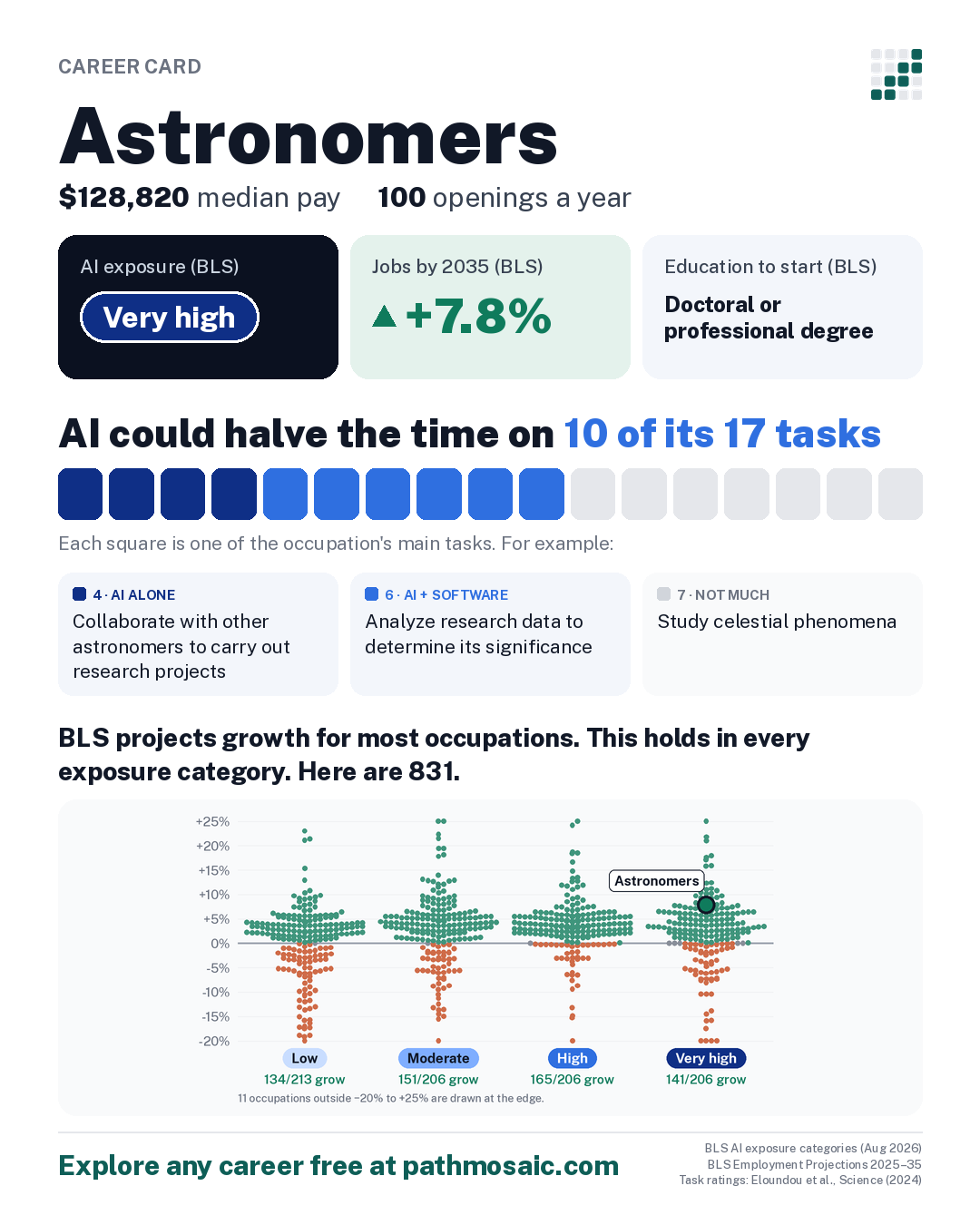
What the data says: AI could halve the time on 10 of its 17 tasks, yet jobs are projected to grow 7.8% by 2035. In the most exposed occupations, the squeeze shows up first among early-career workers. How to think about this →
About this projection
BLS builds AI into its projections where the research supports it: “BLS generally applies adjustments based on this research conservatively, where there is convincing evidence for a change.”
It also notes a limit: “BLS projection methods are not designed to capture extremely rapid technological change.”
On its AI exposure groups, BLS says exposure “does not imply job loss.”
Recent conditions
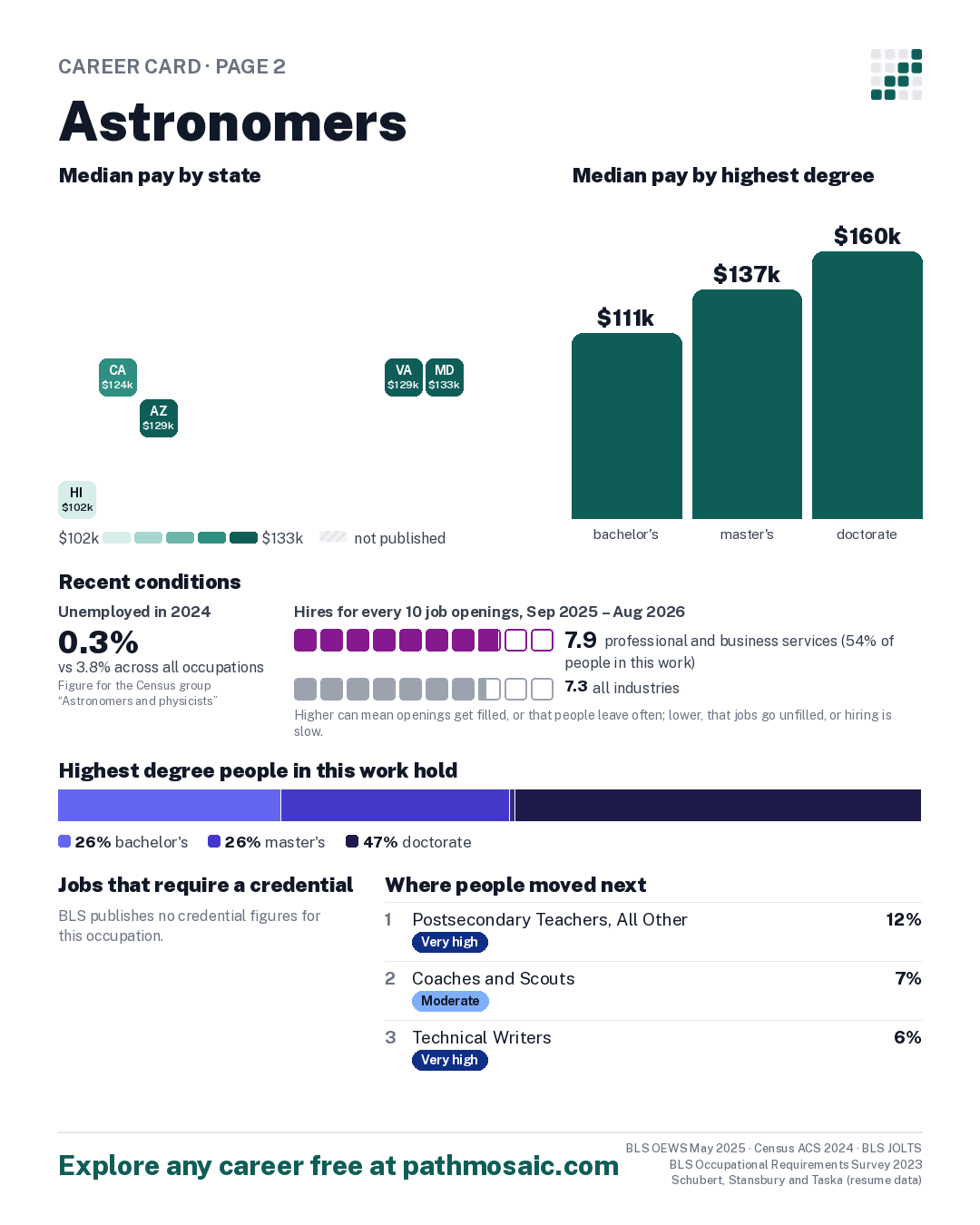
- In 2024, 0.3% of people in this work were unemployed, against 3.8% across all occupations Census ACS 2024, all workers in the Census group “Astronomers and physicists”
- From Sep 2025 to Aug 2026, 7.9 hires for every 10 job openings in professional and business services, which employs about 54% of people in this work, against 7.3 across all industries BLS JOLTS
One box per opening, filled for each hire; hires beyond the openings are added in a lighter shade. Higher can mean openings get filled, or that people leave often; lower, that jobs go unfilled, or hiring is slow.7.9 this industry7.3 all industries
Median pay by state BLS OEWS May 2025, state estimates
Tap a state for its figures.
Median pay in every state
| State | Median | Middle half earn | Jobs |
|---|---|---|---|
| Arizona | $129,020 | $98,430 to $163,020 | 100 |
| California | $123,540 | $76,020 to $182,780 | 110 |
| Hawaii | $102,000 | $78,090 to $122,490 | 100 |
| Maryland | $132,620 | $102,910 to $175,720 | 980 |
| Virginia | $128,930 | $110,170 to $150,160 | not published |
Nationally: $128,820. Shades run from the lowest state median to the highest; a territory below that range takes the lightest. How to read this
How AI touches the work
What AI could speed up, task by task, and where people already use it.
AI could halve the time on 10 of its 17 tasks
| AI rating | Its main tasks | Share of Claude conversations May 2026 |
|---|---|---|
| AI + software | Analyze research data to determine its significance, using computers. | 0.08% |
| AI alone | Present research findings at scientific conferences and in papers written for scientific journals. | Not published |
| Not much | Study celestial phenomena, using a variety of ground-based and space-borne telescopes and scientific instruments. | Not published |
| AI alone | Collaborate with other astronomers to carry out research projects. | Not published |
| AI alone | Develop theories based on personal observations or on observations and theories of other astronomers. | Not published |
| Not much | Mentor graduate students and junior colleagues. | 0.01% |
See all 17 tasks
| Not much | Supervise students' research on celestial and astronomical phenomena. | Not published |
| AI + software | Review scientific proposals and research papers. | Not published |
| Not much | Teach astronomy or astrophysics. | Not published |
| Not much | Measure radio, infrared, gamma, and x-ray emissions from extraterrestrial sources. | Not published |
| AI + software | Develop instrumentation and software for astronomical observation and analysis. | Not published |
| AI alone | Raise funds for scientific research. | Not published |
| AI + software | Develop and modify astronomy-related programs for public presentation. | Not published |
| Not much | Serve on professional panels and committees. | Not published |
| AI + software | Conduct question-and-answer presentations on astronomy topics with public audiences. | Not published |
| AI + software | Calculate orbits and determine sizes, shapes, brightness, and motions of different celestial bodies. | Not published |
| Not much | Direct the operations of a planetarium. | Not published |
Ordered by how important O*NET's respondents rate each task (1 to 5) times the share who say it is part of their job. The ordering is ours. 2 of the 17 have a published share of Claude conversations; “not published” means too few conversations for Anthropic to publish a figure.
Where people already use AI
The tasks above say what AI could speed up. This shows what people are using it for. Its 17 tasks fall under 17 work activities that many occupations share, and Microsoft counted how often each one came up in 200,000 conversations with its Copilot assistant in 2024.
- #4 Maintain current knowledge in area of expertise
- #5 Provide information or assistance to the public
- #20 Present research or technical information
- and 2 more, in the table below
| Work activity | This occupation's tasks under it | People asked AI for help in 10,000 conversations |
AI did it for them in 10,000 conversations |
|---|---|---|---|
| Provide information or assistance to the public | |||
| Monitor environmental conditions | |||
| Direct scientific or technical activities | |||
| Maintain current knowledge in area of expertise | |||
| Present research or technical information | |||
| Analyze scientific or applied data using mathematical principles | |||
| Provide support or encouragement to others | |||
| Teach academic or vocational subjects |
Show all 17 activities
| Assist scientists, scholars, or technical specialists with projects or research | |||
| Advise others on educational or vocational matters | |||
| Design computer or information systems or applications | |||
| Measure physical characteristics of materials, products, or equipment | |||
| Develop scientific or mathematical theories or models | |||
| Analyze data to improve operations | |||
| Prepare proposals or grant applications | |||
| Supervise personnel activities | |||
| Serve on organizational committees |
How people in this work use Claude
What people in this work made with Claude % of conversations
- A document or report22%
- A script or snippet19%
- An analysis or summary14%
- Data or a spreadsheet8%
- An academic paper or thesis8%
How they worked with Claude
49% of these conversations were about work. Anthropic Economic Index, May 2026.
How to read this
Work activities come from O*NET, which links every task to the broader activities it involves. Microsoft's figures are for the activity across everyone who used Copilot, not for astronomers specifically. Copilot is a general chat assistant; dedicated coding tools are not included, so programming help is under-counted here. Activities are listed by how many of this occupation's tasks fall under them.
The task ratings say whether AI could halve the time a task takes: on its own (“AI alone”), or with software built on it (“AI + software”). They were made by people in 2023 (Eloundou et al.). Claude's share is the task's share of all Claude.ai conversations in May 2026; Anthropic doesn't publish a task with too few conversations. None of these add up to the BLS exposure group, which combines five research measures.
More in the Guide: task ratings · task order · work activities · Copilot figures · Claude
High exposure doesn't mean fewer jobs
BLS projects most occupations in its two most exposed groups to grow: 141 of 206 rated Very high and 165 of 206 rated High. Each dot is one of the 831 occupations BLS rates.
Career moves into and out of this occupation
From moves between occupations found in online resumes, 2002–2016. Career changes only: a first job after school isn't a move.
Where people moved next
of 3,076 moves out
- 1 Postsecondary Teachers, All Other Very high +2.0% 12%
- 2 Coaches and Scouts Moderate +6.1% 7%
- 3 Technical Writers Very high +0.8% 6%
- 4 Education Administrators, Postsecondary High +1.8% 6%
- 5 Operations Research Analysts Very high +11.9% 6%
Where people moved in from
of 3,322 moves in
- 1 Operations Research Analysts Very high +11.9% 10%
- 2 Coaches and Scouts Moderate +6.1% 8%
- 3 Postsecondary Teachers, All Other Very high +2.0% 6%
- 4 Education Administrators, Postsecondary High +1.8% 6%
- 5 Administrative Services Managers (2010 group) an older group BLS has since split; no exposure group today 5%
Resumes over-represent younger, white-collar job-seekers and moves into management. Schubert, Stansbury and Taska (resume data).
Education and training for the occupation
O*NET survey of workers in this occupation
- 9% master's
- 65% research doctorate
- 26% post-doctoral training
O*NET 31.0 survey of workers in this occupation · 23 people answered.
Census survey (American Community Survey)
- 26% bachelor's
- 26% master's
- 1% professional degree
- 47% doctorate
Census ACS 2024, all workers in the Census group “Astronomers and physicists” · 230 people surveyed.
Why the two can differ
O*NET asks about 20 people in each occupation, which makes its shares uncertain, but it reports the exact occupation and counts certificates. The Census survey reaches thousands, but it groups some occupations together and counts degrees only. More in the Guide
Median pay by highest degree full-time, year-round · Census ACS 2024, all workers in the Census group “Astronomers and physicists”
5 programs, such as Astronomy, Astrophysics and Planetary Astronomy and Science.
See all
- Astronomy
- Astrophysics
- Planetary Astronomy and Science
- Astronomy and Astrophysics, Other
- Physics and Astronomy
Jobs that require a credential BLS Occupational Requirements Survey 2023
BLS publishes no credential figures for this occupation.
Look up certifications, training and licenses U.S. Department of Labor
- Certification Finder ↗ certifications CareerOneStop lists for this occupation
- Training Finder ↗ schools and programs, nationwide; narrow the place there
- License Finder ↗ licenses by state
- Apprenticeships: DOL's list of apprenticeable occupations doesn't include this one.
These open in a new tab and send only the occupation's public code. More in the Guide
BLS AI exposure categories (Aug 2026) · BLS Employment Projections 2025–35 · O*NET 31.0 · Task ratings: Eloundou et al., Science (2024) · Microsoft "Working with AI" v1.1 · Anthropic Economic Index (2026-06-26) · Schubert, Stansbury and Taska · NCES CIP–SOC · Census ACS 2024 · BLS JOLTS · Brynjolfsson, Chandar and Chen, Stanford (Aug 2026)
See it online, and explore any career: https://www.pathmosaic.com/card/19-2011.00