First-Line Supervisors of Firefighting and Prevention Workers
Also called: Engine Boss, Fire Battalion Chief, Fire Captain, Fire ChiefDirectly supervise and coordinate activities of workers engaged in firefighting and fire prevention and control.
On a phone, press and hold a picture to save it to Photos.
opens your phone's share sheet, where you can save both to Photos
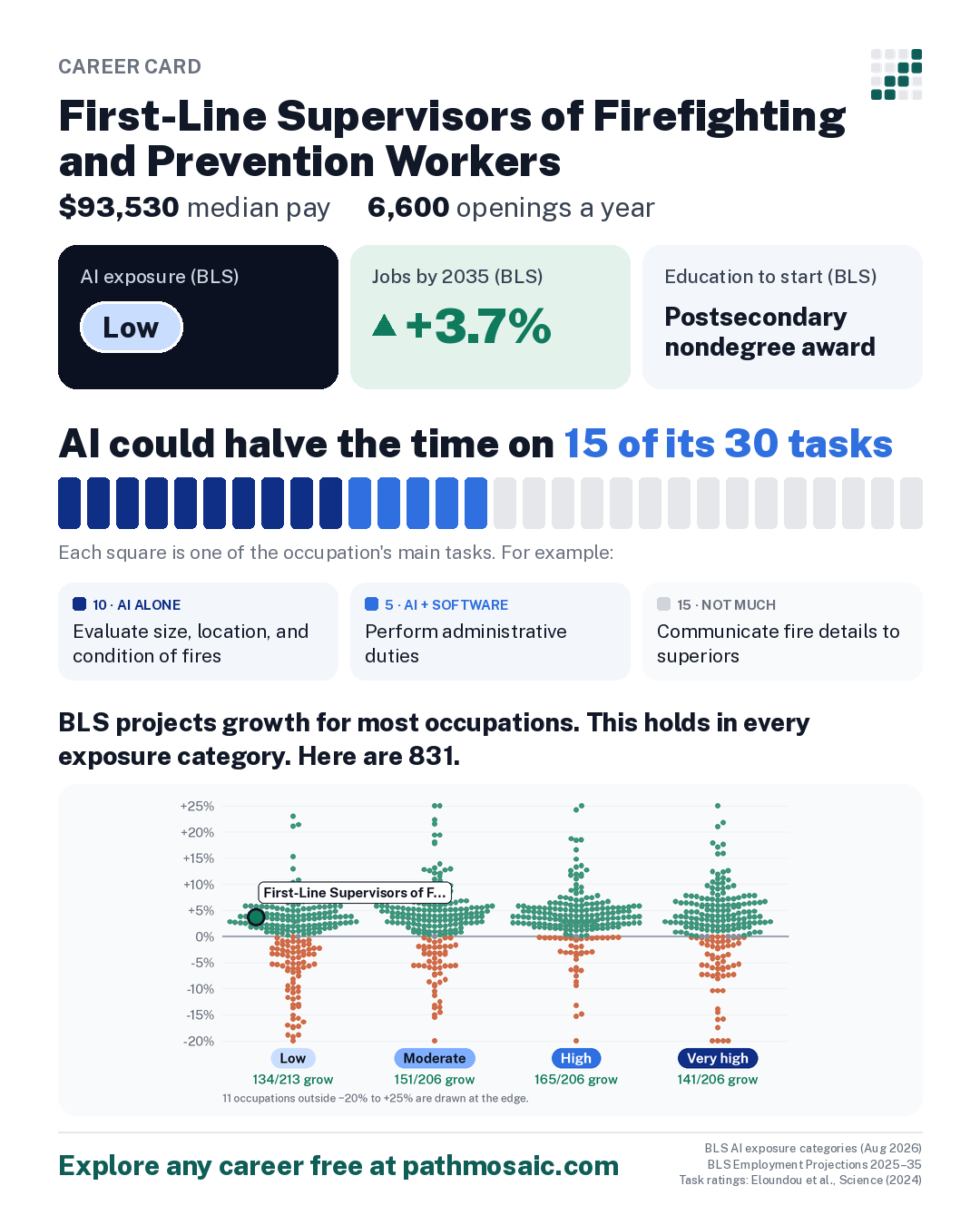
What the data says: AI could halve the time on 15 of its 30 tasks, yet jobs are projected to grow 3.7% by 2035. How to think about this →
About this projection
BLS builds AI into its projections where the research supports it: “BLS generally applies adjustments based on this research conservatively, where there is convincing evidence for a change.”
It also notes a limit: “BLS projection methods are not designed to capture extremely rapid technological change.”
On its AI exposure groups, BLS says exposure “does not imply job loss.”
Recent conditions
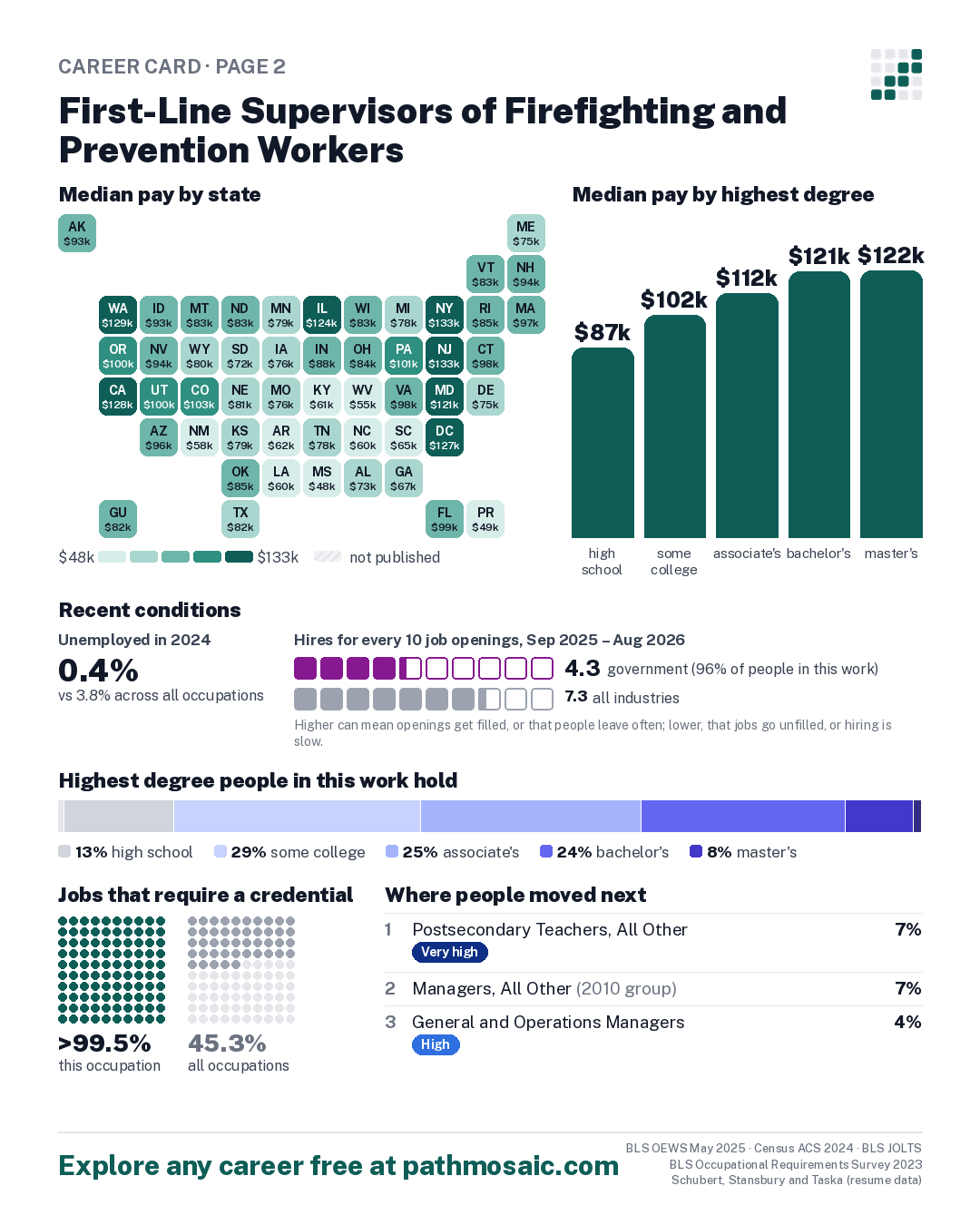
- In 2024, 0.4% of people in this work were unemployed, against 3.8% across all occupations Census ACS 2024
- From Sep 2025 to Aug 2026, 4.3 hires for every 10 job openings in government, which employs about 96% of people in this work, against 7.3 across all industries BLS JOLTS
One box per opening, filled for each hire; hires beyond the openings are added in a lighter shade. Higher can mean openings get filled, or that people leave often; lower, that jobs go unfilled, or hiring is slow.4.3 this industry7.3 all industries
Median pay by state BLS OEWS May 2025, state estimates
Tap a state for its figures.
Median pay in every state
| State | Median | Middle half earn | Jobs |
|---|---|---|---|
| Alabama | $73,320 | $55,500 to $89,230 | 1,440 |
| Alaska | $92,760 | $60,310 to $97,630 | 310 |
| Arizona | $96,470 | $73,320 to $103,400 | 2,670 |
| Arkansas | $61,890 | $49,730 to $79,120 | 920 |
| California | $127,630 | $100,450 to $169,380 | 8,170 |
| Colorado | $102,580 | $84,160 to $125,770 | 1,900 |
| Connecticut | $98,500 | $94,090 to $107,990 | 1,310 |
| Delaware | $74,670 | $63,660 to $100,100 | not published |
| District of Columbia | $126,560 | $114,620 to $133,570 | 380 |
| Florida | $98,560 | $77,120 to $122,090 | 9,540 |
| Georgia | $67,200 | $57,440 to $79,300 | 3,730 |
| Guam | $82,350 | $76,130 to $91,870 | 80 |
| Idaho | $92,630 | $60,690 to $114,430 | 520 |
| Illinois | $123,500 | $95,810 to $131,690 | 3,240 |
| Indiana | $88,310 | $74,270 to $99,750 | 1,290 |
| Iowa | $76,010 | $68,050 to $99,230 | 600 |
| Kansas | $78,880 | $58,250 to $97,520 | 1,450 |
| Kentucky | $60,850 | $46,400 to $78,940 | 1,250 |
| Louisiana | $59,750 | $48,870 to $72,080 | 1,810 |
| Maine | $74,790 | $60,340 to $85,890 | 410 |
| Maryland | $120,530 | $98,670 to $126,110 | 2,380 |
| Massachusetts | $96,600 | $82,470 to $117,830 | 3,370 |
| Michigan | $77,550 | $61,970 to $96,300 | 1,830 |
| Minnesota | $78,800 | $66,820 to $101,780 | 1,120 |
| Mississippi | $48,250 | $36,730 to $61,110 | 1,550 |
| Missouri | $75,970 | $60,120 to $95,760 | 1,950 |
| Montana | $82,820 | $73,610 to $93,640 | 320 |
| Nebraska | $80,810 | $73,540 to $98,630 | 370 |
| Nevada | $93,920 | $78,660 to $128,500 | 1,080 |
| New Hampshire | $93,720 | $77,270 to $101,330 | 450 |
| New Jersey | $133,210 | $128,090 to $160,720 | 2,210 |
| New Mexico | $58,430 | $51,290 to $75,980 | 820 |
| New York | $132,520 | $104,230 to $147,410 | 4,100 |
| North Carolina | $59,560 | $49,490 to $85,480 | 5,050 |
| North Dakota | $82,880 | $64,260 to $103,780 | 130 |
| Ohio | $84,490 | $70,000 to $99,140 | 3,960 |
| Oklahoma | $85,310 | $73,100 to $100,200 | 2,000 |
| Oregon | $100,260 | $86,190 to $119,010 | 1,160 |
| Pennsylvania | $101,050 | $80,370 to $103,900 | 1,340 |
| Puerto Rico | $48,640 | $45,340 to $53,130 | 230 |
| Rhode Island | $85,170 | $75,140 to $93,770 | 770 |
| South Carolina | $65,160 | $56,250 to $82,800 | 1,450 |
| South Dakota | $72,420 | $70,930 to $87,410 | 120 |
| Tennessee | $77,920 | $59,940 to $82,320 | 2,210 |
| Texas | $81,710 | $74,350 to $96,290 | 8,660 |
| Utah | $100,380 | $76,400 to $105,590 | 770 |
| Vermont | $83,250 | $62,250 to $106,160 | 90 |
| Virginia | $97,780 | $74,460 to $115,610 | 3,300 |
| Washington | $129,350 | $103,080 to $148,030 | 3,350 |
| West Virginia | $55,380 | $46,560 to $61,110 | 180 |
| Wisconsin | $83,310 | $74,060 to $98,670 | 1,330 |
| Wyoming | $80,260 | $70,900 to $100,200 | 150 |
Nationally: $93,530. Shades run from the lowest state median to the highest; a territory below that range takes the lightest. How to read this
How AI touches the work
What AI could speed up, task by task, and where people already use it.
AI could halve the time on 15 of its 30 tasks
| AI rating | Its main tasks | Share of Claude conversations May 2026 |
|---|---|---|
| Not much | Communicate fire details to superiors, subordinates, or interagency dispatch centers, using two-way radios. | Not published |
| Not much | Provide emergency medical services as required, and perform light to heavy rescue functions at emergencies. | Not published |
| Not much | Maintain fire suppression equipment in good condition, checking equipment periodically to ensure that it is ready for use. | Not published |
| Not much | Assign firefighters to jobs at strategic locations to facilitate rescue of persons and maximize application of extinguishing agents. | Not published |
| AI alone | Evaluate size, location, and condition of fires. | Not published |
| Not much | Instruct and drill fire department personnel in assigned duties, including firefighting, medical care, hazardous materials response, fire prevention, and related subjects. | Not published |
See all 30 tasks
| AI + software | Perform administrative duties, such as compiling and maintaining records, completing forms, preparing reports, or composing correspondence. | under 0.01% |
| AI alone | Assess nature and extent of fire, condition of building, danger to adjacent buildings, and water supply status to determine crew or company requirements. | Not published |
| AI alone | Recommend personnel actions related to disciplinary procedures, performance, leaves of absence, and grievances. | Not published |
| Not much | Serve as a working leader of an engine, hand, helicopter, or prescribed fire crew of three or more firefighters. | Not published |
| Not much | Evaluate the performance of assigned firefighting personnel. | Not published |
| Not much | Maintain knowledge of fire laws and fire prevention techniques and tactics. | Not published |
| Not much | Direct firefighters in station maintenance duties, and participate in these duties. | Not published |
| Not much | Perform maintenance and minor repairs on firefighting equipment, including vehicles, and write and submit proposals to modify, replace, and repair equipment. | Not published |
| Not much | Inspect stations, uniforms, equipment, or recreation areas to ensure compliance with safety standards, taking corrective action as necessary. | Not published |
| AI + software | Evaluate fire station procedures to ensure efficiency and enforcement of departmental regulations. | Not published |
| AI + software | Maintain required maps and records. | Not published |
| AI alone | Direct the training of firefighters, assigning of instructors to training classes, and providing of supervisors with reports on training progress and status. | Not published |
| AI alone | Schedule employee work assignments and set work priorities. | under 0.01% |
| AI alone | Monitor fire suppression expenditures to ensure that they are necessary and reasonable. | Not published |
| AI alone | Recommend equipment modifications or new equipment purchases. | Not published |
| Not much | Recruit or hire firefighting personnel. | Not published |
| Not much | Inspect and test new and existing fire protection systems, fire detection systems, and fire safety equipment to ensure that they are operating properly. | Not published |
| AI + software | Participate in creating fire safety guidelines and evacuation schemes for nonresidential buildings. | Not published |
| AI alone | Direct investigation of cases of suspected arson, hazards, and false alarms and submit reports outlining findings. | Not published |
| AI alone | Analyze burn conditions and results, and prepare postburn reports. | Not published |
| Not much | Drive crew carriers to transport firefighters to fire sites. | Not published |
| Not much | Supervise and participate in the inspection of properties to ensure that they are in compliance with applicable fire codes, ordinances, laws, regulations, and standards. | Not published |
| AI alone | Study and interpret fire safety codes to establish procedures for issuing permits to handle hazardous or flammable substances. | Not published |
| AI + software | Plan, direct, and supervise prescribed burn projects. | Not published |
Ordered by how important O*NET's respondents rate each task (1 to 5) times the share who say it is part of their job. The ordering is ours. 2 of the 30 have a published share of Claude conversations; “not published” means too few conversations for Anthropic to publish a figure.
Where people already use AI
The tasks above say what AI could speed up. This shows what people are using it for. Its 30 tasks fall under 25 work activities that many occupations share, and Microsoft counted how often each one came up in 200,000 conversations with its Copilot assistant in 2024.
- #4 Maintain current knowledge in area of expertise
- #37 Determine operational methods or procedures
| Work activity | This occupation's tasks under it | People asked AI for help in 10,000 conversations |
AI did it for them in 10,000 conversations |
|---|---|---|---|
| Direct security or safety activities or operations | |||
| Maintain tools or equipment | |||
| Prepare reports of operational or procedural activities | |||
| Monitor environmental conditions | |||
| Notify others of emergencies or problems | |||
| Develop safety standards, policies, or procedures | |||
| Inspect commercial, industrial, or production systems or equipment | |||
| Maintain operational records |
Show all 25 activities
| Inspect facilities or equipment | |||
| Protect people or property from threats such as fires or flooding | |||
| Maintain current knowledge in area of expertise | |||
| Determine operational methods or procedures | |||
| Monitor operations to ensure adequate performance | |||
| Evaluate personnel capabilities or performance | |||
| Train others on operational or work procedures | |||
| Assign work to others | |||
| Monitor safety or security of work areas, facilities, or properties | |||
| Operate transportation equipment or vehicles | |||
| Intervene in crisis situations or emergencies | |||
| Perform recruiting or hiring activities | |||
| Advise others on workplace health or safety issues | |||
| Manage human resources activities | |||
| Supervise personnel activities | |||
| Administer emergency medical treatment | |||
| Direct legal activities |
How people in this work use Claude
What people in this work made with Claude % of conversations
- A document or report35%
- An email or message27%
- Data or a spreadsheet8%
- Advice or a recommendation7%
- An analysis or summary4%
How they worked with Claude
76% of these conversations were about work. Anthropic Economic Index, May 2026.
How to read this
Work activities come from O*NET, which links every task to the broader activities it involves. Microsoft's figures are for the activity across everyone who used Copilot, not for first-line supervisors of firefighting and prevention workers specifically. Copilot is a general chat assistant; dedicated coding tools are not included, so programming help is under-counted here. Activities are listed by how many of this occupation's tasks fall under them.
The task ratings say whether AI could halve the time a task takes: on its own (“AI alone”), or with software built on it (“AI + software”). They were made by people in 2023 (Eloundou et al.). Claude's share is the task's share of all Claude.ai conversations in May 2026; Anthropic doesn't publish a task with too few conversations. None of these add up to the BLS exposure group, which combines five research measures.
More in the Guide: task ratings · task order · work activities · Copilot figures · Claude
High exposure doesn't mean fewer jobs
BLS projects most occupations in its two most exposed groups to grow: 141 of 206 rated Very high and 165 of 206 rated High. Each dot is one of the 831 occupations BLS rates.
Career moves into and out of this occupation
From moves between occupations found in online resumes, 2002–2016. Career changes only: a first job after school isn't a move.
Where people moved next
of 22,815 moves out
- 1 Postsecondary Teachers, All Other Very high +2.0% 7%
- 2 Managers, All Other (2010 group) an older group BLS has since split; no exposure group today 7%
- 3 General and Operations Managers High +5.0% 4%
- 4 Chief Executives Very high +3.2% 4%
- 5 Emergency Medical Technicians and Paramedics (2010 group) an older group BLS has since split; no exposure group today 3%
Where people moved in from
of 29,174 moves in
- 1 Managers, All Other (2010 group) an older group BLS has since split; no exposure group today 6%
- 2 Emergency Medical Technicians and Paramedics (2010 group) an older group BLS has since split; no exposure group today 4%
- 3 Postsecondary Teachers, All Other Very high +2.0% 4%
- 4 General and Operations Managers High +5.0% 3%
- 5 Firefighters Low +3.7% 3%
Resumes over-represent younger, white-collar job-seekers and moves into management. Schubert, Stansbury and Taska (resume data).
Education and training for the occupation
Census survey (American Community Survey)
- 1% less than high school
- 13% high school
- 29% some college
- 25% associate's
- 24% bachelor's
- 8% master's
- 1% professional degree
Census ACS 2024, all workers in this occupation · 611 people surveyed.
Median pay by highest degree full-time, year-round · Census ACS 2024, all workers in this occupation
6 programs, such as Environmental/Natural Resources Law Enforcement and Protective Services, Fire Prevention and Safety Technology/Technician and Fire Services Administration.
See all
- Environmental/Natural Resources Law Enforcement and Protective Services
- Fire Prevention and Safety Technology/Technician
- Fire Services Administration
- Fire Science/Fire-fighting
- Fire/Arson Investigation and Prevention
- Fire Protection, Other
Jobs that require a credential BLS Occupational Requirements Survey 2023
>99.5% this occupation
45.3% all occupations
| By kind | This occupation | All occupations |
|---|---|---|
| a license | 52.2% | 19.1% |
| a certification | 30.7% | 5.8% |
| an educational certificate | 52.5% | 2.8% |
Share of jobs whose employer requires it. BLS doesn't say which credential. How to read this
Look up certifications, training and licenses U.S. Department of Labor
- Certification Finder ↗ certifications CareerOneStop lists for this occupation
- Training Finder ↗ schools and programs, nationwide; narrow the place there
- License Finder ↗ licenses by state
- Apprenticeship Finder ↗ DOL lists 2 registered apprenticeships in this occupation (FIRE CAPTAIN; FIRE PREVENTION OFFICER). Apprenticeship.gov can't be linked to one occupation, so search for “First-Line Supervisors of Firefighting and Prevention Workers” there.
These open in a new tab and send only the occupation's public code. More in the Guide
BLS AI exposure categories (Aug 2026) · BLS Employment Projections 2025–35 · O*NET 31.0 · Task ratings: Eloundou et al., Science (2024) · Microsoft "Working with AI" v1.1 · Anthropic Economic Index (2026-06-26) · Schubert, Stansbury and Taska · NCES CIP–SOC · Census ACS 2024 · BLS JOLTS
See it online, and explore any career: https://www.pathmosaic.com/card/33-1021.00