Insurance Claims and Policy Processing Clerks
Also called: Claims Processor, Claims Representative (Claims Rep), Claims Technician (Claims Tech), Underwriting AssistantProcess new insurance policies, modifications to existing policies, and claims forms. Obtain information from policyholders to verify the accuracy and completeness of information on claims forms, applications and related documents, and company records. Update existing policies and company records to reflect changes requested by policyholders and insurance company representatives.
On a phone, press and hold a picture to save it to Photos.
opens your phone's share sheet, where you can save both to Photos
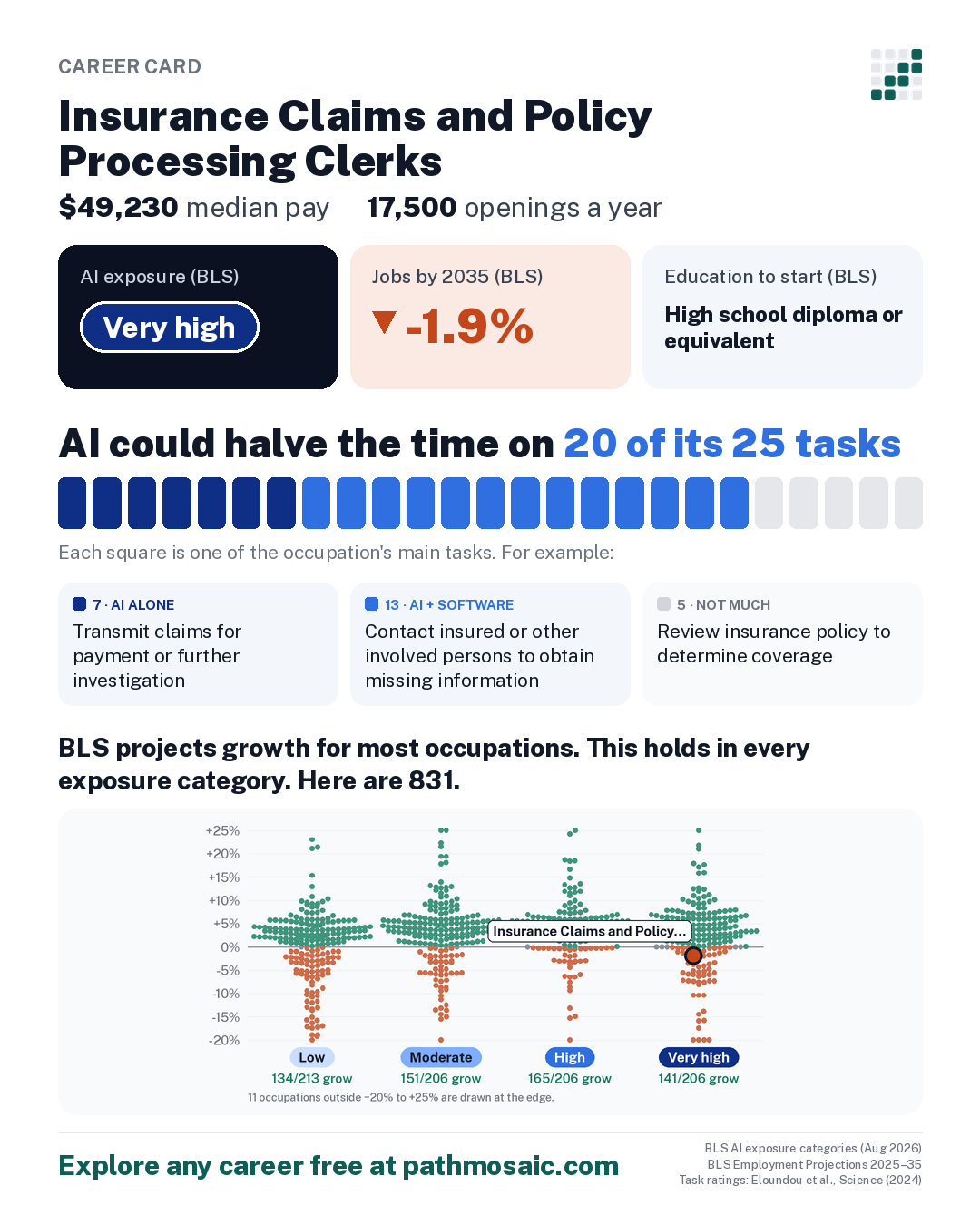
What the data says: AI could halve the time on 20 of its 25 tasks, and jobs are projected to shrink 1.9% by 2035. In the most exposed occupations, the squeeze shows up first among early-career workers. How to think about this →
About this projection
BLS builds AI into its projections where the research supports it: “BLS generally applies adjustments based on this research conservatively, where there is convincing evidence for a change.”
It also notes a limit: “BLS projection methods are not designed to capture extremely rapid technological change.”
On its AI exposure groups, BLS says exposure “does not imply job loss.”
Recent conditions
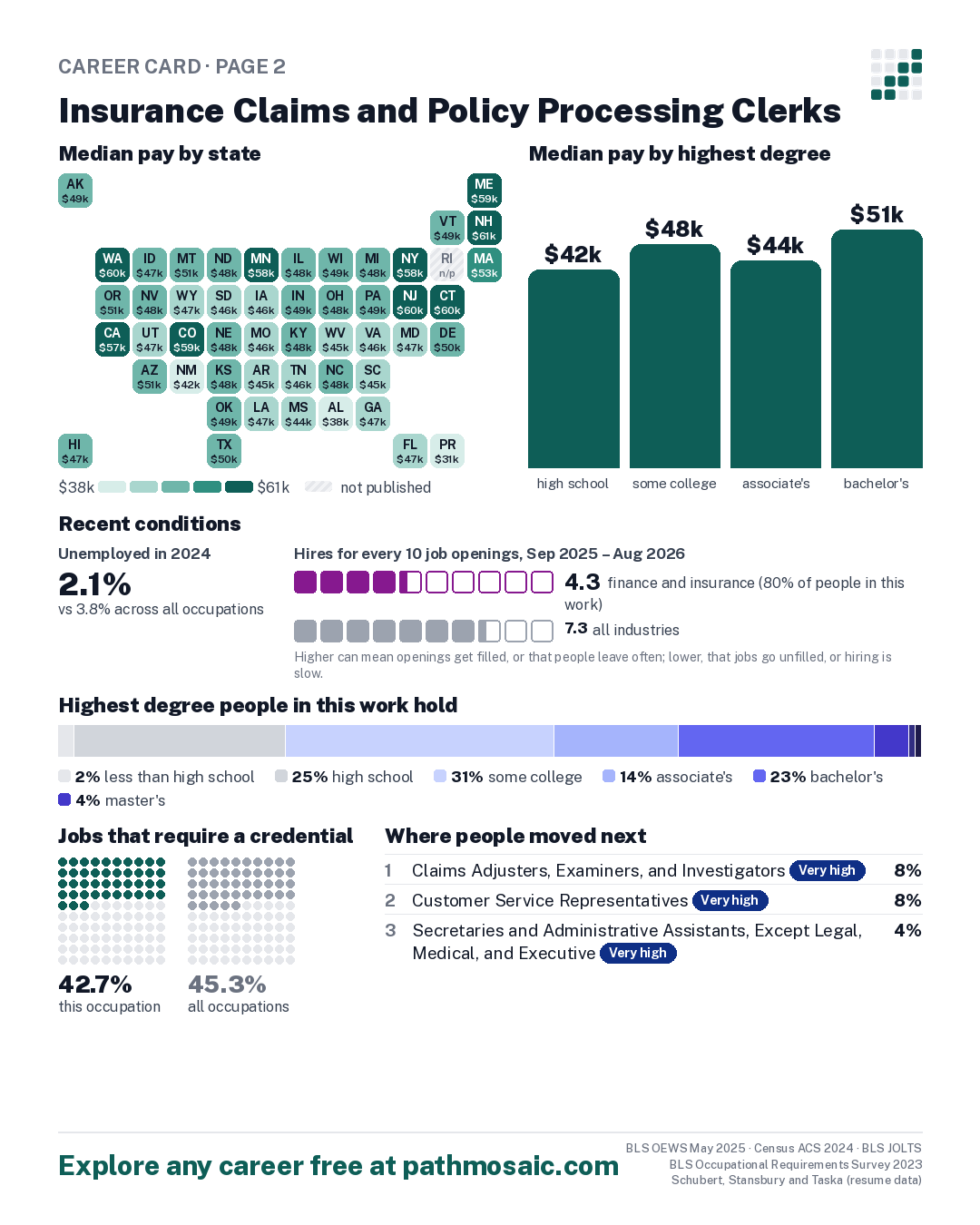
- In 2024, 2.1% of people in this work were unemployed, against 3.8% across all occupations Census ACS 2024
- From Sep 2025 to Aug 2026, 4.3 hires for every 10 job openings in finance and insurance, which employs about 80% of people in this work, against 7.3 across all industries BLS JOLTS
One box per opening, filled for each hire; hires beyond the openings are added in a lighter shade. Higher can mean openings get filled, or that people leave often; lower, that jobs go unfilled, or hiring is slow.4.3 this industry7.3 all industries
Median pay by state BLS OEWS May 2025, state estimates
Tap a state for its figures.
Median pay in every state
| State | Median | Middle half earn | Jobs |
|---|---|---|---|
| Alabama | $38,140 | $35,140 to $48,580 | 2,110 |
| Alaska | $48,740 | $37,330 to $53,940 | 40 |
| Arizona | $50,530 | $44,590 to $52,770 | 8,350 |
| Arkansas | $45,220 | $39,540 to $48,070 | 1,500 |
| California | $56,800 | $47,560 to $63,230 | 23,470 |
| Colorado | $58,660 | $49,330 to $64,750 | 1,380 |
| Connecticut | $59,760 | $50,510 to $72,040 | 2,430 |
| Delaware | $49,990 | $47,170 to $58,090 | 720 |
| Florida | $47,130 | $39,700 to $58,480 | 15,920 |
| Georgia | $46,590 | $42,160 to $58,500 | 6,370 |
| Hawaii | $47,420 | $44,720 to $57,140 | 380 |
| Idaho | $47,200 | $43,220 to $62,120 | 580 |
| Illinois | $48,440 | $45,950 to $60,320 | 9,060 |
| Indiana | $49,240 | $44,080 to $62,120 | 5,190 |
| Iowa | $46,430 | $42,340 to $53,040 | 2,820 |
| Kansas | $47,960 | $45,540 to $56,560 | 800 |
| Kentucky | $48,330 | $48,030 to $59,020 | 3,030 |
| Louisiana | $46,800 | $37,640 to $49,740 | 1,740 |
| Maine | $58,890 | $48,200 to $72,410 | 1,710 |
| Maryland | $47,070 | $37,740 to $61,170 | 1,200 |
| Massachusetts | $52,910 | $47,550 to $61,150 | 4,820 |
| Michigan | $47,860 | $40,750 to $58,780 | 6,410 |
| Minnesota | $58,030 | $50,860 to $60,310 | 3,580 |
| Mississippi | $43,840 | $36,030 to $49,700 | 1,540 |
| Missouri | $46,010 | $36,590 to $56,050 | 4,510 |
| Montana | $50,890 | $44,290 to $60,380 | 360 |
| Nebraska | $48,490 | $43,300 to $58,590 | 2,520 |
| Nevada | $48,300 | $43,680 to $56,060 | 2,880 |
| New Hampshire | $60,650 | $49,230 to $75,440 | 820 |
| New Jersey | $59,810 | $49,930 to $65,860 | 5,000 |
| New Mexico | $41,700 | $37,540 to $49,220 | 920 |
| New York | $57,790 | $48,480 to $64,880 | 8,120 |
| North Carolina | $48,130 | $44,830 to $59,870 | 6,570 |
| North Dakota | $48,390 | $41,980 to $51,720 | 550 |
| Ohio | $48,380 | $46,870 to $58,840 | 11,160 |
| Oklahoma | $48,650 | $39,580 to $61,340 | 1,530 |
| Oregon | $50,890 | $47,010 to $59,500 | 2,640 |
| Pennsylvania | $49,420 | $44,690 to $60,320 | 7,020 |
| Puerto Rico | $30,910 | $30,080 to $34,310 | 1,920 |
| Rhode Island | not published | not published | 710 |
| South Carolina | $44,650 | $37,380 to $49,860 | 4,110 |
| South Dakota | $45,610 | $37,020 to $49,810 | 1,020 |
| Tennessee | $45,720 | $37,370 to $50,330 | 5,470 |
| Texas | $49,880 | $44,520 to $62,180 | 24,470 |
| Utah | $47,120 | $37,200 to $57,280 | 1,880 |
| Vermont | $49,260 | $47,500 to $58,590 | 390 |
| Virginia | $46,430 | $37,730 to $55,960 | 5,950 |
| Washington | $60,220 | $49,700 to $69,010 | 3,730 |
| West Virginia | $44,740 | $37,690 to $49,020 | 1,330 |
| Wisconsin | $49,170 | $46,090 to $60,380 | 5,140 |
| Wyoming | $46,870 | $38,560 to $49,030 | 170 |
Nationally: $49,230. Shades run from the lowest state median to the highest; a territory below that range takes the lightest. How to read this
How AI touches the work
What AI could speed up, task by task, and where people already use it.
AI could halve the time on 20 of its 25 tasks
| AI rating | Its main tasks | Share of Claude conversations May 2026 |
|---|---|---|
| AI + software | Correspond with insured or agent to obtain information or to inform them of account status or changes. | Not published |
| AI + software | Contact insured or other involved persons to obtain missing information. | Not published |
| AI + software | Post or attach information to claim file. | Not published |
| AI + software | Organize or work with detailed office or warehouse records, using computers to enter, access, search or retrieve data. | 0.04% |
| AI alone | Transmit claims for payment or further investigation. | Not published |
| AI alone | Prepare insurance claim forms or related documents, and review them for completeness. | Not published |
See all 25 tasks
| AI + software | Process and record new insurance policies and claims. | Not published |
| Not much | Review insurance policy to determine coverage. | Not published |
| Not much | Examine letters from policyholders or agents, original insurance applications, and other company documents to determine if changes are needed and effects of changes. | Not published |
| AI alone | Provide customer service, such as limited instructions on proceeding with claims or referrals to auto repair facilities or local contractors. | under 0.01% |
| AI + software | Calculate amount of claim. | under 0.01% |
| AI alone | Pay small claims. | Not published |
| Not much | Review and verify data, such as age, name, address, and principal sum and value of property, on insurance applications and policies. | Not published |
| Not much | Compare information from application to criteria for policy reinstatement, and approve reinstatement when criteria are met. | Not published |
| AI + software | Transcribe data to worksheets, and enter data into computer for use in preparing documents and adjusting accounts. | 0.04% |
| AI + software | Notify insurance agent and accounting department of policy cancellation. | Not published |
| AI alone | Compose business correspondence for supervisors, managers, and professionals. | 0.76% |
| AI alone | Process, prepare, and submit business or government forms, such as submitting applications for coverage to insurance carriers. | under 0.01% |
| AI alone | Interview clients and take their calls to provide customer service and obtain information on claims. | Not published |
| Not much | Collect initial premiums and issue receipts. | Not published |
| AI + software | Obtain computer printout of policy cancellations, or retrieve cancellation cards from file. | Not published |
| AI + software | Calculate premiums, refunds, commissions, adjustments, or new reserve requirements, using insurance rate standards. | under 0.01% |
| AI + software | Enter insurance- and claims-related information into database systems. | under 0.01% |
| AI + software | Modify, update, or process existing policies and claims to reflect any change in beneficiary, amount of coverage, or type of insurance. | Not published |
| AI + software | Organize or work with detailed office or warehouse records, maintaining files for each policyholder, including policies that are to be reinstated or cancelled. | Not published |
Ordered by how important O*NET's respondents rate each task (1 to 5) times the share who say it is part of their job. The ordering is ours. O*NET hasn't rated 4 of the tasks, so they come last, in O*NET's own order. 8 of the 25 have a published share of Claude conversations; “not published” means too few conversations for Anthropic to publish a figure.
Where people already use AI
The tasks above say what AI could speed up. This shows what people are using it for. Its 25 tasks fall under 18 work activities that many occupations share, and Microsoft counted how often each one came up in 200,000 conversations with its Copilot assistant in 2024.
- #11 Provide information to guests, clients, or customers
- #12 Explain regulations, policies, or procedures
- #30 Perform administrative or clerical activities
- and 4 more, in the table below
| Work activity | This occupation's tasks under it | People asked AI for help in 10,000 conversations |
AI did it for them in 10,000 conversations |
|---|---|---|---|
| Provide information to guests, clients, or customers | |||
| Process digital or online data | |||
| Examine financial activities, operations, or systems | |||
| Determine values or prices of goods or services | |||
| Evaluate the quality or accuracy of data | |||
| Prepare documentation for contracts, applications, or permits | |||
| Maintain sales or financial records | |||
| Explain regulations, policies, or procedures |
Show all 18 activities
| Perform administrative or clerical activities | |||
| Compile records, documentation, or other data | |||
| Calculate financial data | |||
| Communicate with others about operational plans or activities | |||
| Execute financial transactions | |||
| Interview people to obtain information | |||
| Collect data about consumer needs or opinions | |||
| Maintain operational records | |||
| Process shipments or mail | |||
| Collect fares or payments |
How people in this work use Claude
What people in this work made with Claude % of conversations
- An email or message79%
- Data or a spreadsheet7%
- A document or report6%
- A resume or job application1%
- An analysis or summary1%
How they worked with Claude
77% of these conversations were about work. Anthropic Economic Index, May 2026.
How to read this
Work activities come from O*NET, which links every task to the broader activities it involves. Microsoft's figures are for the activity across everyone who used Copilot, not for insurance claims and policy processing clerks specifically. Copilot is a general chat assistant; dedicated coding tools are not included, so programming help is under-counted here. Activities are listed by how many of this occupation's tasks fall under them.
The task ratings say whether AI could halve the time a task takes: on its own (“AI alone”), or with software built on it (“AI + software”). They were made by people in 2023 (Eloundou et al.). Claude's share is the task's share of all Claude.ai conversations in May 2026; Anthropic doesn't publish a task with too few conversations. None of these add up to the BLS exposure group, which combines five research measures.
More in the Guide: task ratings · task order · work activities · Copilot figures · Claude
High exposure doesn't mean fewer jobs
BLS projects most occupations in its two most exposed groups to grow: 141 of 206 rated Very high and 165 of 206 rated High. Each dot is one of the 831 occupations BLS rates.
Career moves into and out of this occupation
From moves between occupations found in online resumes, 2002–2016. Career changes only: a first job after school isn't a move.
Where people moved next
of 68,388 moves out
- 1 Claims Adjusters, Examiners, and Investigators Very high -5.5% 8%
- 2 Customer Service Representatives Very high -5.3% 8%
- 3 Secretaries and Administrative Assistants, Except Legal, Medical, and Executive Very high -6.0% 4%
- 4 Sales Representatives, Wholesale and Manufacturing, Except Technical and Scientific Products Very high -0.9% 4%
- 5 Managers, All Other (2010 group) an older group BLS has since split; no exposure group today 3%
Where people moved in from
of 62,774 moves in
- 1 Customer Service Representatives Very high -5.3% 14%
- 2 Claims Adjusters, Examiners, and Investigators Very high -5.5% 5%
- 3 Secretaries and Administrative Assistants, Except Legal, Medical, and Executive Very high -6.0% 4%
- 4 Retail Salespersons Very high -0.3% 3%
- 5 Sales Representatives, Wholesale and Manufacturing, Except Technical and Scientific Products Very high -0.9% 3%
Resumes over-represent younger, white-collar job-seekers and moves into management. Schubert, Stansbury and Taska (resume data).
Education and training for the occupation
O*NET survey of workers in this occupation
- 55% high school
- 8% postsecondary certificate
- 9% some college
- 21% associate's
- 7% bachelor's
O*NET 31.0 survey of workers in this occupation · 58 people answered.
Census survey (American Community Survey)
- 2% less than high school
- 25% high school
- 31% some college
- 14% associate's
- 23% bachelor's
- 4% master's
- 1% professional degree
- 1% doctorate
Census ACS 2024, all workers in this occupation · 2,119 people surveyed.
Why the two can differ
O*NET asks about 20 people in each occupation, which makes its shares uncertain, but it reports the exact occupation and counts certificates. The Census survey reaches thousands, but it groups some occupations together and counts degrees only. More in the Guide
Median pay by highest degree full-time, year-round · Census ACS 2024, all workers in this occupation
1 program: General Office Occupations and Clerical Services.
Jobs that require a credential BLS Occupational Requirements Survey 2023
42.7% this occupation
45.3% all occupations
| By kind | This occupation | All occupations |
|---|---|---|
| a license | 42.3% | 19.1% |
| a certification | <0.5% | 5.8% |
| an educational certificate | <0.5% | 2.8% |
Share of jobs whose employer requires it. BLS doesn't say which credential. How to read this
Look up certifications, training and licenses U.S. Department of Labor
- Certification Finder ↗ certifications CareerOneStop lists for this occupation
- Training Finder ↗ schools and programs, nationwide; narrow the place there
- License Finder ↗ licenses by state
- Apprenticeship Finder ↗ DOL lists 2 registered apprenticeships in this occupation (GENERAL INSURANCE ASSOCIATE; General Insurance Associate). Apprenticeship.gov can't be linked to one occupation, so search for “Insurance Claims and Policy Processing Clerks” there.
These open in a new tab and send only the occupation's public code. More in the Guide
BLS AI exposure categories (Aug 2026) · BLS Employment Projections 2025–35 · O*NET 31.0 · Task ratings: Eloundou et al., Science (2024) · Microsoft "Working with AI" v1.1 · Anthropic Economic Index (2026-06-26) · Schubert, Stansbury and Taska · NCES CIP–SOC · Census ACS 2024 · BLS JOLTS · Brynjolfsson, Chandar and Chen, Stanford (Aug 2026)
See it online, and explore any career: https://www.pathmosaic.com/card/43-9041.00